What Does a Business Analysis Consultant Do? A Strategic Guide for 2026
- jonesaqayalo
- Apr 19
- 12 min read
Updated: Apr 20
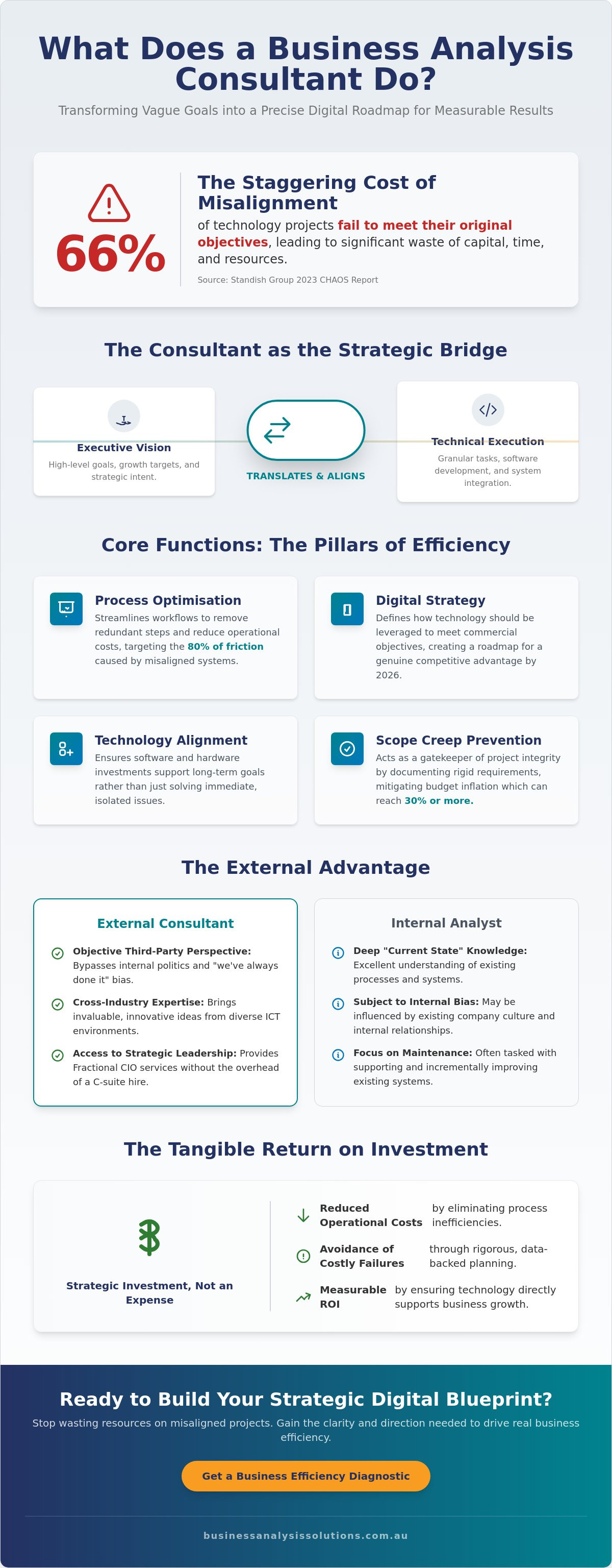
According to the Standish Group's 2023 CHAOS Report, 66% of technology projects fail to meet their original objectives, often resulting in significant waste of capital and internal resources. You've likely experienced the frustration of operational bottlenecks that persist even after implementing expensive software solutions. It's a recurring issue for Australian enterprises where the communication gap between executive leadership and technical teams leads to misaligned outcomes. This guide clarifies what does a business analysis consultant do to resolve these complexities and drive measurable efficiency. We promise to show you how a methodical approach to stakeholder engagement and requirements elicitation transforms vague goals into a precise digital roadmap. You'll learn how to optimize business processes, reduce operational waste, and ensure your 2026 technology investments align perfectly with your long-term strategic vision.
Key Takeaways
Gain an objective, third-party perspective that bypasses internal politics to provide a clear strategic architecture for your modern business.
Understand exactly what does a business analysis consultant do to bridge the gap between your high-level vision and granular operational execution.
Learn how a deep-dive diagnostic process identifies the root causes of inefficiency, ensuring your digital roadmap is built on logic rather than guesswork.
Explore how Fractional CIO services in Australia provide the executive leadership needed for digital transformation without the overhead of a full-time C-suite hire.
Discover the structured methodology for achieving a measurable ROI through reduced operational costs and the avoidance of expensive project failures.
Table of Contents Defining the Business Analysis Consultant: Strategic Architecture for Modern Business The Core Functions: How Consultants Translate Complexity into Efficiency The Diagnostic Process: Identifying Gaps and Mapping the Future Beyond Analysis: Strategic Digital Blueprints and Fractional CIO Leadership The Tangible ROI: Why Businesses Hire Analysis Consultants
Defining the Business Analysis Consultant: Strategic Architecture for Modern Business
A business analysis consultant functions as an external architect for organisational change. They identify critical business needs and determine precise solutions to complex problems. Unlike internal staff, these experts provide an objective, third-party perspective. This removes the "way we've always done it" bias that often stalls progress. Business analysis as a discipline provides the framework for this work, ensuring every recommendation is backed by data and logical reasoning.
The role acts as a translator between executive vision and technical implementation. Executives often have a high-level vision for growth, while technical teams focus on granular execution. The consultant bridges this gap by converting strategic intent into actionable requirements. By 2026, this strategic alignment is the difference between a wasted budget and a genuine competitive advantage. Key focus areas for these professionals include:
Process Optimisation: Streamlining workflows to remove redundant steps and reduce operational costs.
Digital Strategy: Defining how technology should be leveraged to meet commercial objectives.
Technology Alignment: Ensuring software and hardware investments support long-term goals rather than just solving immediate, isolated issues.
Consultant vs. Internal Business Analyst
Internal analysts understand the current state, but consultants bring specialized expertise from diverse ICT environments across multiple industries. This cross-pollination of ideas is invaluable for innovation. Many Australian firms now adopt a fractional model. This provides access to high-level strategic thinking without the overhead of a full-time executive salary. A logical starting point for many organisations is a business efficiency diagnostic to identify immediate bottlenecks and prioritise interventions.
The Scope of Modern Business Analysis in 2026
Understanding what does a business analysis consultant do requires looking beyond simple software requirements. In 2026, the scope includes digital strategy and ICT consultancy. The focus is on process optimization and ensuring the technical architecture supports the business roadmap. It's important to clarify that this role excludes custom software development. Instead, it focuses on strategic alignment; it ensures the right tools are selected and integrated effectively to drive performance.
Organisations often find that 80% of their operational friction comes from misaligned systems. A consultant identifies these friction points through methodical stakeholder engagement and process mapping. They don't just offer services; they offer clarity and direction. This methodical approach reduces risk and increases the return on investment for digital transformations in the Australian market.
The Core Functions: How Consultants Translate Complexity into Efficiency
Understanding what does a business analysis consultant do requires looking past the surface of daily operations to the underlying logic of organisational growth. These specialists use a structured toolkit to move a company from vague problem identification to a validated strategic roadmap. In the Australian market, where operational costs continue to rise, ensuring that every A$1 spent on technology or process change has a clear business justification is no longer optional. It's a survival requirement. By delivering a digital transformation blueprint for business, consultants provide the architectural rigour needed to navigate 2026's volatile economic climate.
A primary value of this role is the prevention of "Scope Creep." This phenomenon can inflate project budgets by 30% or more when requirements aren't strictly defined. Consultants mitigate this risk by documenting rigid requirements before a single line of code is written or a new software license is purchased. They act as the gatekeepers of project integrity; they ensure that the final delivery matches the initial business need without unnecessary, costly additions.
Stakeholder Elicitation and Requirements Management
The elicitation process involves more than just attending meetings. It's an investigative discipline. Consultants interview key players across the hierarchy to uncover hidden pain points that staff might not report through internal channels. This is where the impactful role of business analysis becomes evident. By asking the right questions, they distinguish between what a business says it wants and what it actually needs to function. This work culminates in a formal Business Requirements Document (BRD). The BRD serves as the foundational contract for all future ICT work, ensuring total alignment between technical teams and executive leadership.
Business Process Mapping and Optimization
Efficiency is born from visibility. Consultants use business process mapping to create visual representations of current workflows. These maps allow stakeholders to see exactly where bottlenecks occur. By contrasting "As-Is" (current state) with "To-Be" (future state) modelling, consultants identify automation opportunities that can save an organisation upwards of 300 man-hours per month. This methodical approach replaces guesswork with data-driven certainty. If you're looking to untangle your own internal workflows, reviewing our specialised consulting services can provide the clarity your leadership team needs to move forward.
As-Is Modelling: Captures the reality of current operations, including inefficiencies.
Gap Analysis: Identifies the specific steps needed to reach the desired outcome.
To-Be Modelling: Designs the optimised workflow for maximum ROI and scalability.
The Diagnostic Process: Identifying Gaps and Mapping the Future
A professional consultant doesn't arrive with a pre-packaged solution. Instead, the engagement begins with a rigorous diagnostic of the organization's current health. This investigative phase focuses on uncovering the "Why" behind operational friction before addressing the "How" of technical implementation. By the time a client asks, what does a business analysis consultant do, the answer usually involves a deep dive into the People, Processes, and Technology (PPT) framework to ensure no variable is left unexamined.
The outcome of this stage isn't a mere suggestion list. It's a data-driven blueprint. This document provides a logical business case for every proposed change, ensuring that investments are backed by evidence rather than intuition. It transforms organizational complexity into a structured roadmap for growth.
Conducting a Business Efficiency Diagnostic
The diagnostic methodology relies on three pillars: forensic data collection, direct stakeholder observation, and comparative analysis against Australian industry benchmarks. We examine how work actually flows through the business, often discovering that 20% of manual processes consume 80% of staff resources. This phase identifies "low-hanging fruit" where immediate ROI can be achieved. For example, automating a single redundant reporting task can often save a mid-sized Australian firm upwards of A$15,000 in annual labour costs.
A critical component of this diagnostic is ICT consultancy. We assess whether your current software stack is being used to its full capacity. It's common to find that businesses only utilize 40% of their existing ERP or CRM features. By optimizing current assets before buying new ones, we ensure capital efficiency. This structured approach is a core part of what does a business analysis consultant do to protect a client's bottom line.
Gap Analysis and Strategic Alignment
Gap analysis defines the distance between your current operational state and the specific benchmarks required to meet 2026 strategic goals. This isn't about chasing the latest tech trends. It's about identifying the specific capabilities your business lacks to scale effectively in the Australian market. We look at revenue drivers and cost centres to ensure that every recommendation serves a financial or operational purpose. If a technology doesn't directly facilitate growth or reduce risk, it doesn't make the cut.
Current State Assessment: Documenting existing workflows and technical debt.
Future State Modeling: Defining the ideal architecture for 2026 requirements.
Risk Mitigation: Identifying potential bottlenecks in the transition phase.
Resource Allocation: Determining the budget and personnel needed for delivery.
Strategic Alignment is the process of ensuring every ICT project supports a core business objective. This alignment prevents "project drift" and ensures that the executive vision is translated into functional technical requirements. By maintaining this focus, we turn abstract business goals into tangible, high-performance results.
Beyond Analysis: Strategic Digital Blueprints and Fractional CIO Leadership
By 2026, the definition of what does a business analysis consultant do has expanded into the sphere of executive leadership. It's no longer sufficient to simply document requirements and walk away. Modern consultants bridge the gap between high-level strategy and technical delivery. They act as the catalyst for change. This shift moves the conversation from "what is wrong with our current state?" to "how do we lead the change effectively?".
Consultants now provide the leadership needed to steer digital transformation without the overhead of a full-time C-suite executive. This involves a dual focus. First, they identify the strategic path forward. Second, they manage the projects that bring those ideas to life. In the Australian market, where agility is a competitive necessity, this hands-on leadership ensures that strategic blueprints don't gather dust on a shelf.
The Role of a Fractional CIO
Small and medium enterprises (SMEs) often face a leadership gap. They require board-level ICT governance but don't have the budget for a full-time executive salary, which often exceeds A$250,000. This is where Fractional CIO services Australia provide a logical solution. A consultant acts as an on-demand Chief Information Officer, offering strategic technology planning and ICT budgeting at a fraction of the cost.
The primary value here is objectivity. An external consultant manages your digital strategy without the bias of trying to sell a specific software product or license. They focus on:
Aligning technology investments with 2026 business objectives.
Managing vendor relationships to ensure service level agreements are met.
Developing ICT budgets that prioritise return on investment.
Presenting clear, data-driven reports to the board.
Automation Implementation and ICT Solutions
Once the strategy is set, the consultant transitions into project management to oversee the implementation phase. They ensure the "off-the-shelf" or integrated solutions work as intended. While they don't perform custom coding, they act as the technical translator between your business and the software vendors.
What does a business analysis consultant do during this stage? They verify that the original requirements are actually met by the vendor. This oversight prevents scope creep and ensures that automation implementation delivers the expected efficiency gains. They manage the integration of various ICT solutions to create a seamless ecosystem. This methodical approach reduces the risk of project failure and ensures that technical requirements never lose sight of business objectives.
Secure the leadership your organisation needs to thrive. Book a strategic consultation today.
The Tangible ROI: Why Businesses Hire Analysis Consultants
Hiring an expert isn't an expense; it's a strategic allocation of capital designed to yield a return that far exceeds professional fees. When asking what does a business analysis consultant do, the answer lies in the conversion of organizational ambiguity into measurable financial gain. This ROI manifests through reduced operational overheads, the elimination of redundant processes, and a significantly faster time-to-market for new service offerings.
A consultant provides the objective clarity required for high-stakes decisions. They move the organization from a state of reactive firefighting to a posture of proactive growth. This transition follows a logical cycle: diagnostic assessment, strategic design, and disciplined implementation. It's a process of continuous improvement that ensures every dollar spent on technology or process change contributes directly to the bottom line. To ensure your brand strategy evolves alongside your operational efficiency, check out Redefine Brands Group for guidance on sustainable growth and organisational transformation.
Risk Mitigation and Cost Avoidance
Professional analysis targets the primary driver of ICT project failure: poorly defined requirements. Industry data suggests that roughly 70% of digital transformations fail to meet their original objectives because of a lack of clear functional specifications. Consultants identify these gaps early, ensuring that the solution built actually solves the problem at hand.
They also address the hidden burden of Technical Debt. This occurs when businesses choose quick, cheap fixes over scalable business technology. In the Australian market, this debt often results in A$10,000s of unnecessary rework and integration hurdles later. The cost of a consultant is a fraction of the cost of a failed enterprise software rollout.
Operational Excellence and Scalability
Scaling an Australian business shouldn't require a linear, one-to-one increase in headcount. Analysis consultants design streamlined, automated processes that allow for higher output without bloating the payroll. By mapping workflows and identifying bottlenecks, they create a framework where the business can grow 20% or 50% without a corresponding 50% increase in operational costs. To support this growth with sound financial management, check out Cairns Quality Accounting for expert taxation and accounting support.
There is also a significant psychological benefit known as Quiet Confidence. This occurs when business owners and stakeholders finally possess a precise, documented understanding of their digital landscape. It removes the anxiety of the unknown and replaces it with a structured, methodical operation that performs predictably under pressure. When you understand exactly what does a business analysis consultant do, you realize they don't just fix systems; they provide a roadmap for long-term stability.
Ready to untangle your business complexities? Book a Business Efficiency Diagnostic with Business Analysis & Solutions today.
Securing Your Competitive Advantage Through Analytical Precision
Navigating the complex commercial landscape of 2026 requires more than just intuition. It demands a structured approach to efficiency and digital transformation. When you evaluate what does a business analysis consultant do, the focus remains on their ability to bridge the critical gap between technical requirements and overarching business objectives. Business Analysis Solutions leverages over 20 years of industry experience to provide this clarity. Our team delivers comprehensive Digital Transformation Blueprints specifically tailored to Australian business standards, ensuring your strategic architecture remains robust and scalable.
By moving beyond simple observations to deliver a diagnostic process that identifies operational gaps, consultants provide the logical framework needed for sustained growth. This methodology transforms internal complexity into a streamlined roadmap for success. It's about ensuring every technical investment aligns with your long term commercial goals. Optimise your operations with a professional Business Efficiency Diagnostic. We're ready to help you turn these strategic insights into measurable results for your organization.
Frequently Asked Questions
What is the difference between a business analyst and a business consultant?
A business consultant focuses on high-level strategy and market positioning, while a business analyst concentrates on operational requirements and functional processes. Consultants identify what the business should do, whereas the work of understanding how to execute those changes effectively falls under the scope of what does a business analysis consultant do. This distinction ensures strategic goals align perfectly with technical capabilities.
How long does a typical business analysis consulting engagement last?
Engagement lengths vary based on project complexity, typically ranging from 4 weeks to 12 months. A standard Business Efficiency Diagnostic often concludes within 20 to 30 business days. Larger scale digital transformations or system migrations usually require a sustained commitment of 6 to 9 months to manage stakeholder engagement and ensure seamless integration across the organisation.
Can a business analysis consultant help with digital transformation?
Consultants are essential for digital transformation because they bridge the gap between technical teams and business stakeholders. Since 70% of digital initiatives fail due to misaligned requirements, these experts ensure every piece of technology serves a specific business objective. They provide the logical framework needed to move from legacy systems to modern, cloud-based solutions without disrupting core operations.
What industries do business analysis consultants work in?
Business analysis consultants operate across all major Australian sectors, including financial services, healthcare, and government administration. Any industry managing complex data or high-volume transactions benefits from this expertise. Professional firms often see a 15% increase in throughput after optimising their internal workflows, making these services valuable for any organisation seeking to scale its operations efficiently.
Will a business analysis consultant help implement the changes they suggest?
A professional consultant remains involved through the implementation phase to ensure the proposed solutions deliver the expected return on investment. They don't simply provide a report and exit. By overseeing the transition, they manage requirements elicitation and ensure the final product aligns with the initial strategic vision, which prevents costly scope creep during the development cycle.
What is a Business Efficiency Diagnostic and why do I need one?
A Business Efficiency Diagnostic is a structured audit designed to identify bottlenecks and redundancies within your current workflows. It provides a clear roadmap for improvement by quantifying the cost of inefficiency. Most organisations find that this diagnostic uncovers 10% to 20% in potential savings by eliminating manual workarounds and streamlining communication channels between departments.
How does a Fractional CIO differ from a traditional IT consultant?
A Fractional CIO provides ongoing, high-level strategic leadership on a part-time basis, while an IT consultant typically focuses on a specific, time-bound technical project. When considering what does a business analysis consultant do compared to a CIO, the former focuses on process and requirements, while the latter manages the entire technology portfolio. This model allows mid-sized Australian firms to access executive-level expertise without the A$250,000 plus annual salary of a full-time hire.
What are the most common deliverables of a business analysis consultant?
Standard deliverables include Business Requirement Documents (BRDs), current-state process maps, and comprehensive gap analysis reports. These documents provide the technical and operational blueprints required for successful project execution. By delivering precise documentation, the consultant ensures that all stakeholders have a single source of truth, which reduces errors by up to 40% during the software development lifecycle.



Comments