The Strategic Digital Transformation Roadmap for SMEs in 2026
- jonesaqayalo
- 2 days ago
- 11 min read
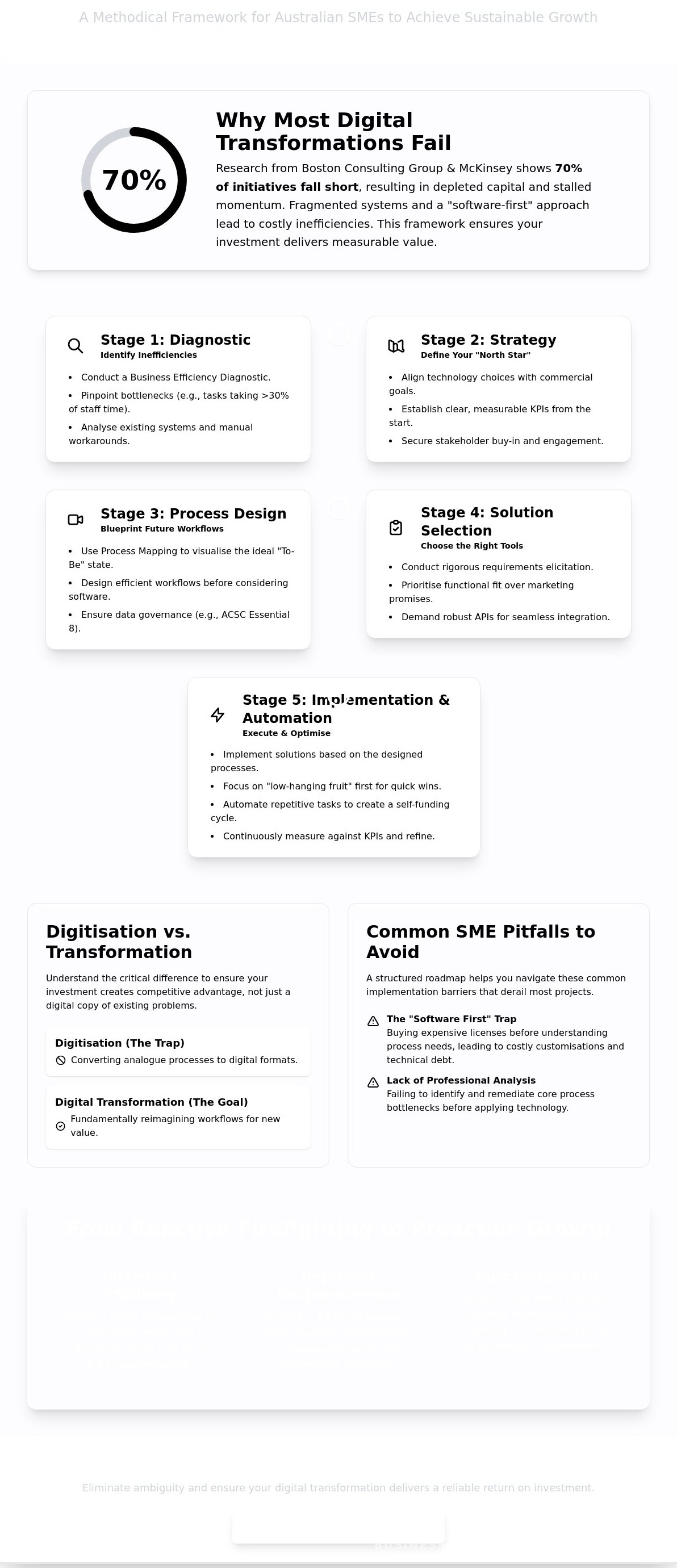
Research by Boston Consulting Group indicates that 70% of digital transformations fall short of their objectives, often resulting in stalled momentum and depleted capital. You likely recognize that fragmented systems and manual workarounds are currently limiting your team's output. To resolve these inefficiencies, you need a methodical digital transformation roadmap for SMEs that eliminates ambiguity and ensures every A$1 invested delivers measurable value. For many Australian business owners, the prospect of overhauling legacy processes feels like a high-risk gamble when internal expertise is limited.
This article provides a five-stage framework to align your business processes with scalable technology for sustainable growth. By following this structured approach, you'll move from reactive firefighting to proactive, data-driven decision making. We'll examine how to build a stable foundation that streamlines your operations and prepares your firm for the specific market conditions of 2026. This is about more than just software; it's about creating a logical path toward operational excellence and a reliable return on investment.
Key Takeaways
Distinguish between simple digitisation and true strategic alignment to ensure technology investments deliver tangible value rather than migrating existing process inefficiencies to the cloud.
Implement a methodical five-stage digital transformation roadmap for SMEs to establish clear milestones that ensure sustainable operational efficiency and continuous ROI.
Prioritise professional business analysis to identify and remediate process bottlenecks before applying automation, ensuring your new systems support a high-performance workflow.
Learn to navigate implementation barriers by balancing strategic transformation initiatives with daily business-as-usual operations in the Australian market.
Leverage the Fractional CIO model to access high-level strategic IT leadership, bridging the gap between complex technical requirements and core business objectives.
Table of Contents What is a Digital Transformation Roadmap for SMEs in 2026? The 5-Stage Digital Transformation Roadmap Framework Why Business Analysis is the Foundation of Your Roadmap Overcoming SME-Specific Implementation Barriers Executing Your Roadmap: The Fractional CIO Advantage
What is a Digital Transformation Roadmap for SMEs in 2026?
A digital transformation roadmap for SMEs is not a simple technical upgrade. It is a strategic architectural document that aligns Information and Communication Technology (ICT) solutions with specific business outcomes. Many Australian business owners confuse digitisation with transformation. Digitisation involves converting analogue processes into digital formats, such as migrating paper records to a cloud storage provider. In contrast, Digital transformation requires a fundamental reimagining of organisational workflows to leverage technology for competitive advantage.
By 2026, the Australian business environment will no longer tolerate siloed applications. Success requires an integrated ecosystem where data flows seamlessly between finance, operations, and customer management systems. A structured roadmap serves as a Digital Transformation Blueprint. This document functions as a risk mitigation tool, preventing the project creep and budget overruns that often lead to unforeseen costs exceeding A$50,000 for even mid-sized implementations.
The Core Components of a Modern SME Roadmap
Strategic Alignment: Technology must serve the business objective. If a tool doesn't directly improve efficiency or revenue, it doesn't belong in the stack.
Stakeholder Engagement: Transformation fails without buy-in. Identifying every individual impacted by process changes ensures smoother transitions and higher adoption rates.
Technology Stack: Selection focuses on scalable ICT solutions. These must integrate through robust APIs to ensure the business isn't locked into rigid, legacy frameworks.
Why Traditional "IT Projects" Fail SMEs
The "Software First" trap remains a primary cause of project collapse. SMEs often purchase expensive licenses before documenting their internal requirements or understanding their existing process bottlenecks. This backwards approach leads to expensive customisations and technical debt. Data governance is another frequent casualty. Failing to implement the Australian Cyber Security Centre (ACSC) Essential 8 framework during the early design phase exposes the business to catastrophic data breaches.
Research from McKinsey (2023) indicates that 70% of digital transformations fail to achieve their stated goals. This high failure rate often stems from a lack of professional project management and requirements elicitation. Without a logic-driven digital transformation roadmap for SMEs, businesses struggle to bridge the gap between technical capability and operational reality. Precision in the planning phase is the only way to ensure a measurable return on investment and long-term organisational resilience.
The 5-Stage Digital Transformation Roadmap Framework
A successful digital transformation roadmap for SMEs isn't a single event; it's a structured evolution. By moving from an internal audit to full-scale automation, businesses avoid the common trap of implementing tech for tech's sake. We prioritise "low-hanging fruit" in the early stages, such as automating a manual invoicing process that saves 10 hours a week, to build immediate organisational momentum. This logical progression ensures that each investment pays for the next, creating a self-funding cycle of improvement.
Stage 1 & 2: Diagnostic and Strategy
Every effective digital transformation roadmap for SMEs begins with a Business Efficiency Diagnostic. This process identifies specific bottlenecks where staff spend over 30% of their time on repetitive, manual tasks. The resulting Digital Strategy defines your "North Star," aligning every technical choice with your long-term commercial goals. To ensure a sustainable digital transformation roadmap, we establish clear KPIs early. For example, an Australian SME might target a 15% increase in lead response times or a 20% reduction in data entry errors within the first six months of implementation. These measurable milestones provide the evidence needed to justify further investment to stakeholders.
Stage 3 & 4: Process Design and Solution Selection
Before buying software, we use Process Mapping to visualise the "To-Be" state of your business. This prevents the mistake of digitising a broken or inefficient process. Selection follows a rigorous requirements elicitation phase where we ignore marketing promises and focus on functional fit. Integration is a non-negotiable requirement in the Australian market. We evaluate API capabilities to ensure your CRM, accounting software, and inventory systems create a unified data environment. This eliminates data silos and ensures that a single source of truth exists across the entire organisation, reducing the risk of costly A$5,000 to A$10,000 errors caused by mismatched spreadsheets.
Stage 5: Implementation and Governance
We use agile project management to deliver value in incremental sprints. This approach creates a feedback loop where market changes or user feedback can shift priorities without derailing the entire project. Success ultimately depends on cultural adoption. If your team doesn't use the system, the ROI is zero. We focus on comprehensive training and change management to ensure the new tools become part of the daily workflow. Ongoing governance is essential to maintain the understanding of business technology as a core competency. If you're ready to identify your organisation's bottlenecks, speaking with a consultant can clarify your path forward.
Why Business Analysis is the Foundation of Your Roadmap
A digital transformation roadmap for SMEs often stalls because of a fundamental misunderstanding: technology is an accelerator, not a cure. If you automate a broken or inefficient process, you simply create a faster version of that inefficiency. Professional business analysis provides the diagnostic rigour needed to fix these underlying issues before any code is written or software is purchased. It's about ensuring the organisation is actually ready for the change it's pursuing.
Business analysts identify hidden friction points that software vendors rarely mention. These might include data silos between departments or manual workarounds that have become invisible over time. By exposing these gaps, firms avoid the trap of technical debt. This debt occurs when companies rush to implement quick fixes that don't scale, eventually costing thousands in A$ to rectify or replace. A structured approach ensures that every new tool integrates seamlessly into the existing ecosystem rather than becoming another isolated island of data.
The primary role of the analyst is to bridge the gap between executive vision and technical execution. Leaders often have a clear idea of the strategic outcome, but the technical execution requires a level of granular detail that developers need to succeed. This alignment prevents project drift and ensures the final solution actually solves the original business problem. Without this foundation, your digital transformation roadmap for SMEs risks becoming a list of expensive tools rather than a strategic evolution.
The Power of Process Mapping
Visualising workflows allows teams to see exactly where manual bottlenecks occur. These maps highlight redundancies where data is entered twice or where approvals sit idle for days. When you map a process, you create the instruction manual for your future automation tools. Process mapping is the visual blueprint of business logic. By documenting the current state (As-Is) and designing the future state (To-Be), you ensure that technology serves the process, not the other way around.
Requirements Elicitation: Getting What You Actually Need
Distinguishing between "wants" and "needs" is critical for maintaining budget control. Many SMEs overspend on enterprise-grade software features they'll never use because they haven't defined their core requirements. A formal requirements document clarifies the must-have functions, which can save your business thousands in annual licensing fees. This disciplined approach ensures your technology choices align perfectly with your digital transformation blueprint for business, creating a sustainable foundation for growth in the Australian market.
Overcoming SME-Specific Implementation Barriers
Many Australian small-to-medium enterprises stall their progress because of two primary objections: a perceived lack of time and a restricted budget. While these concerns are valid, they often stem from a misunderstanding of how a digital transformation roadmap for SMEs actually functions. It isn't a single, monolithic event that halts daily operations. Instead, it's a series of controlled, strategic shifts designed to integrate with your existing business-as-usual (BAU) activities.
Executive sponsorship remains the most critical factor in overcoming these barriers. When leadership treats digital change as an IT project rather than a core business strategy, cultural resistance grows. Leaders must demonstrate that the transformation is a priority by allocating specific hours for staff training and requirements elicitation. Without this visible commitment, employees view new systems as additional burdens rather than tools for efficiency. Risk mitigation during this phase involves rigorous data migration testing. In 2023, industry data suggested that 34% of digital projects fail due to poor data quality or cut-over errors. SMEs can mitigate this by running parallel systems during the initial transition to ensure data integrity before the final switch.
Budgeting for Transformation: Beyond the Software Price
A realistic budget accounts for more than just license fees. SMEs must factor in implementation costs, staff training, and the internal time required for process mapping. Investing in expert project management provides a significant return on investment by preventing scope creep, which can inflate project costs by up to 40%. A phased digital transformation roadmap for SMEs allows for a self-funding model. By targeting high-impact, low-complexity wins first, the resulting efficiency gains can provide the A$ capital needed for later stages.
Managing Change and "Digital Fatigue"
Staff buy-in occurs when technology solves immediate, daily frustrations. Instead of mandating change, leadership should use transparent communication to explain how the new system removes manual data entry or reduces overtime. This approach prevents "Digital Fatigue," where teams feel overwhelmed by constant updates. Sticking to the strategic roadmap is vital. It prevents "Shiny Object Syndrome," where businesses waste resources on trendy tools that don't align with their long-term goals. Focus on the outcome, not the novelty of the software.
To ensure your transformation stays on track and delivers measurable value,
today.
Executing Your Roadmap: The Fractional CIO Advantage
Most Australian SMEs reach a plateau where their technological requirements outpace their internal expertise. While a general IT manager handles day-to-day tickets, they often lack the seniority to architect a comprehensive digital transformation roadmap for SMEs. Hiring a full-time Chief Information Officer in Australia typically requires a salary package exceeding A$220,000, a cost that remains prohibitive for many mid-market firms. This resource gap leads to fragmented systems and technical debt that stifles growth.
The fractional CIO provides high-level strategic leadership without the executive price tag. This model allows business owners to access seasoned expertise on a part-time or project basis. By integrating an objective Analytical Partner into the leadership layer, your organization gains the clarity required to move from theory to measurable results. This external perspective is vital for identifying operational bottlenecks that internal teams might overlook due to cultural inertia or established habits.
The Role of the Fractional CIO in 2026
As we approach 2026, the complexity of the vendor ecosystem requires a disciplined approach to procurement. A fractional CIO leads the vendor selection process by applying rigorous criteria, ensuring choices are based on functional requirements rather than marketing promises. This objective oversight prevents "shiny object syndrome" and ensures every tool serves the broader business strategy.
Utilising fractional CIO services Australia provides a structured framework for sustainable growth. This involves:
Auditing existing legacy systems to determine their viability for future integration.
Establishing Key Performance Indicators (KPIs) that track the actual ROI of digital investments.
Maintaining strategic alignment as the business scales, ensuring the digital transformation roadmap for SMEs evolves alongside market shifts.
How to Start Your Journey Today
Action begins with data, not assumptions. The first step in executing your roadmap is booking a Business Efficiency Diagnostic. This assessment establishes your baseline, identifying exactly where manual processes are costing you time and capital. Without this diagnostic, any attempt at transformation risks solving the wrong problems. Once the baseline is set, you must assemble an internal transformation team comprising key stakeholders from finance, operations, and sales. This ensures buy-in across the entire organization.
Successful execution requires a commitment to continuous improvement rather than a "set and forget" mentality. For those ready to move beyond the planning phase, reviewing this strategic guide to business efficiency provides the tactical depth needed to optimise operations for the coming years. Precision in leadership leads to precision in results; start by securing the expert guidance your roadmap demands.
Future-Proofing Your SME with Strategic Precision
Navigating the technological landscape of 2026 requires a shift from reactive purchasing to proactive strategy. Successful implementation hinges on a robust digital transformation roadmap for SMEs that integrates process mapping with long-term commercial objectives. By addressing implementation barriers through a structured framework, your business can achieve the seamless integration necessary for sustained growth in the Australian market.
Business Analysis & Solutions leverages over 20 years of business analysis experience to guide you through this evolution. We specialise in bridging the gap between business goals and ICT solutions, ensuring your technology serves your strategy rather than complicating it. Our proven diagnostic and blueprint methodology eliminates ambiguity, providing the precision your organisation needs to thrive. You don't have to manage these complexities alone; professional guidance ensures your digital investments translate into measurable efficiency and a clear return on investment.
Take control of your organisation's trajectory. Book your Business Efficiency Diagnostic today and secure the analytical partnership your business deserves. It's the most effective way to turn strategic intent into operational excellence.
Frequently Asked Questions
How long does a digital transformation roadmap typically take for an SME?
A comprehensive digital transformation roadmap for SMEs typically spans 6 to 18 months from initial requirements elicitation to full-scale deployment. This timeframe varies based on organizational complexity and the maturity of existing systems. Most firms complete the discovery phase in 4 weeks, followed by iterative implementation cycles that deliver tangible value every 90 days.
What is the average cost of developing a digital transformation blueprint?
Developing a professional digital transformation blueprint in Australia often involves an investment between A$15,000 and A$45,000 for the planning phase. These figures align with professional consulting standards and federal government grant programs. Costs depend on the depth of process mapping required and the number of operational silos being integrated into the new architecture.
Can we implement a roadmap without hiring additional full-time IT staff?
You can execute a transformation without new full-time hires by leveraging managed service providers or specialized business analysis consultants. Roughly 65% of Australian SMEs outsource technical execution to maintain agility while keeping internal overheads low. This approach ensures you access high-level expertise for strategic alignment without the long-term liability of a permanent payroll expansion.
What are the most common mistakes SMEs make during digital transformation?
The most frequent failure point is neglecting stakeholder engagement, which contributes to the 70% failure rate cited by global industry analysts. Many businesses focus solely on software acquisition rather than process optimization. Success requires a logical bridge between technical requirements and business objectives to avoid investing in redundant or incompatible systems.
How do I know if my business is ready for a digital transformation roadmap?
Your business is ready for a digital transformation roadmap for SMEs when manual process inefficiencies consume more than 15% of your weekly operational capacity. Other indicators include fragmented data silos that prevent real-time reporting or a lack of integration between customer-facing platforms and back-office systems. If your current infrastructure limits your ability to scale by 10% annually, a structured roadmap is necessary.
What is the difference between a digital strategy and a digital roadmap?
A digital strategy defines your high-level business objectives and the logic behind your technology goals. In contrast, a digital roadmap is a chronological execution plan that details the specific steps, resources, and timelines needed to achieve those goals. Think of the strategy as the destination and the roadmap as the turn-by-turn navigation system that ensures project delivery.
How often should an SME update its digital transformation roadmap?
We recommend reviewing and updating your roadmap every 6 to 12 months to account for technological shifts and market volatility. The Australian tech landscape evolves rapidly; a plan created 24 months ago likely lacks current cybersecurity protocols or modern integration opportunities. Regular audits ensure your strategic alignment remains intact as your business scales and goals shift.
Is cybersecurity included in a standard digital transformation roadmap?
Cybersecurity is a fundamental component of any standard roadmap and must align with the Australian Cyber Security Centre Essential Eight framework. You can't separate digital growth from risk management. A robust roadmap integrates security requirements into the process mapping stage to ensure every new system or integration is resilient against evolving threats from the start.


Comments