Expert Business Process Mapping Consultant: Streamlining Australian Operations in 2026
Updated: Apr 20
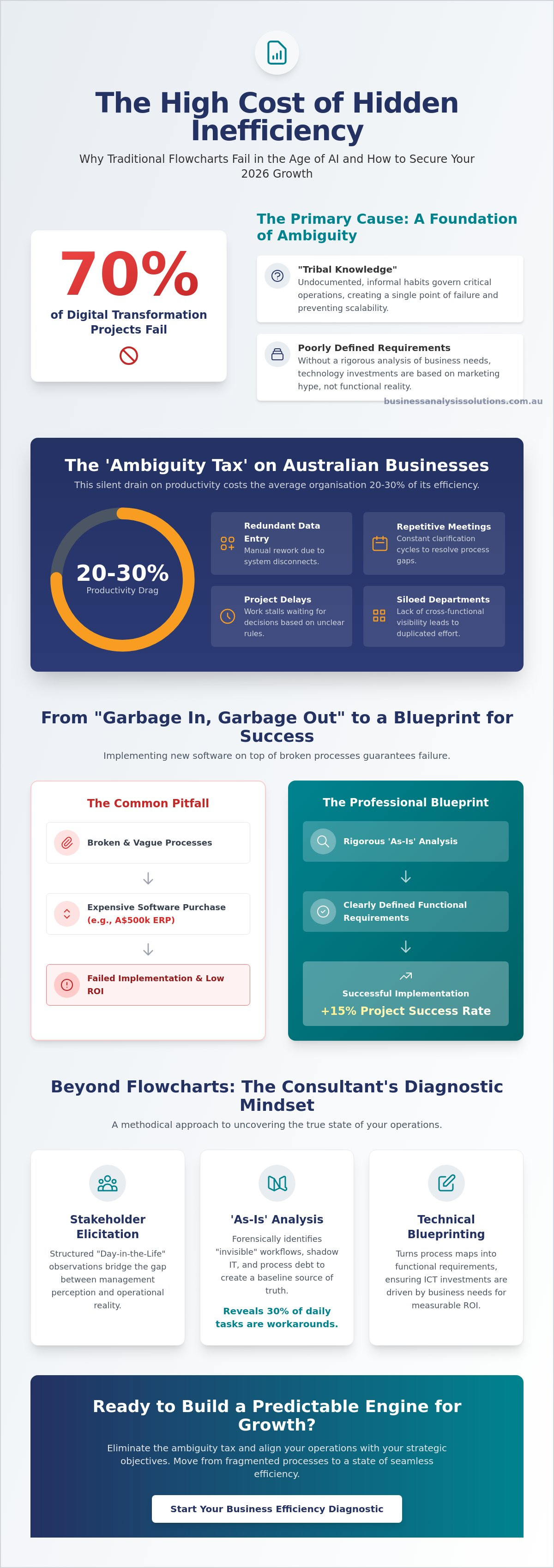
What if the primary barrier to your 2026 growth isn't your technology stack, but the hidden "tribal knowledge" governing your daily operations? Many Australian executives acknowledge that siloed departments and manual rework drain productivity, yet a 2024 industry report indicates that 70% of digital transformation projects fail due to poorly defined requirements. Partnering with a professional business process mapping consultant provides the analytical rigour needed to bridge the gap between technical requirements and business objectives. It's the most effective way to eliminate duplication of effort and ensure your team isn't relying on outdated, informal habits.
You likely understand that your current workflows need more than a superficial update to remain competitive in a shifting Australian market. This guide outlines how an expert consultant untangles organisational complexity to drive measurable efficiency and digital readiness. You'll discover a structured roadmap for reducing operational overhead and establishing standardised practices that empower your workforce. We'll explore the methodical steps required to move from fragmented operations to a state of seamless, strategic alignment.
Key Takeaways
Understand why 2026 demands a shift from simple flowcharts to deep organisational diagnostics to ensure your enterprise is ready for rapid AI integration.
Learn how a professional business process mapping consultant uses rigorous requirements elicitation to bypass "gut feel" and identify hidden operational bottlenecks.
Discover the essential steps for turning process maps into technical blueprints, ensuring your ICT investments are driven by functional requirements rather than marketing hype.
Gain insights into the role of a Business Efficiency Diagnostic in uncovering waste and streamlining Australian operations for measurable ROI.
Explore the strategic advantage of the Fractional CIO model in providing the objective clarity needed to bridge the gap between technical complexity and business objectives.
Table of Contents The Strategic Role of a Business Process Mapping Consultant in 2026 The Methodology of High-Impact Process Elicitation Identifying Inefficiencies: Mapping vs. Intuition Turning Maps into Blueprints: Preparing for Automation The Fractional CIO Advantage: Why Professional Analysis Wins
The Strategic Role of a Business Process Mapping Consultant in 2026
By 2026, the value of a business process mapping consultant has shifted from simple documentation to architectural precision. It's no longer enough to merely sketch how work moves through an office. As Australian firms integrate sophisticated AI agents and autonomous workflows, the margin for error has vanished. A consultant acts as a systems architect, ensuring every automated trigger rests on a foundation of verified logic rather than legacy assumptions. This technical rigor forms the essential starting point for any digital transformation blueprint for business in the current decade.
The distinction between drawing a process and analysing a business system is critical. A drawing is a static representation of a task; a system analysis is a dynamic evaluation of how resources, data, and human capital interact to produce value. Professional consultants focus on the latter to ensure that efficiency gains are sustainable. They don't just record what happens; they challenge why it happens, stripping away decades of "process debt" that accumulates in maturing organisations.
Beyond Flowcharts: The Diagnostic Mindset
Effective mapping requires a forensic approach to organisational health. A skilled business process mapping consultant looks for "invisible" workflows, those undocumented tribal knowledge paths that keep a department running despite outdated official manuals. They identify shadow IT, where staff use unapproved software to bypass clunky corporate systems, creating significant security and data silos. By providing a neutral, third-party perspective, consultants bypass internal politics to reveal the true state of operations. This Business process mapping overview highlights how these diagnostic efforts move beyond visuals to provide a structural baseline for genuine operational change.
The Cost of Ambiguity in Modern Operations
Ambiguity serves as a silent drain on the Australian economy. When processes remain vague, friction costs manifest as repetitive meetings, redundant data entry, and project delays. Implementing new software on top of broken processes leads to the "garbage in, garbage out" trap, where expensive A$500,000 ERP systems fail because the underlying logic was never clarified. The ambiguity tax acts as a 20-30% drag on productivity for the average Australian organisation. Professional mapping eliminates this waste by defining clear accountabilities and measurable outputs before a single line of code is written or a new hire is onboarded. It's about building a predictable engine for growth that doesn't rely on individual heroics to function.
The Methodology of High-Impact Process Elicitation
High-impact process mapping requires a transition from passive observation to active investigation. It's not enough to record what people say they do; a professional business process mapping consultant must uncover what actually happens on the workshop floor or in the back office. This rigorous approach ensures that the resulting maps aren't just theoretical diagrams but functional blueprints for change. According to the 2023 IIBA Global Business Analysis Salary Survey, practitioners who prioritise structured elicitation techniques see a 15% increase in project success rates compared to those using informal methods.
Stakeholder Engagement and Requirements Elicitation
Effective engagement requires tailored communication strategies. When interviewing busy Australian executives, the focus remains on strategic alignment and high-level outcomes like cost reduction or risk mitigation. Conversely, technical specialists require a granular approach that respects their time and expertise. We use structured "Day-in-the-Life" (DITL) observations to bridge the gap between management's perception and operational reality. This process often reveals that 30% of daily tasks are workarounds for legacy system limitations that leadership wasn't aware existed. By asking the right questions, we move beyond surface-level symptoms to find the root cause of bottlenecks.
Current State ('As-Is') Analysis
Documenting the 'As-Is' state provides the essential baseline for any transformation. You can't improve what you haven't accurately measured. This phase creates a "source of truth" that the entire organisation can agree upon, removing the ambiguity that leads to internal friction. During this analysis, we identify 'non-value-add' steps. In many Australian service sectors, we've found that up to 25% of process steps are redundant approvals or manual data entries that can be immediately eliminated. This stage isn't just about drawing boxes; it's about data-driven validation where every step is challenged for its contribution to the final objective.
Logical Sequencing: Every process must follow a strict functional logic to ensure scalability.
Data-Driven Validation: We use real-time metrics, such as cycle times and error rates, to verify the map's accuracy.
Zero Disruption: Our elicitation methods are designed to extract information without halting current operations.
Moving from 'As-Is' reality to 'To-Be' potential requires a disciplined hand. If your organisation struggles with opaque workflows or inconsistent outputs, engaging a professional business process mapping consultant can provide the clarity needed to streamline your operations. Every map we produce serves as a reliable foundation for future automation and continuous improvement initiatives.
Identifying Inefficiencies: Mapping vs. Intuition
Managing a growing Australian enterprise based on "gut feel" is a high-risk strategy that often leads to stagnant growth. While intuition has its place in entrepreneurship, it fails as a tool for operational scaling. When an organisation relies on anecdotal evidence, inefficiencies remain hidden in the gaps between departments. A professional business process mapping consultant provides the objective lens necessary to transition from reactive troubleshooting to proactive management.
A structured Business Efficiency Diagnostic serves as the first step in this transition. It identifies where resources are wasted and where "tribal knowledge" creates a single point of failure. In many Australian firms, critical processes exist only in the minds of long-term employees. This lack of documentation means that if a key staff member departs, the operational logic goes with them. Mapping captures this knowledge, ensuring the business remains resilient and independent of individual personalities.
Quantifying the Cost of Inefficiency
Inefficiency isn't just a frustration; it's a financial leak. When a handoff between sales and operations is delayed by 48 hours, it can delay revenue recognition and impact cash flow. By using process maps, leaders can calculate the exact cost of these delays. For example, if a bottleneck in the approval chain stalls an A$200,000 project for a week, the cost of capital and resource idle time is quantifiable. This data-driven approach allows managers to visualise where work goes to die. Engaging a business process mapping consultant provides the empirical evidence required to justify ICT investments to a board that demands a clear return on investment before approving new software or automation tools.
Bridging the Strategy-Execution Gap
There's often a disconnect between the boardroom's three-year plan and the daily tasks of the frontline team. Process mapping bridges this gap by ensuring that high-level strategy filters down to the smallest task. It clarifies accountability, which naturally reduces the "blame culture" that arises when responsibilities are ambiguous. When every step is documented, it's clear who owns the outcome. This clarity allows for a faster resolution of issues compared to the expensive, slow cycle of trial-and-error management. Mapping transforms a vague corporate vision into a tactical plan by defining every specific action required to achieve a strategic objective.
Turning Maps into Blueprints: Preparing for Automation
Automation without a detailed map is a fast track to compounding existing inefficiencies. Many organisations rush into digital transformation, only to find they've merely "paved the cow path" by digitising a broken manual process. A business process mapping consultant prevents this by treating the map as a technical blueprint. This stage ensures that automation implementation is built on a foundation of logic rather than just software capability. Without this clarity, a 2023 industry study found that 70% of digital transformations fail to meet their original objectives due to poorly defined requirements.
The transition from "As-Is" to "To-Be" requires a methodical assessment of every decision point. We don't just look for what can be automated; we look for what should be eliminated. This involves identifying redundancy and ensuring that data flows seamlessly between departments. By using tools like Microsoft Power Platform and Copilot, we execute workflows that are lean, repeatable, and data-driven. This approach turns static diagrams into active drivers of organisational performance.
ICT Alignment and Solution Design
Effective ICT alignment ensures that new software serves the business, not the other way around. It's common for firms to buy expensive platforms based on marketing hype, only to realise the tool doesn't support their unique operational logic. Our role involves bridging the gap between business analysis and ICT consultancy to ensure every feature serves a documented requirement. This results in strategic technology solutions that integrate with your existing stack while providing the flexibility to scale as your headcount or client base grows.
Selection of software based on functional requirements elicitation.
Elimination of "shadow IT" by centralising process data.
Verification of vendor claims against mapped process constraints.
Future State ('To-Be') Design
Designing the 'To-Be' state is an exercise in foresight. We don't just design for your current needs; we ask how these processes will function in five years. This involves embedding automation triggers and data capture points directly into the new map. For example, a business process mapping consultant might replace a manual approval gate with an automated logic branch that triggers based on specific A$ value thresholds or risk profiles.
Compliance is a critical pillar of our design philosophy. Every new process must remain compliant with Australian professional standards and industry-specific regulations. We ensure that audit trails are baked into the workflow, making reporting a byproduct of the process rather than a separate, manual task. This structured design phase transforms your operations into a predictable, high-output engine.
Ready to transform your manual workflows into scalable digital assets?
to start your automation journey.
The Fractional CIO Advantage: Why Professional Analysis Wins
Static documentation is a common pitfall for Australian firms. Engaging a business process mapping consultant shouldn't result in a forgotten PDF stored on a local drive. It's the starting point for active, strategic leadership. Internal staff often suffer from proximity bias, making it difficult to see the forest for the trees. They overlook deep-seated inefficiencies because those workarounds have become part of the daily routine. An external perspective brings the objectivity needed to challenge the status quo.
With over 20 years of industry experience, our consultants identify cross-sector patterns that internal teams cannot access. We've seen how a bottleneck in a manufacturing operation mirrors a data silo in a financial services organisation. This high-level pattern recognition allows us to bypass the trial-and-error phase. We move rapidly from a diagnostic state to a full implementation roadmap, ensuring your investment yields a measurable return.
Executive IT Leadership On-Demand
A Fractional CIO services model uses process maps to manage long-term ICT project risk. These maps aren't just diagrams; they're risk-mitigation tools. Professional oversight ensures that the CEO's vision translates into the technical delivery of the IT department. This bridges a common communication gap that often leads to project failure. By maintaining logical oversight, we ensure that every software integration or infrastructure change supports the primary business objectives.
Long-term Strategic Alignment
Effective mapping creates a living document that evolves with your organisation. We treat these maps as dynamic assets that require periodic efficiency reviews. This practice ensures your organisation remains agile enough to pivot when Australian market conditions shift. A business process mapping consultant ensures your operations don't become rigid or obsolete. We focus on continuous improvement to keep your workflows lean and your overheads controlled.
Clarity is the foundation of scalable growth. If your current processes feel tangled or opaque, it's time to apply a structured, methodical approach to your operations. Don't let operational complexity stall your progress. Book a Business Efficiency Diagnostic today to start the untangling process and gain the strategic direction your organisation requires.
Securing Operational Excellence for the 2026 Economy
Navigating the complexities of the 2026 business landscape requires moving beyond gut feeling and adopting a structured approach to workflow design. Relying on intuition often masks systemic inefficiencies that drain resources. Engaging a professional business process mapping consultant transforms these hidden bottlenecks into clear, actionable blueprints for automation and growth. Our methodology focuses on high-impact process elicitation to ensure your technical infrastructure supports your strategic objectives without compromise.
For manufacturing and industrial entrepreneurs who want to pair operational clarity with dedicated growth advisory, you can discover Co-Advisor to explore their specialized practice for Australian businesses.
Similarly, for those operating in the disability support and community services sector, you can discover Mighty Mentors WA to learn more about how personalized mentoring and community access services are structured for maximum impact.
Business Analysis & Solutions brings 20+ years of industry-leading experience as an Australian owned and operated boutique consultancy. We specialize in bridging the gap between business goals and ICT solutions, providing the fractional CIO expertise necessary for precision-led scaling. We don't just identify problems; we deliver the logic and clarity required to solve them.
Your organization's transition to a more streamlined and profitable future is a matter of methodical analysis and strategic alignment.
Frequently Asked Questions
What is the difference between a business analyst and a process mapping consultant?
A business analyst focuses on broad functional requirements and software alignment. In contrast, a business process mapping consultant specialises in the visual architecture and logical optimisation of specific workflows. While a BA might manage a whole project lifecycle, the consultant focuses on documenting "as-is" states and designing "to-be" models to eliminate operational friction and waste.
How long does a typical process mapping engagement take for a mid-sized Australian business?
A standard engagement for a mid-sized Australian firm typically spans 4 to 12 weeks depending on the number of departments involved. High-complexity projects involving 5 or more functional areas require the full 12-week window to ensure accuracy. Smaller, single-department audits can often conclude within 20 business days if stakeholder availability is managed effectively from the outset.
Can we map our processes internally using standard tools like Visio or Lucidchart?
You can certainly map processes internally using tools like Visio or Lucidchart, but these tools don't provide the objective scrutiny required for genuine optimisation. Internal teams often suffer from operational blindness where they document what they think happens rather than the reality on the ground. A consultant brings a neutral perspective and adheres to BPMN 2.0 standards that internal staff often lack.
What happens if our current processes are so messy that we don't know where to start?
We begin with a high-level Process Landscape to categorise your core value chain before drilling down into granular details. Even if 90% of your current workflows are undocumented or chaotic, a business process mapping consultant starts by identifying the primary revenue-generating activities. This structured triage ensures we fix the most critical bottlenecks first rather than getting lost in minor administrative tasks.
Does process mapping always lead to expensive software recommendations?
No, process mapping identifies waste that you can often resolve through policy changes or better use of your existing A$0 capital expenditure tools. According to the 2023 Gartner report on operational excellence, 35% of process improvements come from eliminating redundant steps rather than purchasing new technology. Our goal is to drive efficiency through logic, not just through increasing your software licensing costs.
How do you ensure that staff actually follow the new mapped processes?
Staff follow new processes when they're involved in the design phase and when the documentation is accessible and logical. We use stakeholder engagement workshops to ensure buy-in from the first day. If the team builds the process, they own the outcome. We also integrate these maps into your existing Quality Management System to ensure they become the standard for daily operations.
Is business process mapping relevant for service-based industries or just manufacturing?
Process mapping is vital for service-based industries where invisible workflows like client onboarding or claims processing often hide 20% to 30% in hidden costs. While the methodology started in manufacturing, the logic applies to any sequence of tasks. In an Australian professional services context, mapping ensures consistent service delivery and regulatory compliance with ASIC or APRA standards by removing human error.
What is the typical ROI on a professional process mapping project?
Professional process mapping projects typically deliver a return on investment within 6 to 9 months through reduced cycle times and lower error rates. Industry data suggests that companies implementing formal process improvements see a 15% increase in operational capacity without adding headcount. This allows your firm to scale revenue while keeping fixed costs stable, directly improving your bottom-line performance.



Comments