The 2026 Guide to a Business Efficiency Health Check: Optimising Organisational Performance
Updated: May 22
If your digital strategy feels like a series of expensive, disconnected repairs rather than a cohesive engine, you're likely experiencing a diagnostic failure rather than a technical one. Many business leaders find themselves managing siloed departments that rely on fragmented ICT systems, leading to manual workarounds and avoidable human error. You likely recognize that these inefficiencies drive up operational costs, yet finding the precise starting point for reform remains elusive. A comprehensive business efficiency health check provides the clarity needed to stop the cycle of reactive spending and start driving measurable results.
This guide will show you how a structured diagnostic approach identifies hidden operational bottlenecks and ensures your technology spend directly supports your core business objectives. We'll examine the role of process mapping and strategic alignment in creating a clear, prioritized digital transformation roadmap. By the end of this article, you'll understand how to bridge the gap between technical requirements and operational performance to achieve a significant reduction in friction and a better return on your ICT investment.
Key Takeaways
Understand the distinction between a backward-looking financial audit and a forward-looking diagnostic that identifies future operational growth opportunities.
Discover how process mapping exposes the "hidden factory" of manual workarounds that drain resources and create organizational friction.
Learn the structured phases of a professional business efficiency health check to move from data discovery to a functional digital transformation blueprint.
Identify the critical steps for transitioning from a diagnostic report to active project management through targeted automation implementation.
See how Fractional CIO services provide the strategic ICT leadership required to maintain long-term performance without the expense of a full-time executive.
Table of Contents
What is a Business Efficiency Health Check in 2026?
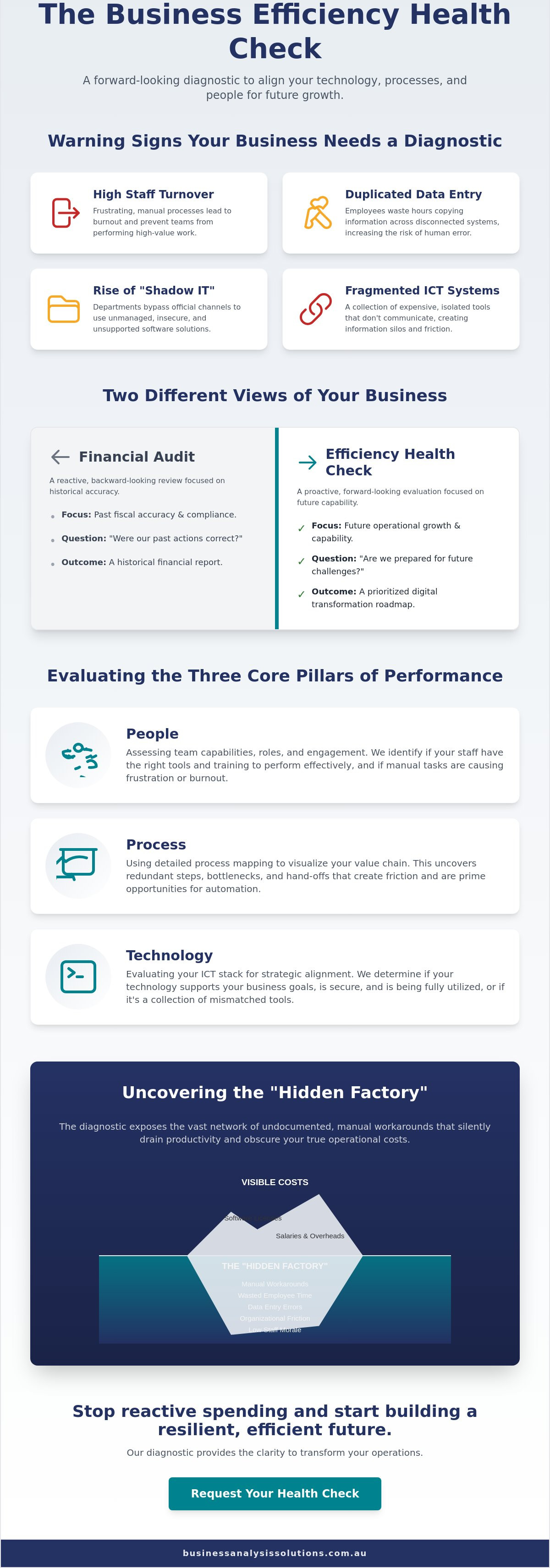
A business efficiency health check is a systematic, technical evaluation of your organizational architecture. It's designed to assess performance, identify latent risks, and uncover specific ICT opportunities that align with your long-term vision. Many leaders confuse this diagnostic with a standard financial audit, but the two serve entirely different purposes. While a financial audit is backward-looking and focuses on fiscal accuracy, an efficiency diagnostic is forward-looking. It prioritizes the future state of your operations by examining how well your current systems can handle projected growth.
In 2026, market dynamics have shifted toward proactive operational reviews. With generative AI adoption reaching 58% among small businesses and cybercrime projected to cost the global economy trillions, a reactive approach to technology is a liability. You need to know if your infrastructure is secure and if your team is actually utilizing the tools you've purchased. We measure the success of this process through strategic alignment. This core metric determines how effectively your technology stack and operational workflows support your high-level business goals. Without this alignment, your ICT strategy remains a collection of expensive, isolated tools rather than a unified asset.
The Distinction Between Growth and Efficiency
Scaling an inefficient business is a strategic error that simply amplifies existing problems. If your workflows are broken, increasing your volume of customers or staff will only lead to more chaos and higher overheads. Efficiency is fundamentally the ratio of output to input within your core processes. To achieve a high ratio, you must apply the principles of Business Process Management to ensure operational agility. Achieving this level of precision requires a commitment to logic and structured analysis. For a deeper exploration of these concepts, refer to our Strategic Guide to Business Efficiency.
Signs Your Organisation is Due for a Diagnostic
Recognising the need for a business efficiency health check usually starts with identifying specific operational red flags. High staff turnover is often a symptom of frustrating, manual processes that prevent your team from performing high-value work. If your employees spend hours on duplicated data entry across disconnected systems, your integration has failed. Another major warning sign is the rise of "shadow IT," where departments bypass official ICT channels to use their own unmanaged software solutions. Operational friction is the invisible tax on Australian business productivity. Sticking with "the way we've always done it" creates a compounding cost that eventually becomes unsustainable in a digital-first economy.
Evaluating the Core Pillars: Process, People, and Technology
Operational performance is not merely a byproduct of financial health; it's the result of a deliberate alignment between the three core pillars of any organization: People, Process, and Technology. This "Golden Triangle" forms the foundation of a robust business efficiency health check. When these pillars are out of sync, your organization develops a "hidden factory." This term describes the vast network of manual workarounds and undocumented processes your team uses to overcome the limitations of inadequate systems. These invisible inefficiencies drain productivity and obscure your true operational costs.
Identifying these gaps requires deep stakeholder engagement. It's not enough to review high-level reports; you must understand the day-to-day realities of your staff. This methodical approach ensures that your ICT solutions serve the business objectives rather than forcing your team to adapt to rigid, unsuitable software. If you're ready to uncover these hidden costs, our business efficiency diagnostic provides the necessary framework to begin your optimization journey.
The Role of Business Process Mapping
Process mapping serves as the visual architecture of your organizational value chain. It provides a granular view of how work actually flows through your departments. By documenting every step, we identify redundant actions, unnecessary hand-offs, and clear opportunities for automation. This clarity allows for the application of advanced Process Improvement Methodologies to streamline operations and reduce waste. For a detailed breakdown of the methodologies used in this phase, see our guide on Strategic Business Analysis Consultancy in Perth.
Technology as an Enabler, Not a Solution
A common strategic error is adopting a "software-first" approach to problem-solving. Purchasing new tools before conducting thorough requirements elicitation leads to expensive systems that fail to solve the underlying problems. Technology should be treated as an enabler of efficient processes, not a standalone solution. To ensure your technology investments deliver a measurable return, you need a Digital Transformation Blueprint. This framework ensures that integrated communication services and data platforms act as the backbone of your efficiency strategy. This approach prevents the creation of new silos and ensures that every technical requirement is grounded in a specific business objective.
The Business Efficiency Diagnostic: A Structured Framework
A professional business efficiency health check requires more than a cursory interview or a 45-minute questionnaire. It demands a structured, data-driven framework that moves beyond financial spreadsheets to examine the mechanical reality of your operations. We utilize a three-phase methodology: Discovery, Analysis, and Blueprinting. This approach ensures that every recommendation is supported by empirical evidence, such as time-motion studies and comprehensive ICT audits. By engaging an objective, third-party analyst, you bypass the internal biases and "sunk cost" fallacies that often cloud the judgment of in-house teams. The ultimate output is a prioritised roadmap that identifies exactly where automation and process refinement will deliver the highest return.
Phase 1: Deep Discovery and Stakeholder Elicitation
The foundation of any successful diagnostic is thorough requirements elicitation. We interview key personnel across all levels of the organisation to distinguish between surface-level symptoms and the underlying pain points. For example, a team might report "slow turnaround times" as their primary issue, but discovery often reveals the root cause is a lack of integrated communication services or redundant data entry. During this phase, we capture the "As-Is" state of your business through detailed process mapping. This documentation provides a transparent baseline for all future improvements. A diagnostic is only as good as the honesty of the discovery phase.
Phase 2: Gap Analysis and Strategic Alignment
Once the current state is documented, we perform a rigorous gap analysis. This involves comparing your existing performance against the standards established in a Digital Transformation Blueprint. We don't just look at speed; we evaluate your current ICT solutions against the Essential 8 framework to ensure cybersecurity and operational stability are maintained. In an era where cybercrime costs are projected to reach $10.5 trillion annually, security is a non-negotiable component of efficiency. We then prioritise improvements based on a logical matrix of ROI and implementation feasibility. This ensures that your resources are focused on high-impact changes that reduce operational friction immediately.
From Diagnosis to Action: Implementing Your Efficiency Blueprint
A business efficiency health check serves as the catalyst for change, but the value is only realized when you transition from diagnosis to execution. Implementation is where strategy meets reality. This phase requires moving beyond the theoretical recommendations of a report into active project management. It involves deploying specific automation implementation solutions to eliminate low-value manual tasks that currently consume your team's capacity and focus. For B2C business owners, freeing up this mental and operational space is a core tenet of the Founder Freedom coaching philosophy, allowing them to shift from working in the business to working on it. However, technical deployment is only half the battle. You must manage the "change curve" within your organization to ensure staff buy-in and long-term adoption. We treat the resulting efficiency blueprint as a living document. It must evolve alongside your business rather than gathering dust as a static, outdated report.
The Importance of Expert Project Management
Logic dictates the sequence of your transformation. Statistics indicate that 70% of digital transformations fail when they lack professional ICT Project Management. A dedicated project manager is essential for maintaining strict control over scope, budget, and strategic alignment throughout the rollout. We often leverage the Microsoft Power Platform for rapid, low-code automation wins. This allows for the swift replacement of manual data entry with automated workflows. It delivers immediate relief to operational friction without the complexity of custom software development. If you're ready to move from planning to performance, our project management services provide the structured oversight needed for success.
Measuring Success Post-Implementation
Post-implementation, we define clear KPIs to validate the return on investment. Key metrics include reduced cycle times, a significant drop in error rates, and measurable improvements in staff sentiment as mundane tasks are removed. We establish an "Efficiency Feedback Loop" to ensure that your new processes remain optimized and relevant. This continuous improvement mindset prevents the gradual "efficiency drift" that often occurs as businesses grow and requirements change. We recommend a follow-up business efficiency health check every 12 to 18 months. This verifies that your operational performance remains aligned with your evolving digital strategy and ensures you're capitalizing on the latest technological advancements.
Executive Leadership: The Role of the Fractional CIO
Maintaining the gains from a business efficiency health check requires more than a one-off project; it demands ongoing strategic oversight. This is where the Fractional CIO becomes the long-term guardian of your organizational performance. Unlike a traditional consultant who delivers a report and departs, a Fractional CIO provides on-demand executive leadership. They offer the strategic ICT guidance your board requires without the prohibitive cost of a full-time executive salary. This model bridges the communication gap between your technical teams and the board, ensuring that every ICT investment remains logically connected to your broader business objectives.
Positioning a Fractional CIO as a partner is the logical next step for organizations that have completed their initial diagnostic and blueprinting phases. While competitors often offer simple consulting or wealth management, they rarely provide the deep, technical leadership needed to manage a modern digital ecosystem. You need a partner who understands that technology exists to serve the business, not the other way around. This partnership ensures that your efficiency roadmap doesn't stagnate but continues to adapt as your industry evolves. It's about maintaining momentum through structured, expert guidance.
Strategic Technology Solutions for 2026
In the current market, a Fractional CIO plays a critical role in evaluating emerging technologies. They assess tools like Microsoft Copilot and various generative AI agents through the lens of operational value rather than technical novelty. With 75% of small and medium-sized businesses now investing in AI tools, you need a Trusted Advisor to manage high-stakes ICT procurement and vendor relationships. This level of strategic leadership turns a health check from a one-off event into a sustainable competitive advantage. It ensures your organization captures the "AI skills dividend" through disciplined implementation rather than scattered experimentation.
Securing the Future: Resilience and Scalability
Future-proofing your organization involves more than just speed; it requires resilience. A comprehensive business efficiency health check must incorporate disaster recovery and business continuity planning to protect your operations from systemic shocks. Your Fractional CIO focuses on creating a scalable ICT architecture that grows alongside your business. This involves rigorous requirements elicitation to ensure that your infrastructure can handle increased loads without a corresponding increase in operational friction. They ensure that your digital strategy is robust, secure, and ready for whatever comes next. By aligning your technology spend with these core pillars, you build a business that is both efficient and enduring.
Contact Business Analysis & Solutions for a comprehensive Business Efficiency Diagnostic to begin optimizing your organizational performance today.
Securing Sustained Operational Excellence
Achieving a high-performance organization requires more than occasional technical updates; it demands a commitment to diagnostic precision. We've examined how a systematic business efficiency health check identifies the hidden factory of manual workarounds and aligns your ICT infrastructure with strategic objectives. By establishing a clear Digital Transformation Blueprint and leveraging Fractional CIO leadership, you ensure technology serves as a catalyst for growth rather than a source of operational friction.
Business Analysis & Solutions brings over 20 years of industry experience to every engagement. As an Australian-based strategic ICT consultancy, we specialize in untangling complexities to deliver tangible value. We prioritize logic and reliability, providing the structured roadmap necessary to transform your operations. If you're ready to eliminate inefficiencies and secure a long-term competitive advantage, an objective assessment is the essential starting point.
Book your Business Efficiency Diagnostic with our expert consultants to begin your journey toward a more resilient and scalable future. We look forward to helping you achieve the clarity and performance your organization deserves.
Frequently Asked Questions
How often should an Australian business conduct an efficiency health check?
Most organizations should perform a business efficiency health check every 12 to 18 months. This frequency ensures that your operational processes remain aligned with rapid technological shifts, such as the rise of autonomous AI agents in 2026. Regular reviews prevent "efficiency drift," where small manual workarounds gradually compound into significant operational bottlenecks as your business scales.
What is the difference between a business audit and an efficiency diagnostic?
A business audit is a backward-looking exercise that primarily focuses on financial accuracy and regulatory compliance. In contrast, an efficiency diagnostic is forward-looking and examines the mechanical reality of your workflows. It evaluates how effectively your people, processes, and technology interact to drive future performance. While an audit checks what happened, a diagnostic determines how to improve what happens next.
How long does a typical business efficiency health check take to complete?
A professional diagnostic usually requires between two and four weeks to complete. This timeframe allows for deep discovery, stakeholder engagement, and the creation of detailed process maps. The exact duration depends on the complexity of your organizational architecture and the number of disconnected ICT systems currently in use. We prioritize a methodical approach to ensure the final blueprint is both accurate and actionable.
What are the primary indicators that our business processes are inefficient?
The most common red flags include high staff turnover, frequent duplicated data entry, and the presence of "shadow IT" where departments use unmanaged software. If your team relies on undocumented manual workarounds to bypass system limitations, you're likely paying an "invisible tax" on productivity. These symptoms indicate that your current workflows have failed to keep pace with your operational requirements.
Can a business health check help with digital transformation planning?
Yes, conducting a business efficiency health check is the essential first step in developing a Digital Transformation Blueprint. It provides the empirical data needed to prioritize technology investments based on actual operational needs rather than market trends. This structured approach ensures that your digital strategy addresses specific bottlenecks and delivers a measurable return on investment.
Do we need to change our existing IT systems after a health check?
Not necessarily. The diagnostic often reveals that existing ICT solutions are simply underutilized or poorly integrated. We frequently find that rapid, low-code automation wins through platforms like Microsoft Power Platform can resolve friction without the need for total system replacement. Our goal is to bridge the gap between technical requirements and business objectives using the most logical and cost-effective path available.
What is the role of a Fractional CIO during a business health check?
A Fractional CIO acts as the strategic architect who oversees the entire diagnostic process. They provide high-level ICT guidance and ensure that the technical roadmap aligns with the board's commercial goals. By bridging the gap between technical teams and executive leadership, they ensure the health check results in a cohesive strategy rather than a series of isolated technical fixes.
How do we measure the ROI of a business efficiency diagnostic?
We measure ROI through concrete metrics such as reduced cycle times, lower error rates, and a decrease in total operational costs. Additionally, we track the "AI skills dividend," which is the time reclaimed by staff as manual administrative tasks are automated. A successful diagnostic provides a clear, prioritized list of improvements that lead to a significant reduction in operational friction and improved staff sentiment.



Comments