Rescuing a Failing ICT Project: A Strategic Recovery Framework for 2026
- jonesaqayalo
- May 11
- 12 min read
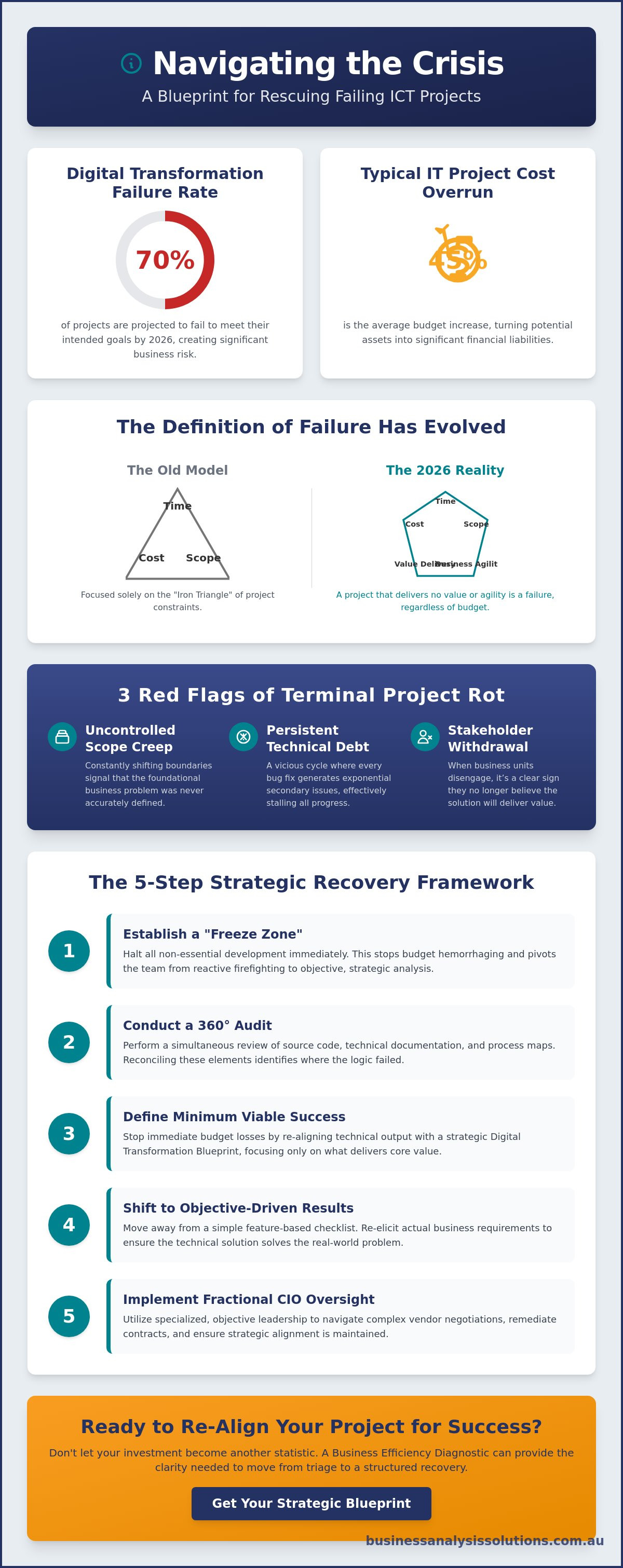
With 70% of digital transformation projects failing to meet their intended goals in 2026, the question for many leaders isn't if a crisis will occur, but how they'll respond when it hits. When your initiative faces the 45% cost overrun typical of modern IT ventures, the pressure to salvage the investment becomes immense. Rescuing a failing ICT project requires more than just additional funding or a shift in personnel. It demands a logical, diagnostic approach that prioritizes strategic alignment over technical band-aids.
You've likely felt the friction of mounting technical debt and the steady erosion of stakeholder confidence as ROI remains elusive. We understand that ambiguity is the enemy of progress in these high-stakes scenarios. This guide provides a systematic, logic-driven framework to identify project rot and audit technical debt with precision. You'll gain a clear Go/No-Go decision matrix and a roadmap to re-align technical output with your actual business requirements. This process ensures your ICT delivery finally serves your organizational objectives and restores professional trust through a structured, methodical recovery.
Key Takeaways
Redefine project failure by moving beyond simple deadlines to focus on value delivery and business agility in a 2026 context.
Establish a "Freeze Zone" to conduct a 360-degree audit of code and process maps, providing the necessary clarity for rescuing a failing ICT project.
Implement "Minimum Viable Success" criteria to stop immediate budget losses and re-align your technical output with a strategic Digital Transformation Blueprint.
Shift from feature-based development to objective-driven results through a rigorous methodology of requirements re-elicitation.
Utilize fractional CIO oversight to provide the specialized leadership required for complex vendor negotiations and contract remediation.
Table of Contents
Identifying the Critical Failure Points in ICT Projects
In the 2026 business environment, the definition of project failure has shifted from simple scheduling delays to a fundamental lack of value delivery. While a project might technically go live, it's considered a failure if it doesn't solve the underlying business problem or if it degrades organizational agility. Rescuing a failing ICT project depends on recognizing that 70% of digital transformation initiatives fail to meet their intended goals, according to data from Integrate.io. This high rate of attrition suggests that most failures aren't isolated technical glitches but are instead rooted in a disconnect between technical execution and strategic purpose.
The traditional model of the iron triangle of project management, which balances scope, time, and cost, remains relevant but incomplete. In a modern context, we must also weigh these constraints against business agility and the ability to pivot as market conditions change. A project that remains on budget but delivers a rigid, obsolete system is a liability, not an asset. Distinguishing between temporary tactical setbacks and systemic ICT rot is the first step in any recovery effort. While setbacks are manageable through better scheduling, systemic rot indicates a breakdown in the very logic of the project. Project rescue is the strategic re-alignment of technology with documented business needs.
The Red Flags of Terminal Project Rot
Identifying terminal rot requires an objective look at three specific areas. First, uncontrolled scope creep usually signals poor initial requirements elicitation. If the project's boundaries are constantly shifting, it's because the foundational business problem wasn't accurately defined. Second, persistent technical debt creates a cycle where every bug fix generates exponential secondary issues, effectively stalling progress. Finally, stakeholder withdrawal is a critical indicator of failure. When business units stop engaging with the ICT team, it's a clear sign they no longer believe the solution will deliver value. In 2026, stakeholder trust is the most difficult currency to recover once lost.
Diagnostic vs. Triage: Knowing the Difference
Recovery doesn't begin with more coding; it begins with an assessment. Utilizing a Business Efficiency Diagnostic allows leadership to identify where the process has broken down before committing more capital. This diagnostic phase is essential to overcoming the sunk cost fallacy. With IT projects experiencing an average cost overrun of 45% according to McKinsey, leaders must decide if the existing path is recoverable or if a pivot is necessary. An objective third-party auditor provides the distance needed to identify internal biases that often cloud the judgment of the original project team. This clarity is the only way to move from desperate triage to a structured, successful recovery.
A Systematic Audit: Triage and Technical Debt Assessment
When rescuing a failing ICT project, the most effective first step is often the most counterintuitive: establishing a "Freeze Zone." In this phase, all non-essential development ceases immediately. Continuing to build on a flawed foundation only compounds technical debt and accelerates budgetary hemorrhaging. Pausing allows your team to pivot from reactive firefighting to objective analysis. This temporary cessation of activity is not a sign of defeat; it is a strategic requirement to ensure that every subsequent dollar spent contributes to a viable solution rather than a sunk cost.
A 360-degree audit must follow the freeze. This process involves a simultaneous review of source code, technical documentation, and existing process maps. In many cases, the documentation has diverged significantly from the actual technical output. By reconciling these elements, you can identify where the logic failed. This audit serves as the baseline for evaluating current vendor performance against your established expert project management framework. Drawing from practical lessons in government IT, we know that failing to hold vendors accountable to specific, measurable outcomes is a primary driver of project collapse.
The final stage of this triage is quantifying the "Cost to Complete" versus the "Cost to Replace." It is a cold, mathematical calculation. If the investment required to remediate the existing architecture exceeds the cost of a fresh start using modern, cloud-native solutions, the project should be decommissioned. This decision requires a level of objectivity that internal teams often struggle to maintain. Engaging an expert for a comprehensive project audit can provide the neutral perspective needed to make this difficult call.
Technical Debt and Architectural Integrity
In 2026, auditing for architectural integrity means assessing for Cloud 3.0 compatibility and AI-readiness. We look for "Shadow IT" elements where developers have bypassed official governance to meet unrealistic deadlines. Crucially, the audit must verify that the system meets current Australian cybersecurity standards, such as the Essential Eight. If the failing project lacks a zero-trust identity framework, the security remediation costs may alone justify a "No-Go" decision.
The Process Audit: Where the Workflow Broke
Systemic failure is rarely limited to the code. We use detailed process mapping to identify bottlenecks in the delivery cycle, often discovering a significant communication gap between technical developers and business analysts. This disconnect usually stems from an ill-fitting methodology. For instance, attempting a rigid Waterfall approach on a project requiring high business agility often leads to the very friction that necessitates rescuing a failing ICT project in the first place.
Re-aligning with a Digital Transformation Blueprint
Rescuing a failing ICT project requires a shift from reactive damage control to strategic reconstruction. When a project drifts, it's usually because the connection between technical tasks and business value has dissolved. A 2026 Digital Transformation Blueprint serves as the corrective lens, providing a structured framework to re-evaluate every requirement against current market realities. This document isn't just a plan; it's a commitment to logic over legacy decisions. It forces the organization to stop viewing the project as a series of IT tickets and start seeing it as a vehicle for measurable business outcomes.
The immediate priority in any recovery effort is to stop the bleeding by establishing "Minimum Viable Success" (MVS) criteria. This involves identifying the absolute minimum functionality required to deliver value and justify the continued investment. To achieve this, leadership must utilize a "Kill-Switch" list. This list contains features and modules that, while part of the original scope, no longer serve a critical purpose or have become too costly to remediate. A strategic project salvage plan often requires the courage to abandon non-essential components to save the core initiative. By narrowing the focus, you reduce complexity and increase the probability of a successful pivot.
Every dollar of ICT spend must be linked back to documented business efficiency. If a module doesn't reduce operational friction or increase ROI, its place in the recovery roadmap must be questioned. This rigorous alignment ensures that the rescued project doesn't just "finish" but actually performs. It transforms the ICT department from a cost center into a strategic partner capable of delivering tangible organizational value.
Defining the New Strategic Direction
Success in 2026 demands a move from "Feature-Focus" to "Outcome-Focus." Instead of measuring progress by how many lines of code are written, we measure it by the resolution of business pain points. The blueprint allows you to reset stakeholder expectations by presenting a realistic, phased rollout. This approach prioritizes quick wins that demonstrate immediate value, which is essential for regaining the credibility lost during the project's initial failure. It replaces ambiguity with a clear, logical sequence of delivery.
Resource Re-allocation and Automation
Recovery often reveals manual processes within the project lifecycle that are ripe for automation implementation. Rather than throwing more human capital at a failing system, we look for ways to streamline workflows through technology. This might include leveraging the Microsoft Power Platform for rapid prototyping of failed modules, allowing for faster validation of new requirements. Ensuring the right talent is in the right role is more effective than simply increasing headcount, which often only adds to the communication overhead and further delays the recovery.
Strategic Stakeholder Management and Requirements Re-elicitation
Requirements management remains the primary point of failure for most ICT initiatives. When rescuing a failing ICT project, we often find that teams spent months discussing "how" to build a feature before confirming "what" business problem they were actually solving. This disconnect creates a solution that is technically functional but commercially useless. In the 2026 landscape, where AI integration and Cloud 3.0 complexity are the norms, this "What vs. How" dilemma is amplified. Precision in the requirements phase is the only way to ensure that technical output generates a return on investment.
Project fatigue is a tangible risk that leadership must address during a recovery. By the time a rescue begins, internal staff are often demoralized by failed sprints, while executives are skeptical of further spending. Restoring momentum requires a shift in how the organization communicates. A business analysis consultancy acts as the neutral bridge between executive vision and technical execution, removing the emotional bias that often plagues internal teams during a crisis. This third-party perspective provides the objective distance needed to evaluate progress without the baggage of past mistakes.
Restoring Transparency and Trust
Trust is rebuilt through radical transparency. We start with a "Brutal Honesty" report, presenting the audit findings to the board without any attempt to sugar-coat the reality of the situation. This report serves as the baseline for a new governance structure where accountability is clearly defined rather than shared. We implement real-time progress tracking through automated dashboards, ensuring that the project never slips into the "dark" again. This visibility allows stakeholders to see incremental progress, which is the most effective cure for project fatigue.
Requirements Elicitation 2.0
The second iteration of requirements elicitation must be grounded in logic, not legacy requests. We use detailed process maps to validate every requested feature against a specific business need. If a feature doesn't directly support a mapped business process or objective, it is removed from the immediate roadmap. We apply the MoSCoW method (Must have, Should have, Could have, Won’t have) with extreme discipline to prioritize the "Minimum Viable Success" criteria identified in the blueprint. Finally, we document a rigorous "Definition of Done" for every module to prevent the scope creep that originally derailed the project. If your project is currently stalled, our strategic business analysis services provide the clarity needed to restart with confidence.
Implementing Fractional CIO Oversight for Project Recovery
Rescuing a failing ICT project often stalls due to a vacuum of high-level leadership. While project managers handle day-to-day tasks, they rarely possess the executive authority to renegotiate vendor contracts or pivot the entire digital strategy. This is where Fractional CIO services provide a critical advantage. By injecting senior expertise into the recovery process, organizations gain the strategic weight necessary to make difficult decisions that internal teams might avoid. A fractional executive brings an objective, results-driven focus that prioritizes organizational solvency over internal politics.
The role of the Fractional CIO extends deep into vendor negotiation and contract remediation. In 2026, many failing projects are bogged down by opaque service agreements that don't align with actual business needs. An experienced CIO audits these relationships, identifying where deliverables have fallen short of the original business technology roadmap. They act as the board's advocate, ensuring that technical spend results in tangible value. This oversight bridges the gap between granular technical requirements and overarching board-level strategy, turning a chaotic rescue into a controlled, professional engagement.
Once the project stabilizes, the focus shifts from "Rescue Mode" to "Continuous Improvement." Stabilization isn't the finish line; it's the new baseline for performance. The Fractional CIO ensures that the lessons learned during the recovery are institutionalized through updated governance and better process mapping. This transition prevents the organization from regressing into the same habits that led to the initial failure. It's a methodical approach to building a resilient ICT ecosystem that supports long-term growth and operational efficiency.
On-Demand Executive Leadership
Interim leadership is often more effective at making hard calls because they aren't constrained by long-term internal career paths. They provide the technical roadmap for scalability, ensuring the rescued project integrates seamlessly with the wider business ecosystem. In May 2026, the fractional model has grown significantly because it offers this high-level expertise at a predictable cost. Current market data indicates that a Fractional CIO typically costs between $2,000 and $15,000 per month, providing a high-ROI alternative to a full-time executive hire during a crisis.
Final Steps: The Handover to Stability
The final phase involves a structured handover to internal teams. We focus on training staff to maintain the new, stabilized environment and establishing a post-rescue audit schedule. This ensures that strategic alignment holds long after the initial crisis has passed. If your ICT project is currently stalling, the path to recovery begins with a clear assessment. Book a Business Efficiency Diagnostic today to identify the specific, logic-driven steps needed to secure your investment and restore project momentum.
Restoring Strategic Momentum to Your ICT Portfolio
Rescuing a failing ICT project isn't a matter of simply increasing headcount; it requires a fundamental return to logical alignment. By implementing a rigorous triage process and re-eliciting requirements based on core business goals, you can pivot from technical stagnation to measurable value. The framework we've discussed moves beyond simple project management to ensure your digital strategy supports long-term organizational agility. This structured approach replaces friction with a clear, documented path to success.
Business Analysis Solutions provides the precision needed to navigate these high-stakes recoveries. With over 20 years of strategic experience, we specialize in bridging the gap between technical requirements and business objectives. As a trusted advisor for digital transformation across Australia, we focus on finding the right solution rather than the easiest one. If your current initiative is failing to meet its intended goals, Request a Business Efficiency Diagnostic to rescue your project. We provide the clarity and direction required to turn your organizational complexities into optimized results. Your investment is salvageable with the right methodology.
Frequently Asked Questions
How do I know if my ICT project is worth saving or if I should terminate it?
You determine if rescuing a failing ICT project is viable by calculating the "Cost to Complete" against the "Cost to Replace." If the investment required to remediate the existing architecture exceeds the expense of a fresh start, termination is the logical choice. McKinsey data from March 2026 indicates IT projects suffer an average 45% cost overrun, so you must assess if the current foundation can support your 2027 goals.
What are the most common reasons ICT projects fail in Australia?
Primary failure points in the Australian market include poor requirements management and a lack of executive sponsorship. Research from Integrate.io in 2026 shows that 70% of digital transformation projects fail to meet their goals, often because foundational work like data governance was skipped. Systemic failure is usually a result of misaligned strategic objectives rather than purely technical errors.
How much does it typically cost to rescue a failing software project?
Rescue costs vary based on the project's complexity and the extent of the technical debt. While there is no fixed price for rescuing a failing ICT project, you should factor in the cost of high-level oversight. For example, a senior Fractional CIO in 2026 typically commands between $400 and $600 per hour for executive-level remediation and vendor negotiation according to industry rate reports.
Can a business analyst really help fix a technical coding issue?
A business analyst doesn't write or fix code, but they resolve the logical errors that cause technical failure. By performing requirements re-elicitation, a BA ensures the developers are building the correct solution for the business problem. They act as the bridge between technical output and business requirements, preventing the "What vs. How" dilemma that leads to project rot and wasted development hours.
What is the role of a Fractional CIO in a project rescue scenario?
A Fractional CIO provides the executive leadership and vendor management expertise required to stabilize a failing initiative. They navigate complex contract remediations and re-align the technical roadmap with board-level strategy. This model has grown into a $5.7 billion market in 2026 because it allows businesses to access elite talent without the expense of a full-time executive hire during a crisis.
How long does the triage and audit phase of a project rescue take?
The triage and audit phase generally requires a "Freeze Zone" of two to four weeks. During this period, all non-essential development stops while we conduct a 360-degree review of code, documentation, and process maps. This timeline ensures we have a data-driven foundation before proposing a recovery roadmap or making a Go/No-Go recommendation to the board based on objective metrics.
Should I fire my current vendor if the project is failing?
You should only replace a vendor after a formal audit proves their performance is the primary cause of failure. In many cases, vendor issues stem from poor requirements provided by the client rather than technical incompetence. A Fractional CIO can often use contract remediation to reset the relationship, though a total transition is necessary if the vendor lacks the capability to meet 2026 standards.
How can automation help in rescuing a delayed ICT project?
Automation streamlines recovery by replacing manual, error-prone workflows with reliable digital processes. We use tools like the Microsoft Power Platform to rapidly prototype modules that previously failed, allowing for faster validation of new requirements. This approach reduces the reliance on large development teams and accelerates the delivery of "Minimum Viable Success" criteria, helping to stop budgetary hemorrhaging quickly.



Comments