Digital Transformation Framework for Small Business: The 2026 Strategic Roadmap
Most small businesses approach technology as a shopping list of tools, but successful digital transformation is an exercise in rigorous business analysis rather than mere technology procurement. With the global digital transformation market projected to reach $3.4 trillion by late 2026, the pressure to modernise is high, yet the risk of investing in the wrong solutions remains a significant barrier. You likely feel the daily friction of fragmented data across disconnected systems and the burden of high manual workloads for tasks that should be automated. It's frustrating to face uncertainty about which specific technology will actually provide a tangible return on investment for your unique operations.
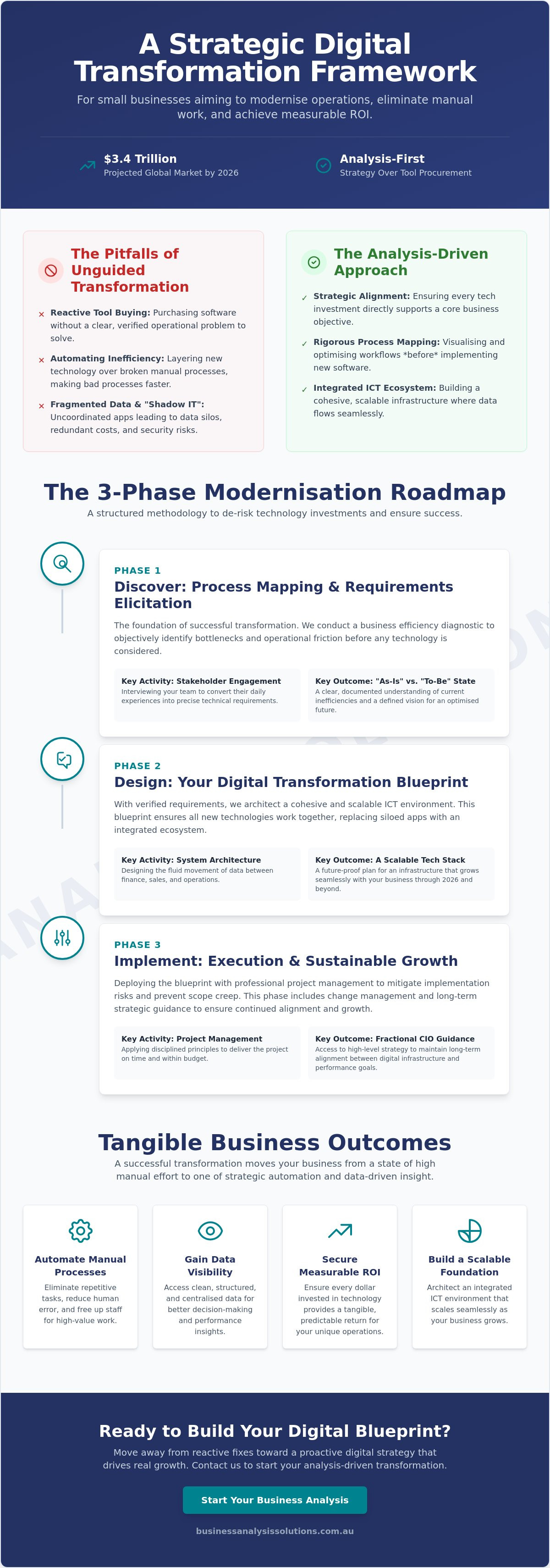
This guide introduces a logical, analysis-driven digital transformation framework for small business designed to modernise your operations and achieve measurable ROI without the risks of unguided technology adoption. By prioritising strategic alignment and precise process mapping, you can move away from reactive fixes toward a proactive digital strategy. We'll explore a structured roadmap to automate manual processes, gain better visibility into business performance, and establish a scalable ICT infrastructure that grows with your business through 2026 and beyond.
Key Takeaways
Move beyond reactive tool adoption by implementing a proactive strategy that aligns technical requirements with your core business objectives.
Master a logical digital transformation framework for small business that uses process mapping to eliminate manual workloads and improve data visibility.
Architect an integrated ICT environment using a structured blueprint to ensure your technology stack scales seamlessly as your business grows.
Secure measurable ROI by applying professional project management principles that mitigate implementation risks and prevent costly scope creep.
Access high-level strategic guidance through fractional CIO services to maintain long-term alignment between your digital infrastructure and performance goals.
Table of Contents
What is a Digital Transformation Framework for Small Business?
A Digital transformation is frequently misidentified as a simple software upgrade or the adoption of a new cloud platform. For a growing firm, a digital transformation framework for small business is a structured methodology that integrates digital technology into all functional areas to fundamentally change how value is delivered to customers. It marks the transition from digitisation, the mere conversion of analogue data to digital formats, to a comprehensive modification of business models. This shift requires moving away from reactive tool adoption and toward strategic technology solutions that are rooted in logic and business analysis.
By 2026, the competitive landscape demands AI-readiness and aggressive data centralisation. It's no longer sufficient to possess data; that data must be clean, structured, and accessible enough for automated systems to process. A logical framework provides the necessary scaffolding to ensure that every investment serves a specific, measurable purpose. It bridges the gap between technical potential and commercial reality, ensuring that technology serves the business rather than the business serving the technology.
The 2026 Small Business Landscape in Australia
In the current Australian market, AI agents and automated workflows have moved from experimental novelties to essential drivers of team productivity. Small teams now leverage these tools to manage high-volume administrative tasks, which allows staff to refocus on high-level stakeholder engagement. However, legacy systems now represent a critical security and efficiency risk. These outdated platforms create bottlenecks that prevent the seamless flow of information. The strategic trend has shifted decisively toward integrated ecosystems where data moves fluidly between finance, sales, and operations, replacing the era of siloed applications that required constant manual reconciliation.
Common Pitfalls of Unguided Transformation
Transformation initiatives often fail when leadership layers new technology over broken manual processes. Without rigorous process mapping, you simply end up automating inefficiency. Another significant risk is the proliferation of "shadow IT," where uncoordinated software subscriptions lead to fragmented data and redundant costs. Maintaining high business technology standards is vital to prevent these outcomes. A structured digital transformation framework for small business ensures that requirements elicitation precedes any procurement. This discipline ensures that every tool added to your ICT stack solves a verified operational problem and contributes to a cohesive, scalable infrastructure.
Phase 1: Process Mapping and Requirements Elicitation
Every successful modernisation effort starts with a business efficiency diagnostic. This objective assessment identifies exactly where your current operations are failing to deliver value. Without this baseline, any technological investment is a gamble. A robust digital transformation framework for small business prioritises this diagnostic phase to ensure that solutions are built on facts rather than assumptions. It prevents the common mistake of purchasing software to solve a problem that hasn't been fully defined.
Formal stakeholder engagement is the primary tool for uncovering operational bottlenecks. By interviewing the people who perform the daily tasks, we reveal the friction points that data alone might miss. The business analyst acts as a translator here, converting these human experiences into technical requirements. This process defines the "As-Is" state of your business, providing a clear mirror of current inefficiencies. Only once this is documented can we design the "To-Be" state, which represents the optimised, digitally enabled future of your organisation. This transition plan ensures that every change is purposeful and directly addresses a verified operational weakness.
The Power of Visual Process Mapping
Visualisation is essential for clarity. Using business process mapping allows us to see the sequence of events that drive your business. It reveals redundant steps and "automation-ready" tasks that are currently draining your team's time. We must standardise these procedures before introducing new software; digitising a broken process only results in a faster, more expensive broken process. You might consider a professional process audit to identify these high-impact areas before committing to a specific vendor or platform.
Eliciting Business Requirements
Requirements elicitation is the discipline of distinguishing between functional "needs" and aspirational "wants." Functional requirements describe what the system must do, such as processing a payment or generating a specific report. Non-functional requirements define how it must perform, covering critical aspects like security standards, scalability, and system uptime. This distinction is vital for vendor selection. It prevents the pitfall of being swayed by flashy features that don't align with your long-term strategic goals. By documenting these requirements with precision, you ensure that your digital transformation framework for small business remains focused on delivering measurable performance gains rather than just adding more software to your stack.
Phase 2: Designing Your Digital Transformation Blueprint
Design follows analysis. Once Phase 1 has clarified your current operational state, the next step is architecting the solution. A digital transformation blueprint for business acts as your master plan, ensuring every component of your stack communicates effectively. This architectural stage is critical because it prevents the adoption of niche, disconnected tools that inevitably create data silos. By using a digital transformation framework for small business, you ensure that your ICT solutions are integrated from the ground up, allowing for a seamless flow of information across your entire operation.
Selecting scalable platforms, such as the Microsoft Power Platform, is a strategic choice that supports long-term growth. These ecosystems allow you to build custom applications and workflows that mirror your specific business logic. During this stage, we focus on three critical design pillars to ensure the blueprint is robust:
Security: Aligning with 2026 regulatory standards and insurance requirements.
Accessibility: Ensuring the team can work effectively and securely from any location.
User Experience: Reducing friction to encourage high adoption rates and team buy-in.
Cloud Infrastructure and Data Centralisation
Modernisation requires moving beyond basic storage to cloud-native business applications. Research indicates that small businesses moving core operations to the cloud can reduce IT costs by 30-40%. However, the primary benefit is the creation of a single source of truth. When your data is centralised, you eliminate the risk of conflicting information across different departments. Secure APIs play a vital role here; they act as the bridges that connect disparate business functions into a unified whole. This connectivity ensures that your business intelligence is based on real-time, accurate data rather than manual exports.
Leveraging Automation and AI
A logical digital transformation framework for small business must account for the rise of generative AI and automated workflows. Effective automation implementation focuses on high-volume, low-value tasks that currently drain your resources. This isn't just about efficiency; it's about preparing your data layer for advanced tools like Microsoft Copilot. If your data is messy and fragmented, AI tools will provide low-quality outputs. By building custom workflows that mirror your unique business logic during the design phase, you create a foundation where AI can actually drive performance rather than just adding noise to your processes.
Phase 3: Implementation and Change Management
Implementation is the stage where strategic design transitions into operational reality. Within a digital transformation framework for small business, this phase requires expert project management to maintain focus and prevent the common trap of scope creep. We execute a phased rollout rather than a "big bang" deployment to minimise operational disruption and allow for adjustments based on real-world feedback. This methodical approach ensures that each department is ready for change before the next level of complexity is introduced.
A critical component of this phase is User Acceptance Testing (UAT). It isn't a mere formality; it's a rigorous validation process to ensure the technical solution perfectly aligns with the requirements elicited during Phase 1. If the system doesn't solve the specific bottlenecks identified in your diagnostic, it hasn't met the success criteria. Training and support strategies must be equally deliberate, focusing on driving high adoption rates through clear documentation and peer mentorship. By adhering to a digital transformation framework for small business, you ensure that ROI is not a vague hope but a calculated outcome of disciplined execution.
The 5-Step Implementation Roadmap
Executing a successful rollout follows a logical sequence designed to protect business continuity:
Step 1: Pilot Testing: Launch the solution with a core group of power users to identify unforeseen friction points in a controlled environment.
Step 2: Data Migration: Securely transition data from legacy systems and begin the decommissioning process for outdated platforms.
Step 3: Staff Training: Formalise new digital processes through structured workshops and accessible reference documentation.
Step 4: Full-Scale Deployment: Integrate hardware and software across all departments, ensuring seamless connectivity and live monitoring.
Step 5: Post-Implementation Review: Conduct a formal audit to confirm the system meets operational goals and identify areas for continuous improvement.
Measuring ROI and Transformation Success
Vague definitions of success often lead to perceived failure. To avoid this, we set specific KPIs based on the initial business efficiency diagnostic. While 89% of companies have adopted a digital-first strategy, few measure the outcome with precision. We track concrete metrics such as time-savings on repetitive tasks, reductions in data entry errors, and improvements in customer satisfaction scores. Calculating the Total Cost of Ownership (TCO) against long-term gains is essential for proving value. If you're ready to move from planning to execution, you can book a transformation consultation to ensure your implementation remains on track.
Sustaining Growth with Fractional CIO Services
Completing the initial rollout is a significant milestone, but the true value of a digital transformation framework for small business is realised through long-term governance. Many organisations make the mistake of viewing modernisation as a one-time project with a fixed end date. In reality, the rapid pace of technological change in 2026 requires continuous oversight to ensure that your ICT environment remains aligned with your evolving commercial objectives. Without executive-level leadership, even the most robust systems can become fragmented as new, uncoordinated tools are added over time.
Small business leaders often find themselves caught between daily operational support and the need for high-level digital strategy. While basic IT helpdesk services manage immediate technical issues, they rarely provide the strategic direction required to navigate complex market shifts. This is where Fractional CIO services Australia become a vital asset. By engaging a part-time executive, you gain access to high-level expertise at a fraction of the cost of a full-time hire. As of May 2026, the average annual salary for a full-time CIO in the United States has reached $134,577, making the fractional model a highly logical and cost-effective solution for growing firms.
The Role of the Fractional CIO in Transformation
A Fractional CIO serves as an analytical partner who provides objective advice on major technology investments. They manage vendor relationships and lead ICT contract negotiations, ensuring you aren't overpaying for services or locked into restrictive agreements. Their primary focus is bridging the gap between technical requirements and business outcomes. By maintaining a clear technical roadmap, they ensure that every adjustment to your digital transformation framework for small business is driven by data and strategic necessity rather than reactive trends.
Continuous Improvement and Future-Proofing
Future-proofing your business requires more than just keeping the lights on; it demands a culture of logical, data-driven decision-making. Your Fractional CIO conducts regular audits of your digital framework to identify emerging bottlenecks before they impact performance. They also ensure your business remains compliant with increasingly stringent cybersecurity regulations, such as the CCPA or PCI DSS. As insurers now frequently require incident response plans and advanced endpoint protection for coverage, having executive oversight is no longer optional. This proactive approach ensures your infrastructure scales seamlessly, allowing you to capitalise on emerging opportunities while mitigating the risks of technical debt.
Securing Your Digital Future through Strategic Analysis
Digital transformation isn't defined by the tools you procure; it's defined by the logic of your integration. Moving from reactive software adoption to a structured digital transformation framework for small business ensures that every technical choice serves a verified operational need. By prioritising rigorous process mapping and stakeholder engagement, you eliminate the risk of automating inefficient workflows and secure a clear path toward measurable ROI.
Business Analysis Solutions provides the clarity and direction needed to navigate these complexities. With over 20 years of industry experience, we specialise in bridging the gap between business goals and ICT solutions. Our expertise in the Microsoft Power Platform and automation implementation allows us to deliver end-to-end results that scale with your organisation.
Book a Business Efficiency Diagnostic with our expert consultants to identify your current bottlenecks and architect a roadmap that supports your 2026 growth objectives. Your organisation's complexities can be untangled through a methodical, analysis-driven approach.
Frequently Asked Questions
How much does digital transformation cost for an Australian small business?
Costs vary significantly based on your operational complexity and the scope of the required ICT solutions. While specific fees depend on the results of a business efficiency diagnostic, many firms utilise available funding to offset these investments. For instance, grants like the Storefront Opportunity Grant provide between $50,000 and $100,000 for established businesses, while loans up to $250,000 are available through various support networks to fund technology adoption.
What is the difference between a digital strategy and a transformation framework?
A digital strategy defines your high-level vision and objectives, whereas a digital transformation framework for small business provides the structured methodology to execute that vision. Strategy identifies the "what" and "why" of your digital goals. The framework provides the "how," covering the specific phases of process mapping, requirements elicitation, and implementation needed to achieve a proactive digital state.
How long does it take to implement a digital transformation blueprint?
Implementation timelines typically range from three to nine months depending on the scale of your operations and the state of your legacy systems. A logical approach avoids the "big bang" deployment model in favour of a phased rollout. The initial diagnostic and blueprint design phases usually require four to eight weeks, followed by iterative implementation cycles that ensure business continuity is maintained throughout the transition.
Does my business need to hire a full-time IT manager for this process?
No, most small businesses don't require a full-time IT manager when they can access high-level expertise through Fractional CIO services. With the national average salary for a full-time CIO exceeding $134,000 in 2026, the fractional model is more cost-effective. It provides the strategic oversight and vendor management required for transformation without the overhead of a permanent executive position.
What are the most common reasons digital transformations fail in small businesses?
Most failures occur when technology is layered over broken manual processes without prior business analysis. When you automate an inefficient workflow, you simply create a faster version of a bad process. Other common pitfalls include poor stakeholder engagement and failing to document functional requirements. Without these logical foundations, the resulting system often fails to solve the actual bottlenecks hindering business performance.
Can we implement a framework if we still rely on paper-based processes?
Yes, starting from paper-based systems is an ideal time to adopt a digital transformation framework for small business. This starting point allows you to build a clean, integrated ecosystem from the ground up without the constraints of existing technical debt. It's a prime opportunity to perform rigorous process mapping and ensure your new digital workflows are designed for maximum efficiency and data centralisation.
How do I choose between different software vendors during transformation?
Vendor selection must be driven by the documented functional and non-functional requirements identified during the elicitation phase. You should evaluate platforms based on their ability to integrate with your existing ICT stack and their capacity for long-term scalability. Avoid being swayed by flashy features that don't align with your strategic goals; instead, use a logical scorecard to assess how each solution addresses your specific operational needs.
What is the role of a business analyst in digital transformation?
The business analyst acts as the critical bridge between your technical requirements and your broader business objectives. They are responsible for process mapping, conducting stakeholder engagement, and ensuring that the final digital transformation blueprint is rooted in operational reality. Their primary goal is to ensure that every technological investment delivers a tangible return and solves a verified business problem.



Comments