21 Essential Questions to Ask a Fractional CIO: A Strategic Hiring Guide for 2026
- jonesaqayalo
- 13 hours ago
- 12 min read
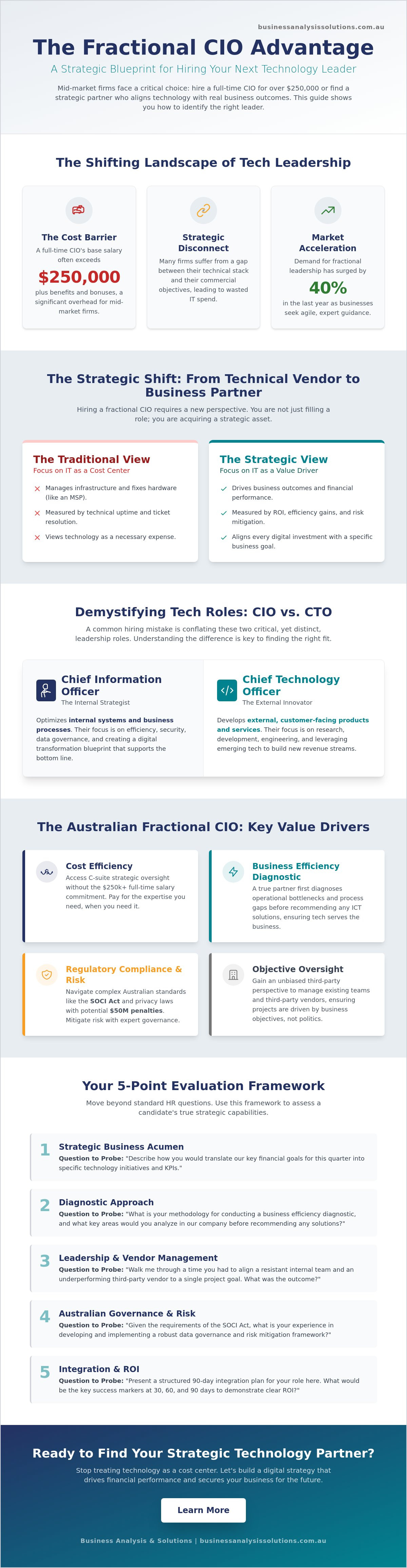
Hiring a full-time CIO often requires a base salary exceeding $250,000, yet many mid-market firms still struggle with a disconnect between their technical stack and their commercial objectives. With the demand for fractional leadership rising by 40% over the last year, the primary challenge isn't finding an expert; it's identifying a partner who prioritizes business outcomes over technical uptime. You likely wonder if a candidate truly understands your operational reality or if they're simply another high-priced consultant. Knowing the right questions to ask a fractional CIO is the only way to ensure your technology investments drive measurable ROI rather than becoming a sunk cost.
You've likely felt the frustration of IT initiatives that fail to align with your strategic goals or the fear of being locked into a rigid contract that lacks scalability. We've developed this guide to help you master the selection process and bridge the gap between technical requirements and organizational harmony. You'll find a comprehensive framework of twenty-one strategic, technical, and operational inquiries designed to reveal a candidate's ability to navigate complex Australian regulations like the SOCI Act and deliver a clear digital transformation blueprint.
Key Takeaways
Learn why traditional HR queries fail and how to identify a leader who treats technology as a primary driver of financial performance.
Master the specific questions to ask a fractional CIO to determine if they can perform a deep business efficiency diagnostic before recommending any ICT solutions.
Evaluate a candidate's ability to manage existing teams and third-party vendors through a lens of operational harmony and objective project management.
Ensure compliance with evolving Australian standards like the SOCI Act by probing their experience with complex data governance and risk mitigation.
Establish a structured 90-day integration plan that uses clear success markers to bridge the gap between technical requirements and organizational goals.
Table of Contents
The Strategic Shift: Why Interviewing a Fractional CIO Requires a Different Lens
Strategic Alignment: Questions to Assess Business and ICT Integration
Operational Excellence: Probing Technical Leadership and Execution
Risk, Security, and Governance: Evaluating Compliance in Australia
The Engagement Model: Ensuring Long-Term Value and Integration
The Strategic Shift: Why Interviewing a Fractional CIO Requires a Different Lens
The executive hiring landscape changed significantly by 2026. Companies no longer look for technical managers; they seek business leaders who happen to possess deep technical expertise. To capitalize on this, you must view a candidate as a strategic partner rather than a technical vendor. Understanding What is a Fractional CIO? is the first step in shifting your evaluation criteria. Unlike a managed IT service provider who maintains infrastructure and fixes hardware, a fractional CIO integrates with your leadership team to drive long-term business outcomes and financial performance.
Standard HR interview questions frequently fail in this context. They tend to probe for past task completion or specific software certifications instead of forward-looking strategic alignment. When determining the right questions to ask a fractional CIO, you must look for evidence of high-level problem solving and financial literacy. A seasoned expert doesn't just manage systems; they orchestrate organizational harmony by aligning every digital investment with a specific business goal. Preparing a structured list of questions to ask a fractional CIO ensures you move beyond surface-level technical talk to uncover true leadership potential.
The 2026 market context demands this shift. As the "AI Premium" continues to drive up full-time executive salaries, on-demand leadership has become the new standard for operational efficiency. This model allows mid-market firms to access the same caliber of strategic oversight as enterprise competitors without the rigid commitment of a traditional C-suite contract.
CIO vs. CTO: Understanding the Distinction
A common mistake in the hiring process is conflating the Chief Information Officer with a Chief Technology Officer. While a CTO focuses on developing external products and customer-facing technology, a CIO optimizes internal systems and business strategy. Asking a potential CIO about their coding abilities is a tactical error. Their value lies in their mastery of ICT project management and their ability to translate complex technical requirements into a clear digital transformation blueprint that supports your bottom line.
The Value of Fractional Leadership in the Australian Market
The Australian business environment currently faces unprecedented regulatory pressure, from the Security of Critical Infrastructure (SOCI) Act to updated privacy laws carrying penalties of up to $50 million. Navigating these complexities requires executive-level oversight that many firms cannot afford on a full-time basis. Fractional leadership provides a solution by offering objective, third-party perspectives without the $250,000+ overhead of a permanent hire. This model prioritizes business efficiency as the primary KPI, allowing leaders to access specialized expertise in process mapping and digital strategy to ensure the organization remains agile and compliant.
Strategic Alignment: Questions to Assess Business and ICT Integration
A strategic partner must demonstrate the ability to translate technical jargon into boardroom-level business strategy. When finalizing your questions to ask a fractional CIO, prioritize those that expose their understanding of your specific revenue drivers. A true leader won't simply manage your stack; they'll optimize it to enhance financial performance. This requires a shift from viewing IT as an isolated department to seeing it as a core component of your organizational coordination. Incorporating specific strategic alignment questions into your interview process will reveal whether a candidate views technology as a cost center or a value driver.
Before recommending any new technology, an expert should perform a thorough business efficiency diagnostic. This methodical approach ensures that existing bottlenecks are identified and resolved through process refinement rather than just adding more software. You need a partner who values precision and understands that technical solutions must serve the broader business objectives. If a candidate suggests immediate technical overhauls without a diagnostic phase, they likely lack the strategic maturity required for executive leadership.
Bridging the Gap Between Tech and Profit
Success in 2026 is measured by how effectively technology fuels the bottom line. Use these questions to probe their commercial acumen:
"How do you ensure IT initiatives directly support our current revenue drivers?" Look for answers that link system performance to customer acquisition or operational throughput.
"Can you provide an example of a digital transformation blueprint you created that failed and why?" Maturity is found in the ability to analyze failure. A seasoned CIO will discuss misalignments in culture or timing rather than blaming the technology itself.
The most valuable fractional CIOs are those who aren't afraid to say "no" to unnecessary technology that adds complexity without tangible value. Their role is to protect your ICT budget from bloated "flavor-of-the-month" solutions that don't drive ROI.
Evaluating Strategic Maturity
To achieve operational excellence, your fractional leader must understand how to scale efficiency through automation and process mapping. Consider these inquiries:
"How do you identify which manual processes are ripe for automation implementation?" The answer should focus on high-frequency, low-variance tasks that currently drain human resources.
"What is your methodology for assessing the strategic value of existing ICT solutions?" They should describe a logical framework for auditing your current systems against your five-year growth plan.
By focusing on these questions to ask a fractional CIO, you ensure your hire is an analytical collaborator capable of delivering end-to-end results. If you need assistance identifying these internal gaps, our team can provide a professional efficiency assessment to guide your strategic planning.
Operational Excellence: Probing Technical Leadership and Execution
Strategic vision requires a robust execution framework to deliver tangible results. While the previous section focused on alignment, this phase of your interview process should evaluate a candidate's ability to drive operational excellence. You need to identify if they can maintain system harmony while managing the day-to-day complexities of business technology. When considering specific questions to ask a fractional CIO, focus on their ability to lead transition periods without disrupting core business functions. A leader who lacks operational discipline will struggle to turn a digital transformation blueprint into a functional reality.
Vendor Management and ICT Governance
Your fractional CIO acts as an objective advocate for your business interests. They must manage existing IT teams and third-party vendors with a focus on accountability and performance. Ask: 'How do you manage relationships with our existing managed service providers (MSPs)?' Their response should highlight a structured approach to SLA monitoring and service quality rather than mere technical oversight. They shouldn't just be a point of contact; they should be a filter that ensures technical tasks align with strategic priorities.
Additionally, ask: 'What criteria do you use to select new software vendors to ensure long-term scalability?' A qualified candidate prioritizes vendor-neutral decision-making to prevent expensive vendor lock-in. They should evaluate vendors based on integration capabilities, data portability, and the total cost of ownership over a three to five-year horizon. This level of ICT governance protects the organization from fragmented systems that create data silos and operational friction. It's about building a stack that's flexible enough to evolve with your business.
Driving Efficiency Through Process Mapping
Efficiency isn't achieved through software alone; it requires a deep understanding of organizational coordination. This is where process mapping becomes essential to the CIO remit. Ask: 'How does process mapping inform your technology recommendations?' This question reveals if the candidate understands the logical flow of your operations before suggesting technical interventions. It's about ensuring the technology fits the process, not forcing the process to fit the technology.
They should also be prepared for the human element of technical change. Ask: 'How do you handle resistance from staff when implementing new automation solutions?' A people-centric approach ensures that new systems are adopted rather than bypassed. The candidate must demonstrate how they bridge the gap between technical requirements and the end-user experience. By focusing on these questions to ask a fractional CIO, you ensure your hire can deliver end-to-end results that maintain operational stability while driving progress.
Risk, Security, and Governance: Evaluating Compliance in Australia
Technical risk has evolved into a primary board-level liability within the Australian regulatory environment. Serious or repeated privacy breaches can now result in penalties of up to $50 million, or 30% of adjusted turnover. This shift makes the governance aspect of the role just as critical as the strategic one. When developing your questions to ask a fractional CIO, you must evaluate their ability to navigate these specific legal frameworks while maintaining operational momentum. A leader who cannot articulate technical risk in terms of financial impact is a liability to the organization. They must bridge the gap between complex cybersecurity requirements and the need for a clear roadmap for digital transformation.
Your fractional leader should possess the calm assurance required to manage high-pressure compliance audits or potential data breaches. They shouldn't just describe security tools; they should provide a structured approach to risk mitigation that aligns with international standards and local laws. This includes a deep understanding of the Security of Critical Infrastructure (SOCI) Act, which requires entities in 11 critical sectors to report cybersecurity incidents within 12 hours. Ensuring your candidate has a proven track record in these areas is a non-negotiable part of the selection process.
The Essential 8 and Cybersecurity
The Australian Signals Directorate’s Essential 8 framework serves as the baseline for cybersecurity in the region. Ask: "What is your experience implementing the Essential 8 framework for Australian businesses?" The response should demonstrate a pragmatic understanding of how to reach maturity levels without stifling productivity. They must also explain how they balance stringent security protocols with operational ease of use. Security that is too rigid often leads to "shadow IT," where employees bypass systems to get work done, creating even greater risk. A seasoned expert knows that system harmony is only possible when security and usability coexist.
Data Sovereignty and Compliance
Cloud computing strategy must be viewed through the lens of data sovereignty and privacy regulations. Ask: "How do you ensure our cloud computing strategy complies with Australian data privacy regulations?" Their process for auditing your current security posture should be methodical and objective. They should also be prepared for the Cyber Security Rules for Smart Devices 2025, which mandate unique passwords and defined security update periods for consumer devices. If you require an objective review of your current risk profile, you can book a fractional CIO consultation to secure your digital assets and ensure long-term compliance.
The Engagement Model: Ensuring Long-Term Value and Integration
The final stage of the selection process focuses on the practical mechanics of the partnership. Moving from a preliminary business efficiency diagnostic into a formal Fractional CIO service requires a clear understanding of logistics and communication cadence. You must define exactly how the leader integrates with your current team to ensure long-term value. When refining your final list of questions to ask a fractional CIO, prioritize inquiries about knowledge transfer and the eventual transition to an internal hire as your organization scales. A successful engagement isn't just about solving immediate problems; it's about building a sustainable foundation for future growth.
Clarity regarding hours, availability, and reporting structures prevents the ambiguity that often leads to wasted investment. You need a partner who values precision and understands that their role is to provide executive-level oversight, not just part-time technical support. This involves setting clear expectations for how they will interact with your board and your operational staff. A structured engagement model ensures that every hour of their time translates into progress toward your strategic objectives.
The First 90 Days: A Roadmap for Success
Onboarding an executive leader should follow a logical, methodical sequence. Ask: "What would your first 30, 60, and 90 days look like in this organisation?" Their response should move from an initial discovery and audit phase toward the delivery of a digital transformation blueprint. They must demonstrate an ability to identify quick wins that improve operational efficiency while simultaneously planning long-term system harmony. Additionally, ask: "How do you document your strategic decisions to ensure continuity if you leave?" This question tests their commitment to your organization's long-term health. You don't want to be left with a proprietary system that only one person understands.
Measuring ROI on Fractional Leadership
Success must be quantifiable to justify the investment. Ask: "What specific metrics do you use to prove your value to the board?" Look for answers that focus on financial performance, such as reduced ICT overhead, improved project delivery timelines, or mitigated risk profiles. A qualified candidate will also explain how they handle the balance between high-level strategy and granular technical issues. They shouldn't be bogged down in daily troubleshooting; their focus must remain on bridging the gap between tech and profit. By asking these questions to ask a fractional CIO, you ensure your hire delivers a measurable return on investment. If you're ready to secure expert leadership for your next phase of growth, Book a consultation with Business Analysis & Solutions to see how our fractional CIO services drive measurable efficiency.
Securing the Future of Your Executive IT Leadership
Securing a fractional leader requires moving beyond technical checklists to find a strategic partner who prioritizes business outcomes. You now possess a methodical framework to evaluate candidates on their ability to drive operational efficiency and bridge the gap between technical requirements and organizational goals. By identifying the right questions to ask a fractional CIO, you ensure your next executive hire understands the nuances of the Australian regulatory environment, including the Essential 8 framework and data privacy laws. This structured approach mitigates the risk of wasted investment and ensures long-term system harmony.
At Business Analysis & Solutions, we bring over 20 years of strategic ICT experience to every engagement. We specialize in developing digital transformation blueprints that deliver measurable financial performance and clear roadmaps for growth. Our expertise in Australian compliance ensures your organization remains secure and resilient in an increasingly complex digital landscape. It's time to transform your technology from a cost center into a primary driver of profit. Optimise Your ICT Strategy with a Fractional CIO today to achieve the clarity and direction your business deserves.
Frequently Asked Questions
What is the primary difference between an IT consultant and a Fractional CIO?
An IT consultant typically focuses on solving a specific technical problem or implementing a single project. In contrast, a fractional CIO functions as a strategic member of your leadership team. They prioritize long term business outcomes and organizational coordination rather than just technical execution. This role ensures that every digital investment aligns with your broader financial objectives and operational goals.
How many hours a week does a Fractional CIO typically work?
The time commitment varies based on your organization's specific requirements and the complexity of your systems. Most engagements range from a few hours per week for advisory oversight to ten or more hours for deeply embedded leadership. This flexibility allows you to scale executive involvement as your digital transformation blueprint evolves without the overhead of a full time salary.
Can a Fractional CIO help with our cybersecurity compliance?
Cybersecurity governance is a core component of the fractional CIO remit. They provide expert oversight to ensure compliance with Australian regulations such as the SOCI Act and the Essential 8 framework. By integrating security into your overall digital strategy, they protect your organization from data breaches and the significant financial penalties associated with privacy law violations.
What should I expect to pay for Fractional CIO services in Australia?
Pricing for these services is typically structured as a monthly retainer based on the level of strategic involvement required. While market rates fluctuate, the cost remains significantly lower than the $250,000+ base salary of a permanent executive hire. This model provides mid-market firms with high level expertise while maintaining predictable operational expenses and avoiding rigid employment contracts.
How do I know if my business is large enough to need a Fractional CIO?
Complexity and strategic need often matter more than head count or revenue. If you find a disconnect between your technology stack and your business goals, you likely need executive oversight. Identifying the right questions to ask a fractional CIO helps determine if your current challenges require this level of analytical collaboration to achieve operational excellence and sustainable growth.
Will a Fractional CIO manage my existing IT team?
A fractional CIO provides strategic direction and governance for both internal IT staff and third party vendors like MSPs. They don't replace your technical team; they empower them by providing clear priorities and objective leadership. This ensures that your technical resources focus on tasks that drive measurable ROI and maintain system harmony across the organization.
How does a Fractional CIO handle vendor relationships?
They act as an objective advocate for your business during vendor negotiations and selection processes. By maintaining a vendor-neutral stance, they prevent expensive lock-in and ensure that software choices support long term scalability. Their role is to verify that every vendor delivers tangible value that justifies its place in your ICT budget and digital roadmap.
What happens if we need to transition to a full-time CIO later?
The fractional model is designed to be flexible and often serves as a bridge to a permanent hire. Your fractional leader will document all strategic decisions and processes to ensure a seamless knowledge transfer when the time comes. They can even assist in the recruitment and onboarding process for your full time executive when the organization reaches that stage of maturity.


Comments