Fractional CIO Pricing in Australia: The 2026 Strategic Investment Guide
What if the most significant drain on your annual budget isn't your software stack, but the missed opportunities caused by a lack of high-level technical leadership? Many Australian boards find themselves caught in a cycle of rising cybersecurity insurance premiums and stalled digital transformation projects. It's a common challenge where technical spend doesn't align with broader business objectives. Understanding fractional CIO pricing Australia requires a shift in perspective, moving away from buying hours and toward securing specific organizational outcomes.
You likely recognize that a traditional full-time CIO, with a total employment cost often exceeding $340,000, is an inefficient allocation of capital for many mid-market firms. This guide provides the clarity you need to evaluate fractional models, from advisory retainers to intensive leadership roles. You'll gain a structured framework to justify the spend to your board and the confidence to select a partner who takes ownership of your ICT results. We'll analyze the current market landscape for 2026 and detail how to bridge the gap between technical requirements and financial performance through methodical process management.
Table of Contents
The Economics of Executive IT Leadership in Australia
The role of the Chief Information Officer has evolved from a back-office technical function into a primary driver of organizational value. In the current 2026 market, senior ICT leadership is a scarce resource. This scarcity is driven by the increasing complexity of digital transformation and the sophisticated nature of modern cybersecurity threats. Many mid-market organizations find themselves at a crossroads; they require high-level strategic direction but cannot justify the fiscal weight of a full-time executive. This is where the concept of a Fractional CIO becomes a strategic necessity. Unlike a generalist IT manager who focuses on tactical maintenance, a fractional leader acts as a mandate-holder. They take ownership of technology outcomes and ensure every dollar of ICT spend directly supports the broader business objectives.
Adopting a fractional model allows businesses to access C-suite expertise without the long-term liability of a permanent hire. It's a pragmatic solution for companies that have outgrown their current technical structures but aren't yet ready to support a full-time executive salary. When evaluating fractional CIO pricing Australia, it's essential to view the engagement as a strategic arbitrage. You are essentially buying the outcomes of a seasoned expert while only paying for the specific capacity your organization requires. This approach mitigates the risk of technical debt and ensures that your systems remain in harmony with your growth trajectory.
The Full-Time CIO Salary Gap
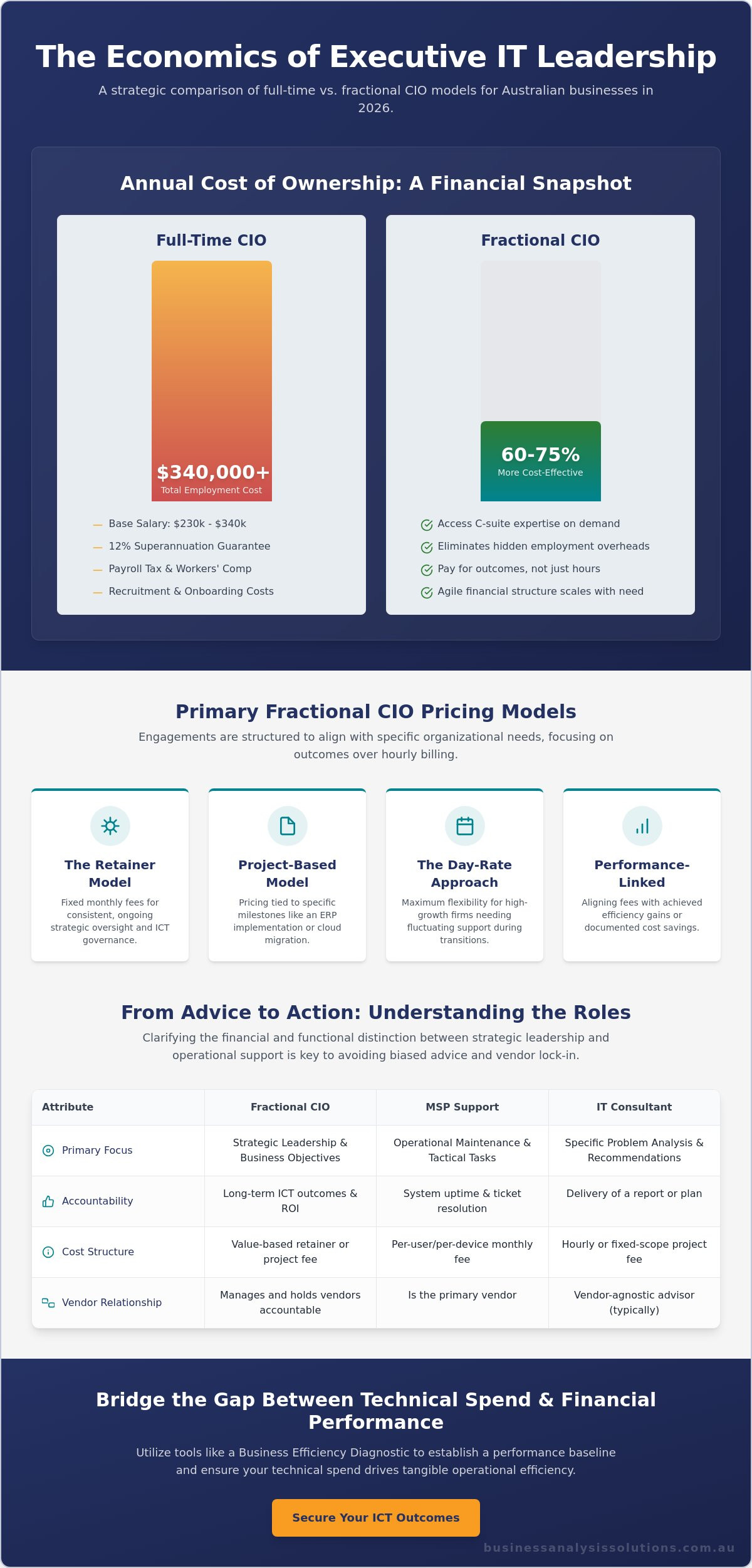
The total cost of employment for a full-time technology leader in Australia has reached unprecedented levels. Current 2026 data indicates that a qualified CIO often commands a base salary between $230,000 and $340,000. However, the base salary is only the starting point. When you factor in the 12% superannuation guarantee, payroll tax, workers' compensation, and recruitment fees, the true cost to the business typically escalates by 25% to 35%. For many organizations, this represents a significant overhead that drains capital away from core operational projects. A fractional engagement eliminates these hidden costs and provides a more agile financial structure, often proving to be 60% to 75% more cost-effective than a traditional hire.
Consultancy vs. Fractional Leadership
There's a fundamental distinction between hiring a consultant and engaging a fractional CIO. Consultants typically provide one-off advice and deliver comprehensive reports that may or may not be implemented. Fractional leadership is centered on execution and ongoing accountability. While fractional CIO pricing Australia reflects a commitment to long-term results, consultancy fees are often tied to short-term deliverables without the burden of ownership. A fractional leader doesn't just identify what needs to change; they manage the transition, oversee vendors, and ensure that digital strategy translates into tangible operational efficiency. This transition from "advice" to "action" is what ultimately drives a superior return on investment for the organization.
Primary Pricing Models for Fractional CIO Services
Structuring a fractional engagement requires a move away from hourly billing toward a model that reflects the strategic weight of the role. In the Australian market, fractional CIO pricing Australia generally falls into four distinct categories, each designed to address specific organizational maturity levels and technical requirements. Selecting the correct model ensures that the partnership remains focused on high-level outcomes rather than administrative task completion. These models provide the flexibility to scale leadership capacity as the business evolves.
The Retainer Model: Fixed monthly fees for consistent, ongoing strategic oversight and ICT governance.
The Project-Based Model: Pricing tied to specific milestones, such as an ERP implementation or a complex cloud migration.
The Day-Rate Approach: Provides maximum flexibility for high-growth firms that need fluctuating levels of support during transition periods.
The Performance-Linked Model: Aligning a portion of the fees with achieved business efficiency gains or documented cost savings.
Securing the right model starts with a clear understanding of your current technical state, which is why many leaders begin with fractional CIO services that prioritize diagnostic clarity. This ensures the engagement is built on a foundation of logic and measurable performance.
The Monthly Retainer Structure
A monthly retainer provides the consistency required for long-term strategic alignment. Most engagements involve a set cadence, such as one day per week or two days per month, depending on the complexity of the technical environment. This structure allows for predictable budgeting and ensures that a senior leader is always available for critical decision-making or board-level reporting. It shifts the focus from reactive troubleshooting to proactive system harmony, ensuring that ICT spend remains disciplined and effective.
Value-Based Pricing for Strategic Projects
Organizations facing a major shift often prefer project-based pricing. This model ties fees to the successful delivery of specific technical objectives rather than time spent on site. Utilizing a Digital Transformation Blueprint allows both parties to define a rigid scope before the engagement begins. This upfront clarity prevents scope creep and ensures that the investment is directly proportional to the risk and potential impact of the transformation. By focusing on outcomes, businesses avoid the common pitfall of paying for activity that does not drive tangible value.
High-growth firms often favor the day-rate approach for its inherent flexibility. It allows them to scale leadership up or down as capital rounds or market conditions shift. Alternatively, some mature organizations explore performance-linked models. These align incentives by ensuring the consultant's compensation reflects the actual improvements in financial performance or operational efficiency they deliver to the firm. This level of accountability is a hallmark of professional fractional leadership.
Fractional CIO vs. Managed IT Services: A Financial Comparison
Distinguishing between operational maintenance and strategic leadership is critical for accurate budgeting. A Managed Service Provider (MSP) excels at "keeping the lights on"—managing helpdesks, patching servers, and ensuring uptime. However, their business model is built on technical stability, not necessarily business transformation. When organizations ask an MSP for strategy, they often receive a roadmap that prioritizes the provider's existing toolsets. This creates a financial bias that can skew fractional CIO pricing Australia by embedding hidden costs in vendor-specific solutions that may not be the most efficient for your specific needs.
The belief that an internal IT Manager can fulfill the CIO role is a common misconception in the mid-market. An IT Manager is typically focused on the "how" of technology, while a CIO focuses on the "why" and the "how much." A fractional CIO brings a level of commercial acumen that allows them to translate technical debt into financial risk. By managing the MSP relationship with professional distance, they hold providers accountable to business-centric outcomes rather than just technical uptime. This shift in governance ensures that your external partners deliver maximum value for every dollar spent. It's about moving from a reactive cost center to a proactive strategic asset.
The Independence Premium
An agnostic CIO delivers immediate financial value by auditing existing vendor contracts and ICT procurement processes. They identify "zombie infrastructure"—redundant cloud subscriptions or legacy systems that consume budget without providing utility. By removing reseller-driven bias, a fractional leader ensures technology selection is based on functional requirements rather than commission structures. This independent oversight often uncovers enough cloud leakage and licensing waste to offset the fractional CIO pricing Australia investment within the first six months of the engagement.
Strategic Alignment and Efficiency
True value is realized through business efficiency gained from methodical process mapping and system harmony. A fractional CIO ensures every technical investment directly supports revenue drivers. By consolidating disparate systems and implementing automation, they reduce the total ICT spend while increasing output. This methodical approach transforms IT into a lean, performance-driven asset that scales predictably with the organization's growth. It ensures that technical requirements never outpace the broader business objectives, maintaining a logical path to profitability.
Key Factors Influencing Your Fractional CIO Retainer
Several organizational variables dictate the final structure of your technical leadership investment. While the pricing models discussed previously offer a logical framework, the specific fractional CIO pricing Australia for your firm will be influenced by four primary drivers: complexity, compliance, ambition, and reporting depth. A multi-entity organization with a geographic spread across several states requires a higher level of operational coordination than a single-site business. This increased coordination load directly impacts the time and expertise required to maintain system harmony and ensure that ICT spend remains disciplined across all divisions.
Your organization's strategic ambition also plays a decisive role in determining the retainer's weight. A mandate focused on stabilization—fixing technical debt and securing existing infrastructure—follows a different financial logic than a mandate for aggressive digital transformation. If your goal is to disrupt your market through automation and advanced data analytics, the leadership requirement shifts from oversight to active innovation. Similarly, the frequency and depth of board-level reporting influence the engagement. High-growth firms often require more granular ICT governance and frequent reporting to satisfy investor requirements or internal performance benchmarks.
If you're ready to define a mandate that aligns with your specific organizational goals, exploring our fractional CIO services is a logical next step to ensure your technical strategy matches your business trajectory.
Regulatory Compliance and Governance
Firms operating within regulated sectors like healthcare, finance, or legal services inherently face a more rigorous leadership requirement. The implementation of the Essential 8 cybersecurity framework, for instance, isn't just a technical task; it's a governance mandate that requires ongoing executive oversight to meet Australian standards. This regulatory load increases the complexity of the CIO's role, as they must ensure every technical decision aligns with evolving privacy laws. High-level technical governance reduces the long-term costs of insurance premiums and potential audit failures, providing a clear financial justification for a more intensive strategic retainer.
The Scope of the ICT Ecosystem
The nature of your existing technical stack significantly impacts the fractional workload. Managing a modern, cloud-native environment typically requires less "technical rescue" than an ecosystem burdened by legacy on-premise systems that require careful migration. The complexity of your ERP and CRM integrations also determines the depth of the engagement; these core systems must be perfectly aligned with your business processes to drive efficiency. As these systems expand, the need for expert project management increases to ensure that large-scale transformations remain on schedule and deliver the intended operational outcomes without disrupting daily performance.
Maximising ROI with Business Analysis & Solutions
Transitioning from an analysis of fractional CIO pricing Australia to the actual realization of value requires a focus on operational discipline. Our fractional CIO services integrate directly with your broader business objectives, ensuring that technical investments aren't isolated from your financial goals. We prioritize process mapping and automation implementation to drive tangible outcomes that improve the bottom line. By bridging the gap between technical requirements and executive strategy, we transform the IT function from a reactive support unit into a strategic performance driver.
Effective technical leadership isn't about maintaining the status quo; it's about optimizing every component of your organizational coordination. We focus on creating system harmony where technology serves the business, rather than the business serving the technology. This methodical approach ensures that every dollar allocated to ICT is justified by a corresponding increase in operational efficiency or risk mitigation. It moves the conversation from "what does it cost" to "what value does it create."
The Efficiency Diagnostic Entry Point
We initiate every engagement with a Business Efficiency Diagnostic to establish a clear performance baseline. This assessment identifies immediate cost-saving opportunities, such as redundant software licenses or inefficient manual workflows that drain productivity. By conducting a formal assessment at the outset, we reduce the long-term cost of the fractional engagement. It allows us to move from diagnostic findings to a permanent strategic roadmap with precision, ensuring that subsequent work focuses only on high-impact areas that deliver the greatest return on investment.
Building Your Digital Transformation Blueprint
Once the baseline is established, we develop a structured Digital Transformation Blueprint. This multi-year plan justifies every technical expenditure by linking it to specific business outcomes, ensuring your technology stack remains an asset rather than a liability. It provides the board with a logical framework for future investment, removing the ambiguity often associated with technical spend. To begin defining your strategic technology roadmap and securing the leadership your organization requires, the next step is to book a consultation with our senior advisory team.
Securing Your Strategic Technical Mandate
Understanding fractional CIO pricing Australia is a critical step toward aligning your technology spend with your broader business goals. By prioritizing independent leadership over vendor-biased advice, you ensure that every technical decision is rooted in logic and measurable performance. We've detailed how moving from a reactive cost-center to a proactive strategic asset requires a methodical approach, often starting with a clear Business Efficiency Diagnostic to identify immediate gains.
Our team brings over 20 years of strategic ICT experience to every engagement, offering an agnostic perspective that focuses solely on your organizational outcomes. We don't just provide reports; we deliver execution through a structured Digital Transformation Blueprint. This ensures your systems remain in harmony with your growth trajectory while mitigating the risks of technical debt. Take the next step toward a more efficient technical future and Request a Fractional CIO Consultation today. We're ready to help you build a resilient, high-performing organization.
Frequently Asked Questions
How much does a fractional CIO cost per month in Australia?
Monthly costs for executive technical leadership depend on your organization's complexity and the required leadership cadence. While industry benchmarks for retainers and daily rates vary, the total investment is structured around the specific mandate and desired outcomes. This model allows mid-market firms to access C-suite expertise at a significant discount compared to the total employment cost of a full-time executive, which often exceeds $340,000 annually.
What is the difference between an IT consultant and a fractional CIO?
An IT consultant typically delivers a specific report or recommendation, while a fractional CIO takes ongoing accountability for technical outcomes. Consultants are usually engaged for a fixed-term project with a narrow scope. In contrast, a fractional leader acts as a member of your executive team, bridging the gap between technical requirements and broader organizational objectives through consistent governance and execution.
Does a fractional CIO replace my existing IT team or MSP?
A fractional CIO doesn't replace your operational team; instead, they provide the strategic leadership to manage them more effectively. They act as a sophisticated layer of governance that holds your MSP or internal team accountable to business-centric KPIs. This ensures that technical staff focus on tactical stability while the CIO ensures those efforts align with the long-term financial performance of the firm.
What is the minimum engagement period for a fractional CIO?
Most strategic engagements in the Australian market last between 6 and 18 months to ensure meaningful transformation. While short-term project work is possible, achieving system harmony and implementing a Digital Transformation Blueprint requires a sustained commitment. This duration allows the fractional leader to stabilize the environment, optimize processes, and embed a culture of technical discipline before potentially transitioning to a lighter advisory role.
Can a fractional CIO help with Essential 8 compliance?
Yes, implementing the Essential 8 cybersecurity framework is a core responsibility for a fractional leader. They provide the executive oversight required to move beyond basic technical controls and into a mature governance model. By managing the roadmap to compliance, they help reduce the risk of audit failures and can lead to more favorable terms for cybersecurity insurance premiums, which are a rising concern for Australian boards.
How do I know if my business is ready for a fractional CIO?
Your business is likely ready if you're experiencing stalled digital projects or a lack of alignment between IT spend and business goals. When technical debt begins to hinder operational efficiency, or when you face complex regulatory pressures without a senior technical voice at the table, a fractional mandate becomes necessary. It's an ideal solution for firms that have outgrown their IT Manager but don't yet require a full-time executive.
Is the cost of a fractional CIO tax-deductible for Australian businesses?
Generally, professional fees paid for contracted executive services are treated as deductible business expenses under Australian tax law. Since fractional leaders are engaged as independent professionals rather than employees, the business also avoids liabilities like the 12% superannuation guarantee and payroll tax. It's essential to consult with a qualified tax professional to confirm how fractional CIO pricing Australia applies to your specific corporate structure.
What industries benefit most from fractional IT leadership?
Regulated industries such as finance, healthcare, and professional services see significant value due to high compliance and data security requirements. However, any mid-market organization undergoing rapid growth or digital transformation will benefit from this model. By optimizing technical leadership across sectors like manufacturing or e-commerce, businesses can ensure their technology stack remains a competitive asset rather than a financial liability.



Comments