Process Improvement Consultant Australia: Strategic Efficiency in 2026
Updated: Jul 13
50% of Australian industry leaders have identified process improvement as their top priority for 2026, yet many organizations remain trapped by fragmented workflows that accumulate process debt. You likely recognize the frustration of implementing new technology that fails to deliver its expected ROI or struggling to map complex functions across different departments. Engaging a strategic process improvement consultant Australia is the most effective way to move beyond these isolated fixes toward a high-performance system. It's a logical step for leaders who value precision and want to ensure their operations are resilient enough to handle new pressures like Payday Super and updated ISO standards.
We agree that managing a growing business shouldn't feel like a constant battle against your own internal systems. This article promises to show you how a methodical approach to operational design can transform disjointed tasks into a clear roadmap for scaling. We will preview the essential steps to reduce waste, increase profit margins, and finally achieve a state of harmony between your people, processes, and technology. This is about more than just efficiency; it's about engineering a business that performs with quiet, reliable confidence.
Table of Contents
What is a Process Improvement Consultant in the Australian Context?
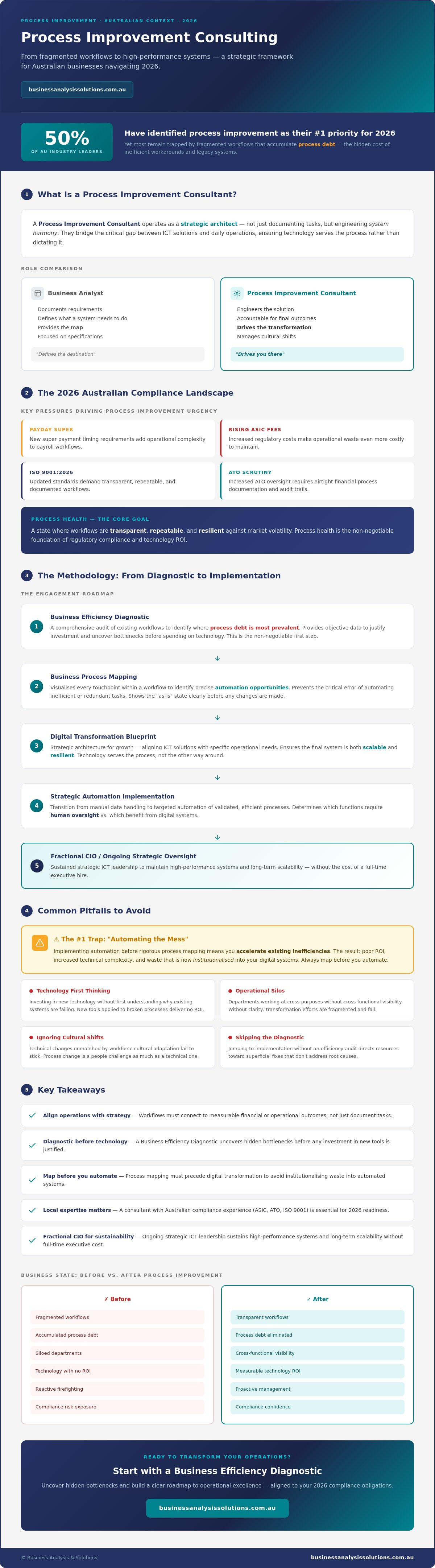
A process improvement consultant Australia operates as a strategic architect, moving beyond tactical fixes to align operational workflows with long-term organizational objectives. While general management consulting often focuses on high-level strategy and market positioning, process improvement is deeply rooted in the mechanics of how work actually happens. It is the discipline of engineering system harmony. As we navigate the economic pressures of 2026, including rising ASIC fees and the transition to Payday Super, the role has evolved. It's no longer enough to simply document a task; a consultant must ensure that every action contributes to a measurable financial or operational outcome.
Modern consultants bridge the critical gap between ICT solutions and daily operations. They utilize the principles of Business Process Management to create a unified framework where technology serves the process, rather than dictating it. This approach prioritizes "process health," a state where workflows are transparent, repeatable, and resilient against market volatility. By focusing on the structural integrity of an organization, these specialists prepare businesses for the rigorous demands of the updated ISO 9001:2026 standards and the increasing scrutiny of the ATO.
The Core Objectives of Process Optimisation
The primary goal is the identification and elimination of "process debt." This refers to the accumulated cost of inefficient workarounds and legacy systems that drain resources. A process improvement consultant Australia works to dismantle operational silos, providing cross-functional visibility that ensures departments aren't working at cross-purposes. This clarity is a non-negotiable foundation for any successful technology adoption. Without it, automation merely accelerates existing inefficiencies, leading to a poor return on investment and increased technical complexity.
Process Specialist vs. Business Analyst: Knowing the Difference
Distinguishing between these roles is essential for leadership teams. A business analyst is primarily focused on documenting requirements and defining what a system needs to do. In contrast, a process improvement consultant engineers the solution itself. They take accountability for the final outcome, ensuring that technical changes are matched by necessary cultural shifts within the workforce. While a business analyst provides the map, the consultant drives the transformation, ensuring that the organization moves from fragmented tasks to a high-performance system that supports sustainable scaling.
The Methodology: From Diagnostic to Implementation
Operational excellence is not a byproduct of chance; it's the result of a deliberate, step-by-step methodology. An experienced process improvement consultant Australia initiates every project with a rigorous evaluation phase rather than jumping straight into implementation. This structured approach ensures that resources are directed toward the areas of highest impact, rather than chasing superficial fixes that fail to address root causes. By following a proven engagement roadmap, businesses can move from a state of reactive firefighting to proactive management.
The Business Efficiency Diagnostic represents the non-negotiable first step in this journey. By conducting a comprehensive audit of existing workflows, a consultant identifies where process debt is most prevalent. This diagnostic provides the objective data required to justify further investment and sets the stage for a Digital Transformation Blueprint. This blueprint serves as the strategic architecture for growth, aligning ICT solutions with the specific operational needs of the business while ensuring that the final system is both scalable and resilient.
The Power of Process Mapping in 2026
Business process mapping is a tool for organisational clarity that visualises every touchpoint within a workflow. In 2026, detailed mapping has become essential for identifying precise automation opportunities. It prevents the common error of automating inefficient or redundant tasks, which only serves to institutionalise waste. By seeing the as-is state clearly, leaders can make informed decisions about which functions require human oversight and which can be transitioned to digital systems to handle the increased complexity of modern compliance.
Strategic Automation Implementation
Moving from manual data entry to intelligent, automated workflows requires more than just new software. It demands system harmony between existing ICT solutions and newly introduced tools. A process improvement consultant Australia ensures that these integrations are seamless, maintaining data integrity and cross-departmental visibility. Success is measured through specific efficiency KPIs, such as reduced cycle times or lower error rates, rather than just the successful installation of a program. This ensures that every technological investment delivers a tangible return to the bottom line.
Effective implementation also requires robust governance. To ensure new processes actually stick in the real world, a consultant establishes clear protocols and accountability structures. This methodical oversight prevents the organisation from sliding back into fragmented habits. If you are ready to identify the hidden bottlenecks in your operation, a Business Efficiency Diagnostic can provide the clarity needed to begin your transformation.
Evaluating a Process Improvement Consultant: A Selection Framework
Selecting a partner is a critical decision that determines the success of your operational scaling. Speed of hire is often prioritized over strategic alignment; however, a process improvement consultant Australia must possess a deep understanding of the local regulatory environment to be truly effective. In 2026, this includes navigating the complexities of the new AML/CTF reforms and the transition to Payday Super. A consultant who lacks this regional context risks designing systems that fail to meet compliance standards, leading to costly retrospective corrections.
When assessing a potential partner, look beyond simple documentation skills. True technical depth must be balanced with strategic breadth. The right consultant doesn't just map a process; they understand how that process interacts with your broader digital strategy and ICT infrastructure. This requires a proven track record in both project management and the implementation of complex systems. You need a collaborator who can speak the language of technical developers while translating those requirements into clear, logical outcomes for executive leadership.
Understanding the engagement model is equally important. While project-based models are ideal for discrete transformations like a Business Efficiency Diagnostic, fractional advisory roles provide ongoing strategic oversight. This approach allows businesses to access high-level expertise without the overhead of a full-time executive, ensuring that new processes remain aligned with evolving organizational goals. It's a pragmatic way to bridge the gap between technical requirements and financial performance.
Key Criteria for Australian Business Leaders
Effective consultants demonstrate a methodical approach to change. They don't offer generic advice; they provide a customized digital transformation blueprint for business that accounts for your specific industry nuances. The ability to bridge the gap between high-level vision and granular execution is what separates a strategic advisor from a temporary contractor. Look for evidence of established methodologies that have successfully moved other Australian organizations from fragmented workflows to high-performance systems.
The ROI of Expert Consultancy
The value of engaging a process improvement consultant Australia is often found in the cost of "doing nothing." Inefficient processes create a silent tax on your profit margins, draining resources through redundant tasks and failed technology ROI. An expert doesn't just fix a single problem; they build internal capability, leaving your team with the tools and governance structures needed to maintain efficiency long after the engagement ends. This shift from day-rate thinking to outcome-based value ensures that your investment delivers a permanent improvement in operational resilience and financial performance.
Common Pitfalls in Process Improvement and How to Avoid Them
Even the most ambitious transformation projects can falter if they aren't grounded in a disciplined, analytical framework. One of the most frequent errors is the attempt to "automate the mess." This occurs when an organisation invests in sophisticated software before fixing underlying workflow inefficiencies. Without the intervention of a process improvement consultant Australia to conduct thorough mapping first, technology merely accelerates existing waste. This leads to a poor return on investment and creates additional technical debt that becomes harder to resolve over time.
A second critical failure point is the lack of genuine executive buy-in. Process change is fundamentally a top-down initiative; it requires the authority of leadership to dismantle silos and enforce new standards across departments. When leadership views these projects as isolated ICT tasks rather than strategic imperatives, the initiative often loses momentum. Similarly, ignoring the human element can derail even the most logically sound system. Workforce resistance is a natural response to change. Managing this through transparent communication and inclusive design ensures that the people operating the processes are as invested in the outcome as the consultants themselves.
Ensuring Successful Project Management
Maintaining focus on value requires expert project management to prevent scope creep. In the complex environment of 2026, where regulatory requirements like mandatory climate disclosures are coming into effect, ICT projects must remain lean and targeted. Setting realistic, data-driven milestones allows for mid-project adjustments based on real-time insights. This keeps the transformation aligned with the original Digital Transformation Blueprint and ensures that every phase delivers a measurable improvement to operational resilience.
Avoiding the "Report in a Drawer" Syndrome
The most successful engagements move rapidly from theory to implementation. A common pitfall is treating the consultant's report as the final product rather than the beginning of the execution phase. To prevent this, a process improvement consultant Australia establishes clear ownership of new workflows post-consultancy. Building a culture of continuous improvement through internal training ensures that the organisation can sustain these gains. This methodical handover process is what transforms a temporary project into a permanent operational advantage. If you want to ensure your strategy leads to actual results, consider a structured Project Management engagement to drive your implementation forward.
Sustaining Efficiency: The Role of Strategic ICT Leadership
The completion of a transformation project marks a significant milestone, but it's not the conclusion of strategic oversight. In the dynamic Australian market of 2026, where 68% of businesses have already integrated AI into their operations, maintaining system harmony requires continuous adjustment. It's a mistake to view operational excellence as a destination. Instead, it's a continuous state of refinement. A process improvement consultant Australia provides the initial architecture for high performance, yet sustaining those gains requires a permanent bridge between daily operational efficiency and long-term ICT strategy.
Business Analysis & Solutions delivers end-to-end organisational harmony by ensuring that the logic of your workflows remains intact as your business grows. We understand that as market conditions shift, such as the 4.75% minimum wage increase effective July 2026, your processes must adapt to protect profit margins. This requires more than just technical maintenance; it demands a commitment to strategic leadership that views every technological change through the lens of process health. By maintaining this focus, you prevent the re-accumulation of process debt and ensure your systems remain scalable.
Fractional CIO: Executive Leadership Without the Overhead
We are seeing a significant rise in Fractional CIO services in Australia. This isn't merely a different contract type; it's a leadership solution designed for businesses that need high-level strategic direction without the financial burden of a full-time executive. A fractional leader provides the ongoing IT advisory needed to ensure your technology remains aligned with your optimized workflows. They manage your digital strategy as you scale, ensuring that every new tool or automation implementation serves the core objectives of the business rather than adding unnecessary complexity.
The Path Forward for Your Business
If your current workflows feel fragmented or your technology ROI is stagnant, the path forward starts with objective data. A process improvement consultant Australia can help you identify immediate gains through a Business Efficiency Diagnostic. This diagnostic serves as the foundation for a scalable operation, allowing you to build a resilient system for the remainder of 2026 and beyond. By engineering harmony between your people, processes, and technology, you create a business that is prepared for both current regulatory pressures and future growth opportunities. Contact Business Analysis & Solutions today for a strategic consultation to begin your transition from fragmented tasks to a high-performance system.
Securing Your Operational Future Through Precise Design
Transitioning from fragmented workflows to a high-performance system requires a methodical shift in how your organization views its internal mechanics. We've established that a diagnostic-first approach is essential to prevent the costly error of automating inefficient tasks. Aligning your operations with local Australian regulations like Payday Super and the updated ISO standards is no longer optional; it's a strategic necessity for 2026. By engineering harmony between your people, processes, and technology, you build a foundation that remains resilient against market volatility.
Engaging a process improvement consultant Australia ensures your digital transformation is grounded in logic rather than just software implementation. Business Analysis & Solutions provides over 20 years of industry experience, specializing in bridging the gap between technical ICT requirements and actual operational performance. Our boutique consultancy approach ensures you have direct access to senior experts who prioritize effective solutions over easy ones. Book a Business Efficiency Diagnostic with our expert consultants today to begin engineering your roadmap for sustainable scaling. Your path to operational excellence is a logical step toward lasting financial performance.
Frequently Asked Questions
What is the difference between a process improvement consultant and a business analyst?
A business analyst primarily focuses on documenting requirements and defining system needs; a process improvement consultant engineers the actual solution and takes accountability for the final outcome. While the analyst provides the map, the consultant drives the transformation. They bridge the gap between technical requirements and broader organizational objectives, ensuring that workflows are optimized before any system changes occur.
How much does a process improvement consultant cost in Australia?
Consultancy fees in Australia vary significantly based on the consultant's experience level and the engagement model. Specialist independent consultants typically charge based on the complexity of the project or through daily rates for strategic advisory. For business owners seeking one-on-one mentorship alongside operational changes, it can be helpful to find out more about Professional Coaching and Advisory Fees. Instead of focusing solely on the initial cost, leadership should evaluate the potential return on investment through reduced waste and protected profit margins.
How long does a typical process improvement engagement take?
The duration depends on the scope of the project, with a Business Efficiency Diagnostic typically taking a few weeks to complete. A full implementation and digital transformation can span several months as the organization moves through mapping, design, and governance phases. A structured approach ensures that each milestone delivers measurable value without causing unnecessary disruption to daily operations.
Should I fix my business processes before implementing a new ERP or CRM?
Yes, fixing processes before implementing new technology is a critical requirement to avoid the common pitfall of "automating the mess." Introducing an ERP or CRM into a fragmented workflow only serves to institutionalize existing inefficiencies and often leads to a failed technology ROI. A process improvement consultant Australia ensures that your workflows are lean and logical before any digital tools are integrated.
What industries benefit most from hiring a process improvement consultant?
Industries with complex cross-departmental functions or high regulatory scrutiny, such as manufacturing, professional services, and retail, see the most significant benefits. With the ATO increasing digital monitoring in 2026, businesses in construction and hospitality also require optimized record-keeping processes. Any organization facing rising operational costs or scaling challenges can use these services to build resilience.
Can a process improvement consultant help with business automation?
A consultant is essential for successful automation because they identify where technology can deliver the highest impact. They use process mapping to visualize current bottlenecks and then design a Digital Transformation Blueprint for implementation. This methodical approach ensures that automation serves the process, rather than creating new technical debt through poorly planned system integrations.
What is a Business Efficiency Diagnostic and why do I need one?
A Business Efficiency Diagnostic is a comprehensive audit of your existing workflows to identify where process debt is draining your resources. You need this diagnostic to provide the objective data required for strategic decision-making and to prioritize improvements. It acts as the non-negotiable first step that prevents investment in solutions that don't address your root organizational challenges.
How do you measure the ROI of a process improvement project?
ROI is measured through specific efficiency KPIs such as reduced cycle times, lower error rates, and increased profit margins. Beyond these financial metrics, success is also evident in improved system harmony and the reduction of unplanned downtime. A process improvement consultant Australia focuses on these tangible results to ensure that the project delivers long-term value and operational scalability.



The insights about the role of a process improvement consultant Australia reveal a necessity for a strategic approach amidst evolving challenges. Organizations must assess their operational workflows critically, as merely automating existing inefficiencies can exacerbate problems. Without this careful consideration, the promise of improved efficiency may become elusive, risking a situation where the concept https://www.bodyblueprint.co.nz/ fades under the weight of unresolved process debt.
The emphasis on process improvement is timely, especially for organizations grappling with fragmented workflows. The necessity for strategic alignment in operational processes becomes even clearer as businesses strive to meet regulatory demands. However, the reliance on a process improvement consultant Australia must be carefully considered; the real challenge lies in sustaining these improvements beyond initial engagements and ensuring that Speedau is effectively managed to prevent returning to inefficient practices.
The article raises important considerations about the role of a process improvement consultant Australia in today's business landscape. The focus on eliminating process debt and ensuring seamless integration of new technologies is crucial. However, the implications of relying solely on automation without addressing underlying inefficiencies could lead to greater challenges. The examination and their alignment with strategic objectives highlights the necessity for comprehensive process mapping to avoid pitfalls.
The discussion around process improvement is increasingly relevant as organizations face mounting operational complexities. A systematic approach is necessary to prevent the common pitfalls associated with fragmented workflows. Integrating technologies without addressing underlying issues often exacerbates inefficiencies, much like how The Pokies can distract from genuine strategic growth. Continuous evaluation can aid in sustaining improvements.
On examination, the interpretations show no exaggeration and remain grounded. Interpretations remain anchored in verifiable data. The website presents further background context on this topic. Contextual breadth is expanded through interactive service frameworks.