The Strategic Guide to Streamlining Business Processes in 2026
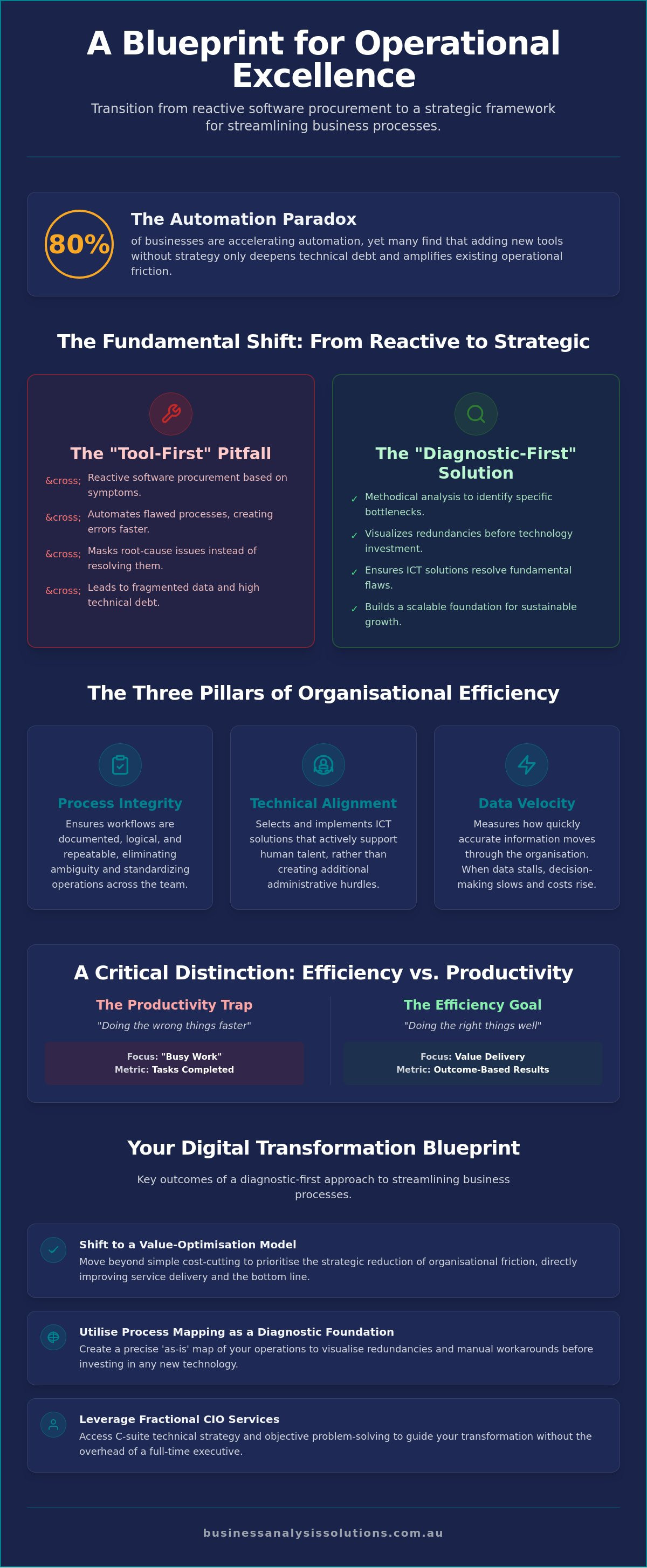
Technology alone is never the solution for an organisation struggling with operational friction. While 80% of businesses are currently accelerating their automation initiatives, many find that simply adding new tools only deepens their technical debt. True progress in streamlining business processes requires a shift from reactive software procurement to methodical, strategic analysis. You've likely seen how fragmented data and manual workarounds create high operational overheads that stifle your team's potential.
We understand that achieving operational excellence feels difficult when legacy systems don't communicate. This guide will show you how to transform that complexity into a streamlined roadmap for performance. You'll learn why a business efficiency diagnostic is the essential first step to identify specific bottlenecks before any implementation begins. By bridging the gap between your technical requirements and broader organisational objectives, you can build scalable processes that support sustainable growth across the Australian market. We'll move from high-level strategic alignment to the granular details of process mapping and digital transformation blueprints.
Table of Contents
What is Streamlining Business Processes in the 2026 Economy?
In the current fiscal environment, Australian organisations can no longer rely on simple cost-cutting to maintain a competitive edge. Streamlining business processes has evolved from a basic administrative task into a sophisticated discipline of strategic friction reduction. It involves identifying every point where information stalls or human effort is wasted on manual workarounds. The 2026 economy demands value-optimisation, where every operational adjustment directly contributes to the bottom line and improves service delivery. This approach aligns closely with the broader principles of Business Process Management (BPM), focusing on the continuous alignment of organisational activities with strategic goals.
Digital resilience is now the benchmark for operational efficiency. It's no longer enough to have systems that work; they must be capable of adapting to rapid market shifts without collapsing under the weight of technical debt. Many Australian SMEs face the hidden cost of "invisible" inefficiencies. These are the hours lost to fragmented data across legacy ICT systems that require manual intervention just to generate a standard report. Addressing these gaps isn't just about software; it's about ensuring your digital strategy actually mirrors your physical operations.
For businesses where physical distribution is a core component of these operations, you might check out Warenous to find pre-screened logistics providers that can help reduce operational friction.
Similarly, when managing physical facilities, choosing between ownership and rental models for essential maintenance tools is a key efficiency decision; ozongeneratorshop.hu offers a strategic look at this trade-off for 2026.
The Three Pillars of Organisational Efficiency
Achieving a frictionless state requires a focus on three fundamental areas. First, Process Integrity ensures that workflows are documented and logical, making them repeatable across the entire team. Second, Technical Alignment involves selecting ICT solutions that actively support human talent rather than creating additional administrative hurdles. Finally, Data Velocity measures how quickly accurate information moves through the organisation. When data stalls, decision-making slows, and the cost of doing business rises.
Efficiency vs. Productivity: A Critical Distinction
A common mistake in leadership is conflating productivity with efficiency. Doing the wrong things faster isn't a sign of progress; it's a symptom of a broken process. Real streamlining business processes focuses on the removal of "busy work" that masquerades as productivity. Instead of measuring how many tasks were completed, successful organisations in 2026 look at outcome-based metrics. They ask whether a process actually delivers value to the client or reduces operational overhead. This shift in perspective allows leaders to stop managing tasks and start managing results, creating a scalable foundation for national growth.
Identifying Bottlenecks Through Business Process Mapping
Visualisation is the prerequisite for any meaningful organisational change. Before you can begin streamlining business processes, you must document the current state of your operations with clinical precision. This 'as-is' mapping reveals the redundancies and manual workarounds that often go unnoticed during daily operations. By laying out every step of a workflow, you bridge the gap between what leadership believes is happening and the reality of the front-line experience. This diagnostic phase is what separates successful transformations from expensive software failures.
A rigorous approach to business process mapping ensures that technical requirements are derived from actual operational needs. This prevents the common mistake of automating a flawed process, which only serves to generate errors at a higher velocity. Industry leaders often suggest 6 Ways To Streamline Business Processes, but the foundation always remains the same: clarity through documentation. Mapping identifies high-impact candidates for automation by highlighting repetitive, rule-based tasks that currently consume significant human capital.
The Anatomy of an Efficient Workflow
Efficient workflows rely on standardised data entry points to maintain a single source of truth. When departments operate in silos, unnecessary hand-offs create delays and increase the risk of human error. Integrating mapping into your regular strategic reviews helps maintain system harmony as your business scales. It's about ensuring your ICT solutions actively support your staff rather than creating new administrative burdens. Logical workflows move from an identified trigger to a specific outcome without circular loops or redundant approvals.
Symptoms of a Broken Process
Several indicators suggest that your current workflows are failing to support your growth objectives. High rates of manual data re-entry across fragmented software platforms are a primary sign of technical debt. If your organisation relies on 'tribal knowledge' rather than documented standard operating procedures, you're at risk of significant disruption if key personnel leave. Frequent project delays caused by unclear requirements or ICT limitations are often symptoms of underlying flaws. If these challenges sound familiar, conducting a business efficiency diagnostic can provide the clarity needed to begin streamlining business processes effectively.
The Strategy-First Approach: Diagnostic vs. Tool-First
Many organisations operate under the misconception that a new ERP or CRM system will automatically resolve their operational friction. However, software implemented on top of a flawed workflow only serves to accelerate inefficiency. True progress in streamlining business processes requires a diagnostic-first approach that prioritises strategic analysis over immediate procurement. This method ensures that the root causes of friction are identified and resolved before any technical solutions are introduced.
A comprehensive business efficiency diagnostic provides the objective data needed to make informed investment decisions. Internal teams often struggle to maintain this level of objectivity because they're deeply embedded in existing manual workarounds. An external business analyst brings a fresh perspective, identifying redundancies that have become "invisible" to the staff. This strategic consultancy offers a higher ROI than off-the-shelf software alone by preventing the costly mistake of investing in tools that don't align with your actual requirements.
Avoiding the Pitfalls of Custom Software
Bespoke software development is frequently presented as a solution for unique organisational challenges, yet it carries substantial risks. The high initial costs are often followed by mounting technical debt as the code requires constant maintenance and updates. Instead of building from scratch, modern efficiency strategies focus on the configuration and integration of existing ICT solutions. This approach ensures long-term organisational harmony while keeping the solution lifecycle manageable and cost-effective. It's about making your current ecosystem work harder, rather than adding unnecessary complexity.
ICT Consultancy as a Growth Lever
Aligning your technology spend with long-term business objectives is critical for sustainable growth. This requires a rigorous requirements framework within your ICT project management to ensure every technical change delivers a measurable operational outcome. Without this strategic oversight, ICT projects risk becoming expensive distractions that fail to move the needle on performance. ICT consultancy serves as the bridge between technical capability and business goals. By maintaining this focus, you ensure that every digital investment contributes directly to streamlining business processes and improving the bottom line.
Creating Your Digital Transformation Blueprint
A blueprint is not a wishlist. It is a methodical document that aligns your technology stack with the specific operational requirements identified during your diagnostic phase. A digital transformation blueprint for business serves as the architectural foundation for all future ICT investments. It moves beyond the simple digitisation of paper-based tasks to provide a phased roadmap for streamlining business processes. This document ensures that every technical change supports your long-term organisational objectives rather than creating new silos.
Successful implementation requires a clear prioritisation of automation projects based on their feasibility and potential impact. Perth SMEs often struggle when they attempt to overhaul every department simultaneously. Instead, your blueprint should establish measurable milestones that allow for incremental wins. This phased approach builds organisational buy-in by demonstrating tangible value early in the cycle. Clear communication of the strategic vision is essential; it ensures that your team understands how these changes will reduce their manual workload and improve overall performance.
A 5-Step Framework for Streamlining
Step 1: Conduct a comprehensive business efficiency diagnostic to uncover the root causes of friction.
Step 2: Map critical processes to identify specific points where data stalls or redundancies occur.
Step 3: Define clear technical requirements based on your verified business goals.
Step 4: Select and integrate ICT solutions that fit within your existing ecosystem without adding technical debt.
Step 5: Execute the plan through disciplined project management and strict change control protocols.
Success Metrics Beyond the Balance Sheet
While financial performance is the ultimate goal, you must track intermediate metrics to ensure the blueprint is delivering results. Monitoring time-to-value for new ICT implementations provides immediate feedback on whether the chosen solution is resolving the identified bottleneck. Employee adoption rates and adherence to new processes are equally critical. If the team reverts to manual workarounds, it indicates a gap between the technical solution and the operational reality. Use these data-driven insights to refine your blueprint over time, ensuring it remains a living document that adapts to market changes.
Establishing a clear roadmap is the only way to avoid the high costs of aimless digitisation. To begin developing your organisational roadmap, consider engaging expert digital strategy services to ensure your technical requirements are perfectly aligned with your growth objectives.
Fractional CIO Services: Executive Leadership for Efficiency
Accessing C-suite technical strategy without the overhead of a full-time executive is a critical advantage for organisations aiming for national growth. Many Perth SMEs reach a point where their technical needs outpace their internal management capacity, yet they don't require a permanent, high-salaried Chief Information Officer. A Fractional CIO provides this high-level leadership on an on-demand basis. This role is essential for streamlining business processes at scale, as it ensures that ICT solutions remain focused on commercial outcomes rather than technical novelty. By providing objective, expert oversight, a fractional leader helps the organisation avoid expensive missteps in software procurement and implementation.
One of the most significant contributions of on-demand leadership is bridging the communication gap between the boardroom and the IT department. Technical teams often focus on functionality and uptime, while the executive team prioritises financial performance and risk mitigation. A Fractional CIO translates complex technical requirements into the language of business value. This alignment ensures that the digital strategy is never a siloed initiative but a core driver of organisational harmony and efficiency.
When to Consider On-Demand ICT Leadership
There are specific operational triggers that indicate a need for executive-level ICT guidance. If your organisation is entering a period of rapid scaling or complex change, the risk of technical debt increases significantly. You might notice that while your ICT spend is rising, your operational efficiency has plateaued or even declined. This suggests a lack of strategic coordination. On-demand leadership is also vital when overseeing high-stakes automation implementation or a comprehensive digital transformation, where the cost of failure is high and the need for precision is absolute.
The Path Forward: From Friction to Flow
The journey from organisational friction to streamlined performance follows a logical, diagnostic-first path. It begins with a thorough analysis of existing bottlenecks and moves through process mapping to the creation of a formal digital transformation blueprint. By adopting this structured approach, you ensure that every change is rooted in data and aligned with your long-term objectives. The benefits of this methodical rigour include reduced technical debt, improved data velocity, and a scalable foundation for future growth. To begin the transition from manual workarounds to operational excellence, the first step is to conduct a formal Business Efficiency Diagnostic. This diagnostic provides the clarity required to begin streamlining business processes with confidence and precision.
Building a Frictionless Future for Your Organisation
The transition from fragmented manual workarounds to high-velocity operations is a deliberate strategic choice. Success in 2026 requires moving beyond the reactive implementation of software to a methodical, diagnostic-first framework. By prioritising process mapping and a formal digital transformation blueprint, you ensure that every ICT investment directly supports your financial and operational performance. True progress in streamlining business processes is achieved only when technical capability is perfectly aligned with your long-term organisational objectives.
We invite you to leverage over 20 years of strategic ICT consultancy experience to resolve your most complex operational challenges. Our proven methodology focuses on bridging technical requirements with business goals through expert project management that delivers end-to-end results. To identify the root causes of friction and establish a clear roadmap for growth, Book a Business Efficiency Diagnostic with Business Analysis & Solutions today. You can transform organisational complexity into a stable, scalable foundation for future excellence.
Frequently Asked Questions
What is the primary difference between business efficiency and productivity?
Efficiency focuses on the strategic reduction of waste and the optimal use of resources to achieve a specific outcome. In contrast, productivity measures the raw volume of output over a given period. A team can be highly productive by completing many tasks, but they're inefficient if those tasks don't contribute to core business goals. True excellence requires balancing both by ensuring the right activities are performed with minimal friction.
How does business process mapping actually improve my bottom line?
Process mapping provides the clinical visibility required to identify where financial leakage occurs within your operations. By documenting every step of a workflow, you uncover redundant approvals and manual workarounds that inflate operational overheads. This data-driven approach is the foundation for streamlining business processes, allowing you to reallocate human capital toward high-value activities. It transforms vague operational concerns into a clear, prioritised list of high-impact improvements.
Why do most digital transformation projects fail to deliver expected efficiency gains?
Most failures stem from a "tool-first" mentality that ignores underlying workflow flaws. When an organisation implements new software to fix a broken process, it often results in the faster generation of errors and increased technical debt. Success requires a strategic alignment of ICT capability with organisational objectives. Without a comprehensive diagnostic to identify root causes, technology remains a costly distraction rather than a growth lever.
What are the first signs that our current ICT solutions are hindering efficiency?
The primary indicators include high rates of manual data re-entry across fragmented software platforms and a heavy reliance on "tribal knowledge" rather than documented procedures. If your staff spends more time managing the system than performing their actual roles, your ICT stack has become a bottleneck. You'll also notice that operational performance plateaus even as you increase your technology spend, suggesting your tools don't support your growth objectives.
Can a small to medium enterprise benefit from Fractional CIO services?
Small to medium enterprises gain significant value from Fractional CIO services by accessing executive-level technical strategy without the cost of a full-time executive. This on-demand leadership ensures your digital strategy is always aligned with your commercial goals. It provides the objectivity needed to navigate complex ICT decisions and bridges the communication gap between technical requirements and boardroom objectives, ensuring every dollar spent delivers measurable results.
What should be included in a comprehensive Digital Transformation Blueprint?
A comprehensive Digital Transformation Blueprint must include a detailed "as-is" analysis, a defined future-state vision, and a phased implementation roadmap. It should outline specific technical requirements, measurable milestones, and a framework for managing organisational change. By setting these parameters early, you ensure your digital transformation remains a disciplined strategic initiative rather than an aimless series of software upgrades that fail to deliver value.
How long does a typical Business Efficiency Diagnostic take to complete?
The duration of a Business Efficiency Diagnostic varies based on the scale of your operations, but it typically requires several weeks of focused analysis. This timeframe allows for thorough stakeholder interviews, process observation, and data verification to ensure findings are accurate. It's a methodical investment that prevents the much larger costs associated with implementing the wrong technical solutions for your specific organisational challenges.
Is automation implementation always the best way to increase efficiency?
Automation is a powerful tool, but it's not a universal solution for every inefficiency. In many cases, simplifying or eliminating a redundant step is more effective and less expensive than automating it. Streamlining business processes often involves a combination of logic-based workflow redesign and targeted technical integration. You must always ensure a process is logically sound and adds value before you commit capital to its automation.



Comments