Key Components of a Digital Transformation Blueprint: A 2026 Strategic Guide
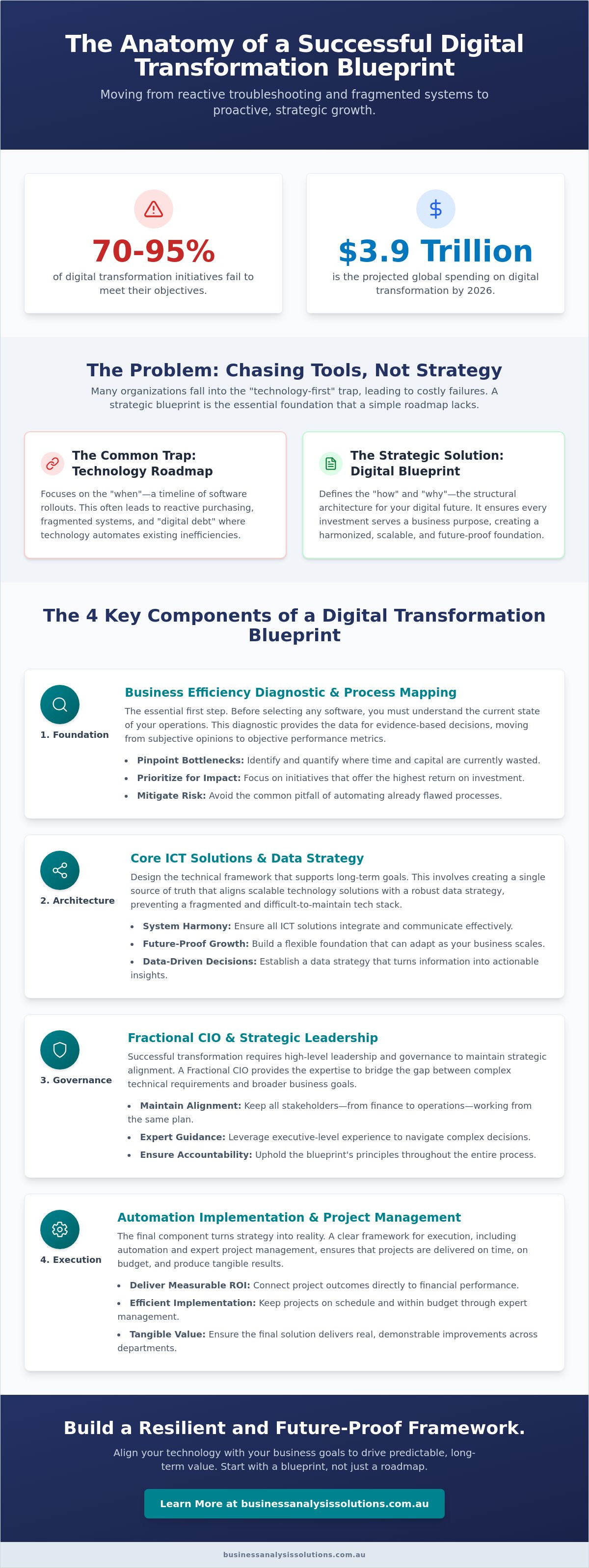
Between 70% and 95% of digital transformation initiatives fail to meet their objectives, even as global spending on these projects reaches nearly $3.9 trillion in 2026. It's a frustrating reality for leaders grappling with fragmented legacy systems and the persistent lack of internal technical leadership. You likely recognize that technology alone cannot solve structural inefficiencies, yet defining a clear path to a measurable return on investment remains a significant challenge. Identifying the key components of a digital transformation blueprint is the first step toward moving from reactive troubleshooting to proactive strategic growth.
This guide provides the architectural clarity needed to build a resilient, efficient, and future-proof framework for your organisation. We'll outline how to bridge the gap between complex technical requirements and broader business goals through methodical process mapping and automation. By focusing on system harmony and operational logic, you'll gain a structured framework for decision-making that supports long-term scalability and delivers tangible value across every department.
Table of Contents
Understanding the Digital Transformation Blueprint vs. a Technology Roadmap
The Foundational Component: Business Efficiency Diagnostic and Process Mapping
The Technical Architecture: Core ICT Solutions and Data Strategy
The Governance Component: Fractional CIO and Strategic Leadership
The Execution Component: Automation Implementation and Project Management
Understanding the Digital Transformation Blueprint vs. a Technology Roadmap
A digital transformation roadmap often focuses on the "when"—a chronological timeline of software rollouts, budget cycles, and scheduled upgrades. While useful for tracking progress, a roadmap is not a substitute for a blueprint. A blueprint defines the "how" and "why" by establishing the structural architecture of your digital future. It serves as the logical framework that ensures every investment serves a specific organisational purpose. Without this foundation, businesses often find themselves in a cycle of reactive purchasing, acquiring ICT solutions that fail to integrate or scale. Establishing the key components of a digital transformation blueprint before committing to vendor contracts is essential for mitigating the high failure rates seen in enterprise-level projects.
The blueprint acts as a defensive measure against "shiny object syndrome." It forces leadership to look beyond the immediate appeal of new tools to consider how those tools will interact with existing data structures and human workflows. By prioritising structural integrity over tactical speed, organisations can build a technology stack that supports long-term growth rather than one that requires constant, expensive remediation. This methodical approach transforms technology from a cost centre into a predictable driver of value.
The Purpose of Strategic Architecture
Strategic architecture bridges the gap between technical potential and business performance. It creates a single source of truth for stakeholders, ensuring that the CFO, CTO, and operations managers all work from the same plan. This alignment allows leadership to establish a clear baseline for measuring digital maturity. Key advantages include:
Objective Alignment: Every technical requirement is directly mapped to a specific business outcome or KPI.
Stakeholder Clarity: Clear documentation reduces ambiguity, ensuring that technical and non-technical teams share identical expectations.
ROI Precision: By defining expected outcomes early, you can track financial performance with accuracy rather than relying on vague estimates.
Why Blueprints Fail Without Logical Foundations
Many organisations fall into the "technology-first" trap, selecting software based on market trends rather than internal necessity. This approach ignores the reality of Digital Transformation, which is as much about process management as it is about tools. When software is layered onto inefficient manual processes, it simply automates that inefficiency. This creates "digital debt"—a state where fragmented legacy systems and mismatched applications hinder agility and increase maintenance costs. A structured approach to ICT consultancy ensures that the key components of a digital transformation blueprint are grounded in your actual operational needs. This logical foundation prevents the accumulation of digital debt and ensures that your technology stack remains harmonised as the business scales.
The Foundational Component: Business Efficiency Diagnostic and Process Mapping
A digital transformation effort that begins with a software purchase is often destined for failure. To achieve a successful digital transformation, leadership must first understand the current state of their operations through a comprehensive efficiency diagnostic. This diagnostic is one of the primary key components of a digital transformation blueprint because it provides the data necessary for evidence based decision making. It moves the conversation from subjective opinions to objective performance metrics. By quantifying where time and capital are currently wasted, you can prioritise initiatives that offer the highest impact on your financial performance. Efficiency drives margin, and margin provides the capital for further innovation.
Diagnostics also serve as a risk mitigation tool. They reveal the hidden complexities that software vendors often overlook during the sales cycle. Without this foundational analysis, organisations risk automating flawed processes, which only serves to accelerate operational errors. A professional Business Efficiency Diagnostic provides the baseline data required to validate your technology spend and ensure that every new tool solves a verified problem.
Auditing Current Digital Capabilities
Before introducing new ICT solutions, you must audit what you already own. This audit identifies "shadow IT"—applications purchased by individual departments without central oversight—which often lead to data silos and security vulnerabilities. A methodical audit evaluates the following areas:
Software Redundancy: Identifying overlapping subscriptions that perform the same function.
Interoperability: Assessing how well current systems communicate and share data.
Workforce Readiness: Evaluating whether the team possesses the digital literacy required to adopt more advanced tools.
Process Mapping as a Transformation Tool
Process mapping provides the visual logic required to redesign workflows for a digital environment. By documenting the "as-is" state, you can pinpoint exactly where manual interventions create friction or data loss. This clarity allows for the design of a "to-be" state focused on business efficiency. Process mapping serves as the critical bridge between manual work and automation implementation. It ensures that the key components of a digital transformation blueprint are built on optimised logic rather than legacy habits. When you map a process, you aren't just drawing a diagram. You're creating a specification for how your organisation will function at peak performance.
The Technical Architecture: Core ICT Solutions and Data Strategy
Once you've mapped your processes and identified operational gaps, the focus shifts to the technical architecture that will support your newly optimised workflows. Defining this architecture is one of the most critical key components of a digital transformation blueprint because it determines the scalability and longevity of your technology investments. In 2026, a resilient architecture isn't just about individual software applications; it's about how those applications interact within a unified ecosystem. Selecting ICT solutions that integrate seamlessly with your existing infrastructure prevents the creation of new data silos and ensures that your technology stack remains an asset rather than a liability.
Cloud computing provides the flexible base required for this ecosystem. It allows organisations to scale resources up or down based on real-time demand, providing a cost-effective alternative to rigid, on-premise hardware. By leveraging cloud-native environments, you gain access to advanced security protocols and automatic updates, ensuring your systems remain compliant with evolving international standards. This flexibility is essential for businesses that intend to grow without being hindered by the physical limitations of their IT infrastructure.
For custom business needs that off-the-shelf software can't address, the Microsoft Power Platform offers a logical solution. It allows for the rapid development of custom applications and automated workflows that bridge the gap between disparate systems. By integrating these tools into your key components of a digital transformation blueprint, you empower your organisation to solve specific operational challenges without the high costs and long lead times associated with traditional custom coding.
Modernising the Technology Stack
Understanding business technology is no longer solely the responsibility of the IT department; it's a core competency for modern leadership. Decisions between SaaS and on-premise solutions now hinge on 2026 security standards and the need for remote accessibility. An API-first architecture is non-negotiable for future-proofing your systems. It ensures that any new tool you adopt can communicate with your core database, allowing for a modular approach where components can be replaced or upgraded without collapsing the entire system.
Data Governance and Business Intelligence
Data is only valuable if it's accurate and accessible. Establishing a robust data strategy ensures data integrity across all organisational silos, providing a "single version of the truth" for decision-makers. Leveraging Power BI allows leadership to transform this raw data into strategic insights through real-time dashboards and predictive analytics. Microsoft Copilot functions as a pervasive intelligence layer that automates routine documentation and data synthesis across the 2026 enterprise environment. By prioritising data governance, you ensure that your business intelligence tools provide reliable information that drives financial performance and operational clarity.
The Governance Component: Fractional CIO and Strategic Leadership
Governance is the structural glue that holds technical initiatives together. Without executive-level oversight, digital projects frequently lose sight of the commercial objectives they were designed to achieve. This is why strategic leadership is among the most vital key components of a digital transformation blueprint, ensuring that technical teams and business units remain synchronised throughout the implementation lifecycle. By establishing a clear chain of accountability, leadership can move from reactive troubleshooting to proactive value creation.
Small and mid-sized organisations often face a leadership gap where they lack the budget for a full-time Chief Information Officer but require the expertise one provides. Fractional CIO services resolve this challenge by offering high-level IT advisory on a part-time or project basis. This professional provides the objective analysis needed to manage complex vendor relationships, ensuring that software providers deliver on their contractual promises. They also identify ICT project risks early, preventing the technical debt that often arises from rushed or poorly planned implementations. By acting as a strategic translator, they turn technical requirements into business outcomes that the board can easily validate.
To ensure your technology strategy remains aligned with your commercial goals, explore our Fractional CIO Services for expert executive guidance.
Strategic Technology Oversight
Governance requires a structured framework that survives personnel changes and market shifts. A well-documented digital transformation blueprint provides this continuity, serving as the definitive reference for executive reporting and a single source of truth for all departments. It allows leadership to align ICT budgets with long-term strategic growth goals, ensuring that technology spend isn't just a cost but a deliberate investment in future capability. This oversight ensures that every technical milestone is measured against its contribution to the organisation's overarching mission, providing the board with the clarity needed to approve high-value investments.
Risk Management and Cybersecurity
In a digital-first environment, risk management must be integrated directly into the transformation architecture. This involves adopting frameworks like the Essential 8 to harden the organisation against evolving threats. A blueprint that includes incident response plans and continuous monitoring protocols ensures that the business can maintain operations during technical disruptions. Effective governance also involves tracking project health to identify early warning signs of scope creep or budget overruns, allowing for corrective action before the project's ROI is compromised. By prioritising security as a strategic pillar, you protect your digital assets and build long-term trust with stakeholders.
The Execution Component: Automation Implementation and Project Management
Execution is the phase where strategic architecture translates into operational reality. It's the most high-stakes stage of the journey. While the blueprint provides the logic, the execution plan provides the momentum. Turning the key components of a digital transformation blueprint into an actionable automation implementation plan requires a focus on sequencing. You don't deploy everything at once. Instead, you identify high-impact, low-complexity wins to build early momentum and secure stakeholder buy-in. These quick wins validate the strategy and provide the financial justification for more complex, long-term initiatives.
Effective execution relies heavily on expert project management to prevent the scope creep that often derails large-scale technical projects. Without strict controls, projects tend to expand beyond their original intent, diluting ROI and exhausting internal resources. Managing the cultural change associated with new digital processes is equally critical. Research indicates that cultural resistance is a primary driver for the 70% to 95% failure rate in digital initiatives. Leaders must communicate the logic behind the change, ensuring that the workforce views new tools as enablers of productivity rather than barriers to their existing workflows.
Automation as a Key Efficiency Driver
Automation serves as the primary engine for improving operational margins. By identifying repetitive manual tasks, organisations can deploy automation implementation strategies that reduce error rates and free staff for higher-value work. In 2026, employee productivity (39%) has surpassed customer experience as the top priority for digital transformation efforts. Workflow automation directly addresses this by removing the friction of administrative overhead. Once a departmental pilot proves successful, the logic can be scaled as an organisational standard, ensuring system harmony across the entire enterprise stack.
Methodical Implementation and Continuous Improvement
The choice between agile and waterfall methodologies depends on the project's complexity and the stability of its requirements. Agile allows for iterative progress and rapid pivots, while waterfall provides a structured sequence for foundational infrastructure. Regardless of the method, post-implementation reviews and diagnostic audits are non-negotiable. These reviews allow you to verify that the key components of a digital transformation blueprint are delivering the expected outcomes. Transformation isn't a one-time event; it's a cycle of continuous digital evolution. Regular audits ensure that your technology stack remains aligned with shifting market demands and internal growth objectives.
Securing Your Organisation's Digital Future
Successful transformation in 2026 requires moving beyond a simple technology roadmap. It demands a logical architecture that prioritises process mapping and strategic governance. By establishing the key components of a digital transformation blueprint, you ensure that every ICT solution serves a measurable business outcome rather than adding to your digital debt. This methodical approach transforms technology from a potential liability into a predictable driver of financial performance and operational efficiency.
Business Analysis & Solutions brings over 20 years of industry experience in ICT consultancy to every engagement. We leverage a specialised Business Efficiency Diagnostic framework and expert Fractional CIO advisory to bridge the gap between technical requirements and executive strategy. This expertise ensures that your digital initiatives remain aligned with long-term growth goals and international standards.
Request a Digital Transformation Blueprint for Your Organisation to begin your transition toward a more efficient, automated future. Your digital evolution is a structured journey toward operational excellence. With a robust framework in place, you can build a resilient organisation that's prepared for the complexities of the modern economy.
Frequently Asked Questions
What is the difference between a digital strategy and a digital transformation blueprint?
A digital strategy defines the overarching goals and desired outcomes for an organisation's digital future. In contrast, a digital transformation blueprint provides the specific structural architecture required to reach those goals. While the strategy answers where the organisation is going, the blueprint details how systems, data, and processes must be configured to support that destination safely and efficiently.
How long does it typically take to develop a comprehensive digital blueprint?
The development timeline typically ranges from four to twelve weeks, depending on organisational complexity and the scope of existing legacy systems. This period includes the initial Business Efficiency Diagnostic, stakeholder interviews, and the technical mapping of core ICT solutions. A methodical approach ensures the resulting document is a precise architectural guide rather than a generic set of recommendations.
Can a small business benefit from a digital transformation blueprint?
Small businesses benefit significantly by using a blueprint to avoid expensive "technology-first" mistakes that drain limited capital. By identifying the key components of a digital transformation blueprint early, smaller organisations can invest in scalable tools that offer the highest ROI. This prevents the accumulation of digital debt and ensures the technology stack supports long-term growth from the outset.
What are the main risks of starting a transformation without a blueprint?
The primary risks include system fragmentation, wasted technology spend, and a high likelihood of project failure. Without a structured plan, organisations often layer new software onto inefficient manual processes, which leads to automated inefficiency. This lack of architectural clarity results in data silos and security vulnerabilities that eventually require costly remediation to resolve.
How does a Fractional CIO contribute to the blueprint process?
A Fractional CIO provides the executive leadership and technical expertise necessary to bridge the gap between business objectives and ICT solutions. They oversee the development of the blueprint, manage vendor relationships, and identify project risks before they impact the budget. This strategic oversight ensures the transformation remains aligned with the organisation's financial and operational goals throughout the implementation.
What role does data privacy play in a digital transformation blueprint?
Data privacy is a foundational element that informs the selection of every tool and the design of every workflow within the architecture. The blueprint must integrate security frameworks, such as the Essential 8, to protect organisational assets and maintain compliance with evolving standards. By embedding privacy into the design, businesses build digital trust and reduce the risk of costly data breaches.
How much should a business budget for the diagnostic phase?
Budgeting for the diagnostic phase depends on the number of departments, users, and existing systems requiring analysis. Leadership should view this phase as a risk-mitigation investment that prevents much larger losses during the implementation stage. It's best to consult with a professional consultancy to determine a scope that matches your specific organisational requirements and technical complexity.
How do you measure the success of a digital transformation blueprint?
Success is measured by comparing post-implementation performance against the baseline metrics established during the initial diagnostic. Key indicators include improved operational efficiency, reduced error rates through automation, and a measurable return on technology investment. A successful implementation of the key components of a digital transformation blueprint results in a harmonised system where technology actively drives business outcomes.



nice text bro
The article highlights a critical aspect of successful digital transformation: the distinction between a digital transformation blueprint and a technology roadmap. The importance of understanding the dynamics of Bitstarz is underscored, as it exemplifies how technology choices must align with operational needs rather than market trends. This misalignment often leads to inefficiencies that accumulate as digital debt, ultimately hindering growth.
The article outlines the complexities and challenges of digital transformation, emphasizing that a technology-first approach often leads to failure. Instead, organizations should focus on the key components of a digital transformation blueprint to effectively align technology with business goals. This reflection raises the question of how companies like Skycrown can implement such structures amidst varying internal capabilities and resource constraints. Identifying methods to bridge these gaps is crucial for achieving sustainable growth.
The article sheds light on the critical components of digital transformation, emphasizing a structured approach. It’s interesting how the framework prevents businesses from falling into the trap of adopting new tools based on trends alone. In many ways, it mirrors the impulse to play The Pokies without a strategic plan, risking financial outcomes by prioritizing excitement over practicality. A clear blueprint can change that narrative.
After examination, the argumentation is tight and internally consistent. No shortcuts are taken in the evidential chain of reasoning. The website presents further background context on this topic. Usage patterns are validated through cross-platform behavioural data.