Measuring the ROI of Digital Transformation: A Strategic Framework for 2026
- jonesaqayalo
- Jun 22
- 11 min read
Updated: Jul 5
If the average enterprise project now costs $27.5 million, why is the process of measuring ROI of digital transformation still treated as an afterthought? Many leadership teams find themselves trapped between rising ICT expenditures and the inability to isolate technical impact from volatile market variables. It's a common frustration to see fragmented data across legacy systems or staff resistance quietly undermining the very metrics intended to prove success. You aren't alone in feeling that the link between high-level digital strategy and tangible financial performance remains dangerously opaque.
This article provides the methodology you need to quantify digital transformation success and ensure every technology investment delivers measurable organizational value. By adopting a structured, logical approach, you'll move beyond vague estimates toward a repeatable framework for ROI calculation. We'll examine how to align your ICT spend directly with strategic goals, providing the clarity required to reduce project risk and achieve system harmony. From establishing precise baselines to managing the 12 to 36 month realization timeline, this guide offers a professional blueprint for driving and documenting meaningful progress.
Table of Contents
Redefining Digital Transformation ROI: Beyond Simple Cost Savings
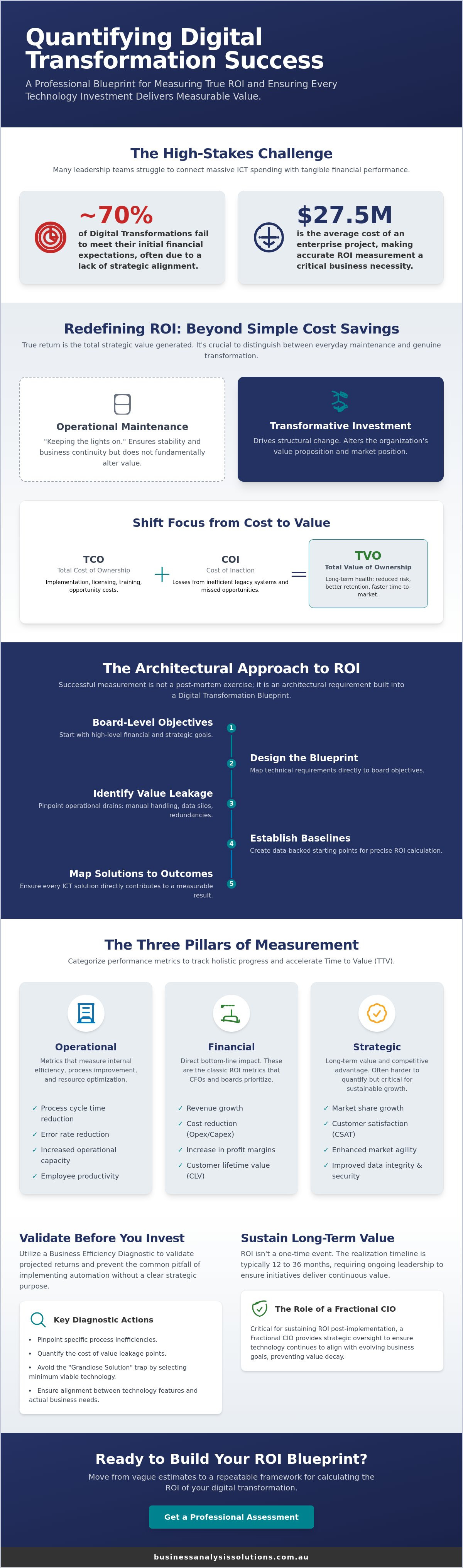
Measuring ROI of digital transformation is frequently misunderstood as a simple calculation of immediate cost savings or departmental budget reductions. In a professional context, true return represents the total strategic value generated relative to the capital and operational investment over a defined period. To achieve precision, leadership must distinguish between standard ICT maintenance—often described as "keeping the lights on"—and genuine Digital Transformation. While maintenance ensures stability, transformation drives structural change that alters the organization's value proposition.
A persistent misconception suggests that ROI is exclusively achieved through headcount reduction. This narrow focus ignores the substantial gains found in increased operational capacity, improved data integrity, and enhanced market agility. When organizations prioritize payroll cuts over system harmony, they often inadvertently strip away the human expertise required to manage the new digital environment. Industry data indicates that approximately 70% of digital transformations fail to meet their initial financial expectations. This high rate of failure typically stems from a lack of clear strategic alignment and the absence of rigorous baseline metrics before the project begins.
The "Grandiose Solution" Trap
Many organizations fall into the trap of purchasing high-end enterprise software under the assumption that the tool itself provides the strategy. This tool-led approach frequently leads to negative ROI because the technology is mismatched with actual business processes. Feature bloat is a significant hidden cost; companies often pay for complex functionalities that their staff never utilize, creating unnecessary complexity and technical debt. A strategy-led initiative, by contrast, identifies the specific business problem first and then selects the minimum viable technology required to resolve it. This ensures that every dollar spent on ICT solutions contributes directly to a measurable outcome.
Total Cost of Ownership (TCO) vs. Total Value of Ownership (TVO)
Calculating the Cost of Inaction (COI) is equally vital. COI quantifies the financial losses an organization incurs by maintaining inefficient legacy systems, such as manual data entry errors or missed market opportunities. By contrasting the TVO of a new digital blueprint against the COI of the status quo, leadership can build a more compelling and logical case for investment that prioritizes sustainable growth over short-term savings.
The Architectural Approach: Building ROI into Your Digital Transformation Blueprint
Successful measurement is not a post-mortem exercise; it is an architectural requirement. To succeed, leadership must treat the digital transformation blueprint for business as the primary foundation for measurement. This document identifies how technical requirements align with board-level financial objectives. Without this structural clarity, organizations often find themselves struggling with measuring ROI of digital transformation because they lack a clear line of sight between a software deployment and a profit-and-loss statement. A well-designed blueprint ensures that every ICT solution is mapped to a specific organizational outcome.
Precision in measurement depends on the identification of value leakage points. These are the specific areas in your current operations where manual handling, data silos, or redundant processes drain capital. Utilizing professional business analysis allows you to pinpoint these inefficiencies before implementation begins. By addressing these gaps during the design phase, you ensure the technical solution is built to capture and retain value, rather than just automating an existing mess. This methodical approach mirrors the strategic focus found in the CIO's Guide to Measuring ROI, which advocates for a tight coupling of technology and business performance.
Establishing Qualitative and Quantitative Baselines
You cannot measure progress without a documented starting point. Auditing current process cycle times provides the quantitative data necessary to prove efficiency gains later. However, qualitative data is equally vital. Identifying "soft" metrics, such as employee frustration levels or customer friction points, helps capture the full impact of the transformation. A baseline represents the definitive zero-point for all future ROI claims, providing the empirical anchor against which all progress is measured.
Mapping Processes to Financial Outcomes
Every workflow adjustment must eventually translate into a financial result. For example, streamlining a single procurement workflow reduces the administrative cost per transaction, which directly impacts the bottom line. Accurate data also improves decision-making speed, reducing the time leadership spends resolving errors. In this framework, business efficiency is not a vague concept; it is a measurable strategic asset. By treating process optimization as a financial driver, you move from measuring ROI of digital transformation as a theoretical exercise to a core component of your operational health.
Core Metrics and KPIs for Measuring Strategic Impact
Measuring ROI of digital transformation requires a transition from anecdotal evidence to a structured, data-driven methodology. To avoid the paralysis of data fatigue, leadership should focus on a multi-domain KPI framework that balances three distinct pillars: Operational, Financial, and Strategic. By selecting no more than five to seven "North Star" metrics, an organization maintains clarity and ensures that reporting remains actionable rather than merely descriptive.
Time to Value (TTV) is a critical metric in this framework. While large-scale enterprise transformations often take 12 to 36 months to realize full financial returns, tracking TTV identifies the specific points where individual initiatives begin to pay for themselves. Another vital leading indicator is the Adoption Rate. If the intended users don't integrate new tools into their daily workflows, the projected financial gains will never materialize. High adoption rates early in the implementation phase provide the strongest signal of eventual project success.
Operational Efficiency and Process Velocity
Operational metrics focus on the mechanics of the business. You should measure the reduction in manual touchpoints achieved through automation implementation. Success is demonstrated when throughput increases without a corresponding rise in operational costs. Additionally, for organizations with distributed teams, the ROI of improved data accessibility can be quantified by tracking the reduction in time spent searching for or validating information across legacy silos.
Customer Lifecycle Value (CLV) Enhancements
Digital shifts must eventually touch the customer. By analyzing how new systems reduce Customer Acquisition Costs (CAC), you can directly link technology spend to marketing efficiency. Improved UX/UI design, identified during the initial process mapping phase, should correlate with higher retention and referral rates. In sales consulting, the ROI of data-driven personalization is often seen in increased average contract values and shorter sales cycles.
Employee Engagement and Productivity
The human element is often the most significant variable in measuring ROI of digital transformation. Quantify the hours saved per week through automated reporting to see the immediate impact on administrative overhead. In a competitive market, the presence of modern, efficient digital tools also serves as a lever for talent retention. Ultimately, employee adoption is the primary gatekeeper of ROI; without it, even the most sophisticated ICT solutions remain stranded assets.
The Business Efficiency Diagnostic: Validating ROI Before Implementation
Validating the financial viability of a project before committing capital is a hallmark of professional leadership. The Business Efficiency Diagnostic serves as a critical risk-mitigation tool by ensuring that every proposed change is backed by a logical business case. This phase prevents the common error of "automation for automation's sake," where organizations digitize inefficient manual processes without first optimizing them. By identifying high-impact, low-complexity "quick wins," you build momentum and secure early proof points for your broader strategy. These early successes are essential for maintaining stakeholder confidence during longer-term initiatives.
A frequent objection to measuring ROI of digital transformation is the claim that an organization lacks the necessary data to establish a baseline. However, the diagnostic phase itself is designed to extract and synthesize this data from existing operations. It transforms anecdotal observations into empirical evidence, providing the clarity required to move forward with confidence. If you don't know your current cost per transaction or lead, the diagnostic establishes these figures as the foundation for all future performance tracking. This methodical approach ensures that measuring ROI of digital transformation is based on reality rather than optimistic projections.
Identifying High-Impact Automation Opportunities
Using detailed process mapping, you can locate specific bottlenecks where ROI is currently being lost to manual friction. This analysis also evaluates legacy systems for "technical debt," which refers to the ongoing costs of maintaining outdated technology that drains resources without providing a competitive edge. Priority should be given to projects that allow the business to scale its output without a linear increase in operational costs. This focus on scalability ensures that the digital investment acts as a force multiplier for the entire organization, turning technical requirements into financial performance.
Mitigating the Risk of Implementation Failure
Professional project management plays a decisive role in avoiding the budget overruns that often sink ROI. A formal requirements document acts as the bridge between technical specifications and strategic intent, ensuring the final tool matches the actual business need. This methodical approach reduces the risk of project failure and ensures that technical requirements remain subservient to broader organizational objectives. By resolving ambiguities early in the diagnostic phase, you prevent the mid-project scope creep that typically erodes financial returns. To begin securing your investment, you can book a Business Efficiency Diagnostic to identify your highest-value opportunities.
Sustaining ROI: The Role of Fractional CIO Leadership
Achieving a successful technical launch is only the first stage of a long-term financial strategy. Many organizations experience a plateau in performance shortly after implementation because they lack the executive oversight required to maintain momentum. Without a dedicated steward, digital systems often drift away from their original strategic intent. This is where Fractional CIO services Australia provide essential value, acting as the permanent guardian of your technology investments. These leaders ensure that measuring ROI of digital transformation remains a continuous process rather than a one-time audit.
Objective, third-party ICT consultancy offers a level of professional distance that internal teams often lack. An external perspective is vital for reporting ROI to stakeholders with total transparency and precision. By removing internal biases, a Fractional CIO provides the board with a reliable, logic-based assessment of how digital assets are performing against organizational goals. This disciplined approach ensures that technology remains a servant to the business strategy, preventing the accumulation of technical debt and protecting the company's capital. It shifts the focus from merely managing systems to actively driving value.
Continuous Improvement and Iterative Value
ROI isn't static; it requires deliberate cultivation through regular audits and process refinements. A Fractional CIO ensures that technology remains aligned with evolving organizational objectives, adjusting the digital framework as market conditions change. This introduces the concept of "Agile ROI," where value is extracted through small, iterative releases rather than waiting years for a massive system overhaul. Beyond internal processes, executive leadership also manages vendor relationships to protect profit margins, ensuring that licensing costs and service agreements remain optimized for the business's current scale. This persistent oversight prevents the "value leakage" that often occurs when systems are left unmanaged.
Bridging the Technical-Strategic Gap
The most significant challenge for many leadership teams is translating complex technical data into actionable board-level insights. Strategic technology solutions only deliver value when they're understood and supported at the highest levels of the organization. A Fractional CIO bridges this gap, converting granular performance metrics into clear reports that highlight operational efficiency and financial health. This leadership ensures that the organization is future-proofed against disruption while maintaining a rigorous focus on immediate results. It's about moving from technical requirements to organizational resolution. To begin your journey toward a more efficient operation, you can request a Business Efficiency Diagnostic to start measuring what matters for your organization's future.
Securing Strategic Value through Precise Measurement
Securing measurable value from technology requires a shift from reactive reporting to proactive architectural design. By establishing empirical baselines during the diagnostic phase and aligning technical requirements with board-level objectives, you transform digital initiatives from cost centers into strategic assets. Measuring ROI of digital transformation isn't merely about tracking savings; it's about validating that your organizational evolution remains profitable and sustainable. This methodical approach ensures that every ICT dollar spent serves a documented business purpose.
With over 20 years of industry experience in ICT strategy, we specialize in bridging the gap between technical requirements and organizational objectives. Our proven methodology for digital transformation blueprints provides the structural clarity needed to drive end-to-end results. You can book a consultation with a Fractional CIO to secure your digital ROI and ensure your systems deliver the performance your leadership demands. The transition to a more efficient, data-driven future is within reach when you apply a methodical framework to your technology investments.
Frequently Asked Questions
How do you calculate ROI for digital transformation?
ROI is calculated by dividing the net strategic value—the total gains minus the costs—by the total investment cost, then expressing it as a percentage. This calculation must account for both direct financial returns and indirect operational improvements. Total investment includes software licensing, implementation fees, staff training, and the opportunity costs associated with the transition phase.
What are the most important KPIs for digital transformation success?
The most critical KPIs are categorized into operational, financial, and strategic pillars. Key metrics include Time to Value (TTV), Adoption Rate, and Process Velocity. Focusing on a limited set of "North Star" metrics ensures that technical progress translates into measurable business outcomes without overwhelming leadership with unnecessary data points.
How long does it take to see a return on investment from digital transformation?
The timeline for realizing returns depends on the project's scope. Narrowly focused initiatives can demonstrate results in 30 to 90 days, while enterprise-level platform ROI typically requires 12 to 36 months to fully materialize. Establishing baseline metrics at the project's inception is the only way to track this progress accurately over time.
Can you measure the ROI of intangible benefits like employee morale?
Intangible benefits are measured through proxy metrics such as employee retention rates, reduced absenteeism, and engagement scores. By quantifying the reduction in hours spent on repetitive manual tasks, you can link improved morale directly to increased operational capacity and lower recruitment costs. These qualitative gains contribute significantly to long-term organizational health.
Why do most digital transformation projects fail to deliver ROI?
Failure typically stems from a lack of strategic alignment or the absence of rigorous baseline data before implementation begins. Many organizations prioritize tool selection over process optimization, leading to the automation of inefficient workflows. Without a logical blueprint, these projects often suffer from scope creep, which erodes the projected financial gains.
What is the difference between ROI and TCO in digital projects?
TCO (Total Cost of Ownership) measures the complete expense of an asset throughout its lifecycle, while ROI measures the return generated relative to that cost. While TCO provides clarity on the capital required, measuring ROI of digital transformation requires evaluating the Total Value of Ownership (TVO) to understand the broader strategic impact on the organization.
How does a Fractional CIO help in measuring and improving ROI?
A Fractional CIO provides the executive-level oversight required to bridge the gap between technical requirements and strategic goals. They act as an objective guardian of ROI, ensuring that technology investments remain aligned with the organization's financial objectives. Their specialized expertise allows them to translate complex technical performance data into actionable reports for the board.
What role does process mapping play in ROI calculation?
Process mapping identifies the specific value leakage points where manual friction and redundant tasks drain capital. By documenting current workflows, you establish the empirical baselines necessary for measuring ROI of digital transformation. This analysis ensures that digital investments are targeted at the areas with the highest potential for impact and scalability.



Comments