Workflow Optimisation Strategies: A Strategic Guide to Operational Excellence in 2026
Does your current ICT infrastructure actually support your growth, or is it a hidden tax on your daily operations? If your team spends 20% of their week on manual rework due to disconnected software, your bottom line is suffering from structural inefficiency. Most Australian business leaders recognize that a lack of visibility into process bottlenecks remains a primary barrier to scale. To overcome this, you need robust workflow optimisation strategies that align your technical requirements with long-term business objectives.
You're likely seeking a way to reduce operational costs and ensure consistent output quality across every department. This guide provides a meticulous roadmap for digital transformation, focusing on the methodologies required to drive measurable efficiency. We'll examine how process mapping and requirements elicitation can bridge the gap between your current state and operational excellence in 2026. By the end of this article, you'll have the clarity needed to untangle organisational complexities and implement a structured, methodical approach to your ICT framework.
Key Takeaways
Identify hidden operational drains and "Shadow IT" by applying a systematic diagnostic framework to evaluate your current business processes and protect margins.
Evaluate the 2026 technology stack to transition from rigid legacy systems to modular, integrated ICT solutions that support scalable growth and seamless communication.
Learn how to execute high-impact workflow optimisation strategies using a Digital Transformation Blueprint designed to mitigate implementation risks and drive measurable efficiency.
Discover why maintaining operational excellence requires a continuous improvement cycle, supported by strategic leadership and Fractional CIO services for mid-market Australian firms.
Table of Contents The Strategic Imperative of Workflow Optimisation in 2026 Diagnostic Foundations: Mapping the Path to Efficiency Technology as an Enabler: Integrating ICT Solutions Implementation Framework: From Blueprint to Operational Excellence Sustaining Agility: The Role of Strategic ICT Consultancy
The Strategic Imperative of Workflow Optimisation in 2026
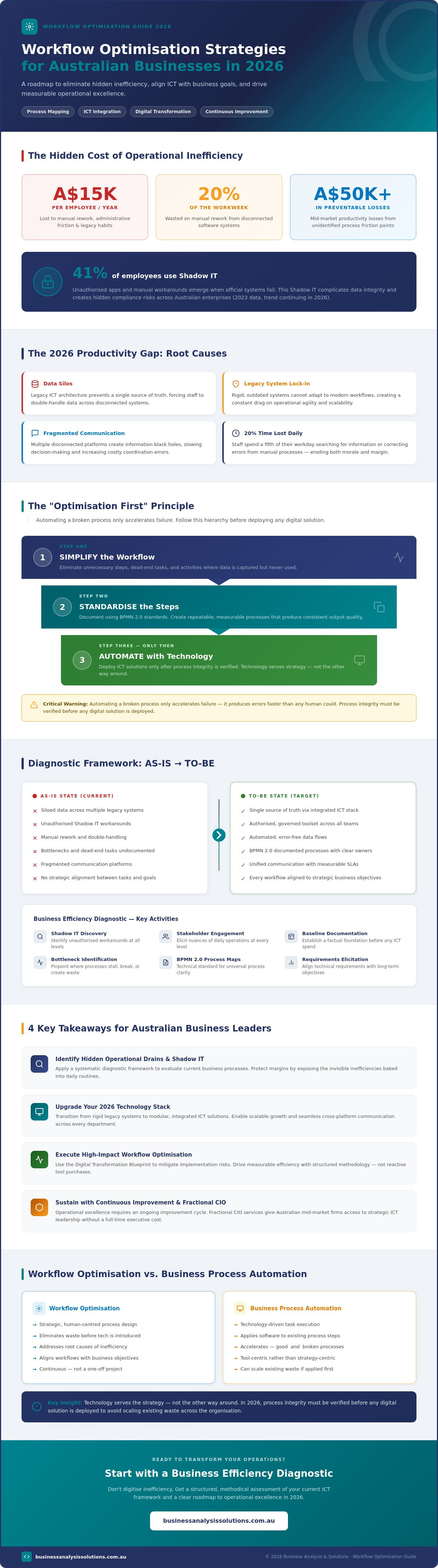
Workflow optimisation is the systematic alignment of people, processes, and ICT solutions to create a seamless operational environment. It's not a one-off project but a continuous commitment to refinement. In the current Australian economic climate, the cost of "invisible" inefficiency has become a critical threat to profitability. Industry data suggests that manual rework and administrative friction can drain business margins by as much as A$15,000 per employee annually. These losses often go unnoticed because they're baked into daily routines and legacy habits.
Achieving holistic business efficiency requires a shift in perspective. Leaders must move away from isolated task improvements and focus on end-to-end value delivery. Implementing robust workflow optimisation strategies allows a firm to remain agile. This agility is the primary differentiator in a 2026 market defined by rapid shifts in consumer demand and supply chain disruptions. For instance, companies looking to streamline their logistical footprint often turn to Alliance Fleet Solutions to integrate fleet management into their broader efficiency framework. For firms sourcing goods from Asia, The Inspection Company provides the essential quality control needed to prevent supply chain disruptions. When your processes are lean, your organisation can pivot without the weight of operational baggage.
Workflow Optimisation vs. Business Process Automation
It's a common mistake to assume that software alone solves operational drag. Automating a broken process only accelerates failure by producing errors faster than a human could. To avoid this, we follow a logical hierarchy: simplify the workflow, standardise the steps, and then apply automation. This methodology is rooted in Business Process Management standards, ensuring that technology serves the strategy rather than dictating it. In 2026, the "Optimisation First" principle dictates that process integrity must be verified before any digital solution is deployed to avoid scaling existing waste.
The 2026 Productivity Gap
The productivity gap in many Australian firms is often the result of legacy ICT architecture. These outdated systems create data silos that prevent a single source of truth, leading to significant workflow friction. When staff spend 20% of their day searching for information or double-handling data, decision-making speed suffers. Fragmented communication across different platforms further complicates the issue. Strategic alignment is the solution. By ensuring that every granular workflow supports high-level organisational objectives, businesses can close this gap. Precise workflow optimisation strategies transform disjointed tasks into a unified engine for growth, turning operational clarity into a sustainable competitive advantage.
Diagnostic Foundations: Mapping the Path to Efficiency
Successful workflow optimisation strategies do not begin with the procurement of new software. They start with a rigorous Business Efficiency Diagnostic to establish a factual baseline of current operations. Without this diagnostic, organisations risk digitising existing inefficiencies rather than eliminating them. A primary focus during this phase is the identification of "Shadow IT"—the unauthorised apps and manual workarounds employees use when official systems fail to meet their needs. Research indicates that approximately 41% of employees utilised some form of Shadow IT in 2023, a trend that continues to complicate data integrity in Australian enterprises.
Stakeholder engagement remains the cornerstone of effective discovery. We engage with personnel at every level to ensure the elicitation process captures the nuances of daily operations. This collaborative approach allows us to document the AS-IS state with absolute precision. By contrasting this with a proposed TO-BE state, we create a clear roadmap for change. Adhering to workflow optimization best practices ensures that these maps are not merely academic exercises but functional tools that highlight exactly where a process breaks down or stalls.
The Art of Process Mapping
Effective process documentation requires more than simple flowcharts; it demands technical standards such as BPMN 2.0 to ensure universal clarity. We meticulously identify bottlenecks, redundancies, and "dead-end" tasks where information is captured but never utilised. These maps serve as the definitive blueprint for all subsequent ICT implementations. In the Australian mid-market, identifying these friction points can prevent productivity losses that often exceed A$50,000 per department annually. A well-constructed map ensures that every technical requirement aligns with a specific operational outcome.
Requirements Elicitation and Analysis
The elicitation phase focuses on moving from "what users want" to "what the business needs." This distinction is vital for maintaining project scope and budget. The business analyst acts as the critical bridge, translating operational pain points into technical specifications that developers and vendors can execute. We prioritise improvements by weighing the projected ROI against the ease of implementation. This logical prioritisation ensures that resources are allocated to high-impact changes first. If your organization requires this level of structured insight, engaging a specialist analyst can provide the objective perspective needed to drive these improvements home.
Technology as an Enabler: Integrating ICT Solutions
The 2026 technology stack isn't just about speed; it's about cohesion. Australian enterprises now view the cloud and AI as foundational utilities rather than luxury add-ons. You'll find that the most successful firms have abandoned monolithic ERPs in favour of modular ICT solutions. This shift allows for surgical precision when updating business functions. By integrating Microsoft Power Platform and Copilot, organisations can automate complex logic through intelligent orchestration. This reduces manual intervention in approximately 70% of standard administrative tasks according to 2025 industry benchmarks. Data integrity remains paramount during these transitions. Adopting the Essential 8 framework ensures that your integration doesn't create vulnerabilities. The Australian Cyber Security Centre (ACSC) reports that maturity in these eight areas significantly reduces the risk of successful cyber attacks, protecting the A$3.9 million average cost associated with local data breaches.
Static vs. Dynamic Workflow Architectures
Rigid legacy systems often create data silos that hinder decision-making. Modern architectures use APIs to ensure data flows across departments in real time. This visibility is essential for operational management. It allows leaders to identify bottlenecks before they impact the bottom line. Implementing dynamic workflow optimisation strategies ensures that your infrastructure grows with your business needs rather than acting as a constraint.
The Role of Automation Implementation
Effective workflow optimisation strategies start by identifying high-volume, low-complexity tasks. These are the prime candidates for immediate automation. Whether it's automated invoice reconciliation or client onboarding sequences, the goal is to free human capital for high-value strategic work. You must ensure all automation scripts are documented and maintainable. This prevents the creation of "black box" logic that becomes a liability when key staff depart. Automation is a journey, not a destination. Success requires continuous refinement as your business requirements and Australian regulatory environments evolve.
Implementation Framework: From Blueprint to Operational Excellence
Transitioning from theoretical process design to live execution requires a structured, evidence-based approach. By Q2 2026, the Australian business landscape will demand even greater agility, making a comprehensive Digital Transformation Blueprint essential for any staged rollout. This document serves as the master reference, aligning technical architecture with high-level business goals. Without this foundation, workflow optimisation strategies often fail to gain the necessary traction across diverse departments.
Expert project management acts as the primary safeguard against implementation risks. It's the discipline that ensures deadlines are met and budgets are respected. In a 2024 industry survey, 68% of Australian firms cited poor project oversight as the leading cause of digital project failure. Professional management mitigates these risks by identifying potential bottlenecks before they disrupt the critical path. It provides the clarity needed to manage complex stakeholder expectations throughout the lifecycle of the project.
Change management is the final, often most difficult, hurdle. Internal resistance usually emerges when employees feel their existing expertise is being undervalued. To overcome this, focus on clear communication and direct training. Show staff how new workflows reduce the burden of repetitive, low-value tasks. Establishing Key Performance Indicators (KPIs) early allows teams to see the tangible benefits of their efforts. These metrics should focus on both output quality and the time saved per transaction.
The Five Steps of Workflow Execution
Execution starts with a controlled pilot in a single business unit. This allows for the identification of technical glitches without risking enterprise-wide disruption. Once data from the pilot is analysed, teams enter a phase of iterative refinement. Real-world user feedback is used to tune the system for maximum usability. Finally, full-scale deployment involves total system integration, ensuring that data flows seamlessly between new tools and legacy databases. This methodical progression ensures that the final solution is both robust and scalable.
Measuring ROI and Efficiency Gains
Tracking the success of workflow optimisation strategies requires a focus on cycle times, error rates, and resource allocation shifts. If a new process reduces invoice processing time by 30%, that's a direct win for liquidity and operational cost. Reporting these results to the executive team should be data-driven and objective. Use clear dashboards that highlight the A$ value of efficiency gains. This reporting creates a feedback loop that informs strategic planning for 2027. It ensures the organisation remains committed to a culture of continuous improvement.
If your organisation is ready to move from planning to execution, contact Business Analysis Solutions today to ensure your implementation is handled with professional precision.
Sustaining Agility: The Role of Strategic ICT Consultancy
Operational excellence isn't a destination reached through a single project. It's a continuous cycle of refinement. Effective workflow optimisation strategies require ongoing oversight to prevent "Optimisation Decay," where processes slowly drift away from business goals as market conditions shift. In the Australian mid-market, maintaining this alignment often fails because internal teams are buried in daily tickets rather than strategic architecture. Without a dedicated focus on the long-term horizon, the efficiency gains achieved this year will likely erode by 2027.
The gap between day-to-day operations and digital strategy is where most businesses lose their competitive edge. It's not enough to implement a new tool; you must ensure that tool evolves alongside your headcount and client demands. Professional ICT consultancy provides the external pressure required to keep these systems lean. It ensures that your technology stack remains a servant to your business logic, not a source of technical debt that stifles innovation.
The Fractional CIO Advantage
Many Australian enterprises find themselves in a leadership gap. They're too large for basic IT support but can't justify the A$300,000 annual salary of a full-time Chief Information Officer. This is where Fractional CIO services provide a pragmatic alternative. You gain access to executive-level expertise on a flexible basis, ensuring your technology spend aligns with your 2026 growth targets without the overhead of a permanent executive hire.
Objective Analysis: We provide a third-party perspective on technology vendors, removing the bias often found in internal teams or sales-driven providers.
Strategic Roadmapping: We develop 3 to 5 year digital strategies that ensure your infrastructure scales before it breaks.
Vendor Management: We handle the complexities of contract negotiations and service level agreements, ensuring you get the value you pay for.
Partnering for Performance
Business Analysis & Solutions focuses on untangling the friction that slows your team down. We don't chase trends or implement software for the sake of it. Our approach is grounded in logic and measurable outcomes. We bridge the gap between technical requirements and commercial objectives, ensuring every workflow optimisation strategy we deploy delivers a tangible return on investment. We focus on what works, prioritizing reliability over marketing hype.
The pace of change in 2026 demands a partner who understands that clarity is the foundation of efficiency. If your current systems feel like a collection of patches rather than a cohesive engine, it's time for a structured review. You can take the first step toward a more resilient operation by booking a Business Efficiency Diagnostic. This focused assessment identifies immediate bottlenecks and provides a clear path toward sustained operational excellence.
Achieving Operational Resilience for the 2026 Landscape
Navigating the complexities of the 2026 business environment requires more than incremental changes. It demands a rigorous commitment to diagnostic mapping and the seamless integration of ICT solutions that align with core business objectives. Effective workflow optimisation strategies aren't just about speed; they're about building a scalable framework that supports long-term agility. Australian firms must move beyond fragmented processes to adopt a unified Digital Transformation Blueprint that delivers measurable performance gains.
Business Analysis & Solutions brings over 20 years of industry experience in strategic business analysis to help you bridge the technical and operational divide. We've a proven track record of delivering bespoke Digital Transformation Blueprints for Australian firms, ensuring every ICT investment translates into tangible value. Don't let operational ambiguity stall your progress. Book your Business Efficiency Diagnostic with Business Analysis & Solutions today to secure your path to operational excellence. We're ready to help you turn these strategic insights into a sustainable competitive advantage.
Frequently Asked Questions
What is the difference between workflow optimisation and process improvement?
Workflow optimisation targets the specific sequence of tasks and technical handoffs within a system, whereas process improvement focuses on the overarching strategic framework. Optimisation refines existing paths for maximum speed and minimal friction. Process improvement might redesign the entire journey to meet new business objectives. This distinction is vital for achieving the 12% efficiency gains typically targeted in ISO-aligned professional environments.
How long does a typical workflow optimisation project take to show ROI?
Most Australian organisations realise a positive return on investment within 4 to 9 months of implementation. Initial financial gains usually stem from a 22% reduction in administrative overhead and manual data entry errors. By the 12-month mark, the cumulative savings from faster turnaround times and improved resource allocation often exceed the total project costs by a factor of two.
Can small businesses benefit from workflow optimisation strategies?
Small Australian businesses gain a significant competitive edge by adopting workflow optimisation strategies to scale without increasing their permanent headcount. Automation can save a boutique team 10 hours per week on repetitive manual reporting. This structural efficiency allows smaller firms to handle a 15% increase in client volume using their current resources and infrastructure.
What are the most common signs that a workflow is failing?
Task redundancy and a 15% increase in project lead times are clear indicators of a failing workflow. You'll often notice bottlenecks where 4 or more files accumulate at a single stakeholder's desk for approval. When staff spend 25% of their workday on "work about work" rather than core tasks, the system has reached a critical breaking point.
How does digital transformation relate to workflow optimisation?
Digital transformation serves as the technological catalyst, but workflow optimisation strategies provide the specific roadmap for operational execution. Transformation installs the necessary cloud infrastructure; optimisation ensures that data flows logically between different departments. Without this strategic alignment, firms risk a 30% drop in productivity during the transition to new digital platforms.
Do I need to replace all my existing software to optimise my workflows?
You don't have to discard your current software to achieve high-level performance. Effective optimisation often involves better integration between existing platforms using APIs or Australian-compliant data connectors. Our analysis shows that 65% of businesses can reach their productivity goals by reconfiguring their current tools to eliminate manual data silos and redundant entry points.
What role does employee feedback play in the optimisation process?
Feedback from your team identifies the practical friction points that automated data logs often miss. Frontline staff understand the 5 or 6 daily hurdles that slow down service delivery and frustrate clients. Incorporating their insights during the requirements elicitation phase ensures the final solution solves real-world problems, leading to a 90% software adoption rate.
How can a Fractional CIO help with workflow strategies?
A Fractional CIO delivers the strategic leadership required to bridge the gap between technical infrastructure and commercial outcomes. They provide expert guidance on risk management and vendor selection without the A$250,000 annual salary of a full-time executive. This partner ensures your technology roadmap supports long-term growth while maintaining the operational stability required in the Australian market.



Comments