Workflow Automation Consultant: A Strategic Guide to Operational Excellence in 2026
Effective automation is fundamentally a business analysis challenge, not a software implementation task. You likely recognize the hidden costs of fragmented ICT systems that refuse to communicate, forcing your team into a cycle of manual data entry and administrative burnout. It's frustrating to manage financial leakage simply because your digital tools aren't aligned with your actual business logic. Engaging a professional workflow automation consultant ensures that your technology serves your strategy, rather than dictating its limitations.
You deserve a clear path toward operational excellence that doesn't rely on increasing headcount. This guide demonstrates how a strategic consultant bridges the gap between complex technical requirements and tangible business growth. We will examine the shift toward AI-driven processes, the impact of the 2026 regulatory landscape, and the framework for achieving system harmony that allows for sustainable, scalable growth. By focusing on process mapping and digital strategy, you can transform disconnected tools into a unified engine for performance.
Table of Contents
What is a Workflow Automation Consultant and Why Do You Need One in 2026?
In 2026, the role of a workflow automation consultant has evolved far beyond the simple configuration of software triggers. It's no longer sufficient to connect two applications and call it an "automation." Instead, a modern consultant acts as a strategic architect. They serve as the critical bridge between your high-level organizational objectives and your underlying ICT capabilities. Their primary function is to ensure that technology serves the business logic, rather than forcing the business to adapt to technical limitations.
The operational landscape has moved toward sophisticated orchestration. While previous years focused on isolated "zaps" or single-task fixes, 2026 demands system harmony. This involves managing multi-step, cross-platform workflows that incorporate AI-driven decision-making and robust data governance. It's essential to understand that this work is distinct from custom software development. A consultant doesn't build new software from scratch; they optimize and integrate the tools you already have to achieve end-to-end Business process automation (BPA).
The Difference Between Tactical and Strategic Automation
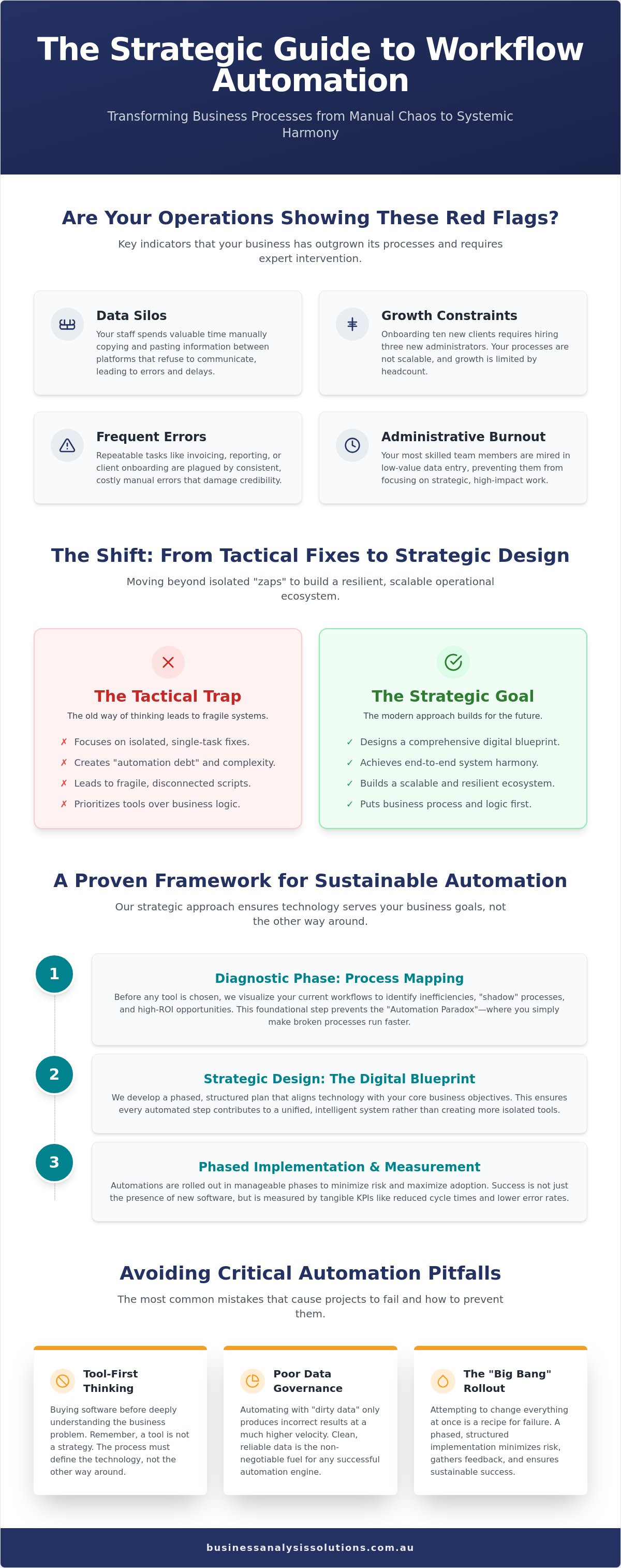
Tactical automation addresses localized pain points, such as auto-saving an email attachment to a specific folder. While helpful, these isolated fixes often create "automation debt" if they aren't part of a larger plan. A strategic approach involves designing a comprehensive digital transformation blueprint for business. This ensures every automated step contributes to a scalable, resilient ecosystem. Strategic oversight prevents the system fragility that occurs when dozens of disconnected scripts run without a central logic.
Key Indicators Your Organisation Requires Expert Intervention
How do you know when your business has outgrown basic tools? First, look for data silos. If your staff is manually copying information between platforms, your systems are failing to communicate. Second, identify growth constraints. If taking on ten new clients requires hiring three new administrators just to handle the paperwork, your processes aren't scalable. Finally, watch for frequent errors in repeatable tasks like onboarding or invoicing. These are clear signs that a workflow automation consultant is needed to replace manual fragility with systemic reliability. Expert intervention moves your team away from low-value data entry and back toward high-value strategic work.
The Diagnostic Phase: Why Process Mapping is the Foundation of Automation
Many organizations rush to buy software, hoping it will solve operational friction. This often leads to the "Automation Paradox." If you automate an inefficient or broken process, you simply generate errors at a higher velocity. A skilled workflow automation consultant prevents this by insisting on a rigorous diagnostic phase before any software is configured. This phase is about understanding the underlying logic before writing a single line of code or setting a trigger.
A comprehensive business efficiency diagnostic acts as the primary tool for identifying high-ROI opportunities. It uncovers "shadow" workflows, which are those unofficial, manual workarounds staff develop to bypass existing system limitations. These hidden processes are often where the most significant financial leakage occurs. By mapping these logics, we establish a clear baseline for performance. This allows for the creation of measurable KPIs, ensuring that success is defined by reduced cycle times or lower error rates rather than just the presence of new software. When getting started with workflow automation, skipping this diagnostic step is the most common cause of long-term project failure.
Visualising the Invisible: The Power of Process Mapping
Process mapping turns abstract operational concepts into concrete visual workflows. It's a collaborative exercise that forces stakeholders to agree on the current state of operations. During this stage, we often find redundant steps that add no value to the final outcome. Eliminating these before automation simplifies the technical architecture and reduces system maintenance. It's about refining the business logic so the automation can run cleanly. This visual clarity ensures everyone understands how data moves through the organization.
Determining the Technical Requirements Document
Once the process is optimized, it must be translated into a formal Technical Requirements Document (TRD). This document serves as the definitive bridge between business needs and technical execution. It lists every integration point, data transformation rule, and security protocol required. We evaluate your existing ICT infrastructure for compatibility and select tools based on security, scalability, and long-term support. A workflow automation consultant ensures that the chosen stack integrates seamlessly with your legacy systems without creating new data silos. This meticulous planning prevents the "tool-first" trap that leads many organizations to overspend on software they don't fully utilize.
Achieving this level of precision requires a deep commitment to professional business analysis that prioritizes long-term stability over quick fixes.
Implementing Your Digital Transformation: The 2026 Strategic Framework
Moving from a conceptual blueprint to operational reality requires disciplined project management. A workflow automation consultant doesn't just hand over a plan; they lead the execution phase to ensure that theoretical gains become practical results. In 2026, the complexity of enterprise environments makes "Big Bang" implementations exceptionally risky. Instead, we advocate for phased rollouts. This approach allows for iterative testing and validation, ensuring that each automated component functions perfectly before the next is introduced. It's about maintaining operational continuity while building your future state.
Integrating modern automation with legacy systems is often the most significant technical hurdle. Industry data indicates that integration with older, on-premise systems remains a hurdle for 41% of organizations. To resolve this, we apply a "Fractional CIO" perspective, looking at the entire ICT ecosystem rather than just the automation layer. This high-level view ensures that new workflows don't break existing dependencies. Understanding What is Workflow Automation in a practical, enterprise context means recognizing that success isn't just about the new tools, but how they harmonize with the old.
The Role of ICT Consultancy in System Integration
System integration is a matter of precision. We focus on ensuring data integrity across every integrated platform, preventing the duplication or loss of records. This involves managing complex API connections and implementing secure webhook protocols to protect sensitive business data. A robust implementation also includes comprehensive error-handling and notification systems. If a process fails, the system should automatically alert the right person and log the incident for immediate resolution. This level of technical oversight prevents small glitches from cascading into major operational disruptions.
Change Management and Staff Adoption
Technology alone doesn't drive transformation; people do. A workflow automation consultant must address the human element to prevent resistance and ensure long-term success. We focus on training teams to work alongside automated systems, repositioning automation as a tool that augments their capabilities rather than replacing them. This includes creating dynamic documentation that evolves as the process matures. Clear communication about the logic behind the change is essential for fostering a culture that embraces efficiency. Without staff buy-in, even the most sophisticated automation will fail to deliver its full ROI.
Avoiding the Top 3 Pitfalls of Workflow Automation Projects
While automation promises to reduce error margins, poor execution often leads to the "Automation Paradox." If you automate a flawed process, you simply accelerate the rate of failure. A seasoned workflow automation consultant identifies these risks early, ensuring that your digital transformation doesn't become a source of technical debt. Success in 2026 requires more than just technical connectivity; it demands a rigorous adherence to business logic and regulatory compliance.
The first major pitfall is "Tool-First Thinking." Organizations frequently purchase expensive software licenses before they've defined the problem they're trying to solve. This results in a fragmented ecosystem of tools that don't align with the actual needs of the staff. The second pitfall is neglecting data governance. Automation moves information at high speeds; if that data is inaccurate or "dirty," you create systemic errors at scale. With the EU AI Act becoming fully applicable on August 2, 2026, and the Colorado AI Act already in effect, poor data governance is now a significant compliance risk. Finally, many projects fail due to a lack of strategic ownership. When automation is treated as a one-off IT task rather than a core business strategy, the project eventually drifts away from its original ROI goals.
Why 'Off-the-Shelf' Solutions Often Require Professional Tailoring
The market is flooded with "one-click" automation templates. While these work for simple tasks, they rarely account for the specific exceptions and nuances of a complex business. Professional ICT solutions involve tailoring these tools to fit your unique operational requirements. A consultant ensures that the automation handles edge cases and errors gracefully, rather than simply stopping when it encounters an unexpected data point. Professional tailoring transforms a generic script into a resilient business asset.
Ensuring Long-Term Scalability and System Maintenance
Automation isn't a "set and forget" solution. Systems evolve, and software updates can break existing integrations. A workflow automation consultant builds workflows with modularity in mind, ensuring that an update to one platform doesn't collapse the entire chain. Regular efficiency audits are necessary to ensure that as your business scales, your automated processes remain optimized. Planning for this next phase of digital maturity prevents your operations from becoming stagnant. To ensure your systems are built for long-term resilience, you should partner with a strategic business analyst who understands the full lifecycle of digital transformation.
The Strategic Advantage: Why Partner with Business Analysis & Solutions?
Partnering with a seasoned workflow automation consultant provides more than just technical configuration. It offers access to a methodology refined over 20 years within the Australian professional landscape. At Business Analysis & Solutions, we prioritize resolution-driven results over temporary software fixes. Our objective is to move your organization beyond isolated digital patches to achieve true operational harmony. This requires a deep understanding of how technical systems intersect with human workflows and broader commercial objectives.
One of our core differentiators is the Fractional CIO services model. This approach grants your leadership team access to high-level digital strategy and ICT oversight without the financial burden of a full-time executive salary. It ensures that your automation projects aren't managed in a vacuum. Instead, they're aligned with your long-term growth plans and financial performance targets. We act as an analytical collaborator, ensuring that every digital investment delivers a measurable return.
A Methodology Rooted in Logic and Precision
Our engagement begins with a Business Efficiency Diagnostic. This structured assessment sets the stage for success by identifying precisely where friction exists. We focus on bridging the gap between granular technical specifications and your board-level goals. Crucially, we maintain complete independence from specific software vendors. This ensures our advice remains objective and entirely focused on what's best for your organization. We don't recommend tools based on commissions; we recommend them based on their ability to solve your specific challenges. This independence is vital for maintaining system integrity as you scale.
Ready to Optimise Your Organisational Performance?
The journey from initial diagnostic to full implementation is a path toward reclaiming your operational edge. Professional workflow automation consulting offers a tangible ROI by reducing operational costs without the need to increase headcount. It allows your staff to focus on high-value initiatives rather than repetitive administrative tasks. Reclaiming efficiency isn't just about the technology; it's about the strategic logic that drives it. If your organization is ready to transition from fragmented systems to a unified, scalable digital environment, the next step is a formal consultation to define your transformation blueprint.
Achieving Sustained Operational Excellence
Transitioning to a high-performance digital environment requires a shift from reactive fixes to proactive orchestration. We've explored how a meticulous diagnostic phase and the avoidance of common pitfalls, such as tool-first thinking, are essential for sustainable growth. By prioritizing process mapping and a structured Digital Transformation Blueprint, you ensure that every automated workflow serves your core business logic rather than complicating it. Engaging a professional workflow automation consultant provides the specialized oversight needed to navigate these complexities while maintaining strict data governance and system integrity.
Business Analysis & Solutions brings over 20 years of industry experience to every engagement, offering the specialized Fractional CIO expertise required for high-level digital strategy. It's time to move beyond administrative bottlenecks and reclaim your team's capacity for high-value work. Book Your Business Efficiency Diagnostic with Business Analysis & Solutions to begin your journey toward operational excellence. With a methodical approach and a commitment to resolution, you can achieve the system harmony necessary for scalable, long-term success.
Frequently Asked Questions
What exactly does a workflow automation consultant do?
A workflow automation consultant acts as a strategic architect who aligns your business logic with your technical infrastructure. They perform deep business analysis to identify inefficiencies and then design a digital transformation blueprint to resolve them. Unlike a technician who simply connects apps, a consultant ensures that every automated step contributes to measurable financial performance and operational harmony.
How do I know if my business is ready for automation?
Your business is ready when growth is constrained by administrative bottlenecks rather than a lack of demand. If your staff spends more time on manual data entry and copying information between systems than on high-value tasks, you have reached a critical tipping point. Frequent errors in repeatable processes like invoicing or onboarding are clear indicators that manual systems are no longer sufficient for your scale.
What is the difference between a workflow consultant and a software developer?
The distinction lies in the approach to problem-solving. A software developer builds custom code to create new functionality from the ground up. In contrast, a workflow automation consultant uses existing ICT solutions and process mapping to optimize how your business currently operates. They prioritize the strategic orchestration of your existing toolset to ensure system harmony without the complexity of custom development.
How long does a typical workflow automation project take to implement?
Implementation timelines vary based on the complexity of your ecosystem. A focused pilot program can often be deployed within a few weeks to demonstrate immediate value. Larger, enterprise-level transformations usually follow a phased rollout over several months. This methodical approach ensures that each integration is fully validated and secure before moving to the next stage of the digital transformation blueprint.
What is the expected ROI for hiring an automation consultant?
Enterprises that deploy professional workflow automation platforms see an average three-year ROI of 248%. This return is realized through the elimination of financial leakage caused by manual errors and the ability to scale operations without a proportional increase in headcount. By automating repetitive administrative tasks, your team can refocus on high-value strategic initiatives that directly drive revenue growth.
Can you automate processes in legacy systems that don't have APIs?
Yes, automation is possible even without modern APIs. While integration with legacy systems remains a significant hurdle for 41% of organizations, consultants use advanced orchestration techniques to bridge these gaps. This ensures that your older, on-premise systems can still participate in a modern, automated ecosystem. It prevents the need for a complete and costly software overhaul while still achieving operational efficiency.
How does a Fractional CIO assist with workflow automation?
A Fractional CIO provides high-level digital strategy and leadership without the expense of a full-time executive. They ensure that your automation projects align with broader organizational objectives and long-term ICT infrastructure plans. This perspective is vital for maintaining data governance and security, especially as new regulations like the EU AI Act impose stricter requirements on automated systems in 2026.
Is workflow automation only for large enterprises or can SMEs benefit?
SMEs often see the most immediate benefits from automation as it allows them to compete with much larger firms. It provides the capacity to handle higher volumes of work without the need to hire additional administrative staff. With cloud-based deployments anticipated to represent 61.4% of the market in 2026, these strategic tools are more accessible and scalable for smaller organizations than ever before.



Comments