Workflow Analysis and Design: A Strategic Framework for Operational Excellence
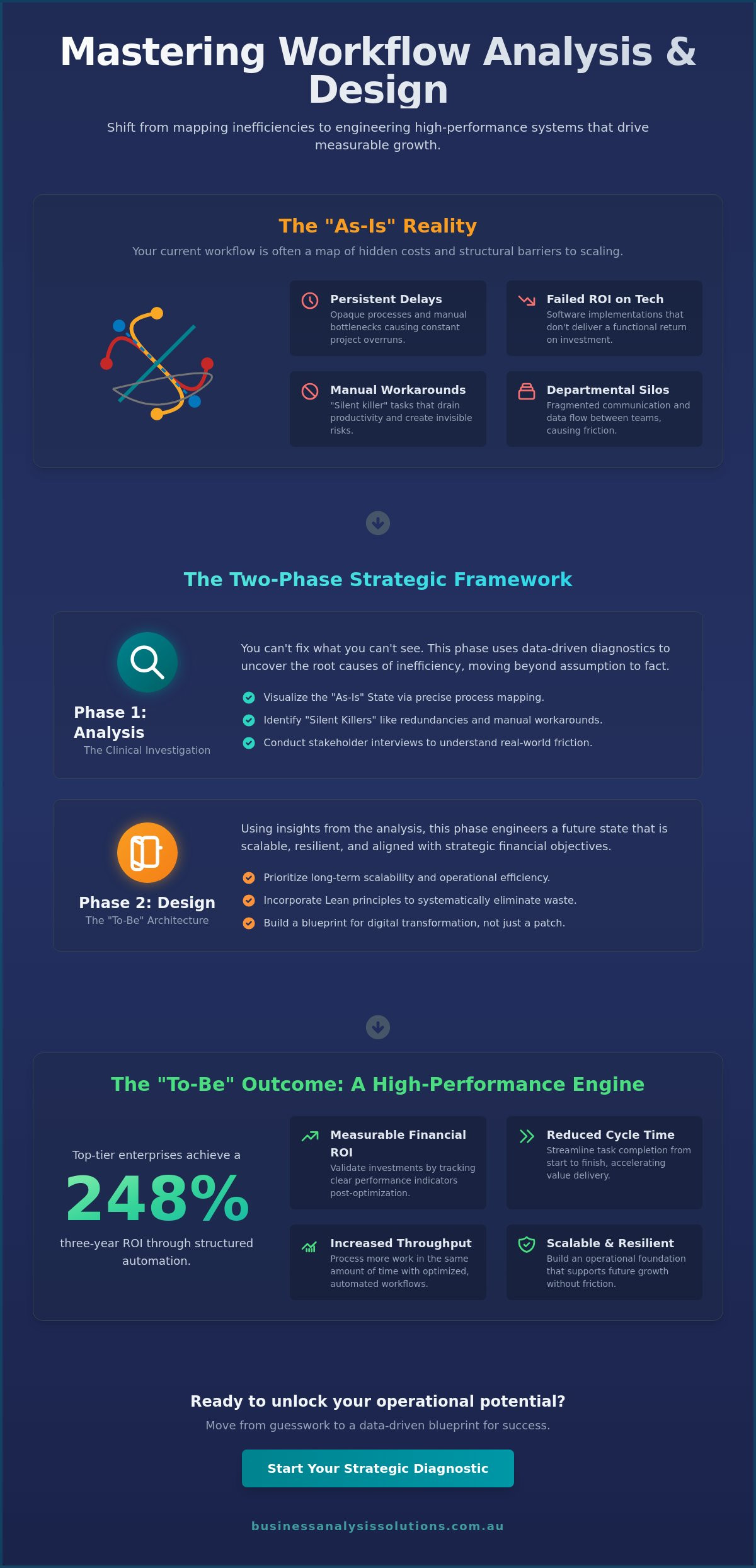
A workflow diagram is not a solution; it is often merely a map of your existing inefficiencies. Many executives recognize the frustration of opaque processes that cause persistent delays or software implementations that fail to deliver a functional return on investment. You likely understand that manual bottlenecks and departmental silos aren't just operational inconveniences; they are structural barriers to scaling. With 67% of companies now utilizing business process automation, the differentiator is no longer the tools you use, but the logic behind them. Mastering workflow analysis and design requires a shift from passive description to a rigorous strategic diagnostic.
This article provides a methodical framework to identify these friction points and engineer high-performance workflows that align with your financial objectives. We'll show you how to move beyond drawing boxes on a screen to building a system that delivers the 248% three-year ROI that top-tier enterprises achieve through structured automation. We will explore how to transition from fragmented operations to a scalable blueprint for digital transformation, ensuring your technical infrastructure and business goals remain in total harmony.
Key Takeaways
Differentiate between the diagnostic and the solution to ensure your operational updates address root causes rather than surface symptoms.
Identify "silent killers" such as redundancies and manual workarounds by visualizing your current "as-is" state through precise process mapping.
Implement a strategic framework for workflow analysis and design that prioritizes long-term scalability and incorporates Lean principles to eliminate waste.
Navigate the transition from mapping to digital rollout by leveraging expert project management and addressing internal resistance to process change.
Validate your operational investments by tracking measurable KPIs like cycle time and throughput to demonstrate clear financial performance post-optimization.
Table of Contents
Defining Workflow Analysis and Design in a Strategic Context
The Diagnostic Phase: Identifying Inefficiencies and Bottlenecks
Principles of Strategic Workflow Design: Architecture for Efficiency
Bridging the Gap: From Process Mapping to Digital Implementation
Measuring Success: The ROI of Methodical Workflow Optimisation
Defining Workflow Analysis and Design in a Strategic Context
Operational excellence isn't achieved through the haphazard adoption of new tools. It requires a rigorous commitment to workflow analysis and design, a two-part discipline that bridges the gap between executive vision and daily execution. While many organizations treat these as interchangeable, they represent distinct phases of a strategic diagnostic. Analysis is the clinical investigation of your current "as-is" state, while design is the engineering of a future "to-be" architecture that prioritizes efficiency. By 2026, the shift toward digital-first architectures has made manual process mapping insufficient. Modern leaders now view these workflows as the connective tissue between organizational system harmony and financial performance.
Understanding what is a workflow? at a foundational level is the first step toward optimization. It isn't just a sequence of tasks; it's a value-delivery system. When these systems are misaligned, the result is friction, increased operational costs, and missed market opportunities. A methodical approach ensures that every action taken within the business contributes directly to a strategic outcome.
The Core Components of a High-Performance Workflow
A high-performance workflow functions as a logical engine of value creation. It begins with inputs, such as raw data or client requests, which undergo specific transformations to become valuable outputs. If the logic of these transformations is flawed, the output will inevitably be sub-optimal. Clear roles and responsibilities are equally critical. You must eliminate ambiguity in task ownership to prevent departmental silos and duplicated effort. Finally, the flow of information must be seamless. Data needs to reach the right decision-maker at the right time. Without this precision, even the most talented teams will struggle with delays and fragmented communication.
Analysis vs. Design: A Symbiotic Relationship
You can't design a superior future state without a clinical analysis of your current reality. Jumping straight to the "to-be" design often leads to failed software implementations because the underlying bottlenecks remain unaddressed. This diagnostic phase identifies the "silent killers" of productivity, such as redundant approvals or manual workarounds that have become standard practice over time. A comprehensive digital transformation blueprint for business integrates both phases. It uses the data gathered during analysis to inform a design that is scalable, resilient, and capable of driving measurable growth. This symbiotic relationship ensures that your operational changes are rooted in logic rather than guesswork.
The Diagnostic Phase: Identifying Inefficiencies and Bottlenecks
Effective workflow analysis and design begins with a radical commitment to transparency. You cannot optimize what you haven't accurately measured. Visualizing the "as-is" state through process mapping is the first step in moving beyond executive assumptions. This diagnostic phase isn't a formality; it's a clinical investigation. Relying on anecdotal evidence often masks the root causes of failure. Instead, professional discovery uses process mining to capture the actual path of a task, revealing the discrepancies between the official manual and daily reality. This data-driven approach ensures that your subsequent design choices are based on fact, not intuition.
Stakeholder interviews are the qualitative anchor of this process. While data shows the delays, your team explains the friction. They're the ones navigating the manual workarounds and redundancies that act as silent killers of organizational momentum. These inefficiencies often arise from departmental silos where one team's output isn't formatted for the next team's input. Conducting a business efficiency diagnostic provides the structured environment needed to surface these hidden costs. It's about finding the friction points before they become systemic failures and ensuring that every stakeholder's perspective is integrated into the final solution.
Methodologies for Effective Workflow Analysis
Choosing the right framework is essential for a precise diagnostic. Value Stream Mapping is particularly effective for distinguishing between value-adding activities and non-value-adding waste. This allows you to strip away the "noise" that complicates your operations and focus on what actually drives revenue. Gap Analysis then measures the distance between your current performance and your strategic objectives. By utilizing established methodologies for workflow analysis, you ensure that your findings are grounded in proven management science rather than subjective opinion. This rigor is what separates a temporary fix from a long-term operational strategy.
Quantifying the Cost of Inefficiency
Inefficiency carries a heavy financial burden that rarely appears as a single line item on a balance sheet. It's buried in "hidden" labor costs where employees spend hours on manual data entry that should be automated. This friction eventually erodes the customer experience, leading to churn and a damaged brand reputation. A bottleneck is a point where demand exceeds capacity, causing a cascade of operational delays. Once these delays become predictable, you've lost your competitive edge. If you're looking to resolve these issues, ICT solutions can provide the technical framework to turn your diagnostic findings into a functional advantage.
Principles of Strategic Workflow Design: Architecture for Efficiency
Strategic design serves as the engineering phase of workflow analysis and design. It moves beyond the simple visual representation of tasks to create a functional architecture that supports long-term organizational goals. A successful design doesn't just describe what happens; it dictates how value is created with the least possible resistance. This requires a commitment to scalability, ensuring that as your volume increases, your operational costs don't rise at the same rate. By building modular processes, you create a system that grows alongside the organization without requiring a total overhaul every eighteen months.
The "Lean" approach is fundamental to this stage. You must strip away redundant approvals and circular logic before they are codified into a new digital structure. This is where many organizations fail by treating design as a graphic exercise rather than a strategic one. Integrating ICT solutions effectively means knowing when to automate a task and when to simplify the underlying human logic. Achieving system harmony is the ultimate goal, where new workflows interact seamlessly with existing legacy systems to maintain data integrity and operational continuity.
Designing the "To-Be" State
When designing the "to-be" state, you must prioritize high-impact processes that offer the most immediate operational relief. This requires a deep business technology alignment to ensure your software capabilities match your process requirements. Utilizing established frameworks for workflow mapping and redesign allows you to create flexible frameworks. These systems don't just solve today's problems; they remain resilient in the face of market volatility and shifting consumer demands.
Automation Implementation as a Design Element
Automation is a powerful design element, but it's not a universal remedy. You should first identify "low-hanging fruit", which are repetitive, high-volume tasks that consume disproportionate staff time. However, you must avoid the "paving the cow path" error. Automating a broken or illogical process only accelerates inefficiency. Every automated sequence needs human-in-the-loop checkpoints for quality assurance. This ensures that while the machine handles the heavy lifting, professional oversight remains the final arbiter of quality and compliance.
Bridging the Gap: From Process Mapping to Digital Implementation
The transition from a conceptual model to a functional digital environment is the most precarious phase of workflow analysis and design. While the diagnostic phase identifies what needs to change, implementation dictates whether that change actually sticks. Many workflow designs fail at this stage because organizations treat implementation as a purely technical event. It's actually a strategic transformation. Success requires a marriage of technical precision and human-centric change management to overcome internal resistance and ensure system adoption. With 67% of companies now using some form of business process automation, the differentiator is no longer the software itself, but the rigor of the rollout.
Effective execution relies on project management that prioritizes clarity and accountability. Without this structured oversight, the gap between the process map and the live environment becomes a source of significant risk. This is where organizations often fail to realize the 248% three-year ROI that top-tier enterprises achieve through methodical automation. Professional oversight ensures that the technical requirements of the new workflow remain aligned with the broader organizational objectives identified during the design phase.
Executing the Digital Transformation Blueprint
Managing risk during a rollout often involves choosing between phased transitions or a comprehensive "Big Bang" approach. Phased rollouts allow for User Acceptance Testing (UAT) in controlled environments, ensuring the design works in the field before a full-scale launch. This iterative process creates continuous feedback loops. These loops allow for refining the design post-implementation, ensuring the system remains responsive to actual user needs rather than just theoretical requirements. It's a pragmatic approach that reduces downtime and prevents the disruption of critical business functions.
The Role of Technical Leadership
Technical leadership is the anchor of any successful digital shift. This role involves bridging the communication gap between business units and IT departments. It's about ensuring data integrity and cybersecurity remain uncompromised during workflow transitions. Utilizing a Fractional CIO services Australia model provides executive-level oversight without the overhead of a full-time hire. This model is particularly effective for managing vendor relationships and ensuring that new automation tools align with the broader digital strategy. If your organization requires a clinical assessment of its current operations, engaging in professional business analysis ensures that your digital implementation is built on a foundation of logic.
Measuring Success: The ROI of Methodical Workflow Optimisation
A successful framework for workflow analysis and design must culminate in measurable outcomes. Without clear Key Performance Indicators (KPIs), operational changes remain subjective rather than strategic. You should prioritize metrics that reflect the health of your engine: throughput, cycle time, and error rates. Throughput measures the volume of work completed within a specific timeframe, while cycle time tracks the duration from initiation to delivery. Post-design, you'll expect to see a significant reduction in error rates as manual intervention is minimized. These data points provide the empirical evidence needed to justify the initial investment and demonstrate the 248% three-year ROI that Forrester research identifies as the enterprise standard for workflow automation platforms.
The impact extends beyond the balance sheet to employee morale and retention. When you eliminate the friction of broken processes, you remove the daily frustrations that lead to burnout. Staff can focus on high-value cognitive tasks rather than the repetitive manual workarounds identified in the diagnostic phase. Partnering with a professional business analysis consultancy Perth ensures these results are sustainable. This expertise provides the rigorous oversight required to prevent "process drift," where teams slowly revert to inefficient habits over time. It's about maintaining the system harmony you've worked to establish.
The Strategic Advantage of Operational Clarity
Operational clarity transforms decision-making by replacing guesswork with transparent data flows. When your workflows are optimized, you achieve a "single source of truth" across the organization, ensuring that every department operates from the same verified dataset. This transparency fosters organizational agility. You gain the ability to pivot operations rapidly in response to competitive threats or market volatility. Instead of being hindered by rigid, legacy structures, your business becomes a dynamic system capable of scaling without a proportional increase in overhead costs.
Next Steps: Initiating Your Efficiency Diagnostic
Initiating an efficiency diagnostic doesn't require a total halt to your daily operations. You can begin with a targeted analysis of a single high-impact department to prove the methodology before a wider rollout. Selecting the right partners for strategic ICT consultancy is critical; they must understand the intersection of technical requirements and executive financial goals. This structured approach ensures that your transition toward digital maturity is both predictable and profitable. Workflow design is a continuous journey of refinement, not a one-time project.
Transforming Operational Friction into Strategic Advantage
A methodical commitment to workflow analysis and design is the catalyst for moving beyond stagnant, manual processes toward a high-performance digital architecture. Success is not found in software alone, but in the clinical diagnostic that identifies bottlenecks and the strategic design that ensures long-term scalability. By bridging the gap between technical requirements and executive financial goals, your organization can achieve the system harmony necessary for sustainable growth.
Achieving this level of operational excellence requires a partner who understands the complexities of the Australian business landscape. With over 20 years of strategic ICT experience, our team specializes in resolving structural inefficiencies through a proven, logic-driven methodology. It's time to replace opaque workarounds with a clear, scalable blueprint for performance. Book Your Business Efficiency Diagnostic to begin the transition from fragmented operations to a unified, results-oriented framework. We look forward to engineering a solution that delivers tangible value to your organization.
Frequently Asked Questions
What is the difference between workflow analysis and process mapping?
Process mapping is the visual documentation of a sequence, whereas workflow analysis is the strategic evaluation of those tasks to identify friction. Mapping provides the "as-is" visualization of current operations. Analysis applies management logic to determine if those steps are necessary or if they represent operational waste. You need both to build a functional bridge between current inefficiencies and future performance goals.
How long does a typical workflow analysis and design project take?
Project durations depend on the scope of the organization, typically spanning four to twelve weeks. A targeted diagnostic for a specific business unit is often completed in a month. However, a comprehensive workflow analysis and design for an entire enterprise requires a phased rollout to manage risk and ensure thorough user acceptance testing across all departments.
Does workflow design always require new software implementation?
New software isn't always a requirement for effective design. Many operational challenges are resolved by simplifying human logic, clarifying task ownership, and eliminating redundant approval layers. While ICT solutions often facilitate these changes, the primary goal is to align your existing resources with your strategic objectives before considering additional technical investments or software acquisitions.
What are the most common signs that a workflow needs analysis?
Common indicators include departmental silos, repeated data entry, and a reliance on manual workarounds. If your staff spends more time managing process friction than delivering value, your architecture is failing. These "silent killers" of productivity suggest that your internal workflow analysis and design is no longer capable of supporting your current volume or complexity.
How do you measure the ROI of a workflow redesign?
You measure success by tracking specific KPIs such as cycle time, error rates, and total throughput. Comparing these metrics against your pre-optimization baseline reveals the tangible impact on your financial performance. Enterprises often target the 248% three-year ROI benchmark identified by industry research to validate the effectiveness of their operational restructuring and digital transformation efforts.
Can workflow analysis help with regulatory compliance?
It plays a critical role in compliance by embedding mandatory checkpoints into your daily operations. This is particularly relevant for organizations preparing for the ISO 9001:2026 revision. Standardized designs ensure that every action is documented and follows a predictable path, creating a reliable audit trail that satisfies both internal governance requirements and external regulatory bodies.
What role does artificial intelligence play in workflow design in 2026?
In 2026, AI has moved beyond task automation to "agentic" workflows that make autonomous decisions based on real-time data. These systems handle complex transformations that previously required human intervention. This shift allows for hyperautomation, where entire end-to-end processes are optimized for speed and accuracy without sacrificing professional oversight or the necessary quality assurance checkpoints.
Should we perform workflow analysis in-house or hire a consultant?
Hiring a consultant provides the objective distance necessary for a clinical diagnostic of your current state. While in-house teams understand the daily culture, they often lack the specialized expertise required to bridge technical ICT requirements with executive financial goals. An external partner brings a methodical, results-driven approach that prioritizes system harmony and long-term scalability over the easiest immediate fix.



Comments