Why Do Digital Transformation Projects Fail? The Strategic Analysis for 2026
- jonesaqayalo
- May 3
- 11 min read
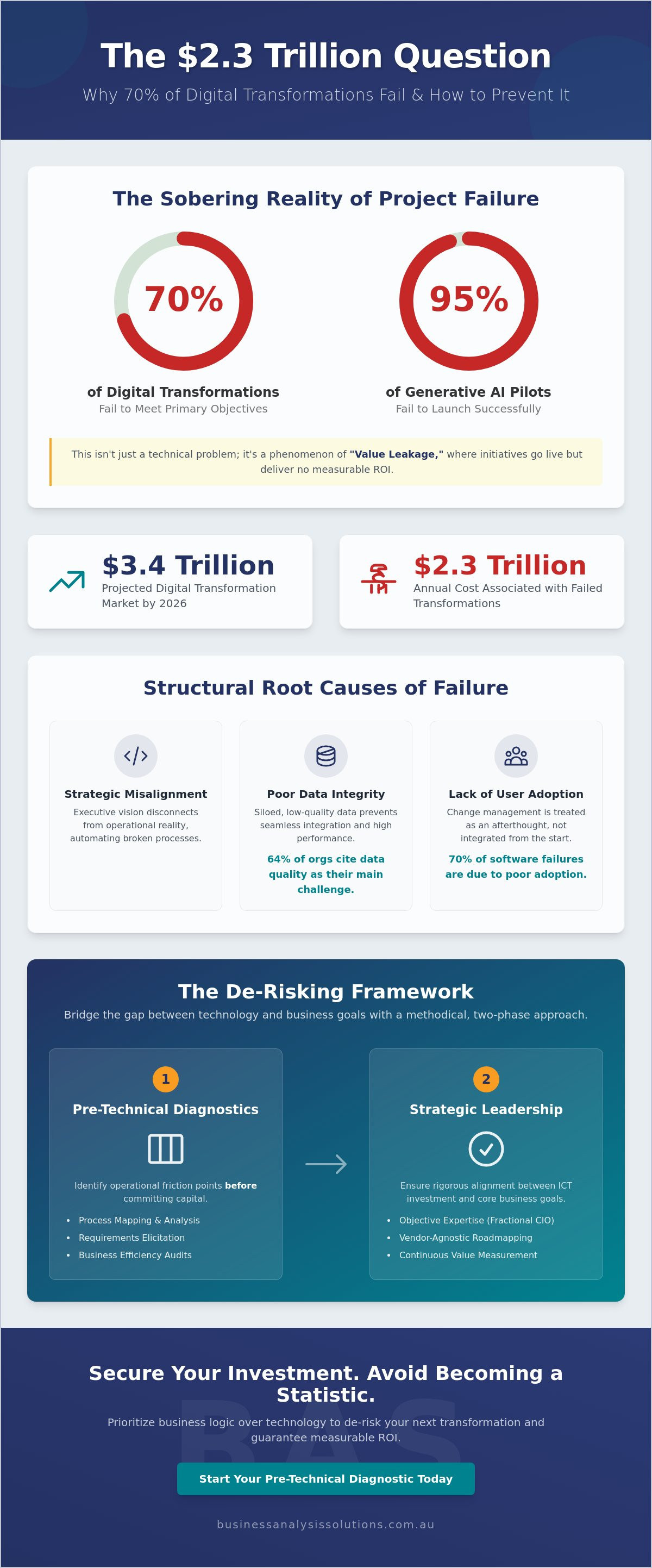
With the global digital transformation market projected to reach $3.4 trillion by 2026, it is sobering to acknowledge that 70% of these initiatives fail to meet their primary objectives. For generative AI pilots, this failure rate surges to 95%. You likely recognize the symptoms of this systemic issue: wasted ICT budgets, stakeholder fatigue, and operational disruptions that yield no measurable ROI. It's frustrating to see significant capital allocated to technology while core business problems remain untouched. Understanding why do digital transformation projects fail requires looking past the software to the underlying business logic that dictates project outcomes.
This analysis identifies the structural root causes of failure and provides the methodical framework necessary to secure your investment. You'll gain a clear understanding of how to bridge the gap between technical requirements and business goals to avoid the $2.3 trillion annual cost associated with failed transformations. We will examine the critical role of pre-technical diagnostics, the impact of the 2026 IT skills shortage, and a repeatable process for achieving strategic alignment.
Key Takeaways
Redefine project failure as "value leakage" and understand why the 70% failure rate persists due to inadequate requirements elicitation.
Identify why do digital transformation projects fail when organizations prioritize "shiny object" technologies over fundamental process optimization.
Apply a two-phase diagnostic solution, incorporating process mapping and efficiency audits, to identify operational friction points before committing capital.
Leverage the objective expertise of a Fractional CIO to ensure rigorous strategic alignment between your ICT investment and core business goals.
Table of Contents The State of Digital Transformation in 2026: Defining Failure The Structural Root Causes: Why ICT Projects Collapse The "Technology First" Trap: AI and Automation Risks The Diagnostic Solution: De-Risking Your Transformation Strategic Leadership: The Role of a Fractional CIO
The State of Digital Transformation in 2026: Defining Failure
Failure in 2026 isn't a binary outcome. While some projects are cancelled outright, the more pervasive issue is value leakage. This phenomenon occurs when an initiative technically "goes live" but fails to deliver the projected return on investment or operational improvements. Organizations often focus on the broad scope of Digital Transformation without establishing a rigorous baseline for success. This lack of precision leads to a scenario where approximately 70% of projects fail to meet their primary objectives. It's a statistic that has remained stagnant for a decade because many leaders continue to treat technology as a cure-all rather than a tool for specific business logic.
The persistent question of why do digital transformation projects fail often finds its answer in the absence of a requirements-first mindset. When technology precedes logic, the result is cultural erosion and missed market opportunities. These hidden costs are often more damaging than the initial capital loss. Employees lose faith in leadership's ability to provide effective tools, leading to stakeholder fatigue that can stall future innovation for years. To secure an investment, firms must move away from passive descriptions of digital goals and toward active, results-driven strategic alignment.
The Three Faces of Transformation Failure
Project collapse usually manifests in three distinct ways. First, budgetary overruns occur because initial estimates are often mathematically flawed, failing to account for the complexity of legacy system integration or data cleansing requirements. Second, timeline slippage becomes inevitable when "scope creep" takes hold in the absence of a strategic blueprint. Finally, there is the "Ghost Solution." This involves delivering a tool that meets technical specifications but remains unused by the workforce. This represents a total loss of capital and a failure of user adoption strategies.
The 2026 Productivity Paradox
The 2026 productivity paradox describes a state where an increase in software deployment leads to a decrease in overall output. Without proper integration, redundant systems create friction rather than flow. True success is measured by business efficiency, not the number of licenses purchased or the complexity of the tech stack. Identifying the gap between technical capability and operational reality is the first step in de-risking your investment. If the software doesn't solve a documented business problem identified through rigorous requirements elicitation, it shouldn't be part of the roadmap. Success requires a methodical approach that prioritizes process mapping before a single line of code is written or a vendor contract is signed.
The Structural Root Causes: Why ICT Projects Collapse
Identifying why do digital transformation projects fail requires a forensic look at the structural foundation of the initiative. Most collapses aren't the result of a single technical glitch. Instead, they stem from a series of logical failures during the planning phase. When the executive vision doesn't align with operational reality, the project is compromised before the first line of code is written. This disconnect leads to a top-down mandate that ignores how work is actually performed on the floor. Without a rigorous diagnostic approach, organizations risk spending millions to automate processes that are fundamentally broken.
Data integrity remains a significant hurdle. In 2026, 64% of organizations identify data quality as their primary challenge. When information is trapped in silos, transformation efforts cannot achieve the seamless integration required for high-level performance. Treating people as an afterthought is a fatal error. With 70% of software implementations failing due to poor user adoption, change management must be integrated into the project's DNA, not added as a final step. A structured Business Analysis & Solutions framework ensures these risks are mitigated before they impact the bottom line.
The Failure of Stakeholder Engagement
Effective transformation demands more than executive sponsorship; it requires deep engagement across every level of the hierarchy. Stakeholder engagement is the cornerstone of project management, serving as the primary mechanism for uncovering the "Shadow IT" systems employees use to bypass inefficient official processes. If these hidden workflows aren't mapped and addressed, the new solution will likely be ignored. Success depends on moving from passive consultation to active collaboration, ensuring the final tool solves real-world friction points.
Requirements Ambiguity: The Enemy of Progress
Ambiguity is the most expensive flaw in any ICT project. There is a vast difference between what a business "wants" and what it actually "needs" to function optimally. A lack of professional business analysis consultancy often leads to flawed blueprints that software vendors follow to the letter. This results in the "perfectly built wrong solution." You cannot assume that a vendor understands your unique business logic. Precision in requirements elicitation is the only way to ensure the technology serves the strategy, rather than the other way around. Without this clarity, projects inevitably succumb to scope creep and budgetary exhaustion.
The "Technology First" Trap: AI and Automation Risks
The allure of emerging technology often distracts leadership from core operational requirements. This "Shiny Object" syndrome is a primary reason why do digital transformation projects fail in 2026. While market pressure to adopt artificial intelligence is intense, 95% of generative AI pilots currently fail to deliver a measurable business impact. This occurs when organizations implement solutions based on industry hype rather than a documented business need. Strategic business technology must serve the organizational strategy; it should never be the factor that defines it.
Custom software development presents another significant risk to project viability. Many firms opt for bespoke builds when a well-configured off-the-shelf integration would offer superior reliability and lower maintenance costs. Bespoke solutions often introduce unnecessary complexity that exceeds the internal team's capacity to manage. This is particularly dangerous as 90% of organizations face IT skills shortages this year. When you build a complex custom tool without the internal resources to support it, you create a legacy debt that hampers future agility. A logic-based approach prioritizes integration over invention whenever possible.
Automation vs. Optimisation
Automating an inefficient process only amplifies its flaws. True progress requires rigorous business process mapping before any technical implementation begins. This diagnostic phase identifies "low-hanging fruit" where automation can deliver immediate ROI without the need for massive architectural overhauls. A "Digital Strategy Blueprint" acts as a roadmap, ensuring that every technical decision aligns with the "as-is" reality and the "to-be" objective. Without this blueprint, projects drift into "feature creep," where the solution becomes too bloated and expensive to be effective for the end user.
The Risks of Unmanaged AI Integration
Unmanaged AI integration poses severe governance and security risks. Adherence to the "Essential 8" cyber security framework is mandatory for modern digital shifts, yet it is often overlooked in the rush to pilot new tools. Effective AI requires a high-quality data architecture. You cannot build intelligence on a foundation of fragmented or poor-quality data. Since 64% of organizations struggle with data integrity, the focus must remain on data governance rather than the AI interface itself. Managing the hype cycle in executive meetings requires an objective partner who prioritizes logic over marketing promises. Leaders must ask whether a tool solves a specific friction point or simply satisfies a desire for innovation.
The Diagnostic Solution: De-Risking Your Transformation
To move beyond the recurring question of why do digital transformation projects fail, leaders must adopt a phased diagnostic approach that prioritizes logic over technology. The first phase involves a Business Efficiency Diagnostic to identify the "as-is" state of the organization. This isn't a surface-level audit; it's a forensic deep dive into how data moves between departments and where it stalls. Phase two uses process mapping to visualize the exact friction points where manual workarounds or legacy systems impede performance. By identifying these bottlenecks before selecting a vendor or a tool, you ensure the technical solution addresses a validated business need rather than a perceived one.
The third phase is the development of a strategic roadmap that provides a clear sequence of implementation. This replaces the "big bang" implementation strategy, which often leads to catastrophic operational disruptions and wasted budget. Phase four focuses on the "Pilot and Iterate" model. By breaking the transformation into manageable, high-impact sprints, you can gather user feedback and adjust the system logic before a full-scale rollout. This iterative method minimizes financial risk and ensures that the final product is both functional and fully adopted by the workforce.
The Business Efficiency Diagnostic
A comprehensive diagnostic evaluates existing ICT solutions against specific business objectives to uncover hidden technical debt. Redundant systems and overlapping software licenses often hide within disparate departments, costing organizations an average of 12% of their annual revenue in wasted resources. This rigorous evaluation provides the clarity needed to prune unnecessary software and consolidate data into a single source of truth. A professional diagnostic prevents the 70% failure rate by ensuring that every technical requirement is anchored in operational reality rather than a vendor's sales pitch.
Creating a Digital Transformation Blueprint
A successful roadmap requires more than a list of software; it requires a digital transformation blueprint for business that maps every technical change to specific KPIs. This blueprint establishes a realistic timeline based on actual resource availability and staff capacity rather than optimistic projections. It defines the technology stack required for seamless integration, ensuring that information flows freely between systems without manual intervention. Establishing this foundation is the only way to achieve long-term ROI and strategic alignment. If you are ready to secure your project's future, you can book a business efficiency diagnostic to begin the process.
Strategic Leadership: The Role of a Fractional CIO
Leadership voids are often the silent killers of ICT initiatives. While technical teams focus on delivery and executives focus on vision, the strategic bridge between them frequently remains unbuilt. This vacuum is a primary reason why do digital transformation projects fail in mid-sized organizations. Without dedicated executive IT oversight, projects lose their alignment with business goals, leading to the "value leakage" identified earlier. A Fractional CIO fills this gap by providing objective, third-party guidance that prioritizes the organization's interests over vendor sales targets.
Transparency in project delivery is impossible without expert oversight. ICT vendors often present progress reports that mask underlying logic flaws or integration risks. Business Analysis & Solutions provides the methodical oversight required to interrogate these reports and ensure the project remains on track. By maintaining a strict focus on requirements elicitation and strategic alignment, we prevent the "Ghost Solutions" that plague 70% of modern transformations. Our approach ensures that every dollar spent on technology translates into a documented operational improvement.
Executive IT Advisory On-Demand
Accessing 20+ years of industry experience shouldn't require the prohibitive cost of a full-time executive salary. The Fractional CIO model offers a "Trusted Advisor" perspective in the boardroom, allowing leaders to make data-driven decisions with confidence. This role ensures that ICT project management stays strictly aligned with the original blueprint, preventing the scope creep that typically exhausts budgets. We act as the analytical partner who untangles organizational complexities and replaces ambiguity with a structured, logical roadmap for success.
Taking the First Step Toward Success
The first 30 days of any transformation are the most critical. This period establishes the communication rhythm and the diagnostic baseline that will govern the entire project lifecycle. We employ a direct, no-nonsense approach to communication that avoids hyperbole and focuses on tangible results. If your organization is struggling to understand why do digital transformation projects fail in your specific context, it's time to move from speculation to diagnostic certainty. Securing your investment requires a partner who values precision and performance over marketing promises. To begin de-risking your initiative and ensuring technical requirements meet business objectives, request a Business Efficiency Diagnostic today.
Securing Your Digital Future Through Strategic Alignment
The path to a successful transformation in 2026 requires a shift from reactive technology adoption to proactive business logic. Precision prevents failure. By prioritizing requirements elicitation and process mapping, you eliminate the ambiguity that compromises 70% of ICT initiatives. A diagnostic approach ensures your technical roadmap is anchored in operational reality, transforming potential value leakage into measurable ROI. Understanding why do digital transformation projects fail allows you to implement the methodical oversight necessary for high-level performance.
Business Analysis & Solutions brings over 20 years of strategic ICT experience to help you bridge the gap between complex technology and your core business objectives. Our logic-driven framework replaces uncertainty with a clear, repeatable path to success. Don't let your transformation become another statistic in the $2.3 trillion annual loss attributed to project collapse. It's time to untangle your organizational complexities through structured, professional leadership. Secure your project with a Business Efficiency Diagnostic and ensure your technology serves your strategy. Your organization is capable of achieving seamless integration through the right analytical partnership.
Frequently Asked Questions
What is the most common reason digital transformation projects fail?
The most common cause is a lack of strategic alignment between technical requirements and business objectives. When technology precedes business logic, projects inevitably drift. This misalignment results in tools that meet technical specifications but fail to solve actual operational friction points. Success requires a meticulous diagnostic phase to ensure the solution serves a documented business need.
How does business process mapping prevent ICT project failure?
Business process mapping prevents failure by providing a visual blueprint of your current operational friction points. This practice ensures you don't automate a broken or inefficient process, which only leads to faster failure. By identifying the "as-is" state, you can optimize workflows before technical implementation. This methodical approach ensures the new software delivers tangible efficiency gains rather than additional complexity.
What is a Digital Transformation Blueprint and why do I need one?
A Digital Transformation Blueprint is a comprehensive roadmap that aligns your technology stack with specific business KPIs. You need one to maintain a steady communication rhythm and prevent the scope creep that typically exhausts budgets. It serves as a single source of truth for stakeholders, ensuring everyone understands the sequence of implementation and the resource requirements for each phase.
Can a Fractional CIO help a project that is already failing?
A Fractional CIO can salvage a failing project by performing a forensic audit to identify where value leakage is occurring. They provide an objective, third-party perspective that internal teams often lack. By re-evaluating requirements elicitation and managing vendor transparency, they can realign the project with original business goals and stabilize the implementation timeline before further capital is wasted.
How much should a business spend on a diagnostic before starting a transformation?
Industry standards suggest organizations should allocate 10% to 15% of their total ICT budget to the diagnostic and planning phase. This investment in precision acts as a safeguard against the 12% revenue loss typically associated with failed transformations. Spending on a rigorous Business Efficiency Diagnostic ensures that the remaining 85% of your budget is allocated to the correct technical solutions.
What is the difference between digital transformation and just upgrading software?
Digital transformation is a fundamental redesign of business logic to improve end-to-end efficiency, while upgrading software is simply replacing an old tool with a newer version. Transformation requires cultural change and strategic alignment across the entire hierarchy. Upgrading software might improve a single task, but transformation optimizes the entire value chain through integrated, data-driven processes.
How do I know if my business is ready for automation implementation?
Your business is ready for automation when core processes are standardized and your data architecture is clean. If your team relies on manual workarounds or "Shadow IT" to complete daily tasks, automation will likely fail. Readiness is achieved once you have mapped your processes and confirmed that your data quality can support the intended automated logic without human intervention.
Why do 70% of digital transformations still fail in 2026?
The failure rate remains high because many leaders still prioritize "shiny object" technologies over fundamental business analysis. In 2026, the 90% IT skills shortage also makes it difficult to maintain complex, bespoke builds. This environment continues to force the question of why do digital transformation projects fail when the answer remains a lack of methodical, logic-driven oversight during the planning phase.



Comments