When to Hire a Fractional CIO: A Strategic Guide for Australian Businesses
With 78% of Australian tech leaders identifying AI as the defining trend of 2026, many organizations find themselves caught in a cycle of reactive spending rather than strategic investment. Knowing exactly when to hire a fractional CIO is now a critical decision for businesses that have outgrown informal IT management but don't yet require a full-time executive. You likely feel the pressure of rising technology costs and the mounting complexity of cybersecurity requirements. It's a common point of friction where technical requirements and broader organizational objectives fall out of alignment.
We understand the anxiety that comes with these shifts and the urgency to maintain a competitive advantage. You deserve a clear technology roadmap that replaces ambiguity with methodical progress. This guide identifies the specific triggers that signal your need for executive-level ICT advisory and a structured digital strategy. We'll explore how to bridge the gap between technical maintenance and high-level leadership to ensure your systems drive measurable financial performance and long-term stability.
Key Takeaways
Distinguish between operational maintenance and strategic leadership to ensure technology investments align with your broader organizational objectives.
Identify the specific triggers, such as internal process friction and the "technology ceiling," that signal exactly when to hire a fractional CIO.
Understand the strategic gap between Managed IT Services and the executive oversight required for governance, vendor management, and system harmony.
Evaluate the financial benefits of securing high-level ICT advisory to eliminate redundant subscription costs and improve operational efficiency.
Learn how to leverage a Business Efficiency Diagnostic to create a Digital Transformation Blueprint tailored to your specific growth targets.
Table of Contents
What is a Fractional CIO? Defining Strategic IT Leadership in 2026
5 Critical Indicators: When to Hire a Fractional CIO for Your Business
Fractional CIO vs. Managed IT Services: Understanding the Strategic Gap
Evaluating ROI: The Financial and Operational Case for Fractional Leadership
Implementing Your Digital Strategy with Business Analysis & Solutions
What is a Fractional CIO? Defining Strategic IT Leadership in 2026
A fractional CIO is a senior executive who provides high-level digital strategy and leadership on a part-time or contract basis. This model has emerged as the standard for Australian mid-market firms in 2026. It allows organizations to access the same caliber of expertise found in enterprise-level boardrooms without the significant overhead of a full-time executive salary. While a traditional IT manager focuses on the technical details of the network, a fractional CIO acts as a strategic partner, ensuring that every technology investment aligns with the broader commercial objectives of the business.
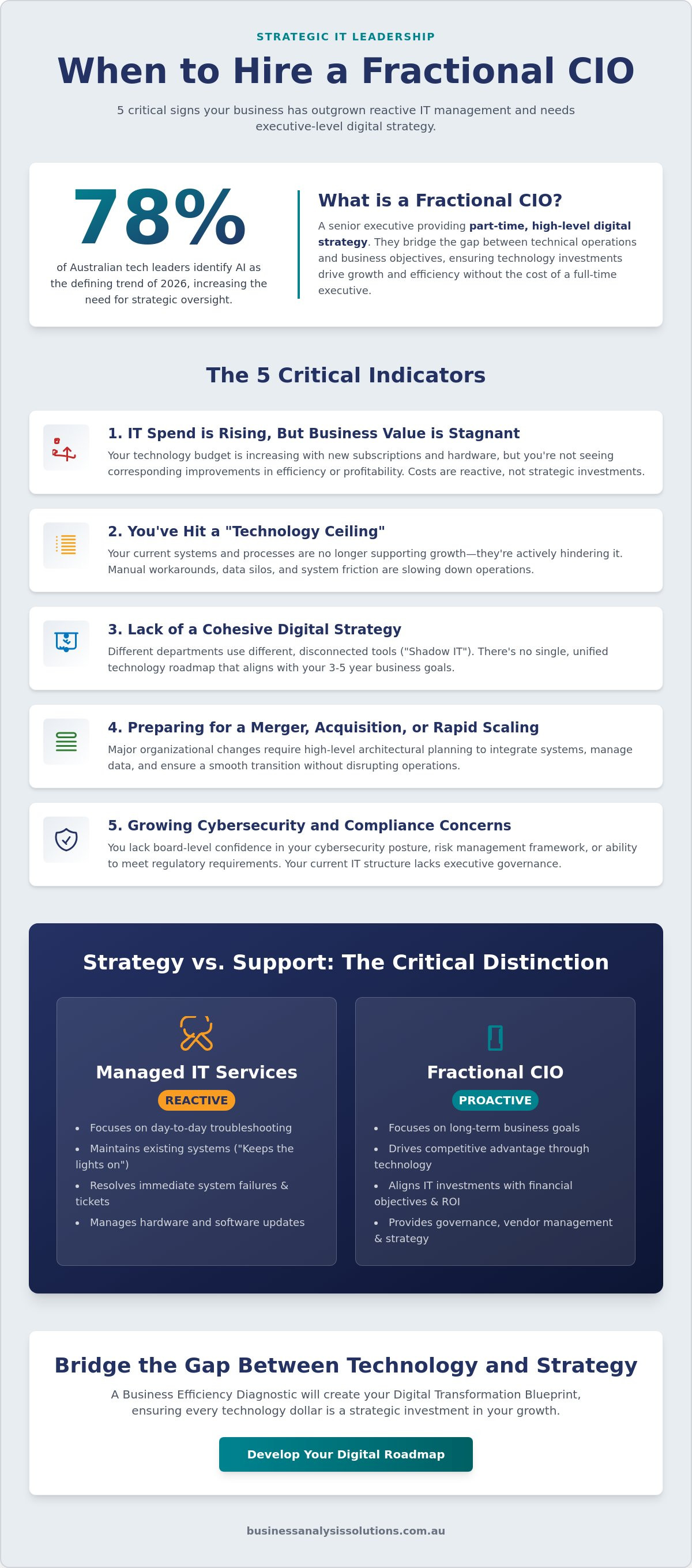
The primary role of this executive is to translate complex ICT jargon into boardroom-ready insights. They bridge the gap between technical requirements and organizational coordination. A common question for leadership teams is: What is a Fractional CIO? It's a role defined by foresight rather than reaction. Understanding when to hire a fractional CIO often begins when a business realizes its technology spend is increasing, yet its operational friction remains high. It's the difference between simply "keeping the lights on" and actively driving a digital strategy that creates a competitive advantage.
Strategy vs. Support: The Critical Distinction
Your lead technician is likely excellent at resolving immediate system failures or managing hardware deployments. However, they're rarely equipped to function as a strategic Chief Information Officer. Support is reactive and focused on day-to-day troubleshooting. Strategy is proactive and focused on long-term business technology goals. A fractional CIO provides the necessary oversight for external vendors and Managed IT Services providers. They ensure these partners deliver value and maintain system harmony, rather than just closing support tickets. This high-level governance prevents "Shadow IT" and ensures that all systems integrate seamlessly to support the company’s growth trajectory.
The Evolution of the ICT Executive Role
The ICT executive role has shifted significantly from basic infrastructure management to data-driven business growth. In 2026, this evolution includes a heavy emphasis on AI governance and cybersecurity leadership. Leaders now recognize that technology is the primary driver of financial performance. A Fractional CIO serves as a primary catalyst for business efficiency, ensuring that every digital asset directly supports operational performance. They don't just manage servers; they optimize the flow of information across the entire enterprise. This transition is essential for Australian businesses looking to scale in an increasingly complex digital economy.
5 Critical Indicators: When to Hire a Fractional CIO for Your Business
Recognizing the precise moment when to hire a fractional CIO requires an objective assessment of your current technical limitations. Many Australian organizations hit what we term a "Technology Ceiling." This occurs when existing systems, once sufficient for operations, begin to actively hinder growth. IT spending in Australia is projected to reach A$172.3 billion in 2026, yet without executive oversight, much of this capital is deployed without a clear return on investment. If your technology roadmap exists only as a series of reactive hardware upgrades or software renewals, you have reached a critical inflection point.
Beyond the ceiling, several other indicators demand attention. A lack of cohesive digital strategy across departments often leads to fragmented data and operational silos. This becomes particularly dangerous during major organizational shifts. If your business is preparing for a merger, acquisition, or rapid scaling, the complexity of integrating disparate systems requires high-level architectural guidance. Persistent project failures or recurring budget overruns also signal a need for professional Project Management and executive-level governance. Finally, growing concerns regarding regulatory compliance and cybersecurity risk management suggest that your current IT structure lacks the necessary oversight to protect the enterprise.
Indicator 1: The Disconnect Between IT Spend and Business Value
When IT is viewed strictly as a cost center, the business loses its ability to innovate. A common sign of this disconnect is when your primary strategy is dictated by your Managed Service Provider’s monthly invoices rather than your own business objectives. A fractional CIO performs a comprehensive audit to uncover redundant software and inefficient processes. This ensures technology serves as a lever for financial performance rather than a drain on resources. With 47% of Australian tech leaders now prioritizing operational efficiency as their greatest opportunity, this strategic oversight is no longer optional.
Indicator 2: Scaling Beyond Current Technical Leadership
As organizations grow, the technical staff who managed early-stage infrastructure often reach their strategic limit. They may excel at maintenance but lack the experience to contribute to executive-level planning. Utilizing Fractional CIO services Australia provides the necessary leadership during rapid headcount growth. This role bridges the communication gap between technical teams and non-technical stakeholders, ensuring that every digital initiative supports the company's long-term vision. Knowing when to hire a fractional CIO is ultimately about recognizing that your business has outgrown its current technical leadership structure and requires a more sophisticated, methodical approach to system harmony.
Fractional CIO vs. Managed IT Services: Understanding the Strategic Gap
Many Australian businesses mistakenly assume that their Managed Service Provider (MSP) fulfills the role of a Chief Information Officer. While an MSP is essential for maintaining hardware reliability and providing helpdesk support, their focus remains tactical. They ensure the network is functional and the software is updated. In contrast, the CIO role focuses on architecture, governance, and business alignment. Recognizing when to hire a fractional CIO often occurs when a leadership team realizes they have a functioning technical environment but no overarching strategy to leverage it for growth.
A fractional CIO acts as a professional advocate for the business during interactions with IT vendors. They provide a layer of objective oversight that an MSP cannot offer. While your service provider handles the day-to-day execution, the CIO ensures those actions serve the long-term financial performance of the organization. This executive presence is particularly vital when evaluating new ICT solutions, as it moves the conversation from technical specifications to measurable business outcomes.
Why an MSP Isn’t a CIO
The primary hurdle in relying on an MSP for strategy is a fundamental conflict of interest. Service providers often sell the very solutions they recommend, which can lead to a bias toward specific technology stacks. Their metric for success is "uptime," which ensures systems stay online. However, uptime does not equal operational efficiency. A system can be functional without being effective. While an MSP maintains the engine, a CIO plans the journey. The CIO remains objective, focusing on reducing redundant subscription costs and ensuring that the technology stack remains lean and purposeful.
The Synergy: How They Work Together
The most effective organizational structures utilize both roles in tandem. The CIO provides the "what" and the "why" by setting the strategic direction, while the MSP executes the "how" through technical implementation. This synergy allows for the optimization of vendor contracts, reducing waste and improving service delivery across the board. By having an executive manage the relationship, the business gains better accountability from its technical partners. This collaborative approach ensures that every technical implementation aligns with the digital transformation blueprint for business, turning IT from a maintenance burden into a strategic asset.
Evaluating ROI: The Financial and Operational Case for Fractional Leadership
The financial justification for deciding when to hire a fractional CIO rests on the elimination of executive bloat and the optimization of existing resources. In the Australian market, a full-time CIO typically commands a salary between $200,000 and $350,000, excluding the 12% superannuation guarantee and other executive benefits. For many mid-sized organizations, this expense is disproportionate to the required volume of strategic work. Fractional leadership provides an alternative by delivering high-level expertise through a structured engagement model. This approach ensures that capital is directed toward technical outcomes rather than fixed payroll costs.
Operational efficiency is further realized through the reduction of "Shadow IT." Without central governance, departments often purchase redundant software subscriptions or unmanaged cloud tools that operate in silos. A fractional CIO identifies these inefficiencies and consolidates the technology stack. This methodical cleanup reduces redundant costs and ensures system harmony. By aligning technical requirements with financial performance, the business gains a clearer understanding of its actual technology ROI.
Mitigating Implementation Risks
High-stakes ICT migrations often fail because they lack senior oversight. A fractional CIO ensures that new software deployments solve specific business problems rather than just adding technical complexity. They utilize process mapping to identify bottlenecks before a single line of code is integrated. This proactive approach prevents the "garbage in, garbage out" scenarios that lead to expensive project overruns. When managing complex transitions, having an executive lead the project management effort ensures that technical implementation never drifts from the original commercial objectives.
Strategic Technology as a Competitive Advantage
Leveraging AI and automation is no longer a future goal; it's a current requirement for maintaining a competitive edge. With 78% of Australian tech leaders prioritizing AI and Machine Learning in 2026, the ability to integrate specialized models into daily operations is essential. A fractional CIO establishes the stable foundation required for this innovation. They improve data visibility across the organization, allowing for more precise executive decision-making. By accelerating the time-to-market for new digital initiatives, the business can outperform competitors while maintaining lower overheads. Ultimately, determining when to hire a fractional CIO becomes a matter of protecting your bottom line and ensuring long-term stability.
Secure your organization’s future with a tailored Digital Strategy that prioritizes long-term financial performance.
Implementing Your Digital Strategy with Business Analysis & Solutions
Identifying the strategic triggers for when to hire a fractional CIO is the initial phase of organizational maturation. Once those indicators are recognized, the focus must shift toward a structured implementation that delivers measurable results. At Business Analysis & Solutions, we bridge the gap between technical requirements and commercial results through a disciplined methodology. We don't sell hardware or custom software. This lack of vendor bias ensures that our recommendations are rooted solely in logic and operational necessity. Every engagement is designed to deliver system harmony and improved financial performance through objective ICT solutions.
Bridging technical requirements with tangible organizational outcomes requires a high level of expertise in both business analysis and project management. A fractional CIO ensures that every digital initiative is a direct response to a documented business need. They oversee the transition from legacy systems to modern, automated workflows, ensuring that the Digital Transformation Blueprint is followed with precision. This oversight minimizes the risk of technical drift, where projects lose sight of their original commercial intent. By maintaining this focus, the organization achieves a higher level of operational efficiency and a more robust competitive position.
The Business Efficiency Diagnostic
The process begins with our Business Efficiency Diagnostic. This is a methodical assessment of your organization’s current state versus its desired outcomes. We analyze your existing workflows to identify bottlenecks in your processes, people, and technology. This isn't a surface-level review; it's a deep dive into the mechanics of your business. The result is a Digital Transformation Blueprint tailored to your specific objectives. This blueprint serves as a comprehensive roadmap, detailing the exact steps required for immediate improvements and long-term stability. It provides the clarity your board needs to make informed decisions about future technology investments.
Why Choose an Independent Strategic Partner?
Choosing an independent strategic partner provides the clarity needed to navigate complex ICT environments without the pressure of a sales quota. We bring over 20 years of experience in business analysis and ICT consultancy to every engagement. Our commitment is to resolution and outcomes, not the sale of additional infrastructure. We act as an analytical collaborator, working alongside your leadership to ensure technology serves the business, rather than the other way around.
Our focus remains on driving measurable progress through better organizational coordination and process mapping. If your business is ready to bridge the gap between technical potential and operational reality, deciding when to hire a fractional CIO is the catalyst for that change. You can initiate a consultation to evaluate your specific fractional leadership requirements and determine the most effective engagement model for your goals. We provide the precision and direction necessary to resolve your most pressing organizational challenges through expert fractional CIO services.
Securing Your Strategic Advantage Through Executive IT Leadership
Aligning your technology stack with commercial objectives requires more than functional hardware; it demands executive-level foresight. We've explored how a fractional CIO bridges the gap between day-to-day maintenance and the high-level governance needed to manage AI integration and cybersecurity risks. Identifying when to hire a fractional CIO allows your business to bypass the "Technology Ceiling" and turn ICT from a cost center into a primary driver of financial performance.
Business Analysis & Solutions provides independent, objective ICT advisory backed by over 20 years of industry experience. We specialize in developing Digital Transformation Blueprints that replace operational friction with system harmony. Our approach ensures that your digital strategy remains focused on resolution and tangible outcomes rather than technical complexity. You can move forward with the confidence that your technology roadmap is built on logic and proven results.
Book a Business Efficiency Diagnostic with our Fractional CIOs to begin optimizing your operations for 2026 and beyond.
Frequently Asked Questions
How much does a fractional CIO cost in Australia?
Cost structures for fractional leadership in Australia are typically based on a monthly retainer model. This varies according to the scope of the engagement and the specific seniority required for the role. While a full-time executive requires a significant fixed salary and on-costs, a fractional model allows for high-level advisory at a more manageable price point. Businesses usually find this model more efficient as they only pay for the strategic oversight they actually use.
What is the difference between a virtual CIO (vCIO) and a fractional CIO?
A virtual CIO is frequently a service provided by a Managed Service Provider to manage technical infrastructure. A fractional CIO functions as a member of your executive team, focusing on business strategy and organizational alignment. While the former ensures your hardware is functional, the latter ensures your technology investments drive financial performance. Knowing when to hire a fractional CIO is often tied to needing this higher level of business-centric leadership.
Can a fractional CIO manage my existing internal IT team?
Yes, a fractional CIO is well-positioned to lead and mentor internal IT staff. They provide the strategic framework that technical teams need to prioritize their workloads effectively. This leadership ensures that internal resources are focused on initiatives that support the company's long-term vision rather than just reactive maintenance. By bridging the gap between technical execution and business goals, they improve the overall output of your existing team.
How many hours per week does a fractional CIO typically work?
Engagement levels are tailored to the specific needs of the organization. Some businesses require only a few hours of strategic advisory per month, while others undergoing rapid digital transformation may need several days of active leadership. The flexibility of the model is its primary strength, allowing the engagement to scale as the business grows. This ensures you have access to executive-level expertise exactly when it's needed most.
Does a fractional CIO handle day-to-day technical support or helpdesk?
Day-to-day technical support and helpdesk tasks remain the responsibility of internal IT staff or external Managed Service Providers. A fractional CIO operates at the strategic level, focusing on vendor management, governance, and architecture. Their role is to ensure these tactical teams are managed effectively and aligned with the broader business strategy. They provide the "what" and "why" while the technical teams handle the "how."
How do I measure the success of a fractional CIO engagement?
Success is evaluated through the achievement of specific organizational milestones. These include the successful implementation of a digital transformation blueprint, a measurable reduction in operational friction, and improved clarity in technology spending. Determining when to hire a fractional CIO should lead to a more stable and predictable technical environment that supports sustainable growth and clear financial performance.



Comments