VCIO vs Fractional CIO: Choosing the Right Strategic IT Leadership in 2026
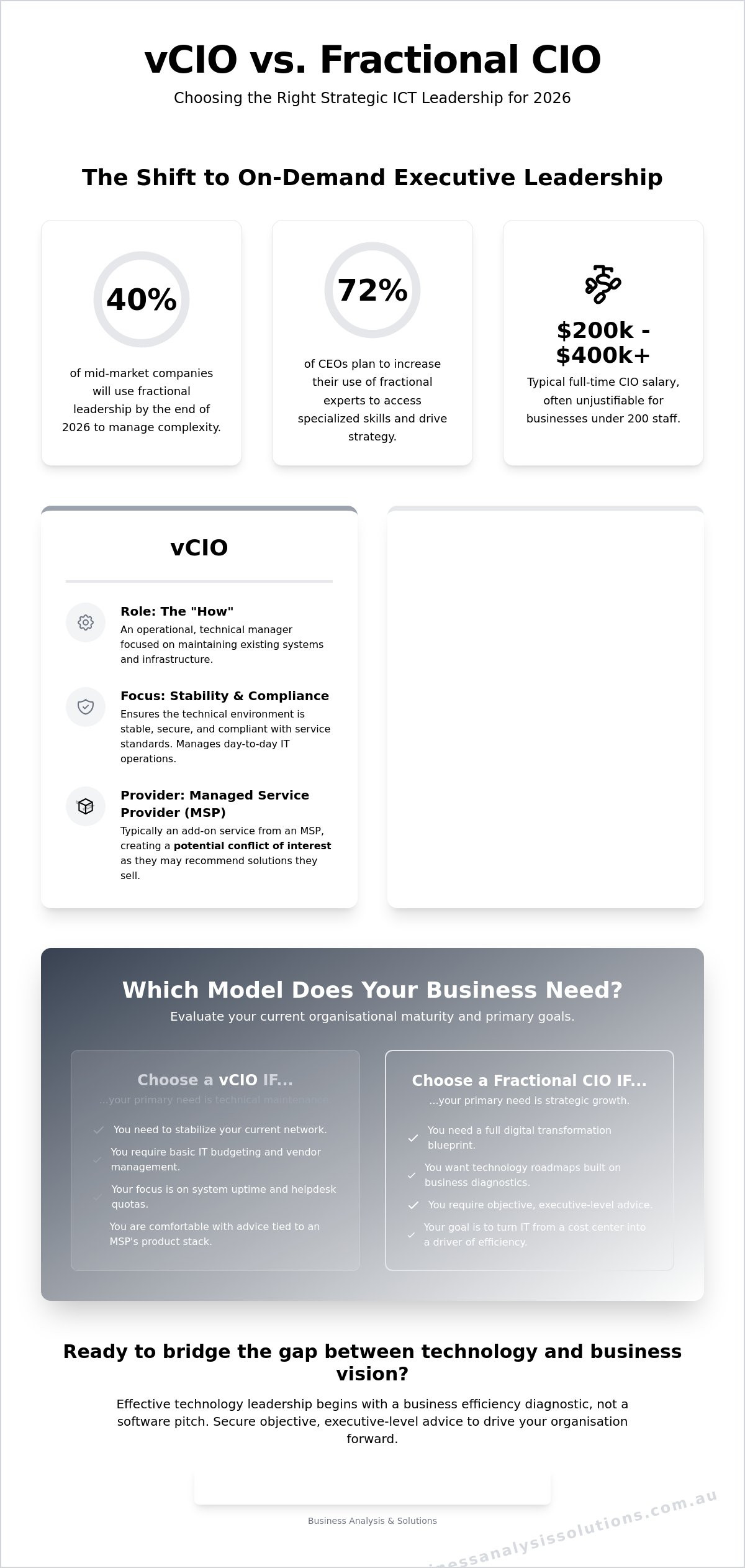
By the end of 2026, over 40% of small and mid-market companies will utilize fractional leadership to manage their organizational complexity. This shift happens because most executives realize that basing technology decisions on MSP sales pitches leads to stagnation. The debate over vCIO vs fractional CIO isn't just about semantics; it's about the fundamental difference between maintaining systems and leading a business through strategic digital transformation. You've likely felt the friction of an IT department that functions as a cost center rather than a driver of efficiency.
This guide provides the clarity you need to align your ICT infrastructure with your 2026 business goals. You'll learn the critical differences between these roles so you can reduce risk and secure objective, executive level advice. We'll analyze current market trends, including why 72% of CEOs plan to increase their use of fractional experts, and provide a structured framework for choosing the leadership model that delivers the highest ROI for your specific requirements.
Key Takeaways
Understand why full-time CIO roles are often unnecessary for organizations under 200 staff and how the on-demand model offers superior agility.
Distinguish between the vCIO vs fractional CIO models to ensure you're hiring for strategic business growth rather than just technical maintenance.
Identify how to avoid conflicts of interest by prioritizing independent ICT leadership that isn't tied to hardware sales or managed helpdesk quotas.
Evaluate your organizational maturity to determine whether your current stage requires basic network stability or a full digital transformation blueprint.
Learn why effective technology roadmaps must begin with a business efficiency diagnostic and process mapping rather than a software pitch.
Table of Contents The Evolution of Executive IT Leadership: Navigating the On-Demand Era vCIO vs Fractional CIO: Defining the Core Differences Strategic Depth and the Conflict of Interest Problem Decision Framework: Which Model Does Your Business Need? Implementing Strategic ICT Leadership with Business Analysis & Solutions
The Evolution of Executive IT Leadership: Navigating the On-Demand Era
The digital landscape for mid-market organisations in 2026 has reached a level of complexity that outpaces traditional management structures. Technology is no longer a background utility; it's a primary driver of competitive advantage and operational resilience. For businesses with fewer than 200 staff, the financial burden of a full-time CIO, with salaries often ranging from $200,000 to over $400,000, is frequently unjustifiable. This creates a leadership vacuum where critical decisions are made without executive oversight. Understanding the distinction between a vCIO vs fractional CIO is the first step in filling this gap with logic and precision.
The global market for fractional executive services has surpassed $5.7 billion, growing at 14% annually as businesses move away from the "IT as a cost centre" mindset. Leaders now recognise that ICT must be treated as a strategic asset. However, many organisations remain stuck in a cycle of incremental technical fixes rather than cohesive planning. This transition requires a shift from technical support to high level strategic direction, ensuring that every digital investment serves a documented business requirement.
The Reactive IT Trap
Many organisations operate within a reactive IT framework, where technology decisions are triggered by failure rather than foresight. You'll recognize this trap by frequent system outages, stagnant internal processes, and the uncontrolled rise of shadow IT. When technology doesn't align with business objectives, the cost of missed opportunities quickly outweighs any perceived savings on leadership. A lack of structured guidance leads to poorly managed ICT solutions that fail to deliver a return on investment. Without a clear roadmap, your infrastructure becomes a collection of disparate tools that hinder rather than help your staff.
Bridging the Gap Between Business and Technology
Modern organisational efficiency depends on the seamless integration of business technology into every facet of operations. This integration requires more than technical proficiency; it demands stakeholder engagement and a commitment to strategic alignment. A Fractional CIO provides this executive level oversight on a part-time basis, offering a pragmatic path to maturity. By the end of 2026, it's projected that over 40% of mid-market companies will use this model to navigate digital transformation without the overhead of a full-time executive. The strategic IT leadership gap is the distance between technical capability and business vision.
vCIO vs Fractional CIO: Defining the Core Differences
The distinction between a vCIO vs fractional CIO is frequently obscured by marketing terminology, yet the difference is fundamental to how your organisation manages its digital future. While both roles provide part-time technology leadership, they operate on different planes of the business hierarchy. A vCIO is typically an operational role provided by a Managed Service Provider (MSP). Their primary objective is to ensure your technical environment remains stable and compliant with the MSP's specific service standards. They focus on the "how" of technology, managing the tools that keep your business running day-to-day.
A Fractional CIO acts as a strategic member of your executive team. This individual isn't just a technical advisor; they're a business leader who understands how ICT investments impact the balance sheet. They focus on the "why" behind technology choices, ensuring that every project aligns with long-term commercial goals. When evaluating a vCIO through an MSP, it's necessary to consider potential conflicts of interest that may arise when the person recommending a solution also benefits from the sale of the underlying hardware or licensing.
The "Virtual" vs "Fractional" labels are often misnomers. "Virtual" refers to the delivery method, while "Fractional" refers to the capacity of the engagement. In 2026, almost all high-level leadership is delivered via a hybrid model. The real choice isn't about location; it's about scope. You're choosing between a maintenance-focused technical manager and a transformation-focused business executive. If you're unsure where your current gaps lie, starting with a business efficiency diagnostic can provide the necessary baseline data for your decision.
The Virtual CIO (vCIO) Scope
The vCIO scope is deeply rooted in infrastructure health. Their deliverables include managing license renewals, overseeing technical roadmaps for hardware replacement, and ensuring uptime. Because they're usually affiliated with an MSP, their strengths lie in technical compliance and standardisation. They're the right choice if your primary requirement is a stable, predictable network and you already have a clear business strategy in place that doesn't require significant digital pivoting.
The Fractional CIO Scope
The Fractional CIO scope prioritises business outcomes over technical specifications. This role involves Digital transformation blueprinting, capital expenditure budgeting, and board-level advisory. Typically hired through independent consultancies, their value lies in objective vendor management and business process optimisation. They don't just manage your network; they manage your digital ecosystem to drive a measurable return on investment, making them essential for organisations targeting aggressive growth or undergoing complex structural changes.
Strategic Depth and the Conflict of Interest Problem
Structural integrity in technology leadership determines the long-term viability of your digital investments. When comparing the vCIO vs fractional CIO models, the most significant risk to your organisation is the inherent conflict of interest found in many MSP-led engagements. Most Managed Service Providers generate revenue through hardware markups, software licensing commissions, and monthly support fees. If your vCIO is an employee of your MSP, their recommendations are filtered through a sales lens, making it difficult to receive truly objective advice on whether a specific investment is necessary or merely profitable for the provider.
Independence serves as a primary value proposition for the fractional model. Because a fractional executive is paid for their expertise rather than product volume, their loyalty remains with your bottom line. This independence allows for a shift from operational oversight to strategic foresight. Instead of asking if the server is running, the conversation evolves to ask if your technology is scaling your revenue. Achieving this level of clarity requires rigorous business efficiency diagnostics to identify where technical debt is stifling growth. By 2027, Gartner predicts that over 30% of midsize enterprises will use fractional executives to ensure their technology strategy is dictated by business requirements rather than vendor quotas.
The Account Manager vs The Executive
There's a distinct difference between a vCIO who manages a contract and a Fractional CIO who manages a strategy. Many MSPs offer "free" vCIO services bundled into their support agreements, but these roles often function as high-level account managers focused on renewals and technical compliance. This approach frequently results in higher long-term costs as the business buys into proprietary ecosystems that are difficult to exit. A Fractional CIO’s primary KPI is business performance, not ticket resolution. They operate within your C-suite to ensure that ICT spending is a calculated investment in organisational maturity rather than a recurring expense for maintenance.
Objective Vendor Management
A Fractional CIO acts as a professional buffer between your business and the aggressive sales tactics of technology vendors. They possess the technical depth to challenge MSP assumptions and the commercial acumen to negotiate contracts that favour your interests. This leads to a more robust digital strategy that remains agnostic to specific brands or platforms. By removing the commission-based incentive, you gain a partner who is incentivised to find the most efficient solution, even if that solution involves reducing the number of tools or services you currently pay for. This objective approach is essential for achieving a high return on investment in the complex 2026 digital ecosystem.
Decision Framework: Which Model Does Your Business Need?
Selecting between a vCIO vs fractional CIO is not a binary choice based on cost alone. It's a strategic decision that must be informed by your firm's current maturity and the specific digital challenges you anticipate over the next 24 months. By the end of 2026, over 40% of mid-market companies will utilize fractional leadership to manage their organizational complexity. The correct model for your business depends on whether you are simply maintaining a network or building a digital ecosystem designed for scale.
Budgetary considerations also play a role in this framework. While a vCIO might appear more cost-effective as a bundled service, the ROI is often limited to operational uptime. In contrast, a strategic investment in fractional leadership focuses on capital expenditure optimization and process efficiency. If your technology is not actively contributing to your revenue growth, you're likely overpaying for maintenance while under-investing in strategy. Identifying "trigger events" is essential for this assessment. If your organization is facing a merger, an ERP implementation, or a move into a highly regulated market, the tactical scope of a vCIO will be insufficient.
Organisational Maturity Matrix
You can determine your leadership requirements by assessing your position on the maturity matrix. Organizations at Level 1 or 2 typically focus on basic stability and technical compliance; in these instances, a vCIO's focus on infrastructure may suffice. However, businesses reaching Level 3 or higher demonstrate strategic dependence on their technology. At this stage, you require a Fractional CIO to manage stakeholder engagement and complex digital transformation blueprints. Utilizing a business efficiency diagnostic provides the objective data needed to identify your current level and the gaps that require executive oversight.
Operational vs. Strategic Comparison
The following table outlines the functional differences to assist in your selection process. This comparison highlights why the two roles are not interchangeable despite common industry misconceptions.
If your current IT leadership is failing to provide a clear roadmap for growth, it's time to re-evaluate your model. You can begin a diagnostic assessment to determine which leadership structure will best support your 2026 business goals.
Implementing Strategic ICT Leadership with Business Analysis & Solutions
The decision between a vCIO vs fractional CIO is finalized by determining how that leadership is executed within your unique operational framework. Business Analysis & Solutions prioritizes logic and documented requirements over generic technology stacks. We don't sell managed helpdesk services or hardware; we provide the executive clarity required to untangle organizational complexities. By integrating our Fractional CIO services with deep business analysis, we ensure every technical requirement is anchored in a verified business objective.
Our methodology is built on the principle that technology should never precede process. Many businesses fail in their digital transformation because they attempt to automate inefficient manual workflows without first mapping the underlying logic. We bridge the gap between technical requirements and board level objectives by acting as your analytical partner. This approach transforms IT from a reactive cost center into a structured driver of growth and efficiency across your entire Australian operation.
The Diagnostic Foundation
Every successful engagement begins with a comprehensive business efficiency diagnostic. We don't rely on assumptions or generic templates. Instead, we use rigorous process mapping to identify exactly where your current systems are creating friction or technical debt. This diagnostic phase allows us to uncover automation opportunities that are often missed by traditional technical managers. With over 20 years of experience in the professional landscape, we've developed a methodical approach that prioritizes precision over marketing fluff. This foundation ensures that when we do recommend an ICT solution, it's based on data and strategic alignment rather than a vendor sales pitch.
Your Strategic Roadmap for 2026
During the initial 90 days of an engagement, we focus on establishing a stable, logical framework for your digital future. This involves developing a digital transformation blueprint that outlines clear milestones and expected ROI. We move beyond keeping the lights on to address the strategic challenges of the 2026 digital ecosystem, such as AI integration and complex risk management. Our role is to provide the objective, executive level advice you need to make informed decisions that protect your bottom line. If your organization is ready to move beyond reactive IT and secure a leadership model that prioritizes business vision, we invite you to Enquire about our Fractional CIO services today. We'll help you build a technology strategy that is as stable and predictable as the processes we create for our clients.
Securing Your Strategic Digital Future
Navigating the complexities of the 2026 digital ecosystem requires a shift from reactive maintenance to executive foresight. The distinction between a vCIO vs fractional CIO is ultimately a choice between keeping systems operational and driving measurable business growth. To achieve a true return on investment, your leadership must remain independent and objective. We provide this clarity through a diagnostic-first approach, ensuring your technology roadmap is dictated by process mapping rather than vendor quotas.
With over 20 years of professional business analysis experience, we specialise in creating digital transformation blueprints that align with your commercial objectives. Our advisory is entirely independent; we don't sell hardware or managed helpdesks, which removes the conflict of interest inherent in many MSP-led models. This structured methodology untangles organisational friction and prepares your firm for the scale you've planned. You can book a strategic ICT consultation to begin mapping your path toward a more efficient, high-performance future. We look forward to helping you transform your ICT infrastructure into a powerful strategic asset.
Frequently Asked Questions
What is the primary difference between a vCIO and a Fractional CIO?
The primary difference lies in the organizational scope and affiliation. A vCIO is usually an extension of a Managed Service Provider focused on technical uptime; whereas a Fractional CIO is an independent executive integrated into your C-suite to drive business strategy. While a vCIO manages your technical roadmap, a Fractional CIO manages your digital transformation. This distinction ensures your technology investments serve commercial objectives rather than just maintaining the status quo.
Is a vCIO cheaper than a Fractional CIO?
A vCIO often appears cheaper on paper because the service is frequently bundled into an MSP retainer. However, current industry data shows vCIO retainers range from $2,000 to $15,000 per month, while a Fractional CIO provides higher ROI by optimizing capital expenditure. The long term cost of a vCIO can be higher if their recommendations are biased toward proprietary hardware sales or lack the strategic depth needed to scale your operations efficiently.
Do I need a Fractional CIO if I already have a Managed Service Provider (MSP)?
You need a Fractional CIO to provide independent oversight of your Managed Service Provider. An MSP focuses on day-to-day helpdesk support and network monitoring, but they aren't incentivized to challenge their own service levels. A Fractional CIO acts as your internal advocate, ensuring your MSP's performance aligns with your 2026 growth goals. This role bridges the gap between technical maintenance and executive level strategy, preventing your IT from becoming a stagnant cost center.
Can a Fractional CIO help with cybersecurity and compliance?
Fractional CIOs are essential for managing modern risk and regulatory compliance. With AI powered cyber threats rising, businesses require executive leadership to navigate frameworks like SOC 2 or HIPAA. Most fractional CISO or CIO engagements for mid-market firms cost between $8,000 and $25,000 per month depending on the complexity of the regulated environment. They don't just install software; they build a culture of security that protects your organizational reputation and bottom line.
How many hours a month does a Fractional CIO typically work?
A Fractional CIO typically works between 8 and 32 hours per month depending on the maturity of your digital ecosystem. This flexibility allows you to access C-suite expertise without the $200,000 to $400,000 annual salary of a full time executive. The engagement is usually structured around specific strategic milestones, such as an ERP implementation or a digital transformation blueprint, rather than a fixed hourly support model. This ensures you pay for outcomes, not just presence.
What qualifications should I look for in a Fractional CIO?
Look for a professional with at least 15 years of experience in both technical leadership and business analysis. A qualified candidate should demonstrate expertise in stakeholder engagement, process mapping, and strategic alignment. They should have a track record of managing digital ecosystems in your specific industry. Avoid technical managers who lack C-suite experience, as the vCIO vs fractional CIO choice depends on finding someone who understands financial statements as well as they understand server architecture.
Will a Fractional CIO replace my internal IT manager?
A Fractional CIO does not replace your internal IT manager; instead, they provide the strategic direction that your manager executes. Your IT manager handles the "how" of daily operations, while the CIO focuses on the "why" of long-term investment and risk management. This structure allows your internal staff to focus on technical excellence while the executive layer ensures those efforts contribute to your 2026 business goals. It's a partnership designed to elevate the entire department.
How does a Fractional CIO improve business efficiency?
Efficiency is improved through rigorous process mapping and the elimination of technical debt. By conducting a business efficiency diagnostic, a Fractional CIO identifies where manual workflows are stifling your staff's productivity. They implement automation strategies that can reduce operational friction by up to 30% in some sectors. This methodical approach ensures that technology is used to solve specific business problems rather than simply adding another layer of digital complexity to your organization.



Comments