The Strategic Role of a Business Systems Analysis Consultant in 2026
By the end of 2026, 40% of enterprise applications will feature task-specific AI agents, making the role of a business systems analysis consultant more critical than ever for organizations struggling with disconnected software. You likely recognize that adding more technology doesn't automatically solve operational friction; in many cases, it actually complicates it. When ICT projects exceed their budgets without delivering a clear return on investment, the issue isn't usually the software itself. It is the absence of a logical link between technical tools and the strategic goals of the organization.
A strategic consultant provides the specialized leadership necessary to resolve these structural imbalances. This article explores how these experts bridge the gap between complex technology and operational efficiency to drive measurable growth. You will discover a clear, logical roadmap for digital transformation that prioritizes automation and ensures your technical infrastructure remains perfectly aligned with your broader business objectives. We'll move from high-level strategy to the granular details of achieving system harmony through precise process mapping and digital strategy.
Table of Contents
What is a Business Systems Analysis Consultant? Defining the Strategic Bridge
The Core Methodology: How Systems Analysis Drives Operational Harmony
Consultant vs. Internal Teams: When to Seek Specialized Systems Advice
Executing the Digital Transformation Blueprint: A Structured Implementation Path
Partnering for Success: The Business Analysis & Solutions Approach
What is a Business Systems Analysis Consultant? Defining the Strategic Bridge
A business systems analysis consultant operates as a high-level architect for organizational efficiency. While a general business coach might focus on leadership dynamics or market positioning, this role is strictly rooted in ICT architecture and process engineering. They don't just suggest improvements; they map the specific technical infrastructure required to sustain them. By identifying organizational gaps, they design technical solutions that ensure every piece of software serves a distinct commercial purpose.
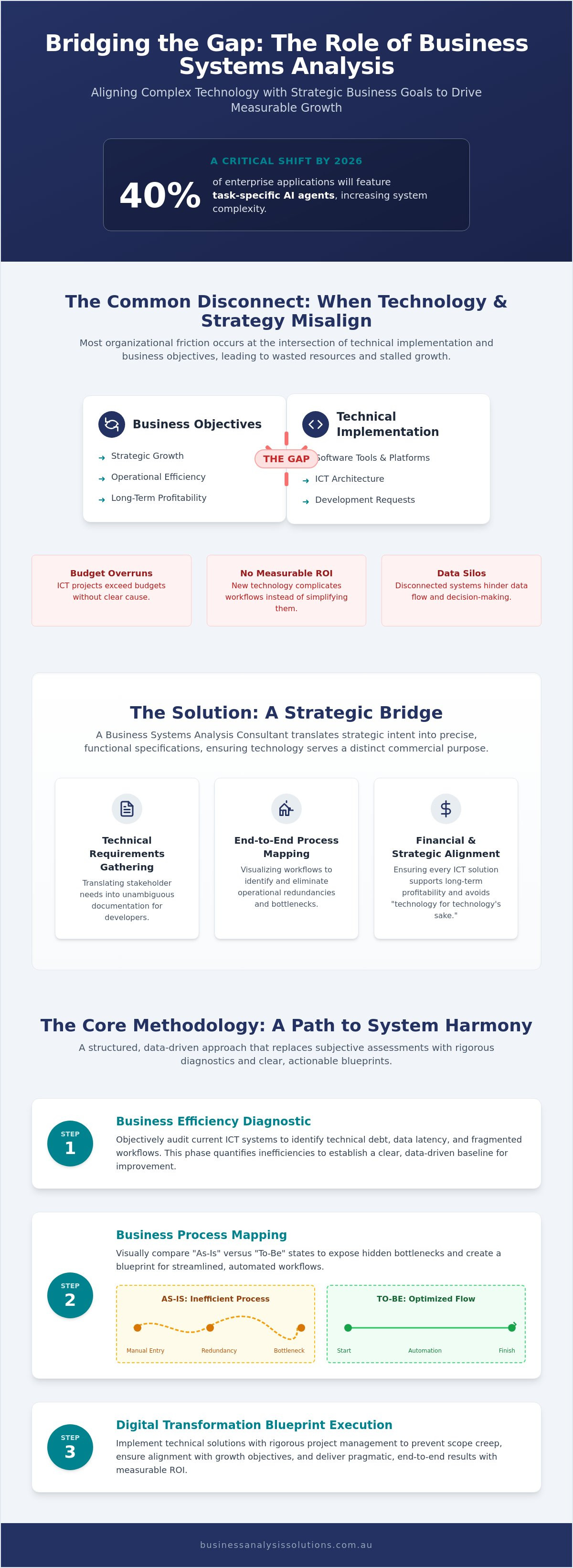
Most organizational failures occur at the intersection of technical requirements and business objectives. IT teams often build what's requested without understanding the commercial "why", while leadership sets goals without grasping the technical "how". The consultant resolves this friction by translating strategic intent into functional specifications. According to the foundational principles of business analysis, this discipline is essential for ensuring that every technical change delivers a measurable return. To achieve this, many organizations now rely on a digital transformation blueprint for business as their foundational roadmap.
The Core Competencies of Systems Analysis
Success in this field requires a blend of technical precision and strategic foresight. The core competencies include:
Technical requirements gathering: Translating stakeholder needs into precise, actionable documentation that developers can follow without ambiguity.
Process mapping: Visualizing end-to-end workflows to identify and eliminate operational redundancies that drain resources.
Financial alignment: Ensuring that every ICT solution supports long-term profitability and avoids the trap of "technology for technology's sake."
Why 2026 Demands More Than Just "IT Support"
By 2026, the landscape of corporate technology has shifted from simple software usage to complex ecosystem integration. Standard IT support is designed to fix what's broken, but a business systems analysis consultant ensures the system is built correctly from the start. With 40% of enterprise applications now expected to have task-specific AI agents embedded, the complexity of modern workflows is unprecedented.
Relying on "off-the-shelf" software fails because these tools aren't designed for your specific operational logic. Without a tailored implementation strategy, these systems often create data silos that hinder growth. Modern systems analysis integrates AI and automation not as buzzwords, but as functional tools to streamline data flow and enhance decision-making accuracy across the entire enterprise.
The Core Methodology: How Systems Analysis Drives Operational Harmony
Precision is the hallmark of a structured consulting engagement. A professional business systems analysis consultant replaces subjective "gut feel" with a rigorous, data-driven approach to organizational health. This methodology begins with a Business Efficiency Diagnostic. This initial phase objectively audits current ICT solutions to identify where technical debt or fragmented workflows are stalling progress. We analyze data throughput, system latency, and user adoption rates to uncover the root causes of operational friction. By quantifying these inefficiencies, we establish a baseline for improvement that is rooted in financial logic rather than technical trends.
Business Process Mapping: Visualising the Path to Efficiency
Process mapping serves as the visual blueprint for optimization. It exposes hidden bottlenecks where manual data entry or redundant approval loops create friction in daily workflows. In 2026, the transition from manual information handling to automated flow is no longer optional; it's a requirement for sustainable scale. These maps provide a clear comparison between "as-is" processes and "to-be" optimized states. They don't just describe the current environment; they provide a measurable baseline to calculate future ROI once new systems are deployed.
Bridging Business Goals and ICT Capabilities
Translating high-level C-suite vision into granular technical specifications is where many digital transformation projects fail. A consultant ensures ICT investments directly support specific KPIs, such as reduced lead times or lower operational overheads. This requires managing the entire lifecycle of a digital transformation project, from initial requirements gathering to final automation implementation. While some might view the career as a systems analyst as purely technical, the reality is deeply strategic. Every technical decision must be vetted against its ability to drive organizational coordination and long-term financial performance.
Achieving true business efficiency requires more than just installing new software. It demands system harmony, where every platform communicates seamlessly to support organizational objectives. A business systems analysis consultant ensures that this alignment is maintained throughout the project lifecycle, preventing the common trap of fragmented technical growth. This structured path ensures that technology serves the business, rather than the business serving the technology. If your current systems feel like a collection of isolated silos, starting with a professional Business Efficiency Diagnostic can provide the clarity needed to move forward.
Consultant vs. Internal Teams: When to Seek Specialized Systems Advice
Every growing organization eventually reaches a technical inflection point. This is the moment where internal IT or operations teams, while skilled at maintenance, become overwhelmed by the sheer complexity of a structural overhaul. Engaging a business systems analysis consultant at this stage provides the objectivity required to resolve legacy process disputes. Internal staff are often too close to existing workflows to see their flaws; they may even have personal or political ties to specific software. An external expert operates without these biases, using logical frameworks to determine what stays and what must be replaced to achieve system harmony.
The cost-benefit of specialized advice becomes clear when you consider the risk of a failed internal project. According to industry data, ICT projects that lack dedicated strategic leadership are significantly more likely to exceed their budgets or fail to deliver the promised ROI. When internal resources are stretched between daily support and transformation goals, neither receives the attention required. For businesses that need high-level oversight without the expense of a full-time executive, Fractional CIO services Australia provide a scalable way to access strategic IT leadership on a flexible basis.
Signs Your Business Has Outgrown Its Current Systems
Frequent data discrepancies: If different departments are reporting different numbers for the same metrics, your systems are likely operating in silos.
Reliance on heroic efforts: Your staff shouldn't have to perform manual workarounds or "heroic" data entry sessions just to overcome system failures.
Scaling bottlenecks: If you can't increase your output without a proportional, linear increase in headcount, your current technical infrastructure is hindering your growth.
Strategic Advisory vs. Helpdesk Support
It's vital to distinguish between "keeping the lights on" and driving organizational change. Most managed IT providers focus on helpdesk support, such as fixing laptops, managing servers, or resetting passwords. While this is essential, it's reactive by nature. A business systems analysis consultant provides a proactive, strategic layer that complements your existing IT support. They don't just fix broken hardware; they fix broken business processes.
This strategic partnership ensures that your technical investments are actually moving the needle on your KPIs. While your IT team manages the infrastructure, the consultant manages the digital strategy, ensuring that every tool is integrated into a logical, high-performing ecosystem. This division of labor allows your internal teams to focus on their core competencies while the consultant drives the long-term roadmap for digital transformation.
Executing the Digital Transformation Blueprint: A Structured Implementation Path
Execution requires more than technical skill; it demands a disciplined framework that prevents strategic drift. A business systems analysis consultant oversees the transition from theoretical planning to active deployment, ensuring that the Digital Transformation Blueprint remains a living document rather than a static report. This structured approach ensures that every technical task remains tethered to the original business case. Without this alignment, organizations often find themselves with expensive tools that fail to resolve the core operational friction they were intended to fix.
Rigorous project management serves as the primary defense against scope creep. In complex ICT environments, projects can easily expand beyond their original intent, draining resources without adding proportional value. A consultant maintains the integrity of the project scope by vetting every requested change against the strategic objectives. This focus ensures that the implementation stays on schedule and within budget, delivering a functional system that supports organizational coordination and financial performance.
The Diagnostic Phase: Identifying the Real Problems
What leadership perceives as a problem is frequently merely a symptom of a deeper structural failure. Slow reporting or inconsistent customer data are usually the results of fragmented data architecture rather than poor staff performance. An objective Business Efficiency Diagnostic cuts through surface-level complaints to identify these root causes. By establishing clear success metrics before any software is purchased, we ensure that the solution is designed to address a specific, quantified deficiency. This logical sequence prevents the common mistake of buying technology in search of a problem.
Implementation and Change Management
The human element is the most significant risk in any systems overhaul. Technical excellence is irrelevant if the staff doesn't adopt the new automated processes. Successful implementation requires a change management strategy that demonstrates immediate value to the end-user, reducing resistance and accelerating the transition. Following deployment, a post-implementation review measures the actual gain in efficiency against the initial baseline. This final audit ensures that the technical infrastructure is performing as expected and delivering the promised return on investment.
The final stage of a successful blueprint is full automation implementation. This isn't just about replacing manual tasks; it's about creating a self-sustaining ecosystem that supports scalable growth. To begin mapping your own structured path to efficiency, you can request a professional Business Efficiency Diagnostic to uncover the hidden bottlenecks in your current operations.
Partnering for Success: The Business Analysis & Solutions Approach
Selecting a business systems analysis consultant is a decision that impacts the long-term structural integrity of your organization. At Business Analysis & Solutions, we leverage over 20 years of cross-industry expertise to transform fragmented ICT environments into synchronized ecosystems. Our approach prioritizes pragmatic, end-to-end results over the delivery of dense, theoretical reports that often gather dust on executive desks. We understand that a strategy is only as valuable as its successful execution, which is why our focus remains firmly on delivering tangible operational improvements.
While we operate with a national reach across Australia, our consultancy remains deeply personal and methodical. We function as the architects of your digital environment, designing the technical logic and process flows required for scale. It is important to clarify that while we provide the specialized architecture and objective oversight for your transformation, we maintain professional distance from the actual software build. This objectivity allows us to hold vendors accountable and ensure that the final implementation aligns perfectly with your original business objectives without the conflict of interest found in firms that sell custom development.
From Diagnostic to Fractional CIO
Our firm provides a tiered support structure designed to meet organizations at their specific point of need. Whether you require a one-off Business Efficiency Diagnostic to identify current bottlenecks or ongoing leadership through our Fractional CIO services, our involvement is always rooted in logical progression. We offer a unique advantage by deeply understanding both business technology and broader organizational strategy. This dual perspective ensures that your technical roadmap supports your financial performance and human capital goals simultaneously. Our commitment to clarity and reliability means you receive expert guidance characterized by quiet confidence and professional precision.
Your Next Step Toward Operational Efficiency
The transition from operational frustration to a structured, high-performing environment begins with a single, logical step. Continuing to operate with disconnected systems and manual workarounds only compounds technical debt and limits your ability to scale. By partnering with a dedicated consultant, you move away from reactive troubleshooting and toward a proactive Digital Transformation Blueprint. This framework provides the clarity needed to align your technical infrastructure with your strategic vision for 2026 and beyond.
Your pathway to enhanced organizational performance is through a methodical assessment of your current state. An initial consultation serves as the foundation for identifying high-impact automation opportunities and structural refinements. We invite you to move beyond the limitations of legacy processes and embrace a future of system harmony. Contact Business Analysis & Solutions today to begin the diagnostic process and secure the strategic leadership your digital transformation requires.
Securing Your Operational Future with Strategic Systems Analysis
The technical landscape of 2026 necessitates a shift from reactive IT support to proactive structural alignment. A business systems analysis consultant provides the meticulous oversight required to ensure that every software integration serves a measurable commercial outcome. By moving through a disciplined path of diagnostics and process mapping, you can eliminate the data silos and inefficiencies that hinder scalable growth. This structured approach replaces operational friction with a logical, high-performing technical ecosystem.
With over 20 years of industry experience, our national Australian consultancy specializes in delivering Digital Transformation Blueprints that move beyond theoretical reports to achieve pragmatic results. We focus on resolving the root causes of system disharmony, ensuring your technical infrastructure remains a driver of financial performance. You can Request your Business Efficiency Diagnostic today to begin establishing a more reliable foundation for your organization. Achieving system harmony is a methodical process; with the right strategic partner, your digital transformation will deliver the clarity and efficiency your business deserves.
Frequently Asked Questions
What is the difference between a business analyst and a business systems analysis consultant?
A business analyst typically focuses on general process improvement and stakeholder requirements, whereas a business systems analysis consultant specializes in the intersection of ICT architecture and operational logic. The consultant identifies technical gaps and designs the specific system configurations required to support strategic goals. This role is more engineering-focused and strategic than general business coaching, ensuring that technical tools and business processes function as a single, unified ecosystem.
How long does a typical Business Efficiency Diagnostic take to complete?
A standard Business Efficiency Diagnostic typically requires two to four weeks to complete, depending on the complexity of your current technical environment. This timeframe allows for a thorough audit of data flows, stakeholder interviews, and the identification of systemic bottlenecks. The result is a documented baseline of your current operational health, providing the clarity needed to move toward a more structured Digital Transformation Blueprint.
Can a systems consultant help if we have already purchased software that isn't working?
Yes, we frequently resolve issues where existing software fails to deliver the expected ROI. In these cases, the failure is rarely the software itself; it is usually a misalignment between the tool and the organizational processes. We perform a diagnostic to identify if the issue lies in poor data architecture, a lack of integration, or low staff adoption, then provide a remedial strategy to fix the disconnect.
Do you provide ongoing support after the Digital Transformation Blueprint is delivered?
We provide structured implementation oversight and Project Management services once the Digital Transformation Blueprint is delivered. This ensures that the technical architecture we designed is executed correctly by your internal teams or external vendors. Many clients also transition to a Fractional CIO arrangement for ongoing strategic leadership, ensuring that system harmony is maintained as the business continues to scale.
How much does engaging a business systems analysis consultant typically cost?
Investment levels vary based on the scope of the engagement and the complexity of the organizational challenges being addressed. We offer different models to suit different needs, including fixed-price project diagnostics and monthly retainers for ongoing advisory roles. This flexible structure allows businesses to access high-level expertise and strategic leadership without the financial overhead of a full-time executive hire.
What industries do you specialize in for ICT project management?
Our ICT project management expertise is cross-industry, covering professional services, manufacturing, and regulated sectors such as finance and healthcare. We specialize in environments where complex data requirements and high-stakes compliance are critical. Our 20 years of experience ensures that we understand the unique operational logic and international standards required for diverse industry applications.
Will a systems consultant work with our existing internal IT team?
A business systems analysis consultant works collaboratively with your internal IT staff to provide a strategic layer that complements their technical skills. While your team manages daily infrastructure and helpdesk tasks, we focus on high-level digital strategy and organizational coordination. This partnership allows your internal resources to focus on their core competencies while we drive the long-term roadmap for transformation.
What is the ROI on hiring a Fractional CIO for a mid-sized business?
The ROI for a mid-sized business often manifests as a significant reduction in wasted ICT spending and the avoidance of failed project costs. By aligning technical investments with commercial KPIs, a Fractional CIO prevents expensive software purchases that don't solve core problems. This strategic leadership ensures that every dollar spent on technology directly supports operational efficiency and measurable, long-term growth.



Comments