The Strategic Role of a Business Process Re-engineering Consultant in 2026
- jonesaqayalo
- May 25
- 11 min read
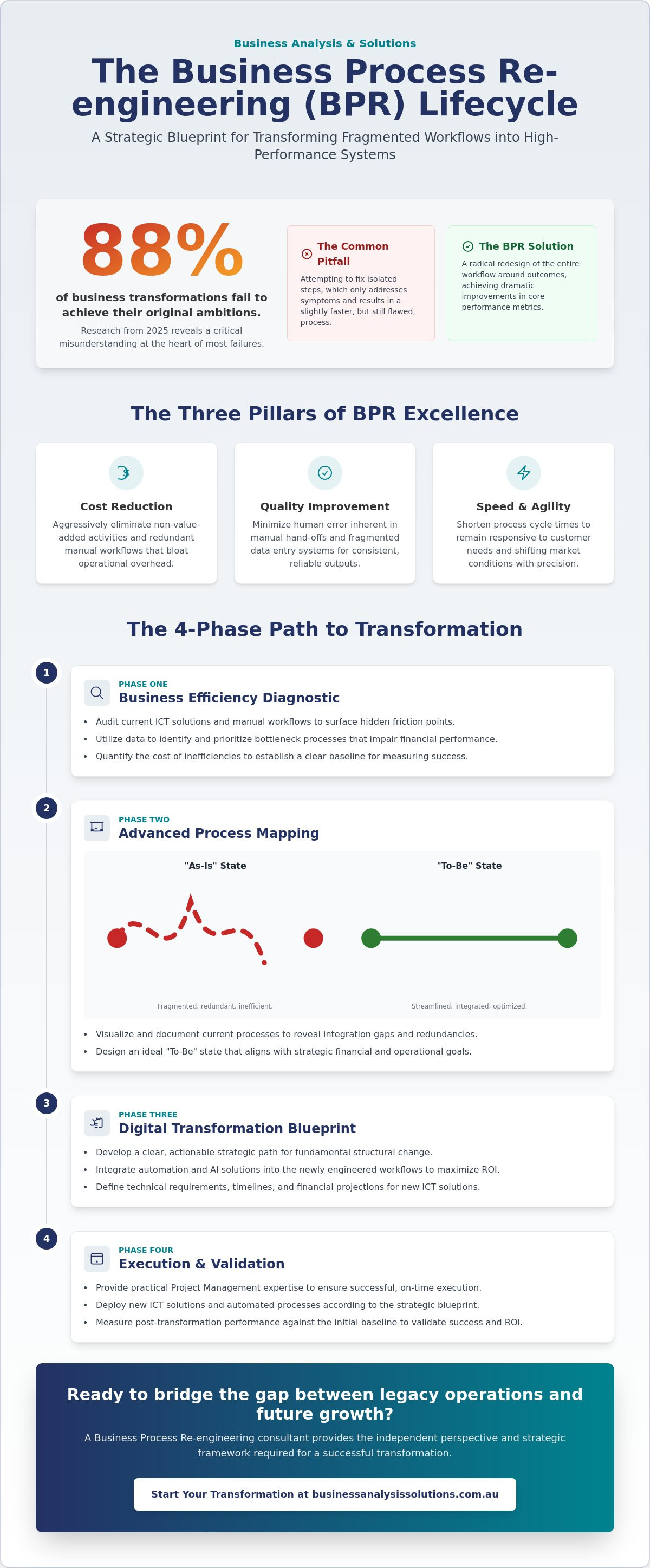
Research from 2025 reveals that 88% of business transformations fail to achieve their original ambitions. This high failure rate often stems from a fundamental misunderstanding; leaders frequently attempt to fix isolated steps rather than redesigning the entire workflow around outcomes. This is why the strategic role of a business process re-engineering consultant is vital for organizations facing fragmented legacy systems. These experts dismantle redundant manual workflows and eliminate the systemic inefficiencies that drive up operational overhead, ensuring that every process aligns with your broader financial goals.
You understand that a lack of visibility into process performance is more than a technical hurdle; it's a barrier to growth. This article explains how a business process re-engineering consultant identifies these bottlenecks to design radical improvements that drive organizational performance. You'll discover how a clear Digital Transformation Blueprint can dramatically increase productivity while reducing cycle times. We also examine how leveraging 2026 regulatory incentives, such as the 100% bonus depreciation under the One Big Beautiful Bill Act, allows your firm to modernize its ICT solutions with significant financial efficiency.
Key Takeaways
Understand why a radical redesign outperforms incremental changes when your organization faces total system failure or significant market shifts.
Determine how a business process re-engineering consultant utilizes a formal Business Efficiency Diagnostic to pinpoint the exact friction points stalling your performance.
Explore the transition from current-state Process Mapping to a final Digital Transformation Blueprint that provides a clear strategic path for structural change.
Evaluate how to integrate automation and AI into newly engineered workflows to maximize the ROI of your ICT Solutions.
Identify the essential criteria for selecting a partner who balances high-level Business Analysis with practical Project Management expertise to ensure successful execution.
Table of Contents
Understanding the Value of a Business Process Re-engineering Consultant
In a volatile economic environment where 70% of digital transformation initiatives fail to meet their objectives, the distinction between incremental improvement and radical redesign is not just semantic; it's strategic. Executives often confuse "fixing" a process with re-engineering it. While fixing addresses symptoms of inefficiency, Business process re-engineering (BPR) focuses on the fundamental rethinking and radical redesign of core workflows. This approach is designed to achieve dramatic improvements in critical contemporary measures of performance, such as cost, quality, and speed.
A business process re-engineering consultant serves as an analytical collaborator who bridges the widening gap between legacy operations and 2026 market demands. These experts don't simply document existing steps; they challenge the necessity of every action within the value chain. By moving beyond passive descriptions of current tasks, a consultant provides the clarity required to align technical requirements with broader organizational objectives. This results-driven methodology ensures that the final strategic outcome is a streamlined, high-performance system rather than a slightly faster version of a flawed process.
The Core Objectives of Re-engineering
Re-engineering focuses on three primary pillars of operational excellence. First, cost reduction is achieved through the aggressive elimination of non-value-added activities that bloat operational overhead. Second, quality improvement is realized by minimizing human error inherent in manual hand-offs and fragmented data entry. Finally, the pursuit of speed and agility ensures that cycle times are shortened; this allows your organization to remain responsive to customer needs and shifting market conditions with precision.
Why an Independent Perspective is Mandatory
Internal teams frequently struggle to overcome the "this is how we've always done it" bias. This institutional inertia often hides deep-seated inefficiencies that an external partner can identify through a structured, methodical approach. An independent consultant identifies cross-departmental silos that internal stakeholders might overlook due to political or cultural constraints. By prioritizing data-driven objectivity, they facilitate organizational coordination that's rooted in logic rather than habit. This professional distance is essential for maintaining the commitment to practical, end-to-end results that characterize a successful transformation.
The BPR Lifecycle: From Diagnostic to Strategic Blueprint
The transition from identifying a need for change to executing it requires a structured framework. A business process re-engineering consultant guides an organization through a lifecycle that prioritizes logical sequence over immediate technical implementation. This ensures that the redesign is rooted in operational reality rather than abstract theory. Understanding What is business process reengineering in a practical context means moving through distinct phases: diagnostic, mapping, blueprinting, and validation. Each stage builds the necessary evidence to justify radical shifts in how work is performed.
Step 1: The Business Efficiency Diagnostic
The lifecycle begins with a comprehensive Business Efficiency Diagnostic. This phase involves a meticulous audit of current ICT solutions and manual workflows to surface hidden friction points. Instead of accepting surface-level complaints, the consultant uses data to identify bottleneck processes that directly impair financial performance. By quantifying the cost of these inefficiencies, the diagnostic phase establishes a baseline for success. The diagnostic phase serves as the indispensable foundation upon which all subsequent re-engineering efforts are built.
Step 2: Advanced Process Mapping
Once the friction points are clear, the focus shifts to visualization. Technical standards are applied to document the functional logic of the "As-Is" state compared to the "To-Be" ideal. This exercise reveals integration gaps between disparate software platforms that often lead to redundant data entry. Effective business process mapping provides the clarity needed to ensure system harmony across the entire organization. It's not just about drawing boxes; it's about defining how information flows to support strategic outcomes.
The culmination of this analytical work is the Digital Transformation Blueprint. This document acts as a comprehensive roadmap, detailing the specific structural changes required to achieve desired performance gains. Before full-scale implementation begins, the new process logic must be validated against organizational objectives. This testing phase ensures that the proposed redesign actually resolves the identified bottlenecks. Finally, the project moves into execution, where a business process re-engineering consultant oversees the transition from strategy to tangible results. To ensure your roadmap is grounded in technical precision, engaging an expert for a Business Efficiency Diagnostic is a logical first step toward recovery.
Re-engineering vs. Continuous Improvement: Choosing the Right Path
Choosing the right methodology depends entirely on the scale of the organizational challenge. A business process re-engineering consultant distinguishes between Business Process Management (BPM) and Business Process Re-engineering (BPR) to ensure the intervention matches the specific need. BPM follows an evolutionary path; it focuses on the incremental fine-tuning of stable, high-performing departments. In contrast, BPR employs a clean slate approach. This radical redesign is necessary when an organization faces total system failure or significant market shifts that render existing workflows obsolete.
The risk of choosing incremental improvement when radical change is required often leads to paving the cow path. This occurs when a business automates a fundamentally broken process. While automation may increase speed, it merely accelerates the generation of errors if the underlying logic is flawed. By applying standards similar to those found in the GAO BPR Assessment Guide, a consultant evaluates whether the current structure supports 2026 performance requirements or if it requires a complete overhaul to remain competitive.
The Risk Assessment of Radical Change
Evaluating organizational readiness is a prerequisite for any BPR engagement. Large-scale transformation introduces volatility that can disrupt operational continuity if not managed with technical precision. A business process re-engineering consultant utilizes rigorous Project Management methodologies to mitigate these risks. This involves creating a phased transition plan that protects core functions while the new architecture is implemented. Success relies on a structured approach to change management, ensuring that the human element of the organization evolves alongside the technical systems.
System Harmony: Aligning Technology with New Processes
Effective re-engineering ensures that your ICT strategy serves the process, not the other way around. Too many organizations fall into the trap of purchasing expensive software to solve a process problem, only to find the new tool is incompatible with their actual needs. Achieving true system harmony requires a lean process architecture that dictates the technical requirements. For a comprehensive structural framework, leaders should consult a Digital Transformation Blueprint for Business. This document ensures that every ICT investment aligns with the redesigned workflows to deliver measurable financial performance and operational efficiency.
Executing the Transformation: Automation and ICT Strategy
Execution begins once the process logic is finalized. A business process re-engineering consultant ensures that technology serves as a catalyst for efficiency rather than a source of complexity. By identifying specific candidates for automation within the newly engineered workflows, organizations eliminate the friction of high-volume, low-complexity tasks. This is where Robotic Process Automation (RPA) and Artificial Intelligence (AI) provide the most value; they streamline routine operations so human capital can focus on high-value strategic objectives. Bridging the gap between technical requirements and business goals requires a meticulous approach to organizational coordination.
Data integrity remains a critical priority throughout the transformation. As processes are redesigned, the underlying information architecture must be secured against vulnerabilities. This involves establishing clear protocols for data handling and ensuring that new ICT Solutions comply with international standards. By prioritizing system harmony, the consultant ensures that the digital shift doesn't compromise the reliability of organizational data. Research from 2025 indicates that 95% of generative AI pilots at enterprises are failing, highlighting the necessity of a structured approach to technology integration that prioritizes process logic over the tools themselves.
Automation Implementation Strategies
Modern automation implementation moves beyond simple scripts to create end-to-end workflow automation. Utilizing platforms like the Microsoft Power Platform allows for a cohesive environment where disparate systems communicate effectively. When evaluating the ROI of these investments, the BPR framework provides a clear metric for success based on reduced cycle times and operational costs. Under the One Big Beautiful Bill Act (OBBBA) signed in 2025, businesses can leverage 100% bonus depreciation for qualified capital investments in automation systems, which significantly enhances the financial viability of these strategic projects.
The Fractional CIO Role in BPR
Maintaining the long-term health of a re-engineered environment requires consistent executive-level IT leadership. A Fractional CIO services Australia model provides this expertise without the overhead of a full-time hire. This role ensures that the ICT environment continues to evolve in alignment with the original strategic blueprint. By providing objective advisory and technical oversight, a fractional lead ensures that the benefits of re-engineering are sustained over time. If your organization requires a roadmap to integrate these technologies, our team provides the Automation Implementation expertise needed to drive measurable results.
Partnering for Success: What to Look for in a BPR Consultant
Selecting a partner for a radical redesign is a high-stakes strategic decision that determines the long-term viability of your operations. A qualified business process re-engineering consultant must demonstrate a proven track record that spans both deep business analysis and technical ICT consultancy. It's essential to avoid firms that offer generic advice or "shelf-ware" reports that lack actionable depth. Instead, prioritize a partner whose methodology is anchored in a formal diagnostic phase. This structured approach ensures that every recommendation is supported by objective data and aligned with your specific financial performance goals.
The ability to bridge the gap between granular operations and high-level executive strategy is a hallmark of a seasoned expert. While many large firms prioritize billable hours, a specialized consultant focuses on delivering tangible results that manifest as reduced cycle times and lower overhead. This requires a commitment to professional distance and objective problem-solving. It ensures that the final solution is the most effective one, not merely the easiest to implement. By maintaining this focus, the consultant facilitates organizational coordination that remains resilient against market volatility.
The Analytical Collaborative Approach
Professionalism in this field is defined by clarity and reliability. You should look for a partner who avoids marketing jargon in favor of precise, technical communication. With over 20 years of experience in the Australian business landscape, a boutique consultancy often provides a level of precision that larger, more fragmented firms cannot replicate. This local expertise allows for a deeper understanding of regional standards and the specific operational challenges faced by Australian enterprises. This analytical collaboration ensures that your workflows are optimized for the specific demands of the 2026 market without unnecessary complexity.
Next Steps: From Inquiry to Diagnostic
Initiating a transformation begins with a focused inquiry to identify your organization's efficiency potential. During the first 30 days of a BPR engagement, you can expect a rigorous audit of your existing workflows and a clear identification of systemic bottlenecks. This period is dedicated to establishing the logical foundation for the eventual Digital Transformation Blueprint. By focusing on resolution and outcomes from the outset, the consultant ensures that the project maintains momentum and delivers on its promise of radical improvement. To begin this process, you can Schedule a Business Efficiency Diagnostic with our expert consultants to evaluate your current operational health and define a clear path forward.
Driving Sustainable Performance Through Radical Redesign
Success in 2026 requires more than incremental adjustments. It demands a fundamental rethink of how workflows deliver value. Moving from fragmented legacy systems to a high-performance environment depends on a structured lifecycle that begins with technical precision. By prioritizing process logic before software implementation, organizations avoid the trap of automating inefficiency and instead build a foundation for long-term business agility. It's a strategic necessity for those facing high operational overhead and a lack of visibility into performance metrics.
Engaging a business process re-engineering consultant provides the objective perspective necessary to bridge the gap between technical requirements and broader organizational objectives. With over 20 years of industry experience and national Australian service coverage, our team specializes in resolving complex operational challenges through methodical analysis. You can Optimise your operations with a Business Efficiency Diagnostic to identify your specific friction points and establish a clear strategic path forward. Taking this step ensures your organization is prepared to meet market demands with clarity and confidence.
Frequently Asked Questions
What is the primary difference between a BPR consultant and a standard business analyst?
A BPR consultant focuses on the radical, "clean slate" redesign of workflows to achieve dramatic performance gains. While a standard business analyst often works on incremental improvements or documenting current requirements, the consultant challenges the necessity of every existing process. They bridge the gap between technical ICT solutions and strategic business goals to drive fundamental organizational change rather than minor adjustments.
How long does a typical business process re-engineering project take in Australia?
Most BPR engagements in Australia range from six to eighteen months depending on the organization's complexity. The initial Business Efficiency Diagnostic and mapping phases typically take eight to twelve weeks to complete. Implementation timelines are then dictated by the scale of the Digital Transformation Blueprint and the speed of technical integration across various departments.
Can BPR be performed without replacing our existing software systems?
Yes, re-engineering frequently focuses on the logic of how work is performed rather than the tools themselves. A business process re-engineering consultant may find that existing software is adequate but is being used inefficiently or lacks proper integration. The goal is system harmony; this can often be achieved through better process architecture and targeted automation implementation without a total system replacement.
What is the expected ROI of hiring a business process re-engineering consultant?
ROI is typically measured through reduced operational overhead, shortened cycle times, and increased output. While specific financial outcomes vary, the objective is to eliminate non-value-added activities that bloat costs. By aligning ICT strategy with lean processes, organizations often see a significant return through improved financial performance and the ability to scale without proportional increases in staff.
How does BPR affect employee morale and organizational culture?
Radical change can create temporary friction, so effective change management is a mandatory component of the BPR lifecycle. When employees see that redundant manual workflows are replaced by streamlined automation, morale often improves as they shift to higher-value tasks. Clear communication and training ensure that the new organizational culture values efficiency and data-driven decision-making over legacy habits.
What industries benefit most from radical process re-engineering?
Industries with high-volume transactions and complex coordination requirements, such as logistics, financial services, and manufacturing, gain the most from BPR. Any sector burdened by fragmented legacy systems or high operational overhead will see dramatic results. These organizations benefit from the radical redesign of core processes to meet the speed and quality demands of the 2026 market.
Is BPR suitable for small to medium-sized businesses?
BPR is highly effective for small to medium-sized businesses facing scaling bottlenecks. While large enterprises use it for cost-cutting, smaller firms often use it to build a robust foundation for growth. A targeted Business Efficiency Diagnostic can reveal friction points that, once resolved, allow a smaller team to compete with much larger organizations through superior operational agility.
How do we ensure the new processes are sustained after the consultant leaves?
Sustainability is achieved through rigorous documentation and the establishment of clear performance metrics. A Digital Transformation Blueprint provides the roadmap, but long-term success often requires ongoing oversight. Many firms utilize Fractional CIO Services to ensure that the re-engineered ICT environment continues to align with strategic objectives as the business evolves and market conditions change.



Comments