The Strategic Risks of Business Process Automation: A 2026 Executive Guide
- jonesaqayalo
- Jun 18
- 12 min read
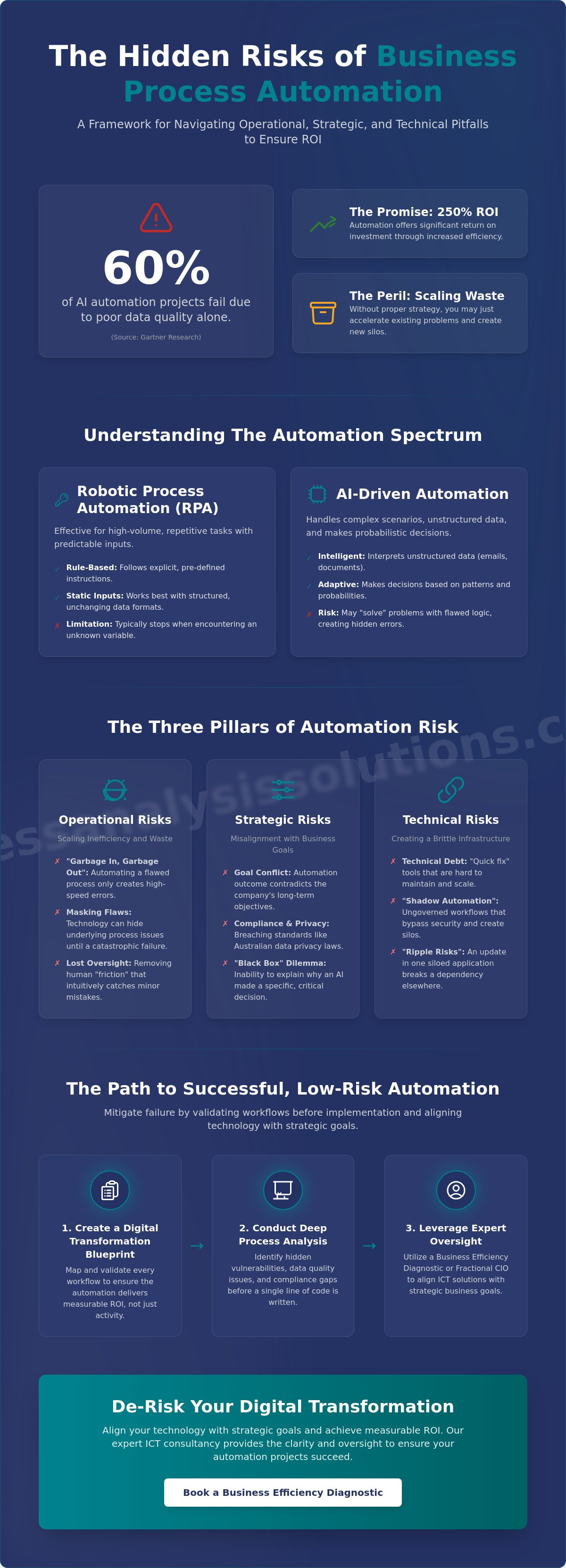
Sixty percent of AI-driven automation projects fail due to poor data quality alone, according to Gartner research from January 2026. While the potential for a 250% return on investment is significant, many leaders rightly fear that they might simply be scaling existing waste or creating new system silos. You likely recognize that manual processes are a bottleneck, yet the uncertainty regarding the risks of business process automation can lead to strategic paralysis. It's a valid concern; without a methodical approach, technology often accelerates disaster in poorly mapped workflows rather than resolving them.
This guide identifies the hidden operational, strategic, and technical risks of automation to ensure your digital transformation delivers measurable ROI. We provide a clear framework for identifying these vulnerabilities before they manifest as technical debt or compliance failures under Australian standards. You'll gain the methods needed to ensure automation aligns with your broader organizational objectives and the confidence to select ICT solutions that support long-term system harmony. This overview moves systematically from high-level strategy to the granular details required for a successful, low-risk implementation.
Key Takeaways
Understand the critical distinction between basic robotic tasks and intelligent AI-driven workflows to ensure your technology stack supports long-term scalability.
Identify the primary risks of business process automation, including the "Garbage In, Garbage Out" principle that can inadvertently scale operational waste and technical debt.
Navigate the complexities of 2026 compliance standards, focusing on Australian data privacy and solving the "black box" dilemma in automated decision-making.
Utilize a Digital Transformation Blueprint and process mapping to validate workflows before implementation, ensuring every automation delivers measurable ROI.
Leverage expert oversight through a Business Efficiency Diagnostic or Fractional CIO services to align technical ICT solutions with broader strategic goals.
Table of Contents
Understanding the Landscape of Automation Risks in 2026
In the current fiscal year, Business process automation (BPA) has transitioned from a competitive advantage to an operational necessity. By 2026, the technology has evolved beyond simple task-based triggers into sophisticated ecosystems that integrate generative AI, agentic workflows, and predictive analytics. However, a persistent "automation first" mindset often encourages leaders to deploy solutions before they fully understand the underlying process architecture. This haste creates significant risks of business process automation, primarily because technology that is layered over a fragmented or inefficient workflow only serves to accelerate the delivery of errors.
Distinguishing between Robotic Process Automation (RPA) and intelligent, AI-driven automation is critical for modern risk management. RPA remains effective for high-volume, rule-based tasks with static inputs. In contrast, AI-driven automation handles unstructured data and makes probabilistic decisions. This shift introduces a new category of risk: unpredictability. While an RPA bot might stop if it encounters an unknown variable, an AI system might attempt to "solve" the problem using flawed logic, leading to outcomes that appear correct but are fundamentally detached from organizational standards. In the Australian market, where integrated ICT environments are becoming increasingly dense, these discrepancies can trigger cascading failures across interconnected supply chains and financial systems.
The Evolution of Automation Complexity
Low-code and no-code platforms have democratized technical agency, allowing department heads to build custom workflows without direct intervention from IT. While this increases agility, it has exponentially expanded the threat of "shadow automation." These ungoverned processes often bypass established security protocols and data sovereignty requirements. As workflows become cross-departmental, a single update in a marketing automation tool might inadvertently break a critical compliance check in the finance department. The 2026 landscape requires a rigorous diagnostic approach because the interdependencies between systems are now too complex to manage through manual oversight alone.
Strategic vs. Tactical Risk Identification
Effective leadership requires a clear distinction between tactical glitches and strategic failures. A tactical risk involves a software bug or a temporary API outage that disrupts a single task. These are manageable and often resolved through standard ICT solutions. Strategic risks, however, involve a fundamental misalignment where the automated outcome contradicts the company's long-term objectives or regulatory obligations. Strategic automation risk is the misalignment of technology and business objectives. Ensuring that every implementation serves a specific, documented goal is the only way to prevent automation from becoming a source of technical debt that hampers future growth.
Operational Risks: Scaling Inefficiency and Technical Debt
A fundamental law of digital transformation is the "Garbage In, Garbage Out" (GIGO) principle. If an existing workflow is redundant, illogical, or overly complex, automating it won't resolve those issues. Instead, it creates a high-speed liability. By removing human intervention, you lose the intuitive "friction" that often catches minor errors before they escalate. Consequently, the risks of business process automation become most acute when technology masks underlying operational flaws. These flaws remain hidden beneath a layer of digital efficiency until they manifest as a catastrophic system failure or a significant financial discrepancy.
Technical debt is another silent byproduct of rapid, uncoordinated automation. Many organizations opt for "quick-fix" tools to address immediate pain points without considering how these solutions integrate with the broader ICT stack. While these tools provide short-term relief, they often create "ripple risks" where an update in one siloed application breaks a critical dependency elsewhere. This fragmented approach leads to a brittle infrastructure that's expensive to maintain and difficult to scale. Proactively identifying these automating business processes risks is essential for maintaining long-term operational stability.
The Danger of Automating Unmapped Processes
Rigorous business process mapping is the only reliable way to prevent the automation of waste. Without a visual and logical representation of every step, handoff, and decision point, automation initiatives inevitably hit bottlenecks. For instance, a logistics firm that automated its dispatch without mapping its fluctuating inventory levels found that the system consistently over-promised delivery times. This led to a documented 15% increase in customer churn within three months. The cost of re-engineering a live, automated process is typically three to five times higher than the investment required to map it correctly at the outset.
Cascading Failures and System Harmony
In an integrated environment, a single logic error doesn't stay contained. It propagates through the entire ICT stack, affecting everything from CRM data to financial reporting. Another overlooked risk is the erosion of "institutional knowledge." When a process is fully automated without comprehensive documentation, the understanding of why a task is performed a certain way often vanishes with the departing staff who designed it. Maintaining system harmony requires a commitment to regular business efficiency diagnostics. These assessments ensure that your automated workflows continue to serve their intended purpose as the market evolves. If you're concerned about hidden inefficiencies, a professional Business Efficiency Diagnostic can provide the clarity needed to proceed with confidence.
Data Security, Compliance, and the Black Box Dilemma
The speed of automation is a double-edged sword. While it accelerates output, it also accelerates the potential for data breaches and compliance failures if the underlying architecture is insecure. In the current regulatory environment, the risks of business process automation often center on the "Black Box" problem. This occurs when AI-driven systems make probabilistic decisions without a clear, human-readable audit trail. If a system denies a credit application or flags a transaction as fraudulent, your organization must be able to explain the logic behind that decision to satisfy both internal auditors and Australian regulators. Without this transparency, you're not just facing an operational glitch; you're facing a significant legal liability.
Third-party integrations further complicate the security perimeter. Many automation tools rely on API connections to move data between disparate platforms. Each connection point is a potential vulnerability that can be exploited if not properly managed. When you integrate a cloud-based automation tool with your internal databases, you're essentially extending your trust to that vendor's security protocols. This creates a data sovereignty risk, particularly for Australian firms that must ensure sensitive information remains within specific geographic or legal jurisdictions. Managing these integrations requires a methodical approach to ensure that "convenience" doesn't bypass essential security controls.
Maintaining Governance in Automated Environments
Effective governance requires that every automated transaction leaves a verifiable footprint. You can't manage what you can't see. Establishing robust audit trails ensures that if a failure occurs, your team can pinpoint exactly where the logic deviated from the intended path. This level of oversight is a core component of strategic ICT consultancy, where the focus is on maintaining data integrity across the entire lifecycle of a process. Access controls must also be strictly enforced; automated service accounts should never have more permissions than are absolutely necessary to perform their specific function.
Regulatory Alignment and the Essential 8
Automation plays a pivotal role in adhering to the ASD Essential 8 cybersecurity framework, particularly regarding automated patching and backups. However, if these automated systems are "over-privileged," they become high-value targets for attackers. A service account with administrative rights that is compromised can be used to move laterally through your network with devastating speed. By December 2026, businesses operating within global supply chains must comply with the EU AI Act's transparency obligations for high-risk systems, a standard that is rapidly becoming the benchmark for Australian data handling and automated decision-making protocols. Ensuring your automation implementation supports these standards is critical for long-term resilience.
Mitigating Failure Through Process Mapping and Analysis
Mitigation is not a reactive state; it is a proactive architectural choice. A formal Digital Transformation Blueprint serves as the primary instrument for neutralising the risks of business process automation before they impact the balance sheet. This document acts as a master reference, ensuring that technical capabilities never outpace operational logic. By involving a multidisciplinary team of Business Analysts, ICT experts, and departmental stakeholders, you ensure that the solution is both technically sound and practically viable. This collaborative oversight prevents the creation of system silos that often occur when departments purchase software in isolation.
The 5-Step Risk Mitigation Framework
Step 1: Comprehensive Business Efficiency Diagnostic. This initial audit identifies current bottlenecks and ensures you aren't simply automating an existing failure.
Step 2: Detailed Process Mapping. Visualising the "As-Is" state versus the "To-Be" state allows for the identification of logic gaps that software alone cannot resolve.
Step 3: Technical Requirement Alignment. Rigorous ICT solution selection ensures that the chosen platform supports your specific governance and security needs.
Step 4: Pilot Testing and Incremental Deployment. Contain potential ripple risks by deploying in a controlled environment before a full-scale rollout.
Step 5: Continuous Monitoring and Refinement. Establish a lean feedback loop to adjust automation logic based on real-world performance data and changing market conditions.
Building Organisational Resilience
A resilient automation strategy treats technology as a tool for human empowerment rather than a replacement for human judgment. Implementing a "Human-in-the-Loop" (HITL) failsafe is essential for critical decision points where probabilistic AI outputs require verification. This approach mitigates the risks of business process automation by ensuring that accountability remains with the leadership team. Staff must be trained to oversee and manage these systems, moving from manual task execution to high-level system orchestration. This transition requires a shift in focus from "doing the work" to "verifying the outcome."
Resilience also depends on a culture of transparency. Every automated workflow must be documented with the same precision as a financial audit. If a system fails, your incident response plan should provide clear protocols for manual overrides and data recovery. This methodical preparation ensures that system disruptions remain minor incidents rather than organizational crises. To start securing your operational future, book a Business Efficiency Diagnostic with our senior analysts to identify and resolve your specific transition risks.
Strategic ICT Consultancy: The Solution to Automation Anxiety
Automation anxiety often stems from a lack of high-level visibility. When leadership lacks a clear grasp of how disparate systems interact, the risks of business process automation can appear insurmountable. Strategic ICT consultancy provides the necessary bridge between technical requirements and organizational performance. By engaging a Fractional CIO, businesses gain executive-level oversight without the overhead of a full-time hire. This role ensures that every automation initiative is vetted against the broader digital strategy. It prevents the accumulation of technical debt and ensures that technology serves the business, rather than creating new layers of complexity.
An objective, third-party Business Efficiency Diagnostic is the most effective way to validate your current state. It provides a detached analysis of your workflows, identifying where automation will yield the highest ROI and where it might introduce new vulnerabilities. This pragmatic approach moves the conversation from "what can we automate?" to "what should we automate to drive performance?" It replaces uncertainty with a structured roadmap, allowing you to move forward with the calm assurance that your foundations are secure.
Expert Project Management for Digital Transformation
Implementation is where most strategic visions fail. Utilizing expert project management significantly reduces implementation risk by providing structured frameworks and clear accountability. A seasoned consultant acts as an advocate for your organization, preventing vendor lock-in and ensuring that the final solution integrates seamlessly with your existing ICT stack. This disciplined approach ensures end-to-end results. It moves the organization away from isolated automation projects toward a sustainable, cohesive digital strategy that remains resilient as market conditions evolve.
Your Next Steps Toward Efficient Automation
Securing your operational future begins with a clear understanding of your current readiness. Assessing your organization through a strategic audit allows you to identify hidden bottlenecks before they are codified into software. Initiating a Digital Transformation Blueprint allows you to visualize your roadmap and anticipate the risks of business process automation before they become costly failures. This methodical planning phase is the difference between a successful transformation and an expensive lesson in system misalignment.
Confidence in technology comes from the rigor of the process used to implement it. Secure your operations and ensure your digital transformation delivers measurable value. Start with a professional Business Efficiency Diagnostic to identify your specific transition risks and build a robust, scalable foundation for the future.
Securing Your Operational Future Through Strategic Automation
Successful digital transformation in 2026 requires a shift from reactive technology adoption to proactive process orchestration. By prioritizing architectural integrity and rigorous mapping, you can effectively navigate the risks of business process automation while capturing its full performance potential. The focus must remain on bridging the gap between technical requirements and broader organizational objectives to ensure long-term system harmony. A methodical approach ensures that your investments deliver measurable ROI rather than accumulating technical debt or compliance liabilities. This transition is an opportunity to redefine operational excellence across your entire enterprise.
Business Analysis & Solutions brings over 20 years of industry experience to help you resolve complex organizational challenges. Our strategic, outcome-focused approach combines deep expertise in ICT strategy and process mapping to provide clarity in an increasingly complex technical landscape. We don't just identify problems; we provide the structured framework needed for resolution. To ensure your digital transformation remains on track, Book a Business Efficiency Diagnostic with our expert consultants today. Taking this first step provides the objective insight required to scale your operations with confidence and precision.
Frequently Asked Questions
What is the biggest risk of business process automation?
The most significant risk is the automation of an inherently flawed or unmapped process. When you apply technology to an inefficient workflow, you simply accelerate the production of errors and waste. This "Garbage In, Garbage Out" scenario is one of the primary risks of business process automation that leads to project failure. Success requires a stable, logical foundation before any digital implementation begins.
How does automation impact data security and compliance?
Automation introduces vulnerabilities through increased API integration points and the "black box" decision-making dilemma. Every connection between disparate systems is a potential entry point for unauthorized access. Compliance risks arise when AI-driven workflows lack a clear audit trail; this makes it difficult to demonstrate adherence to Australian data privacy laws. Maintaining security requires strict access controls and regular governance reviews of all automated service accounts.
Can business process automation lead to job losses or cultural resistance?
Automation often shifts the human role from manual task execution to high-level system orchestration. Cultural resistance usually stems from a lack of clarity regarding how these new systems function. When staff understand that automation handles repetitive tasks to allow for more strategic work, adoption rates improve. Managing this transition requires clear documentation and a "Human-in-the-Loop" failsafe to maintain accountability and oversight.
What is technical debt in the context of automation?
Technical debt occurs when organizations deploy "quick-fix" automation tools that don't integrate with the broader ICT stack. These isolated solutions create a brittle infrastructure that is difficult to maintain or scale. Over time, the cost of managing these fragmented systems outweighs the initial efficiency gains. Avoiding this debt requires a Digital Transformation Blueprint that prioritizes long-term system harmony over short-term tactical fixes.
How do I know if a process is ready for automation?
A process is ready for automation only after it has been thoroughly mapped and optimized. If the workflow is unpredictable, lacks clear rules, or depends on undocumented institutional knowledge, it is a poor candidate for technology. Performing a Business Efficiency Diagnostic is the most reliable way to assess readiness. This audit identifies bottlenecks and ensures the process logic is sound before you commit to an Automation Implementation.
What is the role of a Fractional CIO in risk management?
A Fractional CIO provides the executive oversight necessary to align technical solutions with organizational performance. They manage the risks of business process automation by vetting vendors and ensuring that every project supports the long-term digital strategy. This role bridges the gap between IT and the boardroom; it provides seasoned leadership to prevent system silos and ensure that automation delivers measurable, strategic value.
How much does an automation risk assessment typically cost?
The cost of an automation risk assessment depends on the complexity of your organizational structure and the number of interconnected systems involved. While rates vary across the industry, the investment is typically a fraction of the cost associated with remediating a failed implementation. Rather than looking for a generic price, leaders should focus on the scope of the assessment. A professional diagnostic provides a tailored breakdown of requirements based on your specific operational environment.
What happens if an automated process fails?
If an automated process fails, the resulting logic errors can propagate through your entire integrated ICT stack. These cascading failures often disrupt critical functions like financial reporting or customer service before the error is even detected. To mitigate this, organizations must have clear incident response plans and manual override protocols. Regular monitoring and a lean improvement cycle ensure that failures are caught early and resolved without catastrophic impact.



Comments