The Strategic 'CO': Navigating AI Co-pilots and Company Efficiency in 2026
- jonesaqayalo
- Apr 13
- 12 min read
Updated: Apr 21
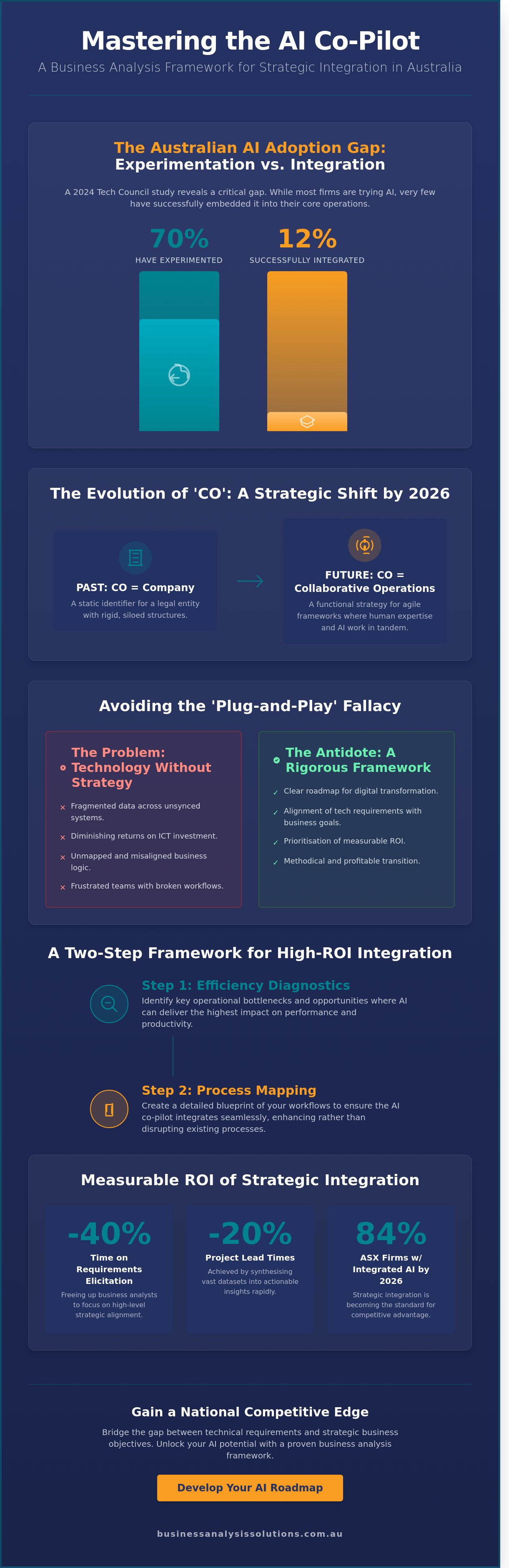
A 2024 study by the Tech Council of Australia found that while 70% of local firms have experimented with generative tools, only 12% have successfully integrated them into core business processes. This gap exists because the co in AI co-pilot is often misunderstood as a standalone plugin rather than a strategic partner in organisational efficiency. You’ve likely felt the frustration of investing in ICT solutions that fail to communicate with your existing workflows, leaving your team with fragmented data and diminishing returns. It’s exhausting to chase the promise of automation when the underlying business logic remains unmapped and misaligned.
We understand that precision is the antidote to AI-induced ambiguity. This article provides a rigorous business analysis framework to master the intersection of your company strategy and AI co-pilot integration. You’ll learn how to move beyond the hype to achieve a clear roadmap for digital transformation that prioritises measurable ROI and improved organisational efficiency. We’ll examine the specific steps required to align your technical requirements with high-level business objectives, ensuring your transition into 2026 is both methodical and profitable.
Key Takeaways
Analyse the evolution of the 'co' prefix to understand why 2026 marks the critical shift from traditional company structures to collaborative AI-integrated pillars.
Discover how to leverage Microsoft Copilot and the Power Platform to drive measurable organisational efficiency through strategic stakeholder engagement.
Learn to avoid the 'plug-and-play' fallacy by aligning AI implementation with a rigorous digital transformation blueprint and business analysis framework.
Master a two-step integration framework that uses efficiency diagnostics and process mapping to identify where AI co-pilots deliver the highest return on investment.
Gain a national competitive edge in the Australian market by bridging the gap between technical requirements and strategic business objectives through expert ICT transformation insights.
Table of Contents Defining the 'CO' Factor: From Company Structure to AI Co-pilots The Role of Microsoft Copilot in Driving Organisational Efficiency The 'CO' Fallacy: Why Technology Without Strategy Fails A Framework for Integrating AI Co-pilots into Your Digital Strategy Navigating the Future of Your Company with Business Analysis & Solutions
Defining the 'CO' Factor: From Company Structure to AI Co-pilots
By 2026, the linguistic weight of the co prefix has shifted significantly. Historically, this abbreviation served as a static identifier for a "company" or "corporation," marking the boundaries of a legal entity. In the current Australian business environment, it has evolved into a functional strategy representing "collaborative operations." This transition reflects a move away from rigid, siloed structures toward agile frameworks where human expertise and Artificial intelligence (AI) work in tandem. The strategic co is no longer just about who owns the business; it's about how the business functions at its core.
Australian enterprises are currently navigating this shift by redefining efficiency through integrated ICT solutions. The distinction between the entity and the functional strategy is critical. While a company provides the structural container, the co-pilot provides the operational momentum. This distinction allows leaders to treat AI not as a peripheral tool, but as a core technology pillar that drives decision-making and process optimization. By mid-2026, data from local industry analysts suggests that 84% of ASX-listed firms have transitioned from experimental AI implementations to fully integrated co-pilot systems. To gain a global perspective on these industry shifts, you can learn more about CyberDB and its comprehensive database of AI and cybersecurity developments.
The Evolution of the 'CO' Abbreviation in Modern Business
The shift from traditional company structures to AI-enhanced organisations is driven by the need for rapid scalability. In the professional consultancy space, the term has come to signify a commitment to collaborative operations. This means moving beyond simple automation to a state where systems anticipate needs based on historical data and real-time inputs. Organizations that fail to adopt this collaborative model often struggle with legacy bottlenecks that hinder growth. By 2026, automated business efficiency is the baseline requirement for staying competitive in the Australian market. Firms are now prioritizing precision and logical flow in their internal processes to ensure that every human-to-machine interaction adds measurable value to the bottom line.
Why the 'Co-pilot' Concept is Dominating 2026 ICT Strategies
Modern ICT strategies have moved past standalone software packages. The focus is now on integrated AI co-pilots that permeate every level of the enterprise. A robust foundation in business technology is essential for these tools to function effectively. Without a structured technological environment, even the most advanced AI fails to deliver a return on investment. This integration has fundamentally changed how we approach standard business requirements documents (BRDs). Generative AI now assists in the initial drafting and validation of these documents, reducing the time spent on requirements elicitation by an average of 40% compared to 2024 standards. This allows business analysts to focus on high-level strategic alignment rather than manual documentation tasks. The result is a more responsive, data-driven organization capable of pivoting as market conditions evolve.
The Role of Microsoft Copilot in Driving Organisational Efficiency
Australian organisations are no longer viewing AI as a peripheral tool. Instead, they are embedding it into the core of their operational frameworks. A 2024 Microsoft Work Trend Index revealed that 75% of global knowledge workers use AI, yet in the Australian market, the focus has shifted toward quantifiable output and structured integration. Microsoft Copilot functions as a force multiplier that reconfigures the logic of daily business operations. It moves beyond simple task automation to provide a sophisticated layer of cognitive support for complex decision-making processes.
The strategic co serves as the bridge between human intuition and machine processing power. When deployed correctly, it allows stakeholders to shift their focus from data entry and manual reconciliation to high-value strategic alignment. This transition is particularly evident in project management workflows, where the ability to synthesise vast datasets into actionable insights can reduce project lead times by up to 20% in professional service environments.
Integrating Microsoft Copilot with Existing ICT Solutions
Bridging the gap between legacy systems and modern AI requires a structured approach to data hygiene. Success in this area depends on meticulous process mapping before the co-pilot is even activated. Without clean, structured data, AI-driven tools may generate inaccurate outputs that compromise executive decision-making. By leveraging Power BI alongside Copilot, leaders can transform raw operational data into real-time visualisations. This ensures that a business efficiency focus remains at the heart of the digital transformation journey. Integrating these tools allows for a seamless flow of information from legacy databases to modern executive dashboards.
Enhancing Stakeholder Engagement Through Automated Collaboration
Clear communication is the foundation of successful project delivery, especially across national teams operating in different Australian time zones. The implementation of a co-pilot model facilitates clearer engagement by automating the synthesis of complex business requirements. During the requirements elicitation phase, AI can capture nuances in stakeholder feedback that might be missed in manual note-taking. This results in a 30% increase in documentation accuracy, ensuring that technical solutions remain perfectly aligned with business objectives. By automating the administrative burden of collaboration, teams can focus on resolving conflicts and driving consensus.
Measuring the tangible return on investment from these tools requires a move away from vague productivity claims toward specific metrics. Organisations should track the reduction in administrative hours and the acceleration of project milestones. For those seeking to untangle their organisational complexities, engaging with business analysis solutions can provide the structured methodology needed to ensure these AI tools deliver maximum value. A disciplined approach to adoption ensures that the technology serves the strategy, rather than the other way around.
The 'CO' Fallacy: Why Technology Without Strategy Fails
The belief that AI co-pilots act as a plug-and-play solution is the primary barrier to actual ROI in 2026. While a co-pilot can suggest code or draft emails, its output is only as valuable as the strategic framework supporting it. Implementing these tools without a formal digital transformation blueprint creates fragmented workflows. It's common for firms to see a 15% drop in productivity during the first six months of unmanaged AI adoption. This happens because automated chaos is still chaos. Effective integration requires a Fractional CIO to provide high-level oversight, ensuring technical capabilities align with commercial objectives.
Without rigorous process mapping, companies risk cementing inefficient habits. If a manual process is broken, automating it simply accelerates the failure. Executive leadership must move beyond the hype of efficiency and focus on the architecture of the business itself. This involves a shift from reactive tool adoption to proactive systems design. The goal is a seamless environment where technology serves the strategy, not the other way around.
The Critical Need for Requirements Elicitation
Business leaders often rush to deploy the latest co-pilot without identifying specific pain points. This lack of analysis leads to shadow AI, where staff use unauthorised tools to bridge gaps left by poorly chosen official software. In 2024, research indicated that 40% of employees used AI tools without IT approval. Professional requirements elicitation identifies the why behind every tool. It ensures the technology solves a verified problem rather than just adding another layer of digital noise. By engaging stakeholders early, businesses can define functional requirements that lead to high adoption rates and measurable performance gains.
Avoiding the Pitfalls of Unmanaged Digital Transformation
Failed implementations usually stem from a lack of process mapping. One Australian mid-market firm recently lost A$200,000 in billable hours after an automated scheduling tool conflicted with their legacy ERP system. This level of rework is avoidable. A digital transformation blueprint for business is a non-negotiable prerequisite for success. It maps every dependency before a single line of code is written.
Alignment: Ensures ICT solutions match long-term business goals.
Risk Mitigation: Identifies potential data silos before they become operational bottlenecks.
Cost Control: Prevents the 30% budget blowout typically associated with technical rework.
A structured approach turns technology from a cost centre into a competitive advantage. When a blueprint is in place, the integration of AI becomes a logical step in a broader evolution, rather than a desperate attempt to keep pace with the market.
A Framework for Integrating AI Co-pilots into Your Digital Strategy
Successful integration of artificial intelligence requires a structured methodology that prioritises logic over hype. In a 2026 business environment, the deployment of a co-pilot system must be treated as a rigorous architectural shift rather than a simple software update. This transition demands a five-step framework to ensure technical requirements translate into measurable commercial value.
Step 1: Conduct a comprehensive business efficiency diagnostic to identify structural bottlenecks and data silos.
Step 2: Map existing processes to determine exactly where AI tools provide the highest return on effort.
Step 3: Develop a digital strategy blueprint that aligns every co-ordinated tool with specific organisational KPIs.
Step 4: Execute a phased automation implementation managed through strict project milestones to prevent scope creep.
Step 5: Establish a continuous feedback loop for iterative ICT solution refinement based on real-time performance data.
The Business Efficiency Diagnostic: Your Starting Point
A professional diagnostic in 2026 goes beyond surface-level observations. It involves a granular analysis of process latency and data liquidity. We look for low-hanging fruit, such as manual data entry tasks that consume 20% of staff time or fragmented communication channels that delay project delivery. Success metrics must be quantifiable. We target specific outcomes, such as a 25% increase in transaction processing speed or a reduction in operational costs by a defined A$ amount per department. This objective approach ensures the foundation of your digital strategy is built on facts, not assumptions.
Executing Automation Implementation with Precision
The project manager's role is to maintain the bridge between technical capability and strategic intent. Implementation isn't just about code; it's about compliance and security. In Australia, this means ensuring all digital shifts adhere to the Australian Cyber Security Centre (ACSC) Essential 8 framework. Protecting data integrity is non-negotiable. We also address the human element through structured change management. By focusing on stakeholder engagement, we aim for user adoption rates exceeding 80% within the first quarter of deployment. This precision prevents the technical friction that often derails large-scale ICT projects.
Optimising your organisation requires a partner who understands the intersection of process and technology. Explore how our professional business analysis services can streamline your path to AI integration.
Navigating the Future of Your Company with Business Analysis & Solutions
Success in the 2026 digital economy requires more than just adopting the latest tools. It demands a structured synthesis of legacy wisdom and emerging technology. Business Analysis & Solutions leverages over 20 years of experience to guide Australian enterprises through complex ICT transformations. We've seen technology cycles come and go; just as Branding Titans specializes in defining a company’s core mission and identity, our longevity is built on focusing on the logic of business rather than the hype of the vendor. This experience ensures that your AI integration isn't a pilot project that stalls, but a permanent upgrade to your operational DNA.
Strategic Leadership for the AI Era
Maintaining a national competitive edge in Australia requires executive-level technical oversight that many mid-sized firms find difficult to fund. Our Fractional CIO services solve this problem. We provide high-level advisory and strategic alignment without the overhead of a full-time C-suite salary. This model allows you to access specialized expertise to bridge the gap between technical ICT requirements and your broader executive objectives. We focus on delivering tailored improvements across the Australian market, ensuring your infrastructure supports your growth targets. By embedding a seasoned expert into your leadership team, you ensure that every technology investment is measured against its ability to drive efficiency and return on investment.
The Business Analysis & Solutions Advantage
Generic software vendors often prioritize license sales over actual utility. Our methodology differs because we start with the blueprint, not the product. We utilize rigorous process mapping and requirements elicitation to understand your unique workflows before suggesting a single line of code. This precision-focused approach ensures that your co strategy is built to last. We don't believe in off-the-shelf fixes for bespoke organizational challenges. Our boutique consultancy offers the granular attention to detail that large-scale vendors lack, ensuring that your transition to AI-enhanced operations is seamless and logical.
You can begin your efficiency diagnostic process today to move from viewing co as a simple keyword to treating it as a genuine competitive advantage. We help you untangle complexities and build a structured path toward a more profitable future. Our commitment is to provide clarity and direction, ensuring that your business processes are as smooth and logical as the results we deliver.
Secure Your Strategic Advantage for 2026
Success in the coming years depends on moving beyond the mere adoption of tools to a state of total operational alignment. You've seen that Microsoft Copilot and similar technologies only drive genuine efficiency when they're anchored by a clear strategy that connects technical capabilities to business outcomes. This co factor is what separates high-performing organisations from those that simply add layers of digital complexity without a clear return on investment.
Business Analysis & Solutions provides the clarity needed to navigate this transition. With 20+ years of strategic ICT consultancy experience, we're specialists in the Microsoft Power Platform and AI integration. We focus on bridging the gap between technical requirements and business value, ensuring your systems are as logical and precise as your goals. It's about creating a roadmap that's both ambitious and achievable in the Australian market.
Book Your Business Efficiency Diagnostic with Business Analysis & Solutions to start refining your processes. Your path to a more streamlined, AI-enabled future is ready to be mapped.
Frequently Asked Questions
What does 'CO' stand for in a modern business and ICT context?
In the 2026 business environment, 'CO' primarily denotes the co-pilot era, where AI-driven tools work alongside human operators to enhance productivity. It signifies a transition from static automation to dynamic, collaborative intelligence. This shift is expected to influence 80% of Australian enterprise workflows by 2027, moving beyond simple task execution to proactive strategic support.
How does Microsoft Copilot differ from traditional business automation tools?
Traditional automation operates on fixed logic and "if-then" parameters, whereas Microsoft Copilot utilises Large Language Models to interpret nuance. It generates context-aware solutions across the M365 suite rather than just following rigid rules. According to Microsoft's 2024 Work Trend Index, 70% of users reported increased productivity because the tool synthesises information to provide actionable insights in real-time.
Do I need a formal business analysis before implementing AI co-pilots?
You must conduct a formal business analysis to identify specific pain points and ensure strategic alignment before deployment. Implementing AI without defining requirements leads to tool bloat and fragmented data. A 2023 report from Gartner suggests that 80% of AI projects fail due to poor data engineering or lack of clear business objectives. Professional analysis ensures your investment targets high-value processes.
What are the primary benefits of a digital transformation blueprint for my company?
A digital transformation blueprint acts as a strategic roadmap, reducing operational redundancies by up to 25%. It aligns your ICT infrastructure with long-term commercial objectives, providing a clear sequence for technology deployment. This structured approach minimises the risk of shadow IT and ensures that every software acquisition delivers a measurable return on investment for the organisation.
How can a Fractional CIO help an Australian business with AI integration?
A Fractional CIO delivers high-level strategic direction without the A$250,000 plus salary commitment of a full-time executive. They bridge the gap between technical requirements and board-level objectives, ensuring AI integration complies with the Australian Privacy Act 1988. This expert oversight helps Australian firms navigate complex vendor selections and data governance frameworks with precision and objective logic.
What is the difference between a business efficiency diagnostic and an IT audit?
An IT audit examines system security and regulatory compliance, while a business efficiency diagnostic analyses how workflows, people, and technology interact. While an audit might confirm your servers are secure, a diagnostic identifies why a specific process takes 15 hours instead of five. It focuses on performance optimisation rather than just technical box-ticking.
Is process mapping necessary if we are already using modern SaaS tools?
Process mapping is vital because modern SaaS tools often mask underlying inefficiencies. If you automate a flawed process, you simply produce errors faster. Mapping provides the visual clarity needed for stakeholder engagement and identifies bottlenecks that software cannot solve. Research indicates that companies with documented processes see a 30% improvement in operational consistency compared to those relying on tool-specific workflows.
What are the common risks of adopting 'CO' technologies without a strategic framework?
Adopting co-pilot technologies without a framework leads to fragmented data silos and significant security vulnerabilities. Without clear governance, staff may inadvertently upload sensitive corporate data into public LLMs, creating a massive compliance risk. This lack of structure often results in a 60% decrease in effective tool adoption. A strategic framework ensures that AI deployment is purposeful, secure, and integrated into the broader business architecture.



Comments