The Strategic Business Software Selection Process: A 2026 Framework
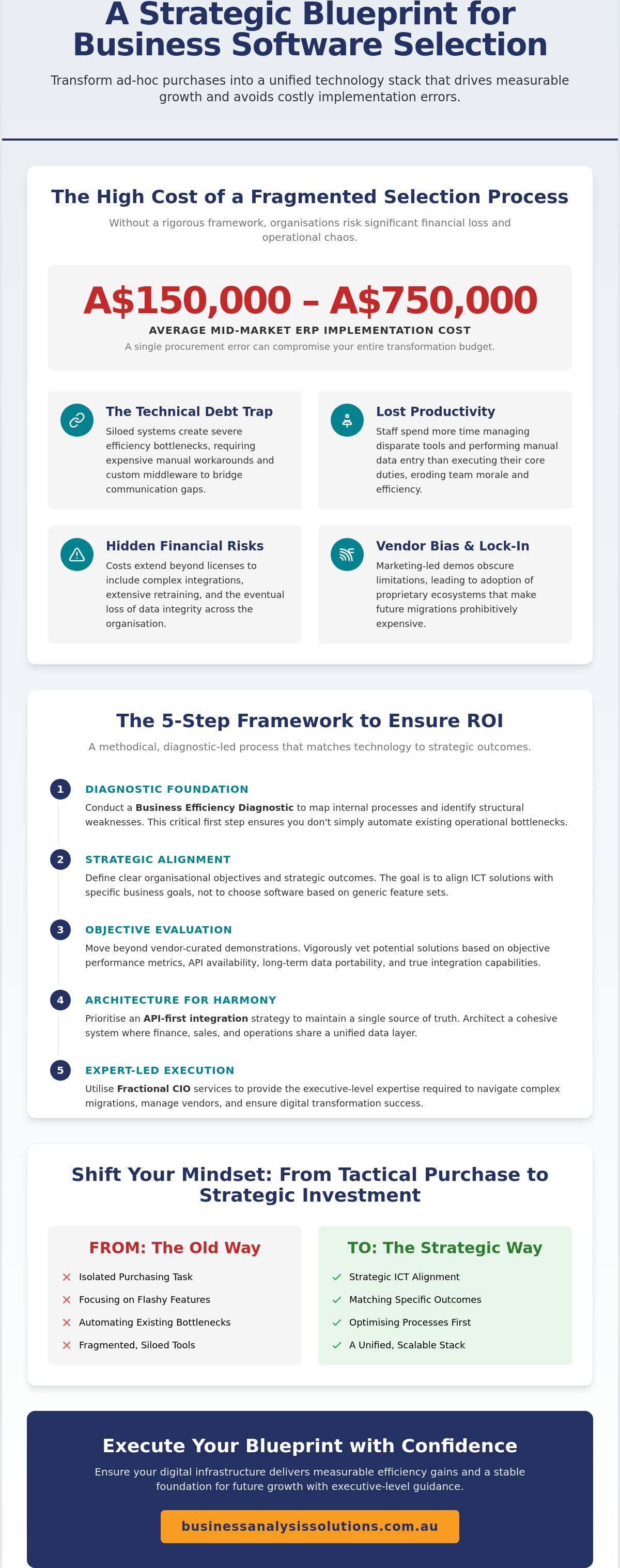
With mid-market ERP implementations now averaging between A$150,000 and A$750,000, a single procurement error can compromise your entire digital transformation budget. Most Australian organisations struggle with siloed data and mounting technical debt not because they chose "bad" software, but because they lacked a rigorous framework to align those tools with their operational logic. You likely recognise the frustration of investing in platforms that promise efficiency yet ultimately create more manual workarounds for your team.
To secure a genuine return on investment, you must master a methodical, diagnostic-led business software selection process that ensures operational harmony across every department. This article provides a clear roadmap for moving away from ad-hoc purchases and toward a unified technology stack. We'll explore how to bridge the gap between technical requirements and broader organisational objectives, ensuring your digital infrastructure delivers measurable efficiency gains and a stable foundation for future growth. By treating software selection as an architectural exercise rather than a simple purchasing task, you can eliminate implementation risks and drive sustained performance.
Table of Contents
The Strategic Risks of a Fragmented Business Software Selection Process
Selecting a new platform is frequently treated as a simple procurement event. This is a strategic mistake. A robust business software selection process is actually an exercise in aligning ICT solutions with specific organisational goals. When leadership prioritises flashy features over functional logic, they inadvertently create a fragmented architecture that hinders progress. True success requires a process-first mentality where the technology is chosen to mirror an optimised workflow, not the other way around.
Ad-hoc software purchases frequently lead to what experts call the 'Technical Debt Trap'. This occurs when tools are selected to solve isolated departmental problems without considering the broader organisational ecosystem. Over time, these disconnected systems create severe efficiency bottlenecks that require expensive manual workarounds or custom middleware to bridge. Instead of a cohesive workflow, the organisation ends up with a patchwork of various business software categories that fail to communicate effectively. This fragmentation forces staff to spend more time managing the tools than performing their core duties.
The financial consequences of a poor selection extend far beyond the initial subscription or license fee. Hidden costs often include complex integration requirements, extensive staff retraining, and the eventual loss of data integrity. In the Australian market, where mid-market ERP implementations can cost up to A$750,000 in the first year, the stakes for getting the selection right are exceptionally high. A fragmented approach doesn't just waste capital; it actively erodes the agility of the business.
Beyond Digitisation: Software as a Transformation Catalyst
In 2026, simply moving paper processes to a screen isn't enough to remain competitive. True digital transformation requires tools that fundamentally improve how value is delivered to the client. Utilizing a Digital Transformation Blueprint ensures that every selection supports long-term system harmony. This strategic framework ensures that finance, sales, and operations share a unified data layer, turning software into a catalyst for growth rather than a digital filing cabinet. It's about building a foundation that scales with your ambition.
The Hidden Hazards of Vendor Bias
Marketing-led demonstrations are carefully curated to highlight strengths while obscuring underlying technical limitations or integration gaps. Without an objective, third-party analytical collaborator to vet these claims, businesses often fall into the trap of 'locked-in' proprietary ecosystems. These environments make future migrations or integrations with best-of-breed tools prohibitively expensive. A methodical business software selection process removes the emotional influence of a polished sales pitch, focusing instead on objective performance metrics, API availability, and long-term data portability to protect the interests of the business.
The Diagnostic Foundation: Why Process Mapping Must Precede Selection
Skipping a thorough internal assessment is the fastest route to implementation failure. Before evaluating vendors, conducting a Business Efficiency Diagnostic is essential. This diagnostic identifies the structural weaknesses that a tool alone cannot resolve. Without this clarity, a business risks selecting a platform based on perceived needs rather than operational reality. A logical business software selection process begins with a cold, analytical look at how work actually moves through the organisation.
Purchasing software for an inefficient workflow merely "automates the mess." It accelerates bad data and compounds operational friction. When processes are broken, adding technology only makes those errors occur faster and at a larger scale. This diagnostic phase also uncovers "shadow IT", the unauthorised apps or spreadsheets employees use to bypass current system gaps. These workarounds are valuable data points; they reveal exactly where your current infrastructure is failing your team. By identifying these gaps, you can find "low-hanging fruit" where targeted automation implementation can yield immediate ROI without the need for a total system overhaul.
Process Mapping: Visualising the Operational Current State
Documenting workflows through formal process mapping reveals the redundancies and silos that are often invisible to leadership. It bridges the gap between how executives think work is done and how it actually happens on the ground. This exercise highlights where manual data entry is draining expensive executive time and where information "bottlenecks" occur between departments. If you're unsure where your operational leaks are, professional Process Mapping services can provide the necessary visibility to make an informed decision.
Requirements Engineering: Translating Needs into Technical Specs
Effective selection requires moving beyond vague "wish lists" toward precise technical specifications. Functional requirements define what the system must do, while non-functional requirements address performance, security, and scalability. We recommend prioritising these features using the MoSCoW method: Must-have, Should-have, Could-have, and Won't-have. This structured approach ensures that the business software selection process remains focused on board-level strategic goals rather than individual departmental preferences. It maintains the project scope and prevents the "feature creep" that often derails mid-market ICT projects.
A 5-Step Framework for Business Software Selection in 2026
Executing a successful digital transition requires more than a simple checklist; it demands a structured framework that prioritises strategic outcomes over technical bells and whistles. In 2026, the business software selection process has shifted from generic feature-matching to rigorous outcome-matching. This means every potential tool is evaluated based on its ability to deliver the specific results identified during your diagnostic phase. By following a methodical sequence, mid-market firms can mitigate implementation risks and ensure high stakeholder buy-in from the outset.
Step 1: Market Scanning and Long-List Curation
The global SaaS market is increasingly saturated, making it difficult to identify truly viable ICT solutions. Start by filtering vendors based on their financial stability and scalability. While peer reviews provide insight into user experience, professional analyst reports offer a deeper look into a vendor's long-term viability and technical maturity. Curation should focus on tools that demonstrate a clear understanding of your industry's specific coordination challenges. Avoid the temptation to include "shiny" new entrants that lack a proven track record of uptime and reliable support structures.
Step 2: The Deep-Dive Evaluation and Proof of Concept (PoC)
Once you have a shortlist, move beyond the standard marketing slide deck. Request scripted demos where the vendor must demonstrate how their tool handles your specific workflows based on your previously drafted process maps. This forces the vendor to show, rather than tell, how their system resolves your unique bottlenecks. A Proof of Concept (PoC) phase is non-negotiable for testing critical integration points. It's during this stage that you'll discover if the software's API can truly maintain system harmony or if it will create new data silos. Evaluate the vendor's product roadmap to ensure the software will grow alongside your business objectives over the next five to ten years.
Step 3: Risk Assessment and Compliance (Essential 8)
For Australian organisations, the business software selection process must integrate local cybersecurity standards. We recommend applying the Essential 8 framework to evaluate every vendor's security posture. This involves verifying their approach to multi-factor authentication, regular backups, and patch management. Data sovereignty is another critical factor; you must confirm where your data is stored and ensure it complies with the Australian Privacy Act. Assessing the vendor's Service Level Agreements (SLAs) ensures that you have clear recourse if performance dips below agreed standards. This objective risk assessment protects the organisation from the high cost of data breaches and implementation failure.
The final steps of the framework involve a formal decision matrix and a structured implementation plan. By following these initial stages with precision, you build the necessary momentum to transition from selection to a successful, high-ROI deployment.
Architecting for System Harmony and Data Integrity
A successful software implementation depends entirely on the underlying technical architecture. During the business software selection process, you must evaluate how a new tool integrates into your existing data layer to ensure long-term stability. The primary objective is to establish a 'Single Source of Truth' where information flows seamlessly between departments without manual intervention. This architectural integrity prevents the data fragmentation that often leads to operational silos and ensures your data remains a reliable asset for executive decision-making. If your systems don't talk to each other, you're merely trading one set of manual problems for another.
In 2026, an API-first architecture is non-negotiable for any mid-market organisation. Modern systems must communicate in real-time to maintain operational harmony and support rapid scaling. When assessing business technology, prioritise vendors that provide robust, well-documented APIs. This flexibility ensures your stack can support your five-year growth plans without requiring a total overhaul every time your requirements shift. Beyond the technical specifications, User Experience (UX) serves as the ultimate metric of selection success. If the interface is unintuitive, adoption rates will plummet; this makes UX a functional requirement rather than a cosmetic preference.
The Role of Middleware and the Microsoft Power Platform
Leveraging middleware like the Microsoft Power Platform allows firms to bridge the gap between legacy systems and modern cloud solutions. By utilising low-code tools, you can customise workflows and automate repetitive tasks without the high costs and risks associated with custom software development. This approach reduces the burden on your internal IT team and allows for a more agile response to changing market conditions. It provides a layer of system harmony that allows disparate tools to function as a unified ecosystem, protecting your previous ICT investments while you modernise your stack.
Data Migration: The Critical Path to Go-Live
Data migration is frequently the most underestimated phase of the implementation lifecycle. Establishing strict data governance protocols during the business software selection process is critical to avoiding the 'garbage in, garbage out' trap. You must cleanse and map your existing data before it touches the new system to ensure accuracy. This methodical approach involves identifying redundant records, correcting formatting errors, and ensuring that your new platform is populated with high-quality, actionable information from day one. Successful migration is less about the move itself and more about the preparation that precedes it.
For organisations looking to secure their digital future, engaging professional Digital Strategy services ensures your architecture is built for performance and scale.
Executing the Blueprint with Fractional CIO Leadership
Selection is only half the battle. The transition from procurement to performance requires executive-level oversight that many mid-market organisations lack internally. This is where Fractional CIO services Australia provide essential value. An on-demand CIO offers the strategic leadership necessary to navigate complex migrations without the overhead of a full-time executive salary. They act as the analytical bridge between technical requirements and board-level strategy, ensuring that the business software selection process translates into tangible financial performance and long-term stability.
Strategic advisory moves the organisation away from a reactive "project" mindset toward a culture of continuous digital improvement. Instead of viewing software as a static purchase, leadership begins to see it as a dynamic engine for growth. This high-level guidance ensures that every technical decision supports the long-term ROI and operational harmony discussed in previous sections. It's about maintaining a steady, logical progression toward a more efficient future rather than chasing the latest industry trends without a clear objective.
Managing the Implementation Life Cycle
Successful deployment depends on rigorous, outcome-focused Project Management. We advocate for a phased rollout rather than "big bang" implementations, which carry high risks of system failure and staff burnout. By phasing the release, you can isolate variables and address issues in a controlled environment. Establishing clear KPIs during this stage is vital. These metrics should measure not just technical uptime, but also process efficiency, data accuracy, and user adoption rates across every department.
Post-Implementation Review and Optimisation
The work doesn't end at go-live. A formal 90-day review is necessary to identify user friction points and process gaps that only emerge during real-world usage. Continuous monitoring of system ROI ensures that the efficiency gains promised during the business software selection process are actually being realised. This iterative approach allows for fine-tuning the system to better serve the evolving needs of the business. It ensures the technology remains an asset rather than a burden.
Software serves as the engine of your organisation, but the blueprint remains the map. Without a structured framework and professional leadership to guide the way, even the most advanced tools will fail to deliver their full potential. Focus on the strategy first, and the technology will follow as a logical extension of your operational goals.
Securing Long-Term ROI through Architectural Precision
Transitioning from a fragmented ICT stack to a unified ecosystem requires more than just capital; it demands a disciplined business software selection process. You've seen how rigorous process mapping and architectural integrity prevent the high costs of implementation failure. By focusing on outcome-matching rather than simple feature-matching, you ensure that every digital investment serves a clear strategic purpose and integrates seamlessly into your organisational logic.
Our team specialises in mid-market digital transformation and automation, bringing over 20 years of expertise in ICT consultancy and business analysis to every engagement. We provide a proven methodology for bridging the gap between technical specifications and broader board-level objectives, ensuring your technology stack supports sustained operational harmony. This structured approach removes the ambiguity from complex migrations and replaces it with a clear roadmap for measurable efficiency gains.
Take the first step toward a more resilient, data-driven future. Request a Business Efficiency Diagnostic to Inform Your Software Selection today. You can build a robust digital foundation with the calm assurance that your systems are engineered for performance and scale.
Frequently Asked Questions
What is the most common mistake in the business software selection process?
Prioritising software features before defining internal processes is the most frequent error. This leads to "automating the mess," where inefficient workflows are simply accelerated. Organisations often buy based on a polished sales demo rather than a diagnostic mapping of their actual requirements. This oversight usually results in low user adoption and significant technical debt that takes years to resolve.
How long does a formal software evaluation typically take for a mid-market firm?
A formal evaluation for a mid-market firm typically spans three to six months. This duration allows for a thorough business software selection process, including diagnostic mapping, market scanning, and scripted demonstrations. Rushing this phase often leads to overlooked integration gaps that can cost hundreds of thousands of dollars to rectify during the implementation stage. Precision in the planning phase saves significant capital during rollout.
Why should we use a diagnostic approach instead of just buying a market leader?
A market-leading tool is only effective if it aligns with your specific operational logic. Choosing a "brand name" platform without a diagnostic assessment often forces the business to change its successful processes to fit the software's rigid constraints. A diagnostic approach ensures the technology supports your unique competitive advantages rather than diluting them. It's about finding the most effective solution for your specific coordination challenges.
What is the difference between an IT roadmap and a digital transformation blueprint?
An IT roadmap focuses on technical lifecycle management and maintenance, while a digital transformation blueprint aligns technology with broader business outcomes. The blueprint serves as a strategic guide for organisational change, focusing on process optimisation and value delivery. It ensures that every ICT investment contributes directly to board-level performance goals. A blueprint provides the strategic "why" behind the technical "how" of your roadmap.
How does the Essential 8 framework impact our software choice?
The Essential 8 framework dictates the minimum cybersecurity standards a vendor must meet to be considered viable in the Australian market. It requires leadership to evaluate how a new platform handles multi-factor authentication, backup integrity, and patch management. This framework ensures that your business software selection process prioritises data resilience and mitigates the risk of catastrophic breaches. Compliance with these standards is a non-negotiable requirement for modern risk management.
Can we integrate new software with our existing legacy systems?
Integration with legacy systems is possible through API-first architectures or middleware solutions like the Microsoft Power Platform. These tools allow modern cloud platforms to communicate with older on-premise databases, preserving previous investments while improving data flow. Successful integration requires a detailed mapping of data dependencies during the initial evaluation phase. It's a methodical way to bridge the gap between technical requirements and broader organisational objectives.
What are the benefits of a Fractional CIO during the selection process?
A Fractional CIO provides objective, executive-level oversight to ensure technical choices align with financial objectives. They act as an analytical collaborator who vets vendor claims and manages implementation risks. This on-demand leadership is particularly valuable for mid-market firms that need high-level expertise for complex migrations without the cost of a full-time executive. They ensure the tool mirrors an optimised process rather than defining it.
How do we calculate the true ROI of a software investment?
True ROI is calculated by measuring tangible efficiency gains, reduced manual work hours, and the elimination of redundant software licenses. You must contrast these gains against the total cost of ownership, which includes implementation, training, and annual maintenance fees. Establishing clear KPIs during the selection phase allows for objective measurement of these financial outcomes post-implementation. It's a vocabulary of pragmatism and performance that justifies the initial capital outlay.



Comments