The Strategic Benefits of a Fractional CIO: Driving Business Value in 2026
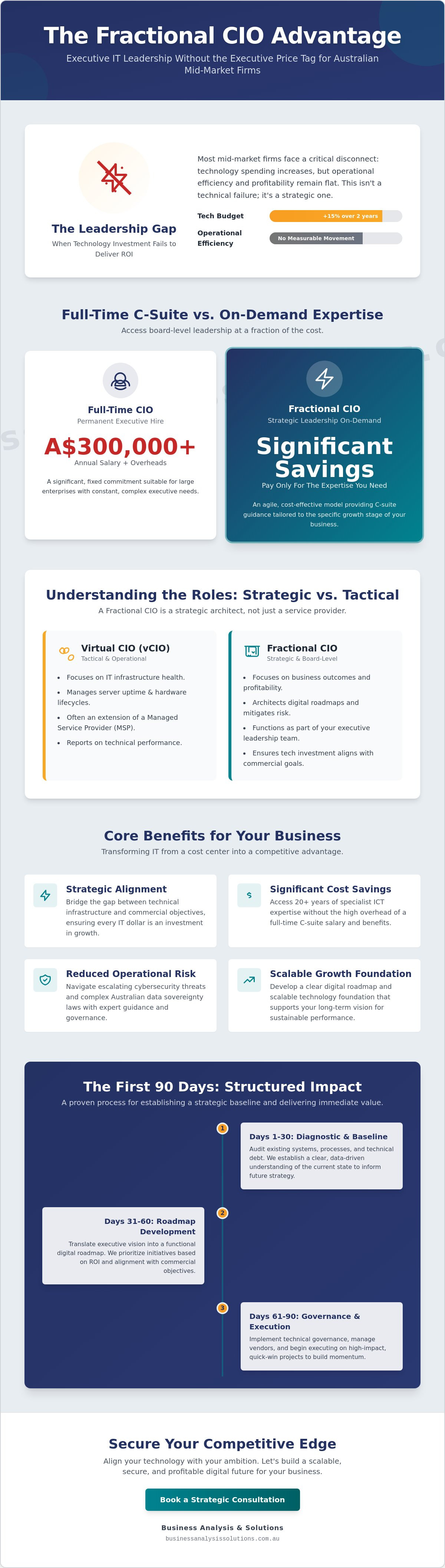
If your technology budget has increased by 15% over the last two years but your operational efficiency hasn't moved, you aren't just facing a technical issue. You're likely experiencing a leadership gap that prevents your systems from speaking the language of your balance sheet. Most mid-market Australian directors recognize that their technology investments often fail to yield the expected ROI, leading to a persistent misalignment between IT teams and commercial objectives. Understanding the strategic benefits of a fractional CIO allows your organization to bridge this gap without the A$300,000 plus annual commitment of a full-time executive hire.
You've likely felt the anxiety of managing escalating cybersecurity threats while trying to scale your infrastructure for 2026. It's a complex environment where one wrong decision can stall growth for years. This article demonstrates how fractional CIO services provide the precise, executive-level leadership required to align your technology with your long-term business goals. We'll examine the process of building a clear digital roadmap, reducing operational risk, and creating a scalable foundation that supports sustainable performance.
Key Takeaways
Understand how board-level technology leadership on a part-time basis provides mid-market Australian firms with the executive oversight needed to navigate complex digital landscapes.
Discover the strategic benefits of a fractional CIO in bridging the gap between technical infrastructure and commercial objectives through rigorous business analysis.
Learn how to access 20+ years of specialist ICT expertise while realizing significant cost savings compared to the high overhead of a full-time C-suite salary in A$.
Identify the optimal timing for engaging on-demand leadership and the structured diagnostic process used to establish a strategic baseline within the first 90 days.
Explore how the synergy between business analysis and executive advisory transforms IT from a cost center into a primary driver of operational efficiency and competitive advantage.
Table of Contents What is a Fractional CIO? Defining Executive IT Leadership on Demand Strategic Alignment: How Fractional CIOs Bridge the Business-IT Gap The Core Benefits of a Fractional CIO for Australian Businesses Practical Implementation: Integrating a Fractional CIO into Your Team Securing Your Competitive Edge with Business Analysis & Solutions
What is a Fractional CIO? Defining Executive IT Leadership on Demand
A Fractional CIO serves as a board-level technology leader who provides strategic oversight on a part-time or project basis. Unlike traditional full-time executives, these professionals offer the same caliber of leadership at a scale that fits an organization's specific lifecycle or maturity level. To define the role clearly, one must understand What is a Fractional CIO? beyond the surface level; it's the provision of executive-grade technical governance without the overhead of a permanent A$300,000+ C-suite salary. By 2026, the Australian mid-market has shifted toward this agile executive model to combat the rising costs of specialized talent and the increasing complexity of the local regulatory environment.
The demand for on-demand leadership in Australia is surging as firms recognize that technology is no longer a back-office function but a primary revenue driver. One of the primary benefits of a fractional CIO is the injection of objective, high-level expertise into a business that might otherwise lack a seat for technology at the boardroom table. These leaders take ownership of technical governance, ensuring that every software investment or infrastructure change aligns strictly with the firm's commercial objectives. Their core responsibilities extend from mitigating cybersecurity risks to architecting scalable systems that support rapid growth.
Fractional CIO vs. vCIO: Understanding the Difference
While the terms are often used interchangeably, the distinction is fundamental to organizational success. A virtual CIO (vCIO) is typically an extension of a Managed Service Provider (MSP), focusing on the tactical health of IT infrastructure, such as server uptime and hardware lifecycles. In contrast, the Fractional CIO operates at the board level, prioritizing business outcomes and strategic accountability. The Fractional CIO functions as a strategic architect rather than a service provider, focusing on how technology can optimize process mapping and stakeholder engagement. They manage the vendors and the vCIO, ensuring that technical delivery serves the broader corporate strategy.
The Role of the CIO in the Modern Australian Enterprise
Modern Australian businesses face unique challenges, including strict data sovereignty laws and a competitive landscape that demands rapid innovation. A Fractional CIO bridges the gap between technical requirements and commercial outcomes by providing a cold, analytical perspective on legacy systems. They're particularly effective at identifying technical debt that drains operational efficiency. By leading the charge on a digital transformation blueprint for business, these experts ensure that modernization efforts aren't just cosmetic. They implement structured frameworks that turn fragmented data into actionable insights, highlighting the benefits of a fractional CIO for firms that need to scale without the friction of outdated technology. This methodical approach ensures that every project delivers a measurable return on investment.
Strategic Alignment: How Fractional CIOs Bridge the Business-IT Gap
Many Australian mid-market firms struggle with a significant disconnect where IT operates as an isolated cost centre rather than a strategic value driver. A Fractional CIO resolves this by aligning technical expenditure with specific commercial objectives. They don't just manage infrastructure; they translate executive vision into a functional technology stack. One of the primary benefits of a fractional CIO is their ability to audit existing systems through the lens of profitability and long-term viability.
By integrating with the leadership team, these experts ensure that every ICT project has a clear business case. They facilitate stakeholder engagement across departments to ensure that digital initiatives aren't just technical successes, but operational ones. This alignment prevents the common "shadow IT" problem where departments procure their own software, leading to fragmented data and security risks.
The Importance of Business Analysis in ICT Strategy
Technology projects often fail because of poor requirements elicitation and a lack of structured planning. Research indicates that approximately 70% of digital transformations fall short of their goals due to a lack of clear strategic intent. A Fractional CIO employs a Strategic Business Analysis Consultancy approach to identify bottlenecks before any capital is committed to new software.
Using formal business analysis, the CIO identifies inefficiencies that might be costing the organisation upwards of A$60,000 annually in lost productivity. This methodical process includes:
Process Mapping: Visualising current workflows to identify redundancies and manual hand-off points.
Data-Driven Justification: Using internal performance metrics to prove the ROI of a proposed technology investment.
Scalability Assessment: Ensuring that any new ICT solution can handle a 20% to 50% increase in volume without requiring a complete overhaul.
Creating a Digital Transformation Roadmap
Most organisations operate in a reactive state, addressing technical issues only when they disrupt daily operations. A Fractional CIO shifts this dynamic toward a proactive, multi-year technology strategy. By providing strategic IT leadership, they help businesses move away from "firefighting" and toward a structured roadmap for 2026 and beyond.
This roadmap prioritises automation implementation to reduce human error and free up staff for higher-value tasks. It ensures that all ICT projects align with the long-term vision of the organisation, providing a clear path for growth. When you understand the benefits of a fractional CIO, you see that their value lies in creating a stable, predictable environment where technology supports, rather than hinders, expansion. If your current systems feel like a hurdle, it's time to optimise your operational workflows with a dedicated expert who understands the intersection of logic and technology.
The Core Benefits of a Fractional CIO for Australian Businesses
Australian mid-market firms often struggle to bridge the gap between technical operations and long-term strategy. Engaging a fractional CIO provides immediate access to over 20 years of cross-industry expertise without the overhead of a permanent executive. The benefits of a fractional CIO extend beyond simple cost-cutting; they provide the structural discipline required to scale in a volatile 2026 market. By integrating a seasoned leader, businesses gain high-level technical governance and a methodology for accelerated project delivery. This approach ensures that every technology investment is directly linked to a measurable business outcome.
Financial Optimisation and ROI
The primary fiscal advantage lies in the reduction of executive remuneration costs. A full-time CIO in Sydney or Melbourne typically commands a base salary between A$280,000 and A$400,000, excluding bonuses, superannuation, and payroll tax. The fractional model delivers this same C-level talent at a mid-market price point, allowing organisations to reallocate capital toward growth initiatives. Beyond salary savings, these leaders identify and eliminate "shadow IT," which often accounts for 30% to 40% of an organisation's software spend. They audit redundant subscriptions and ensure that every ICT project adheres to a strict ROI framework. Research indicates that the benefits of fractional executives include increased agility and the ability to pivot resources quickly as market demands shift.
Risk Management and the Essential 8
Security is no longer a secondary concern for Australian boards. A fractional CIO prioritises the implementation of the Australian Cyber Security Centre (ACSC) Essential 8 framework to mitigate the majority of common cyber threats. They move the organisation beyond basic antivirus software toward a posture of genuine resilience. This includes rigorous data privacy compliance under the Privacy Act 1988 and the development of tested disaster recovery protocols. For firms considering mergers, acquisitions, or a future exit, the fractional CIO provides necessary technical due diligence. They ensure the digital assets are audited, secure, and ready for valuation. This level of oversight reduces the likelihood of project overruns, which currently affect 45% of large-scale IT transformations globally.
Expert project management is a critical driver for value. A fractional CIO applies a structured approach to requirements elicitation and stakeholder engagement, which reduces the friction typically found in digital transformations. By aligning technical roadmaps with business objectives, they shorten the delivery cycle for new products. This ensures that Australian businesses remain competitive in a landscape where speed to market is a primary differentiator. When a business understands the benefits of a fractional CIO, it's able to transform IT from a cost centre into a strategic engine for growth.
Practical Implementation: Integrating a Fractional CIO into Your Team
Organizations often reach a tipping point where IT complexity outpaces internal capability. This usually occurs when a company scales past 50 employees or when legacy system failures cause more than 5% revenue loss annually. Engaging a professional allows you to capture the benefits of a fractional CIO without the A$300,000+ salary commitment of a full-time executive. The integration process is most effective when it's treated as a strategic partnership rather than a temporary fix.
Selecting the Right Fractional Partner
Selecting a partner requires more than a technical checklist. You need a leader who demonstrates analytical rigour and a vendor-agnostic approach. This independence ensures that software recommendations are based on your specific business requirements rather than third-party commission structures. A critical component is their proven ability in project management; they must show they can drive transformation within the specific regulatory environment of the Australian market. Look for a track record of bridging the gap between technical teams and the board room.
The Diagnostic Phase: Where Strategy Begins
The first 90 days are critical for establishing a strategic baseline. This period begins with a comprehensive business efficiency diagnostic. We don't guess; we measure. This phase identifies immediate "quick wins," such as consolidating redundant SaaS subscriptions to save 10% on operational overheads. Simultaneously, the Fractional CIO builds a long-term roadmap to address structural gaps. This diagnostic ensures that every IT investment aligns with the broader corporate strategy. It sets clear expectations for deliverables and reporting cycles from day one.
Integration into existing leadership teams must be seamless. The Fractional CIO acts as a bridge; they translate complex data into actionable insights for board meetings. Success isn't a feeling; it's a metric. One of the primary benefits of a fractional CIO is the introduction of objective performance tracking. We measure success through specific, quantifiable KPIs:
System uptime maintained at 99.9% or higher to ensure business continuity.
A 15% to 20% improvement in process efficiency within the first 12 months.
On-time and on-budget delivery of Tier-1 digital transformation projects.
Reduction in cybersecurity risk profile based on Australian Essential Eight standards.
This structured approach turns technology from a reactive cost centre into a proactive value driver. It provides the clarity needed to make informed decisions about future growth. If your organization is ready to move beyond reactive IT management, explore our strategic business analysis services to start your transformation.
Securing Your Competitive Edge with Business Analysis & Solutions
Business Analysis & Solutions bridges the gap between executive vision and technical execution. We provide high-level IT advisory that avoids the A$250,000 to A$350,000 annual salary typically required for a full-time executive in the Australian market. By leveraging the benefits of a fractional CIO, your organisation gains access to seasoned leadership that prioritises commercial outcomes over technical complexity. Our model ensures that your IT infrastructure isn't just a cost centre, but a driver of measurable business value.
Our approach relies on a unique synergy between professional business analysis and strategic leadership. We don't guess what your organisation needs; we use data to prove it. This diagnostic-led methodology ensures that technology serves your specific operational requirements, not the other way around. We identify bottlenecks, map stakeholder needs, and align every technical project with your long-term growth targets. This creates a structured environment where digital transformation is predictable and results-oriented.
Our Proven Methodology for 2026
We've refined a framework that focuses exclusively on business efficiency through tailored ICT consultancy. Our consultants work to eliminate the disconnect between technical requirements and commercial objectives. We purposefully exclude low-value, repetitive tasks like helpdesk support or hardware maintenance. This allows our team to focus entirely on high-impact strategy, governance, and vendor management. You get the executive brainpower needed to lead a digital shift without the operational noise of daily IT support.
Strategic alignment of ICT investments with 2026 business goals.
Rigorous requirements elicitation to prevent project scope creep.
Vendor-neutral advice that puts your organisational interests first.
Optimisation of existing legacy systems to extend their lifecycle and ROI.
Book Your Strategic Consultation
Moving from digital uncertainty to a structured transformation blueprint starts with a business efficiency diagnostic. During your initial discovery session, our senior consultants will evaluate your current technology stack and identify immediate opportunities for cost reduction or performance gains. We provide a clear roadmap that outlines how the benefits of a fractional CIO can be applied to your specific organisational challenges.
Our consultants bring a no-nonsense, logical approach to every engagement. We'll discuss your current pain points, from integration issues to data silos, and determine the most efficient path forward. Don't let technical debt or a lack of strategic direction stall your progress. Contact Business Analysis & Solutions today to secure executive IT leadership that delivers a genuine competitive advantage in a rapidly evolving economy.
Future-Proof Your Technology Strategy for 2026 and Beyond
The transition toward on-demand executive leadership represents a logical response to the increasing complexity of the Australian digital landscape. By 2026, the ability to align technical infrastructure with overarching commercial objectives will define market leaders. One of the primary benefits of a fractional CIO is the immediate access to high-level strategic oversight without the substantial overhead of a full-time executive salary.
Business Analysis & Solutions leverages over 20 years of industry experience to deliver precise, objective results. We specialize in navigating Australian-specific regulations and implementing the Essential 8 framework to harden your security posture against evolving threats. Our vendor-agnostic advisory model ensures that every recommendation is driven by your specific operational requirements rather than external sales targets. This structured approach transforms IT from a cost center into a reliable engine for long-term growth.
Contact Business Analysis & Solutions for a Fractional CIO Consultation to begin optimizing your technology roadmap. We're ready to help you turn organizational complexity into a clear path for success.
Frequently Asked Questions
How much does a Fractional CIO cost compared to a full-time CIO?
A Fractional CIO typically costs between A$3,000 and A$10,000 per month, depending on the scope of the engagement. In contrast, the 2024 Hays Salary Guide indicates that a full-time CIO in Australia commands a median base salary of A$280,000, excluding bonuses and payroll tax. By adopting a fractional model, your business can reduce executive overhead by up to 70% while still securing high-level strategic alignment.
What is the difference between a Fractional CIO and an IT consultant?
The distinction lies in the duration of the partnership and the level of accountability. An IT consultant is generally hired to execute a specific project, such as a system migration. A Fractional CIO serves as a long-term member of your leadership team. They focus on continuous stakeholder engagement and business outcomes. While consultants deliver a defined output, the CIO provides ongoing guidance to ensure technology drives tangible value.
Does my business need a Fractional CIO if we already have a Managed Service Provider (MSP)?
Yes, because an MSP manages your tactical operations while a CIO manages your strategy. Your MSP ensures your network is stable and your helpdesk is responsive. A Fractional CIO provides the oversight needed to ensure your MSP's activities align with your 2026 growth targets. This governance prevents technical debt and ensures that one of the core benefits of a fractional CIO is a technology roadmap that actually supports your commercial goals.
How many hours a month does a Fractional CIO typically work?
Most engagements involve between 8 and 32 hours of dedicated service per month. The exact commitment depends on your organisational complexity and the pace of your digital transformation. A smaller firm might only require one day a month for board reporting and strategy reviews. A larger company undergoing intensive process mapping might need two days a week. This flexibility allows you to scale expert input as your requirements evolve.
Can a Fractional CIO help with cybersecurity compliance like the Essential 8?
A Fractional CIO provides the executive leadership necessary to implement the Australian Signals Directorate's Essential 8 framework effectively. They don't just manage the technical settings; they integrate security into your corporate governance. With 60% of Australian organisations now using cybersecurity maturity as a key vendor selection criterion, your CIO ensures you meet these standards. They protect your reputation and ensure your business remains resilient against evolving digital threats.
What industries benefit most from Fractional CIO services?
Industries with complex regulatory requirements or high-volume data needs see the greatest return on investment. This includes Australian sectors like manufacturing, healthcare, and professional services. These businesses often face rapid digitisation hurdles and strict privacy laws. A Fractional CIO helps these firms navigate technical requirements while maintaining a lean structure. Any mid-market organisation with an annual technology spend exceeding A$200,000 will find the strategic oversight highly beneficial.
How do I know if my business is ready for a Fractional CIO?
You're ready when technology feels like a barrier to your growth rather than an enabler. If your leadership team lacks a clear three-year digital roadmap, or if IT costs are rising without a clear ROI, it's time for professional intervention. Most businesses hit this point when they reach 30 employees or A$10 million in annual revenue. At this stage, the benefits of a fractional CIO become clear as they resolve the friction between technical needs and business objectives.
Will a Fractional CIO manage my internal IT team?
Yes, they provide the professional mentorship and management your internal IT staff need to succeed. Instead of your CEO or CFO managing technical personnel, the Fractional CIO takes responsibility for performance reviews and resource allocation. They translate high-level business goals into actionable tasks for your technical team. This structure improves staff retention and ensures your internal resources focus on high-value projects that drive the business forward.



Comments