The Strategic Automation Implementation Plan: A 2026 Framework for Business Efficiency
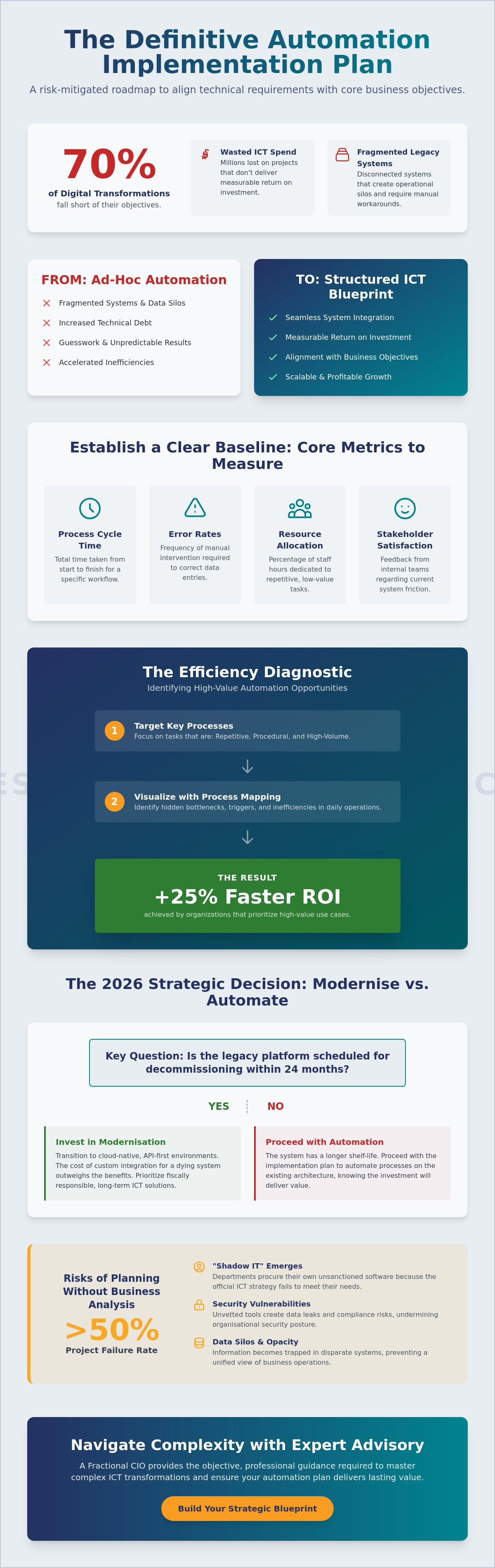
Research from the Boston Consulting Group indicates that 70% of digital transformations fall short of their objectives, often resulting in millions of A$ in wasted ICT spend. You likely understand the frustration of managing fragmented legacy systems that refuse to communicate, leaving your team to bridge the gap manually. It's a common scenario where technical complexity creates a barrier to actual business progress. You need a strategy that moves beyond guesswork and delivers predictable results.
This article provides a definitive automation implementation plan designed to eliminate ambiguity and ensure every technical investment delivers a measurable return. By mastering this methodology, you'll learn to design a risk-mitigated roadmap that aligns technical requirements with core business objectives. We'll examine the 2026 framework for achieving seamless integration through precise process mapping, stakeholder engagement, and rigorous requirements elicitation. This structured approach ensures your ICT solutions are both functional and financially sound, providing a clear path toward organisational efficiency.
Key Takeaways
Transition from fragmented, ad-hoc automation to a structured ICT blueprint that prevents technical debt and eliminates operational silos.
Utilise an Efficiency Diagnostic to identify repetitive, high-volume tasks and build a pipeline of high-value, ROI-driven use cases.
Design a robust automation implementation plan that bridges the gap between technical architecture and strategic business objectives for scalable growth.
Master the end-to-end implementation lifecycle, from precise process mapping and technical specification to the configuration of complex logic.
Understand the role of a Fractional CIO in providing the objective, professional advisory required to navigate complex ICT transformations in the Australian market.
Table of Contents The Strategic Necessity of a Structured Automation Implementation Plan Identifying High-Value Opportunities: The Efficiency Diagnostic Developing the Automation Roadmap: Bridging Strategy and ICT The Implementation Lifecycle: From Process Mapping to Deployment Navigating Complexity with Fractional CIO and Strategic Advisory
The Strategic Necessity of a Structured Automation Implementation Plan
A robust automation implementation plan serves as a definitive ICT blueprint, moving beyond simple software deployment to align technology with long-term business objectives. In the Australian market, where operational costs continue to rise, businesses often rush into digital adoption without a clear roadmap. This ad-hoc approach creates fragmented systems and significant technical debt. Industry data indicates that Australian enterprises spend approximately 30% of their IT budgets managing legacy friction caused by uncoordinated automation efforts. By treating automation as a strategic pillar rather than a series of isolated patches, organisations ensure that every digital tool delivers measurable value.
True efficiency requires a clear distinction between task-level automation and comprehensive Business process automation. While a script might save an individual five minutes on data entry, it does not address the underlying workflow bottlenecks. Strategic alignment ensures that technology serves the business goal, whether that is reducing lead times by 20% or improving data accuracy across the board. Without this high-level vision, automation simply accelerates existing inefficiencies.
The 2026 Landscape: Modernise vs. Automate
Modernisation in the context of 2026 ICT standards is the systematic transition of legacy architectures into cloud-native, API-first environments that facilitate real-time data interoperability and scalable performance. Before committing to an automation implementation plan, leaders must evaluate the remaining shelf-life of their current systems. If a legacy platform is scheduled for decommissioning within 24 months, the cost of building custom integrations often outweighs the benefits. In these scenarios, investing in modern ICT solutions or off-the-shelf platforms is more fiscally responsible than investing heavily in custom software development for a dying architecture.
The Risks of Planning Without Business Analysis
Poorly defined roadmaps are the primary driver of "shadow IT," where departments procure their own software because the official ICT strategy fails to meet their needs. This creates security vulnerabilities and data silos that hamper organisational transparency. Skipping the requirements elicitation phase is a costly error; projects that bypass rigorous business analysis face a failure rate exceeding 50%. Success depends on establishing a clear baseline for business efficiency before any digital intervention occurs. We focus on these core metrics:
Process Cycle Time: The total time taken from start to finish for a specific workflow.
Error Rates: The frequency of manual intervention required to correct data entries.
Resource Allocation: The percentage of staff hours dedicated to repetitive, low-value tasks.
Stakeholder Satisfaction: Feedback from internal teams regarding current system friction.
By quantifying these elements, businesses can calculate a precise return on investment. This logical, evidence-based approach ensures that the transition to automated workflows is both predictable and profitable.
Identifying High-Value Opportunities: The Efficiency Diagnostic
The "Identify and Evaluate" phase serves as the foundation of a robust automation implementation plan. It shifts the focus from speculative technology adoption to a pipeline of value-driven use cases. We target processes that are repetitive, procedural, and high-volume. According to a 2024 industry report, organisations that prioritise these specific criteria see a 25% faster return on investment than those that automate haphazardly. Success depends on isolating tasks where human intervention adds no cognitive value but consumes significant time.
Visualising these opportunities requires rigorous process mapping. This technique identifies bottlenecks and clear automation triggers that are often invisible during daily operations. We use these insights to prioritise projects according to the Digital Transformation Blueprint for Business. This ensures that every automated workflow aligns with the overarching 2026 strategic framework, preventing the creation of "digital silos" that fail to communicate with the rest of the organisation.
Process Mapping as a Foundation
Detailed process maps reveal the hidden complexities and redundancies in manual workflows. By documenting the "As-Is" state, we capture the reality of how work is performed, rather than how it's documented in outdated manuals. We then design the "To-Be" state to eliminate waste. Stakeholder engagement is critical here; we use structured interviews and observation to ensure the discovery process is accurate. This level of detail is essential when constructing a phased implementation plan that balances technical requirements with operational continuity.
The Business Efficiency Diagnostic Framework
Our diagnostic framework evaluates organisational readiness for automated ICT solutions by examining current infrastructure and data integrity. We quantify potential ROI through tangible metrics like time-savings and error reduction. For instance, automating a standard procurement workflow can reduce processing errors by 35% and save an average of 12 hours per week for senior staff. This data-heavy approach mirrors our Strategic Business Analysis methodology, which prioritises logic and precision to drive efficiency in the Australian market. If your current systems feel disjointed, it's likely time to re-evaluate your process architecture with a professional diagnostic.
By the end of this diagnostic phase, the business has a clear, ranked list of automation candidates. Each candidate is vetted for technical feasibility and financial impact. This methodical selection ensures that the automation implementation plan moves forward with high-confidence projects that deliver measurable improvements to the bottom line without introducing unnecessary risk.
Developing the Automation Roadmap: Bridging Strategy and ICT
A robust automation implementation plan requires more than a software license; it demands a technical architecture that balances immediate utility with long-term scalability. Designing this architecture involves a meticulous evaluation of how new tools will interact with existing systems. We focus on integration points that prevent data silos, ensuring that information flows freely between departments. Security isn't an afterthought in this phase. By aligning with the Australian Cyber Security Centre (ACSC) Essential 8 framework, specifically the November 2023 updates, we embed application control and restricted administrative privileges into the very fabric of the roadmap. This structured approach mitigates risks before they manifest in the production environment.
Designing for scalability means anticipating the load of 2026 and beyond. We build frameworks that allow for iterative expansion. This involves:
Modular Integration: Using APIs to connect legacy software with modern AI agents.
Security Synchronisation: Mapping automation permissions to existing identity management protocols.
Resource Elasticity: Ensuring cloud-based ICT solutions can handle peak processing periods without performance degradation.
The iterative approach, moving from a controlled pilot to an enterprise-wide rollout, allows for the refinement of technical requirements based on real-world performance data.
Tool Selection and Vendor Neutrality
Logic dictates that functional requirements drive procurement, not marketing trends. While approximately 70% of Australian enterprises currently utilise Microsoft environments, selecting the Power Platform or Copilot shouldn't be a default choice without a rigorous gap analysis. We evaluate these tools based on their ability to integrate with existing ERP and CRM infrastructure, such as SAP or Salesforce. A vendor-neutral stance ensures the toolset solves the specific business problem rather than just adding another layer of complexity. This objective methodology focuses on long-term ROI and ease of maintenance for internal ICT teams.
Data Governance and Performance Metrics
Success is measured through hard data, not anecdotal feedback. We use Power BI to monitor automated process health in real-time, tracking KPIs such as the "exception rate" where human intervention is required. Establishing these protocols ensures the automation implementation plan delivers sustainable value rather than temporary gains. Data ownership must be clearly defined to comply with the Privacy Act 1988, ensuring all automated workflows protect sensitive organisational information. By setting realistic milestones and monitoring them through centralised dashboards, we provide the clarity needed to adjust the roadmap as the business evolves.
The Implementation Lifecycle: From Process Mapping to Deployment
Stage 1: Design and Project Planning. This phase defines the technical specifications and architectural scope. Precision here prevents scope creep, which impacted 48% of Australian ICT projects in 2024. We establish the boundaries of the automation, ensuring it integrates with existing ERP or CRM systems without creating data silos.
Stage 2: Development and Configuration. Technical teams build the automation logic based on validated process maps. This isn't just about coding; it's about configuring the business rules that govern how data moves through the organisation. Developers focus on creating modular scripts that can be updated as your business scales toward 2027.
Stage 3: Rigorous Testing. We move beyond basic functionality to User Acceptance Testing (UAT). This stage involves validating edge cases; those rare but critical scenarios that can break a system if not accounted for. Testing ensures the automation handles 100% of standard transactions and at least 95% of identified exceptions before moving to production.
Stage 4: Deployment and Stabilisation. The transition to live production occurs during a controlled cutover window. The stabilisation period, typically the first 30 days post-launch, involves intensive monitoring to ensure the system performs under real-world loads. This phase concludes only when the automation meets the predefined performance benchmarks.
Expert Project Management in ICT
Expert Project Management is the anchor for cross-departmental automation. Managing the "Go-Live" window is critical to minimise operational disruption, especially for firms where an hour of downtime can cost upwards of A$15,000. A structured post-implementation review validates outcomes against the initial diagnostic conducted in early 2025, ensuring the automation implementation plan delivered the promised value.
Change Management and Stakeholder Adoption
Successful automation depends on the human element. We address this through targeted training and upskilling, preparing your workforce for a 2026 environment where their roles shift from manual data entry to strategic oversight. By communicating the 30% reduction in administrative burden, we reduce friction and encourage adoption. A continuous feedback loop ensures that staff on the ground can suggest refinements, keeping the process efficient as market conditions evolve.
Ready to modernise your operations with a structured approach? Partner with Business Analysis Solutions to lead your digital transformation.
Navigating Complexity with Fractional CIO and Strategic Advisory
Complexity often stalls progress in large-scale digital projects. Internal ICT teams frequently lack the bandwidth to manage high-level strategy while maintaining daily operations. Data from the Australian Bureau of Statistics indicates that while over 90% of businesses use some form of digital technology, only a small percentage successfully integrate these tools into a cohesive strategy. This gap creates a vacuum where technical debt accumulates and strategic alignment suffers, ultimately undermining the ROI of new investments.
An objective, third-party perspective eliminates internal bias. It allows for a rigorous business analysis that identifies inefficiencies hidden by legacy habits. By employing professional process mapping and requirements elicitation, an external advisor ensures your automation implementation plan addresses root causes rather than symptoms. This structured approach moves the organization from reactive fixes to proactive optimization, ensuring that every automated workflow serves a specific, measurable business objective.
The Role of the Fractional CIO
A fractional CIO offers executive-level IT leadership without the full-time overhead of a C-suite salary, which frequently exceeds A$300,000 in the current Australian market. These leaders bridge the gap between technical requirements and board-level objectives. They translate complex data into actionable insights for directors, ensuring technology is viewed as a value driver rather than a cost centre. By leveraging Fractional CIO Services in Australia, businesses gain a long-term roadmap for digital transformation. This oversight ensures that your automation implementation plan remains agile and focused on high-impact results.
Partnering for Long-Term Success
Sustainable growth requires a partner that understands the specific nuances of the Australian professional landscape, including local compliance standards and labor market conditions. Successful outcomes depend on a diagnostic-led approach. This involves a deep dive into organizational health before any software is deployed. It's the difference between tactical automation and achieving holistic Business Efficiency. A professional partnership provides the steady, methodical guidance needed to navigate the economic pressures of 2026.
Objective Analysis: Removing internal silos through independent stakeholder engagement and transparent reporting.
Strategic Roadmap: Aligning ICT spend with 12-month and 36-month business goals to prevent fragmented technology stacks.
Risk Mitigation: Identifying security and integration gaps early in the implementation phase to protect organizational data.
Clarity is the foundation of efficiency. Moving from a state of operational friction to streamlined performance requires a disciplined methodology and expert oversight. This final stage of the framework ensures that your transformation isn't just a project, but a permanent upgrade to your business's capabilities.
Ready to resolve organizational complexity? Contact Business Analysis & Solutions for a Business Efficiency Diagnostic to begin your strategic transition.
Securing Your Competitive Advantage Through Structured Automation
As we approach 2026, operational efficiency isn't just a target; it's a fundamental requirement for navigating the Australian economic landscape. Success requires moving beyond fragmented tools toward a cohesive automation implementation plan that aligns ICT capabilities with specific commercial outcomes. We've identified that the most resilient organisations are those that prioritise a rigorous diagnostic phase and follow a structured lifecycle from initial process mapping through to final deployment.
Business Analysis Solutions provides the clarity needed to untangle organisational complexities. With over 20 years of experience in ICT strategy and business analysis, we possess the expertise required to bridge the gap between technical requirements and strategic objectives. Our methodology is built on proven frameworks for digital transformation and process optimisation, ensuring every automation investment delivers tangible value. We focus on results-driven progress rather than technical speculation.
The path to a streamlined operation starts with an objective assessment of your current state. Take control of your digital roadmap and ensure your systems work for your business, not against it. Request a Business Efficiency Diagnostic to start your automation journey
Frequently Asked Questions
What is the first step in an automation implementation plan?
The first step in an automation implementation plan is comprehensive process discovery and requirements elicitation. You must document current workflows to establish a baseline for performance. According to the 2023 State of Process Mining report, 54% of successful projects begin with data-driven process discovery. This ensures you target high-volume, repetitive tasks that offer the highest immediate value rather than automating inefficient processes.
How long does a typical business automation project take to implement?
A typical business automation project requires between 12 and 24 weeks to reach full deployment. Initial proof-of-concept phases often conclude within 30 days. Larger enterprise integrations involving complex legacy systems in the Australian financial sector can extend to 9 months. This timeline accounts for requirements gathering, stakeholder engagement, rigorous testing, and final user acceptance training to ensure the solution remains stable.
Can automation replace the need for business process mapping?
Automation cannot replace business process mapping; it makes the practice more critical. Automating a broken process only accelerates failure. You must map every decision point and data handoff before applying technology. Analysis from the Business Analysis Body of Knowledge suggests that skipping this step increases the risk of logic errors by 40% during the development phase. Mapping provides the necessary clarity for successful integration.
What are the most common reasons automation implementation plans fail?
Most automation implementation plans fail due to poor strategic alignment and inadequate stakeholder engagement. A 2024 study by Deloitte Australia found that 35% of digital initiatives stall because business objectives weren't clearly defined. Technical debt and rigid legacy infrastructure also contribute to high failure rates. Without a structured framework, teams often focus on the technology itself rather than the specific business problem they're solving.
How do I calculate the ROI of an automation implementation plan?
You calculate ROI by comparing the total cost of ownership against the value of recovered labour hours and error reduction over a 12-month period. Use the formula: (Total Savings - Implementation Cost) / Implementation Cost x 100. For an Australian firm paying a median salary of A$85,000, saving 500 hours annually results in a direct labour recovery of approximately A$20,400. Factor in a 15% reduction in manual data entry errors for a complete picture.
Is a Fractional CIO necessary for managing automation projects?
A Fractional CIO provides the strategic oversight required to align technical solutions with commercial goals without the expense of a full-time executive. They bridge the gap between technical requirements and executive expectations. For Australian SMEs, this model offers access to high-level expertise at roughly 25% of the cost of a full-time Chief Information Officer. This ensures your project maintains focus on long-term scalability rather than just immediate tactical fixes.
What is the difference between RPA and broader business automation?
Robotic Process Automation (RPA) focuses on mimicking human actions at the interface level to complete specific, repetitive tasks. Broader business automation integrates multiple systems and data layers to manage entire end-to-end workflows. While RPA might automate a single invoice entry, broader automation handles the entire procurement cycle from vendor selection to payment. This holistic approach ensures data flows seamlessly across the entire organisation without manual intervention.
How does an automation roadmap align with a digital transformation blueprint?
An automation roadmap serves as the tactical execution layer within a broader digital transformation blueprint. The blueprint defines the overall vision for the organisation's future state, while the roadmap outlines the specific sequence of technical deployments. Aligning these documents ensures that every automated process contributes to the 2026 strategic objectives. This structured approach prevents departmental silos and ensures a unified return on investment across the business.



Comments