The Role of a Project Manager in Digital Transformation: A Strategic Guide for 2026
- jonesaqayalo
- May 16
- 12 min read
Project failure rates increased to 13% in 2026, even as the global digital transformation market reached a staggering $3.4 trillion. This widening gap highlights a critical friction point, as 54% of companies cite a lack of expertise as the primary barrier to their success. You likely recognize the frustration of technical teams moving in one direction while business goals point in another. It's a common struggle where scope creep and misaligned ICT projects drain resources without delivering the promised operational efficiency. Understanding the role of a project manager in digital transformation is no longer about simple task coordination; it's about acting as a strategic architect for the entire organization.
We'll show you exactly how modern project managers bridge the gap between high level digital strategy and successful technical implementation. This article provides a clear framework for these evolving responsibilities, helping you reduce risk in digital initiatives and ensure ICT solutions align with operations. We'll explore the transition from tactical management to value delivery, ensuring your digital transformation blueprint leads to measurable financial performance and system harmony.
Key Takeaways
Understand the structural shift required for the role of a project manager in digital transformation, moving from rigid timelines toward iterative, value-based delivery systems.
Gain a framework for translating high-level executive vision into granular technical requirements that align IT capabilities with broader operational objectives.
Learn to differentiate between tactical coordination and strategic architecture to ensure every digital initiative delivers measurable business value and system harmony.
Identify the critical 2026 competencies, such as data-driven resource allocation and Agile-Lean hybrid mastery, essential for managing complex enterprise environments.
Discover how external project management and Fractional CIO services enhance governance and provide the specialized expertise needed for successful automation implementation.
Table of Contents
Defining the Role of a Project Manager in Digital Transformation
Digital transformation isn't a destination with a fixed finish line; it's a fundamental shift in how an organization delivers value. Traditional project management often relies on rigid Waterfall structures where success is measured by adherence to a pre-defined schedule. However, in the context of understanding digital transformation, this approach frequently leads to obsolescence before the project even launches. The role of a project manager in digital transformation has evolved into a central nervous system for the enterprise. They connect disparate departments, ensuring that the technical capabilities of ICT solutions remain tethered to the actual needs of the operations team.
In 2026, the project manager serves as a strategic architect, synchronizing technical implementation with organizational objectives to ensure digital initiatives drive measurable, sustainable business value.
Traditional methodologies fail in fluid digital environments because they lack the flexibility to handle high-speed iterations. When a project is locked into a two-year delivery cycle, the underlying technology or market demand often changes mid-stream. A modern PM recognizes that value is delivered incrementally, not just at the end of a long Gantt chart. This shift requires a deep commitment to problem-solving and a meticulous approach to coordinating people, processes, and technology.
From Traditional PM to Digital Orchestrator
The transition from Waterfall predictability to Agile adaptability is non-negotiable. Modern orchestrators don't just track tasks; they manage cultural debt. This involves addressing the resistance and process gaps that occur when new systems are introduced. A project manager must understand business logic as deeply as they understand software capabilities. Without this dual perspective, the implementation of a new Digital Transformation Blueprint risks becoming a technical success but a functional failure. They must facilitate collaboration between technical teams and business stakeholders to ensure system harmony.
The 2026 Landscape: Why the Role is More Critical Than Ever
The 2026 landscape is defined by hyper-integrated cloud ecosystems and AI-driven workflows. These complex environments require nuanced oversight that goes beyond simple milestone tracking. Project managers now face the challenge of managing the human element within an increasingly automated workplace. They must ensure that automation implementation doesn't just replace human effort but enhances it. As digital strategy becomes more intricate, the need for high-level project governance, often provided through Fractional CIO services, becomes a standard requirement for maintaining operational efficiency and financial performance.
Core Responsibilities: Bridging the Gap Between Strategy and Execution
The primary challenge in any digital initiative is the friction between executive ambition and technical feasibility. The role of a project manager in digital transformation is to resolve this friction by translating high-level vision into granular, actionable requirements. This isn't merely about creating a checklist; it's about ensuring every technical milestone delivers a measurable business efficiency outcome. To master these complexities, professionals must develop next-generation project management skills that prioritize value over mere activity.
Effective execution requires managing cross-functional teams that often speak fundamentally different languages. IT teams prioritize system architecture and security, while Operations focuses on throughput and user experience. A PM acts as the connective tissue, ensuring that technical developments don't drift away from the core business logic. A comprehensive Business Efficiency Diagnostic can provide the baseline data needed for this level of precision, allowing the PM to ground every decision in objective reality.
Continuous risk mitigation is equally vital. In an environment where technology becomes obsolete quickly, the PM must vet every ICT solution against the established Digital Transformation Blueprint. This ensures that the organisation doesn't invest in 'dead-end' technologies that fail to integrate with the broader stack. By focusing on resolution and outcomes, the PM moves the project forward with a sense of momentum and professional competence.
Stakeholder Alignment and Communication
Managing expectations between the C-suite, end-users, and external ICT vendors requires a methodical approach to communication. The PM must build a narrative that secures buy-in for disruptive changes by highlighting the strategic outcomes rather than just the technical features. Maintaining transparency through data-driven reporting and clear KPIs is the only way to sustain momentum. This structured flow of information builds trust and reinforces the image of a stable, predictable partner in change.
Technical Oversight without Micro-Management
When looking at the role of a project manager in digital transformation, the ability to maintain system harmony across a sprawling technology stack is perhaps the most critical technical oversight responsibility. The PM must identify 'shadow IT' risks before they compromise the project's integrity. Rather than managing every line of code, the focus remains on ensuring that all ICT solutions adhere to the strategic roadmap. This involves:
Vetting vendor capabilities against internal process mapping.
Ensuring data integrity across integrated communication services.
Validating that automation implementation meets the original business case requirements.
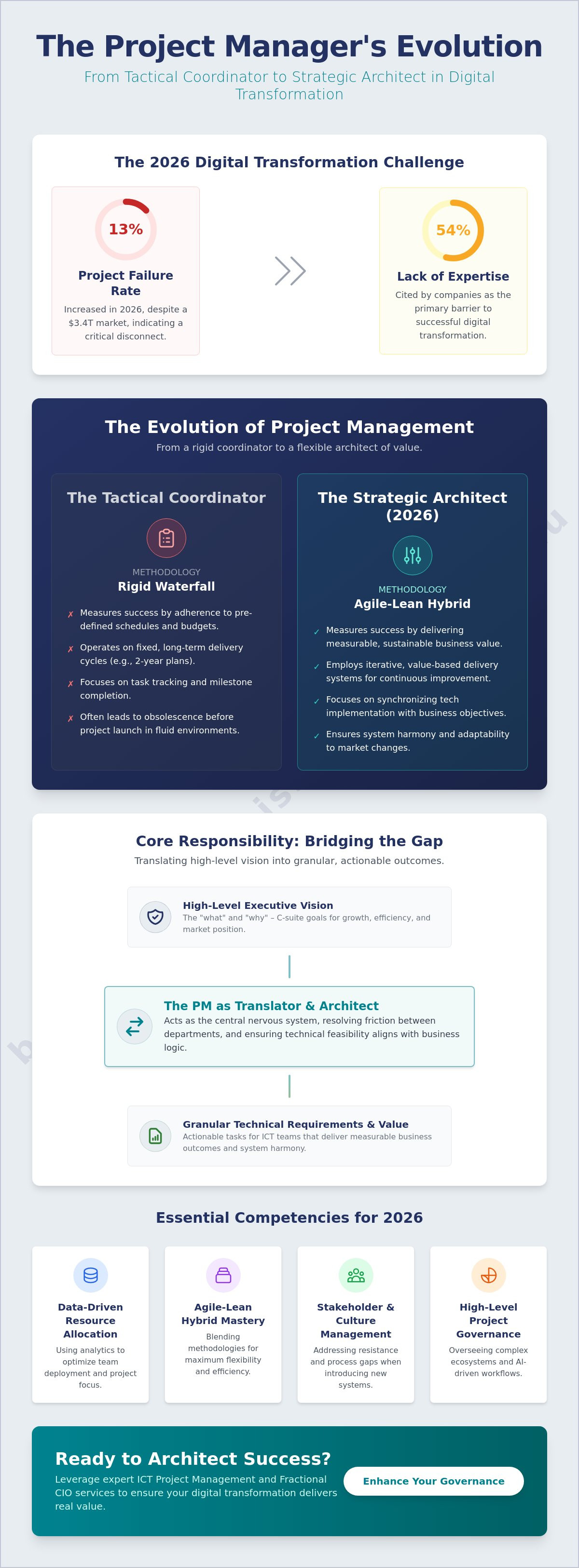
The Evolution of Project Management: Tactical Coordinator vs. Strategic Architect
The evolution of the role of a project manager in digital transformation represents a fundamental shift in professional identity. In previous decades, a tactical coordinator was often sufficient for project delivery. Their success was defined by the iron triangle of being on-time, on-budget, and within scope. However, digital initiatives in 2026 demand a strategic architect who prioritizes value delivery over simple task completion. A strategic architect doesn't just ask if the software is installed; they ask if the implementation has improved financial performance or operational efficiency.
Transitioning from managing a single project to overseeing a portfolio of transformative outcomes requires a deep immersion in business logic. This transition is essential because digital strategy is no longer a siloed IT function. It's the core of the business. During the project lifecycle, the architect actively identifies opportunities for automation implementation. They don't wait for a request; they use data and logic to pinpoint where manual processes are creating friction. This proactive approach ensures that the project remains a vehicle for progress rather than a technical burden.
The Architect's Mindset: Designing for Efficiency
Before any technology is selected, the strategic architect employs business process mapping to visualize the current state of operations. This step is critical to ensure the project solves a root-cause problem rather than just digitising a broken process. Digitising an inefficient workflow only results in a faster, more expensive version of the same failure. By focusing on process management first, the PM ensures system harmony. They evaluate the long-term ROI of digital investments, looking well beyond the initial 'go-live' date to ensure the solution remains scalable and sustainable for the organisation.
Avoiding the Task-Tracker Trap
Passive status reporting is a hallmark of the tactical coordinator, and it often leads to project stagnation and stakeholder frustration. Leaders in 2026 expect proactive problem-solving that mirrors fractional CIO-level strategic thinking. When the underlying business technology landscape shifts, as it frequently does in high-complexity environments, the PM must have the agency to pivot. They don't just report that a milestone was missed. Instead, they provide a resolution that realigns the project with the original Digital Transformation Blueprint. This level of professional directness avoids unnecessary complexity and keeps the organisation focused on tangible value.
Essential Skills for Leading Digital Initiatives in 2026
The role of a project manager in digital transformation has shifted from generalist oversight to a specialized blend of data literacy, emotional intelligence, and technical rigour. In 2026, proficiency in advanced analytics is a prerequisite. Modern PMs use data to inform project trajectory and resource allocation, ensuring that decisions are rooted in objective performance metrics rather than subjective intuition. This analytical approach minimizes the high failure rates often associated with complex ICT projects by identifying bottlenecks before they impact the critical path.
Mastering an Agile-Lean hybrid methodology is equally vital. While Agile provides the speed necessary for iterative development, Lean principles offer the rigour required for stable enterprise systems. This balance ensures that speed doesn't come at the expense of system harmony. Furthermore, security awareness must be integrated into every project phase. By embedding frameworks like the Essential 8 into the initial planning stages, the PM protects the organisation's financial performance and reputation from the outset.
Digital disruption often triggers significant emotional responses within a workforce. Navigating this human element requires deep empathy and a structured approach to change management. A successful PM understands that technical implementation is only half the battle; ensuring staff adoption is what ultimately drives operational efficiency. To ensure your leadership team possesses these critical competencies, consider a Business Efficiency Diagnostic to identify and bridge existing skill gaps.
Mastering the Digital Strategy Framework
Execution excellence depends on a PM's ability to interpret and implement a digital transformation blueprint for business. This involves balancing 'Quick Wins' that build stakeholder confidence with the long-term infrastructure stability required for sustained growth. The modern PM possesses the analytical distance to audit and refine the digital strategy as the project evolves, ensuring the final ICT solutions remain aligned with the original business logic.
Technological Proficiency for Non-Developers
While coding isn't a requirement, understanding the capabilities of low-code platforms and automation tools is essential for modern project management. This knowledge allows the PM to facilitate more effective communication between technical teams and operations. Familiarity with cloud architecture is also necessary to ensure operational flexibility across the technology stack. Project managers must stay current with AI developments like Microsoft Copilot to automate routine administrative tasks, allowing them to focus on high-value strategic coordination and problem-solving.
Leveraging Expert ICT Project Management for Organisational Success
Internal project teams often face institutional inertia and the subtle pressure of internal politics. While an in-house team understands the company culture, they may lack the objective distance required to challenge inefficient legacy processes. This is where the role of a project manager in digital transformation is significantly bolstered by external expert project management support. External specialists bring a fresh perspective that prioritizes system harmony over "the way we've always done it," ensuring that every ICT solution is vetted against international standards rather than internal preference.
High-level project governance is often the missing link in failed digital initiatives. Engaging Fractional CIO services provides the strategic oversight necessary to align complex technical requirements with long-term financial performance. This fractional model allows organizations to access senior leadership expertise without the overhead of a full-time executive, closing the gap between granular technical tasks and broader organizational goals. It ensures that the project manager remains focused on value delivery while the governance layer manages strategic risk.
Identifying the true scope of a transformation project is impossible without a clear baseline. A Business Efficiency Diagnostic serves as this foundation, uncovering hidden bottlenecks and operational friction points that a standard project plan might miss. By grounding the project in documented reality, you eliminate the ambiguity that leads to scope creep and budget blowouts. This methodical approach ensures that technical requirements are always tethered to bottom-line results, transforming digital strategy from a cost center into a driver of profitability.
The Value of an External Perspective
Objective analysis is a powerful tool for resolving stakeholder conflicts. When departments have competing interests, an external consultant provides a neutral voice rooted in logic and industry best practices. Accessing decades of cross-industry experience allows a project manager to predict common ICT pitfalls before they manifest as critical failures. This proactive risk management is essential for maintaining momentum in high-pressure digital environments. It moves the conversation from personal preference to operational efficiency and results.
Your Next Steps in Digital Transformation
Success begins with a formal requirements document created before any procurement decisions are made. This document acts as the anchor for your Digital Transformation Blueprint, ensuring that every vendor selected can actually meet your operational needs. Transitioning from a messy digital state to a structured, optimized environment requires a disciplined sequence of actions. You don't have to navigate this complexity alone. Exploring diagnostic services is the most effective way to set a solid project foundation and ensure the role of a project manager in digital transformation delivers the maximum possible value for your organization.
Mastering the Strategic Shift in Digital Delivery
Successful digital initiatives in 2026 depend on more than just meeting deadlines; they require a fundamental shift in professional identity. We've explored how the role of a project manager in digital transformation has evolved from simple task coordination to strategic architecture. This transition demands a focus on value delivery, system harmony, and the integration of robust security frameworks from the start. By prioritizing process management and data literacy, you ensure that technology serves your business goals rather than complicating them.
Navigating these complexities requires a partner who understands the friction between high-level vision and technical reality. We bring over 20 years of strategic ICT experience to help you bridge the gap between the C-suite and IT teams. Our specialized approach focuses on creating a Digital Transformation Blueprint that delivers measurable operational efficiency. Book a Business Efficiency Diagnostic to set your project up for success and gain the clarity needed for sustainable growth. You can transform your digital environment into a predictable driver of financial performance through a structured, methodical approach.
Frequently Asked Questions
What is the difference between a regular Project Manager and a Digital Transformation Project Manager?
A digital transformation project manager focuses on cross-functional integration and business value rather than just task execution within a single department. While a regular project manager might manage a discrete software installation, the role of a project manager in digital transformation involves aligning technical implementation with a broader Digital Strategy. They ensure that every milestone contributes to a measurable improvement in operational efficiency and financial performance.
Why do so many digital transformation projects fail despite having a Project Manager?
Project failure often results from a lack of alignment between technical teams and business objectives rather than a lack of coordination. Many initiatives start without a thorough Business Efficiency Diagnostic, leading to a fundamental misunderstanding of the project's true scope. When a PM acts only as a task tracker instead of a strategic architect, they fail to resolve the underlying friction between ICT solutions and daily operations.
How much technical knowledge does a PM need for a digital transformation project?
A project manager needs enough technical proficiency to vet ICT solutions and understand cloud architecture without needing to write code. They must be able to translate executive vision into actionable technical requirements for developers. This knowledge allows them to identify "shadow IT" risks and ensure system harmony across the organization's technology stack during the implementation phase.
Can a Project Manager also act as a Business Analyst in digital transformation?
Yes, project managers frequently perform Business Analysis tasks, particularly in small to mid-sized organizations. This overlap is natural because both roles require a deep understanding of process mapping and business logic. However, for complex enterprise shifts, a dedicated analyst ensures that the Digital Transformation Blueprint remains robust while the PM focuses on high-level governance and stakeholder management.
What are the biggest risks a Project Manager faces during a digital shift?
The most significant risks include scope creep in complex digital environments and cultural resistance from staff. Rapid technological obsolescence also poses a threat, as selected ICT solutions may become outdated before the project is fully realized. A meticulous PM mitigates these risks by maintaining a strict focus on the original business case and ensuring continuous alignment with organizational objectives.
How does Agile methodology change the role of the Project Manager?
Agile shifts the project manager's focus from following a rigid, long-term schedule to facilitating iterative, value-based delivery. Instead of managing a single "go-live" date, the PM ensures that the team delivers incremental improvements that provide immediate benefits. This methodology requires a high degree of adaptability and a commitment to proactive problem-solving as the project landscape evolves.
What role does the Project Manager play in selecting new business technology?
The project manager ensures that any new business technology aligns with the established Digital Transformation Blueprint and existing operational workflows. They facilitate the selection process by vetting vendor capabilities against specific technical requirements and process mapping. Their goal is to prevent the procurement of siloed tools that fail to integrate or deliver long-term ROI.
How can a Project Manager ensure that staff actually use the new digital tools?
Ensuring adoption requires a structured approach to change management that prioritizes staff empathy and clear communication. The role of a project manager in digital transformation includes demonstrating how new tools directly improve daily tasks and reduce manual friction. By involving end-users early in the process mapping phase, the PM builds the necessary buy-in for a successful transition.



Comments