The Role of a Fractional CIO in Digital Transformation: A Strategic 2026 Guide
- jonesaqayalo
- May 24
- 12 min read
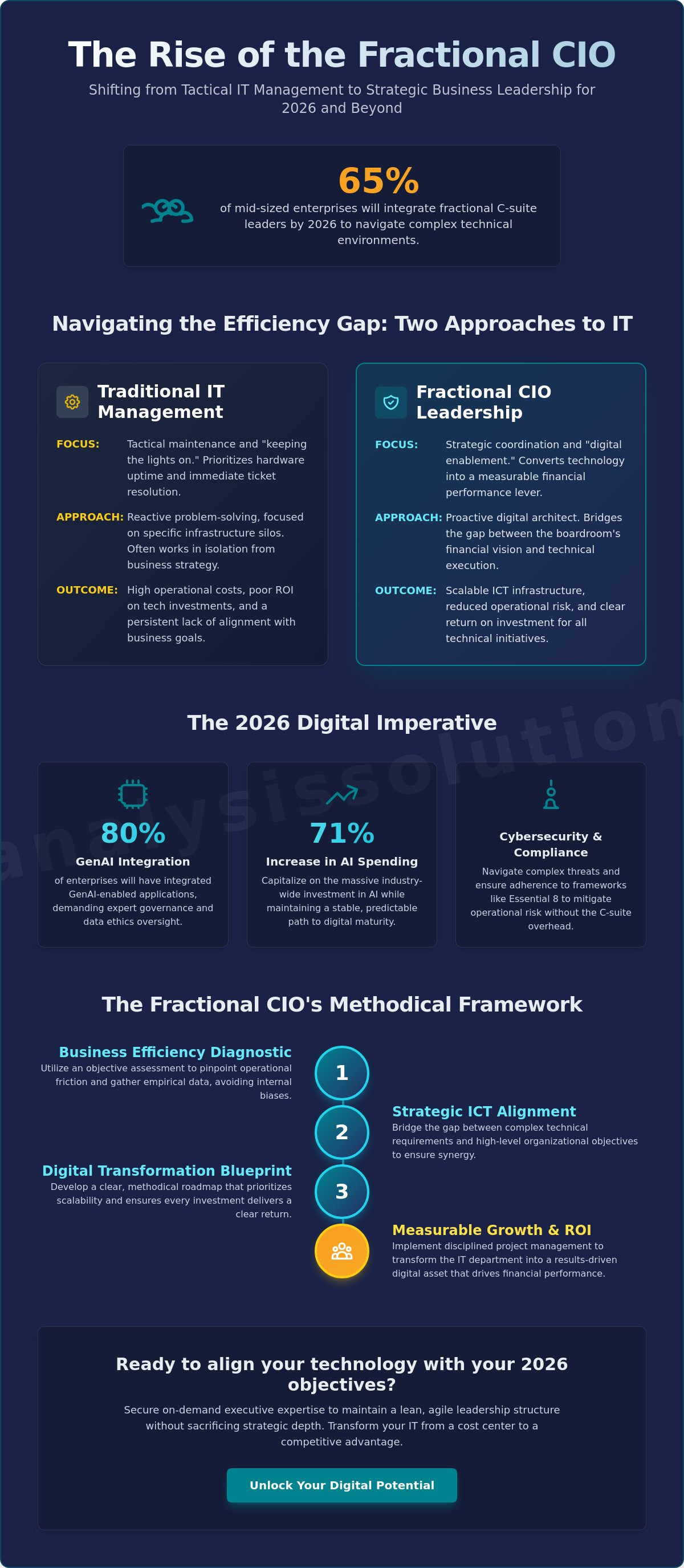
By 2026, approximately 65% of mid-sized enterprises have integrated at least one fractional C-suite leader into their leadership structure to navigate increasingly complex technical environments. You likely recognize that the traditional approach to IT often leads to expensive investments with poor ROI and a persistent lack of alignment between your technical stack and your broader business goals. Understanding the role of a fractional CIO in digital transformation is no longer just about part-time oversight. It's about securing a strategic architect who converts technology into a financial performance lever.
We understand the pressure of technological stagnation and the risk of unguided digital spending. This guide demonstrates how fractional IT leadership bridges the gap between high-level strategy and operational execution to drive measurable digital growth. We'll examine how these experts utilize business analysis and digital transformation blueprints to build a scalable ICT infrastructure while reducing operational risk. By the end of this guide, you'll have a clear framework for aligning your technology with your 2026 business objectives through methodical process mapping and disciplined project management.
Key Takeaways
Understand how fractional leadership replaces tactical IT management with strategic coordination to drive measurable financial performance.
Identify the specific role of a fractional CIO in digital transformation for bridging the gap between complex technical requirements and organizational objectives.
Learn how to utilize a Business Efficiency Diagnostic to pinpoint operational friction and align ICT solutions with your growth targets.
Explore a methodical framework for executing a Digital Transformation Blueprint, ensuring every technical investment delivers a clear return on investment.
Evaluate the cost-to-value ratio of on-demand executive expertise to maintain a lean, agile leadership structure without sacrificing strategic depth.
Table of Contents
Defining the Fractional CIO in the 2026 Digital Landscape
A Fractional CIO serves as an on-demand executive who provides high-level ICT strategy without the financial commitment of a full-time C-suite salary. Unlike traditional IT managers who focus on daily technical maintenance, or Managed Service Providers (MSPs) that handle specific infrastructure silos, the fractional leader operates as a strategic partner. They prioritize organizational coordination and financial performance over simple troubleshooting. In the 2026 business environment, this distinction has become a necessity for survival. As of this year, approximately 65% of mid-sized enterprises have integrated fractional leaders into their teams to secure expert guidance that scales with their operational needs.
The role of a fractional CIO in digital transformation is characterized by a shift from "keeping the lights on" to proactive digital enablement. It's no longer sufficient to maintain stable systems; businesses must now leverage technology to create competitive advantages. This requires an analytical collaborator who understands how to turn technical requirements into broader organizational objectives. By focusing on digital strategy and process mapping, these experts ensure that every technical investment supports the company's long-term roadmap rather than creating isolated pockets of automation that fail to deliver a return on investment.
Strategic Leadership vs. Tactical IT Management
Standard IT management often prioritizes hardware uptime and immediate ticket resolution. While these tasks are necessary, they don't drive growth. The fractional CIO focuses on ICT governance and measurable business outcomes. They evaluate how system harmony influences operational efficiency and employee productivity. This role requires a meticulous approach to problem-solving that moves beyond technical support. The strategic CIO acts as a functional bridge between the boardroom's financial vision and the technical realities of the server room. They provide the clarity and direction needed to transform a stagnant IT department into a results-driven digital asset.
The 2026 Imperative: AI, Data, and Cybersecurity
By 2026, more than 80% of enterprises have integrated GenAI-enabled applications into their production environments. This rapid adoption demands executive oversight to manage AI governance, data ethics, and the shift toward autonomous workflows. A fractional leader provides the specialized expertise required to navigate these complexities while maintaining strict adherence to the Essential 8 cybersecurity framework. They ensure compliance with international standards and mitigate operational risk without the overhead of a permanent executive role.
Organizations are also moving toward a composable enterprise model, replacing monolithic systems with flexible, modular architectures. A fractional CIO manages this transition by implementing a Digital Transformation Blueprint that prioritizes scalability. They oversee the integration of agentic AI and hyper-automation, ensuring these tools work in concert with human talent. This methodical approach allows leadership to capitalize on the 71% increase in AI spending seen across the industry this year while maintaining a stable and predictable path toward digital maturity.
Orchestrating Digital Transformation through Strategic Alignment
The role of a fractional CIO in digital transformation goes beyond identifying software. It requires a deep understanding of how technical systems interact with financial outcomes. This shift reflects the broader evolution of the CIO role from a technical support lead to a strategic business driver. To bridge the gap between a company's current state and true digital maturity, a fractional leader initiates a business efficiency diagnostic. This objective assessment provides the empirical data needed to align ICT investments with specific organizational goals. By maintaining a third-party perspective, the fractional executive avoids the internal biases and "sunk cost" fallacies that often plague long-term IT projects.
Bridging the Gap with Business Analysis
Every successful transformation begins with a strategic business analysis consultancy phase. Without this foundation, technology often becomes a costly band-aid for broken workflows. Through detailed process mapping, a fractional CIO identifies operational bottlenecks that hinder performance before any software is purchased. It's a fundamental principle of modern industry: technology acts as a multiplier of existing processes. If the underlying process is flawed, automation only accelerates the failure. By resolving these structural issues first, the organization ensures that new digital tools serve as catalysts for growth rather than sources of friction. This methodical approach ensures that technical requirements are always subservient to the broader organizational vision.
Maximising ROI on Technology Spend
Maximizing ROI in 2026 is increasingly challenging. Research indicates that only 27% of organizations now expect a return on investment within the first six months of a project. A fractional leader addresses this by performing a meticulous audit of current systems to eliminate "zombie infrastructure," which includes licensed software and hardware that consume budget without providing utility. The role of a fractional CIO in digital transformation includes applying a disciplined procurement strategy and handling vendor negotiations to ensure the business receives maximum value from every dollar spent.
This process often involves transitioning from heavy capital expenditure (CapEx) to a more flexible, strategic operational expenditure (OpEx) model. This shift improves cash flow and allows for the modular, "composable" architecture necessary for rapid scaling. If your current IT spend feels disconnected from your results, a formal Business Efficiency Diagnostic can provide the necessary clarity to recalibrate your strategy. This ensures technology serves as a lever for financial performance rather than a drain on resources.
Fractional CIO vs. Full-Time Executive: Navigating the Efficiency Gap
Mid-market firms often face a structural dilemma where they require executive-level technical leadership but cannot justify the total compensation of a full-time CIO, which frequently approaches $500,000 when including benefits and payroll taxes. This creates an efficiency gap where strategic decisions are either delayed or delegated to tactical staff who lack a business-first mindset. The role of a fractional CIO in digital transformation resolves this by providing high-level expertise on a disciplined, part-time basis. While skeptics ask if a part-time leader can drive full-time change, the reality is that a fractional executive focuses exclusively on strategic outcomes rather than the administrative burdens of a full-time role. This results in a higher concentration of value per hour engaged.
Specialized expertise is another distinct advantage. A fractional leader often manages multiple environments concurrently, bringing cross-pollinated insights from various industries to your organization. They don't just understand technology; they understand how different business models successfully implement automation and ICT solutions. This on-demand nature is particularly effective for high-intensity, time-bound projects such as ERP implementations or infrastructure overhauls. Instead of hiring a permanent executive for a temporary strategic surge, you engage the necessary talent to architect the solution and then scale back once the system achieves stability.
When to Hire a Fractional CIO
Recognizing the need for external leadership is a critical step in maintaining operational momentum. Common triggers include rapid organizational growth that outpaces current systems, legacy technology failures, or complex merger and acquisition activity. The fractional CIO services Australia model offers a scalable solution for businesses navigating these transitions. To evaluate your current leadership maturity, consider the following checklist:
Is your IT department viewed as a cost center rather than a growth lever?
Are technical decisions being made without a clear link to financial performance?
Does your organization lack a documented digital roadmap for the next 24 months?
Are you experiencing recurring ROI failures on significant software investments?
If you answered yes to two or more of these, the role of a fractional CIO in digital transformation can provide the necessary correction to your strategic trajectory.
The Cultural Impact of Fractional Leadership
Digital transformation often meets internal resistance. An external CIO serves as a neutral change agent, unencumbered by internal politics or long-standing cultural biases. They provide an objective voice that prioritizes system harmony and process efficiency over "the way we've always done it." This allows for a more direct approach to identifying and resolving operational friction. Additionally, these leaders serve as mentors for your existing internal IT staff. They elevate the technical team's performance by introducing professional industry standards and methodical project management frameworks. Once the digital transformation blueprint is operational and the internal team is capable of maintaining the new standard, the fractional engagement can be concluded with a structured hand-off, ensuring no loss of momentum.
Executing the Digital Transformation Blueprint: A Methodical Framework
Execution remains the most significant hurdle in any digital change initiative. Without a structured approach, technical projects often drift, consuming resources without reaching their intended milestones. The role of a fractional CIO in digital transformation is to provide the disciplined oversight required to move from abstract strategy to tangible results. Central to this process is the digital transformation blueprint for business. This framework ensures that every technical shift is anchored in organizational logic and financial performance.
The execution of this blueprint follows a five-step sequence designed to minimize risk and maximize system harmony:
Diagnostic Assessment: A comprehensive mapping of the current technical and process landscape to identify legacy bottlenecks.
Strategic Visioning: Defining the desired future state and establishing the key performance indicators (KPIs) that will measure success.
Roadmap Development: Prioritizing specific projects based on their immediate impact and long-term feasibility.
Implementation Oversight: Applying expert project management to coordinate vendors and internal stakeholders through the deployment phase.
Governance and Optimization: Establishing long-term security standards and performance monitoring to ensure the system remains efficient.
The Importance of Process Mapping in Execution
Technology must serve the user, not the other way around. When organizations skip the process mapping phase, they risk automating inefficient workflows, which only compounds operational waste. A fractional CIO ensures that every tool addresses a documented business requirement. During the automation implementation stage, the focus remains on enhancing human productivity through better system coordination. This rigorous approach prevents "shiny object syndrome," where leadership is tempted by trending software that offers no actual functional utility. By maintaining this level of precision, the organization secures a lean, high-performing technical stack.
Managing ICT Risk and Governance
Security is a fundamental component of the transformation process, not a final addition. The role of a fractional CIO in digital transformation involves embedding cybersecurity and data privacy into the blueprint by design. This includes the creation of robust disaster recovery and business continuity plans that protect organizational assets from disruption. Furthermore, the fractional leader facilitates a deeper understanding of business technology at the board level. This ensures that ICT risk is managed as a core business function, allowing leadership to make informed decisions grounded in technical reality.
Establishing this level of strategic control requires a partner who values precision and reliability over marketing jargon. If you're ready to eliminate technical ambiguity and drive measurable growth, our Fractional CIO Services provide the expertise necessary to deliver end-to-end results.
Integrating Fractional CIO Services into Your Business Strategy
The role of a fractional CIO in digital transformation is ultimately about creating a sustainable architecture for growth. By integrating high-level ICT strategy directly into the executive layer, organizations resolve the disconnect between technical spending and business outcomes. This integration serves as a catalyst for organizational efficiency, ensuring that every digital asset performs as a strategic lever rather than an operational burden. Transitioning from a state of technological stagnation to one of scalable innovation requires a partner who understands that technical requirements must always follow functional logic. This disciplined approach ensures that your leadership maintains full agency over the digital roadmap.
The Business Analysis & Solutions Advantage
Business Analysis & Solutions provides a specialized blend of business analysis and ICT consultancy, backed by 20 years of professional industry experience. We focus exclusively on high-level advisory, digital strategy, and the implementation of robust digital transformation blueprints. Our strategic focus is maintained by explicitly excluding services such as custom software development or managed IT helpdesks. This ensures our recommendations remain objective, agnostic, and strictly aligned with your organizational coordination needs. We prioritize tangible, end-to-end results over marketing hyperbole, offering the quiet confidence that comes from a methodical, problem-solving approach. Our personality is that of an analytical collaborator committed to finding the most effective solution for your specific financial performance goals.
Commencing Your Digital Journey
A successful engagement moves systematically from an initial diagnostic assessment to an ongoing strategic partnership. This transition ensures that the groundwork laid during the process mapping and roadmap development phases remains stable as the business scales. To initiate this transformation, we advocate for a methodical start through a Business Efficiency Diagnostic. This initial step provides the clarity needed to identify immediate performance levers and long-term infrastructure requirements. It allows your leadership team to see the financial impact of technology initiatives before committing to a full-scale automation implementation.
Leaders ready to align their technology with their 2026 financial goals should seek a partner who values precision and reliability. Exploring our national strategic offerings provides a clear path toward reducing operational risk and achieving system harmony across all departments. If you require executive-level technical leadership to architect your digital future and fulfill the role of a fractional CIO in digital transformation within your firm, you can Contact Business Analysis & Solutions for a Fractional CIO Consultation to begin your assessment.
Securing Your Digital Future through Strategic Coordination
Digital maturity in 2026 requires more than just technical adoption; it demands a disciplined alignment between your operational workflows and your long-term financial objectives. We've explored how a methodical approach, starting with a diagnostic assessment and moving through a structured blueprint, ensures that technical investments provide a measurable return. The role of a fractional CIO in digital transformation is to act as this strategic architect, bridging the gap between high-level vision and granular execution. By prioritizing process mapping and rigorous project management, you eliminate the risk of technological stagnation and inefficient infrastructure spend.
Business Analysis & Solutions brings over 20 years of industry experience to this challenge. We specialize in bridging business logic with technical execution to deliver system harmony for organizations across Australia. Our national service coverage ensures that your leadership has access to the precise, objective advisory needed to navigate complex transitions with confidence.
Secure Your Strategic IT Leadership with Our Fractional CIO Services and begin your transition toward a more scalable, efficient digital environment today.
Frequently Asked Questions
What exactly does a fractional CIO do during a digital transformation?
A fractional CIO provides the strategic leadership necessary to align technical investments with organizational goals. They oversee the entire lifecycle of a digital transformation blueprint, from the initial business efficiency diagnostic to the final automation implementation. Unlike a technician, they focus on how system harmony influences financial performance; they ensure technology serves as a multiplier for efficient processes rather than a fix for broken ones.
How does a fractional CIO differ from a virtual CIO (vCIO)?
The primary difference lies in strategic independence and scope. A virtual CIO is typically an extension of a Managed Service Provider focusing on operational uptime and specific product recommendations. In contrast, the role of a fractional CIO in digital transformation involves acting as an independent executive partner. They prioritize long-term digital strategy and vendor-agnostic ICT solutions over daily helpdesk management or hardware maintenance.
Can a fractional CIO manage my existing IT team or MSP?
Yes, a fractional CIO acts as a strategic bridge between the board and your technical execution teams. They provide professional oversight for internal staff and manage third-party vendors to ensure they meet documented KPIs. This leadership ensures that your MSP or IT department remains focused on high-level organizational objectives rather than just tactical ticket resolution, which improves overall project management outcomes.
What is the typical duration of a fractional CIO engagement?
Engagement durations are flexible and scale based on your specific requirements. A high-intensity project, such as an ERP implementation or a complete infrastructure overhaul, might require a six to twelve month commitment. Other organizations maintain a long-term strategic partnership on a retainer basis, typically engaging the CIO for one to three days per week to ensure continuous alignment with their digital roadmap.
How do you measure the ROI of fractional CIO services?
ROI is measured through tangible improvements in operational efficiency and financial performance. Key metrics include the reduction of "zombie infrastructure" costs, decreased project delivery timelines, and the successful mitigation of operational risks. By aligning technical spend with business analysis, a fractional CIO ensures that every dollar invested in ICT solutions contributes directly to the company's growth and scalability targets.
Is my business too small for a fractional CIO?
Business complexity often dictates the need more than headcount alone. If your organization manages diverse data sets, faces strict compliance requirements, or struggles with technological stagnation, you likely require executive leadership. Mid-market firms often find that the role of a fractional CIO in digital transformation provides the necessary expertise to compete with larger enterprises without the overhead of a full-time C-suite salary.
What information should I have ready before hiring a fractional CIO?
You should prepare a summary of your current ICT spend, existing vendor agreements, and a list of known operational bottlenecks. Having a clear understanding of your organizational growth objectives for the next 24 months is also vital. This data allows the fractional leader to perform an accurate business efficiency diagnostic and begin mapping technical requirements to your broader strategic goals immediately.
How does a fractional CIO handle cybersecurity and compliance?
Cybersecurity is managed through a framework-first approach to governance. A fractional CIO integrates standards like the Essential 8 directly into your digital transformation blueprint to ensure compliance by design. They develop disaster recovery and business continuity plans that protect your assets. This methodical oversight ensures that security is a core business function rather than an isolated technical task, reducing overall organizational risk.



Comments