The Evolving Role of the CIO in Digital Transformation: A 2026 Strategic Guide
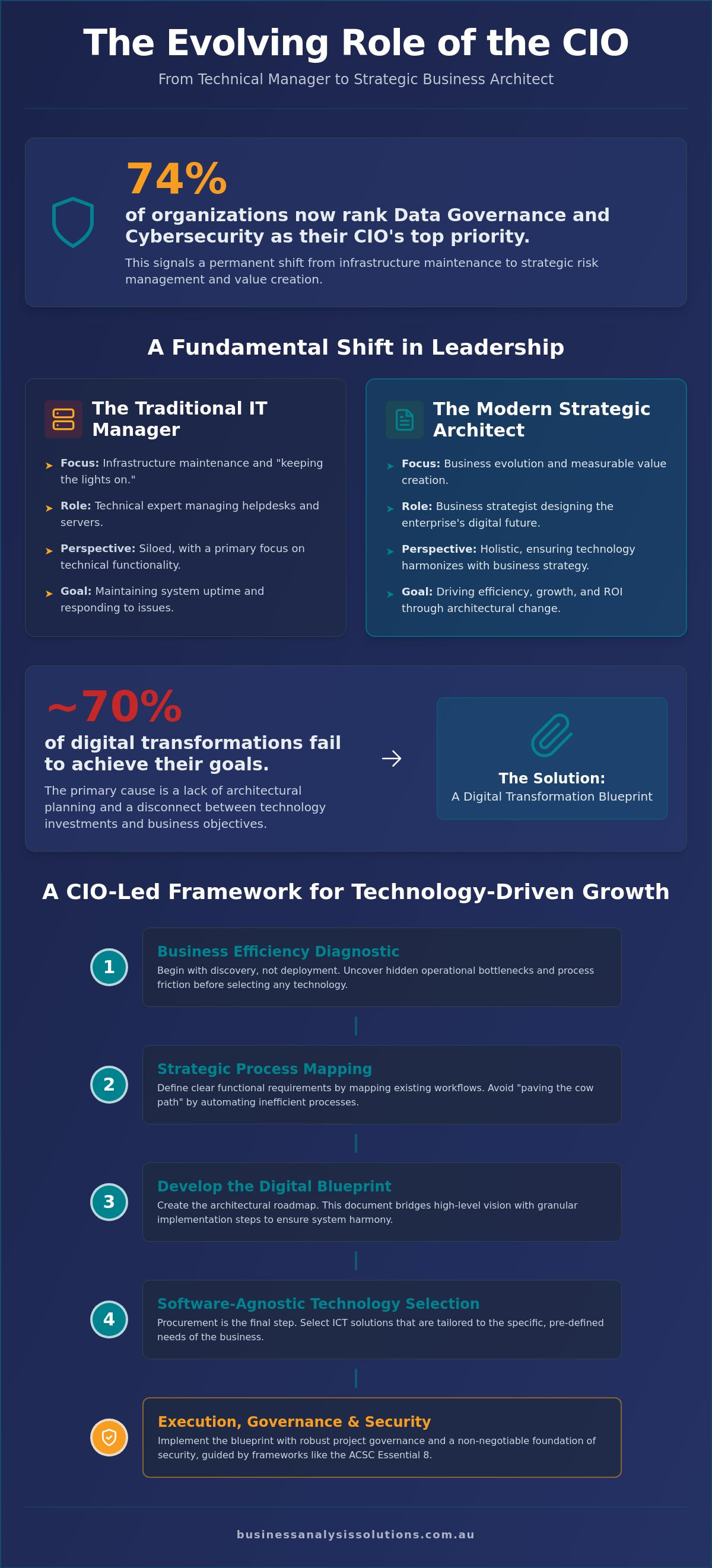
74% of organizations now rank data governance and cybersecurity as their CIO's top priority, signaling a permanent shift in executive expectations. It's a common frustration to see technical spend increase while business ROI remains stagnant, especially when compliance with the ACSC Essential 8 adds layers of complexity. You've likely realized that simply maintaining infrastructure isn't a viable strategy for sustainable growth in the Australian market.
This guide explains how the modern role of CIO in digital transformation has evolved from a technical manager to a strategic architect. You'll learn how to bridge the gap between ICT requirements and organizational objectives using a logical, diagnostic-led framework. We provide a methodical roadmap for technology-driven growth, focusing on operational efficiency through automation and robust governance to ensure your digital projects finally deliver the measurable value they promise.
Table of Contents
Defining the Role of the CIO in Digital Transformation for 2026
The role of CIO in digital transformation has undergone a fundamental shift. It's no longer a position defined by technical oversight of infrastructure or the management of a helpdesk. Instead, the modern Chief Information Officer (CIO) acts as a strategic architect who designs the digital future of the enterprise. While traditional IT management focuses on maintenance and "keeping the lights on," digital transformation leadership is about evolution. This requires the CIO to sit at the precise intersection of business operations and technology, ensuring that every ICT investment serves a specific, measurable business outcome.
The focus has moved from managing physical servers to orchestrating data-driven value chains. In this context, technology isn't the goal; it's the mechanism for driving operational efficiency and financial performance. By moving away from a siloed technical perspective, the CIO ensures that systems aren't just functional, but are harmonised with the broader organisational strategy. They must view the business as a series of interconnected processes that can be optimised through logical, architectural change rather than just software procurement.
The Transition from Technical Expert to Business Strategist
Technical proficiency is now the baseline requirement, not the differentiator for success. Modern leadership demands a shift in focus toward communication and strategic alignment. A CIO must translate complex ICT solutions into tangible business outcomes that the board can understand and value. This evolution includes a heavy emphasis on risk mitigation, particularly concerning cybersecurity frameworks like the Essential 8, and a direct responsibility for the financial performance of digital initiatives. Success is measured by how effectively technology reduces friction in business processes and creates new avenues for growth.
Why a Blueprint is the CIO’s Most Important Deliverable
Without a structured plan, digital initiatives often become fragmented and ineffective. The digital transformation blueprint for business serves as the CIO’s primary roadmap for execution. Industry data suggests that roughly 70% of digital transformations fail, often due to a lack of architectural planning and a disconnect between tech and business goals. A well-constructed blueprint avoids this pitfall by defining the logical sequence of change. It ensures system harmony across the organisation, preventing the common problem of technical debt where disconnected systems fail to communicate. This document is the bridge between a high-level vision and granular, successful implementation.
The CIO as Architect: Leading with Business Efficiency Diagnostics
Technology selection is the final step of a successful transformation, not the first. Many organisations fail because they lead with procurement, hoping that new software will solve underlying operational friction. A strategic architect knows that the role of CIO in digital transformation is to first act as an objective analyst of organisational logic. By prioritising discovery over deployment, leadership ensures that technical solutions are built on a foundation of sound business processes rather than digital band-aids.
This discovery phase is best executed through a Business Efficiency Diagnostic. This methodical assessment uncovers hidden bottlenecks that software alone cannot fix. Similar to the changing role of a government CIO, where managing legacy systems and public funds requires extreme precision, private sector leaders must also account for every efficiency gain. Identifying these gaps early prevents the costly mistake of scaling an inefficient process through automation.
Process Mapping: Identifying the Bedrock of Transformation
Effective business process mapping prevents the automation of redundant or inefficient workflows. There is a significant danger in "paving the cow path" by applying expensive new software to outdated methods. Instead, the CIO uses process maps to define clear functional requirements. This ensures that the eventual ICT solution is tailored to the specific needs of the business, creating a system that supports growth rather than adding technical debt. It's about fixing the logic before fixing the tool.
Conducting a Comprehensive Efficiency Diagnostic
A thorough diagnostic evaluates current system health, data integrity, and manual overheads. It's during this phase that a CIO identifies "shadow IT" and redundant subscriptions that drain resources. By linking these findings to a strategic guide to business efficiency, the organisation can move toward a leaner operational model. This objective analysis is the only way to ensure that digital transformation delivers a genuine return on investment. Establishing this clarity early allows for a more predictable implementation phase. If you're ready to move beyond technical guesswork, a professional business efficiency diagnostic provides the objective data needed for strategic decision-making.
Fractional vs. Full-Time CIO: Choosing the Right Leadership Model
Choosing between a permanent C-suite executive and on-demand leadership is a critical decision for growing Australian organisations. While large enterprises often justify a full-time salary, mid-sized firms frequently find the cost prohibitive. This creates a leadership gap where technical decisions are made without high-level strategic oversight. The role of CIO in digital transformation is essentially to provide this oversight, ensuring that technology serves the business rather than the other way around. For many, the fractional model offers a solution that balances executive-level expertise with financial pragmatism.
The Fractional CIO services Australia model provides access to seasoned experts on a part-time or project basis. This approach is particularly effective because external consultants bring an objective perspective that internal hires might lack. They aren't entrenched in company politics, which allows them to drive difficult organisational changes and challenge legacy processes with logical authority. It's a common misconception that high-level transformation is only for the top end of town; in reality, SMEs can achieve similar outcomes by leveraging specialised, on-demand leadership. In fact, year-over-year demand for fractional CIOs has grown by 68%, reflecting a broader market shift toward flexible, high-impact executive roles.
When to Opt for Fractional CIO Services
The "tipping point" usually occurs when basic IT support can no longer manage the complexity of your digital environment. If your technical spend is increasing but your operational efficiency remains stagnant, you need a strategist, not just a technician. The role of CIO in digital transformation at this stage is to move beyond maintenance and focus on architectural evolution. A fractional leader takes over high-stakes project management tasks, ensuring that ICT solutions are delivered on time and within budget. This allows firms to access the same level of strategy as a global corporation without the burden of a full-time executive salary.
Maintaining Strategic Continuity
Strategic leadership isn't a one-off event. A fractional CIO ensures long-term governance by overseeing the execution of the digital blueprint over months or years. They act as a vital bridge between external software vendors and internal stakeholders, ensuring that technical delivery matches business expectations. This methodical approach maintains momentum, preventing projects from stalling due to a lack of professional oversight. It's about consistent, logical progress toward a defined end-state, ensuring that the organisation doesn't just start a transformation, but actually finishes it.
A 2026 Framework for CIO-Led Execution and Governance
The role of CIO in digital transformation involves moving from theoretical strategy to disciplined execution. Execution is where most digital initiatives falter, often due to a lack of structured oversight. In 2026, success is best achieved through a five-step framework: Diagnostic, Blueprinting, Selection, Implementation, and Governance. This sequence ensures that technical delivery aligns with business logic. It begins by identifying friction and mapping the future state before any software is procured. This methodical progression prevents the common mistake of buying tools before the underlying problem is fully understood. The ultimate objective is "System Harmony," where every tool, process, and data point works in concert to support the organisation’s goals.
Automation implementation plays a pivotal role in this framework. By automating repetitive, manual tasks identified during the diagnostic phase, the CIO can significantly reduce human error and lower operational costs. This isn't about replacing staff; it's about reallocating human talent to higher-value activities. When automation is applied to a mapped and optimised process, the results are predictable and scalable. This creates a more resilient operational model that can adapt to market changes without a corresponding increase in overhead. It ensures that the digital environment remains lean and purpose-built.
Integrating Cyber Resilience and the Essential 8
Cybersecurity is no longer a separate IT function; it's a foundational element of the digital blueprint. In Australia, the CIO is responsible for aligning all ICT solutions with the ACSC Essential 8 maturity levels. Security must be "baked in" from the initial design phase rather than added as a reactive layer after implementation. The Essential 8 serves as the baseline for operational trust in 2026, providing a clear standard for protecting data integrity and ensuring business continuity. This proactive approach to risk management protects the organisation’s reputation and financial stability.
Measuring ROI and Performance Outcomes
Success must be measurable through concrete data points that reflect business reality. The CIO tracks improvements in cycle times, data accuracy, and the reduction of manual overheads to prove the value of the transformation. These key performance indicators (KPIs) provide the board with a clear view of the return on investment. Measuring these outcomes confirms the role of CIO in digital transformation as a driver of financial health. Ensuring that a deep understanding of business technology translates to the bottom line is the final test of a successful leader. If you need assistance in establishing this level of oversight, our ICT solutions and governance services help you maintain control over your digital evolution.
Strategic ICT Consultancy: Implementing Your Transformation Blueprint
Business Analysis & Solutions functions as the objective architect for your organisational evolution. With 20+ years of industry experience, we specialise in bridging the gap between technical requirements and broader business goals. Our methodology ensures that your digital transformation is a logical progression toward operational efficiency rather than a series of disconnected technical upgrades. We understand that in a technical field, ambiguity must be avoided. Because we don't sell custom software development or managed helpdesk services, our recommendations remain entirely unbiased. We're more interested in finding the most effective solution for your specific needs than selling the easiest one.
In 2026, the role of CIO in digital transformation requires a partner who prioritises resolution and system harmony over software sales. We help leadership move from reactive IT maintenance to a proactive digital strategy by focusing on the underlying organisational logic. This transition is vital for Australian firms that must balance rapid growth with strict adherence to the ACSC Essential 8. We provide the meticulous, objective oversight needed to turn complex challenges into tangible business value through a structured, methodical approach.
The Value of Objective, Expert Guidance
An external perspective is often the only way to identify deep-seated operational friction that internal teams might overlook. Our consultancy prioritises professional directness and pragmatic, end-to-end results. We support your team throughout the entire lifecycle, from the initial Business Efficiency Diagnostic to the final implementation of your Digital Transformation Blueprint. This ensures that the strategic vision isn't lost in technical complexity and that every ICT solution serves a clear purpose within your broader value chain.
Taking the First Step Toward Transformation
Initiating a transformation begins with a clear choice: engaging a fractional CIO for ongoing oversight or conducting a targeted efficiency diagnostic for immediate clarity. Within the first 90 days of a strategic partnership, we establish a comprehensive baseline of current system health and identify immediate opportunities for automation. This period focuses on resolving data integrity issues and addressing manual overheads that drain resources. This structured approach creates a sense of momentum and professional competence, ensuring that your digital evolution is both stable and predictable. It’s a process that replaces ambiguity with a clear, documented roadmap for success. To begin your journey toward a more efficient future, Book a Strategic ICT Consultation today.
Securing Your Organisation's Digital Future
The transition from technical management to strategic architecture is no longer optional for Australian leaders. By prioritising business efficiency diagnostics over software procurement, you ensure that your digital environment is built on a foundation of sound logic and measurable ROI. As we've explored, the role of CIO in digital transformation is now defined by this ability to bridge the gap between technical requirements and broader organisational objectives while maintaining strict adherence to the ACSC Essential 8 maturity levels.
Business Analysis & Solutions brings over 20 years of strategic ICT leadership experience to every engagement. As a boutique, objective consultancy, we provide the expert oversight needed to drive complex change without the bias of software sales. Whether you require a fractional CIO or a comprehensive roadmap for automation, we're committed to delivering pragmatic, end-to-end results that secure your competitive advantage. It's time to move beyond reactive maintenance and lead with precision. Request a Digital Transformation Blueprint Consultation to begin your structured evolution today. We look forward to helping you achieve true system harmony.
Frequently Asked Questions
What is the primary role of a CIO in digital transformation?
The primary role of CIO in digital transformation is to act as the strategic architect who aligns technology investments with specific business outcomes. Unlike a traditional technical manager, the CIO focuses on creating measurable value by redesigning data-driven value chains. They ensure that every ICT solution serves the broader organisational strategy rather than existing in a technical silo.
How does a Fractional CIO differ from a full-time IT Manager?
A Fractional CIO provides high-level strategic leadership on an on-demand basis, whereas an IT Manager typically focuses on day-to-day technical maintenance. While an IT Manager ensures systems remain functional, a Fractional CIO drives architectural evolution and executive-level decision-making. This model allows mid-sized firms to access senior expertise without the financial burden of a full-time executive salary.
Why do digital transformation projects often fail without a CIO?
Digital transformation projects frequently fail because they lack a structured architectural roadmap and executive-level governance. Without a CIO, organisations often lead with software procurement before understanding their underlying operational friction. This disconnect between technical spend and business ROI leads to fragmented systems that fail to deliver the promised efficiency gains.
What are the Essential 8, and why should a CIO care about them?
The Essential 8 is a prioritised list of mitigation strategies developed by the ACSC to protect Australian organisations against various cyber threats. A CIO must prioritise these standards to establish a baseline of operational trust and ensure long-term business continuity. In 2026, aligning technology with these maturity levels is a non-negotiable requirement for effective risk management.
Can a mid-sized business benefit from a digital transformation blueprint?
Mid-sized businesses benefit significantly from a digital transformation blueprint because it prevents the waste of limited resources on ineffective tools. A blueprint provides a logical sequence of change that ensures all systems work in harmony. It acts as a defensive measure against technical debt, allowing smaller firms to scale their operations with the same precision as larger competitors.
How does business process mapping assist the CIO?
Business process mapping assists the CIO by providing a visual representation of current workflows to identify hidden bottlenecks. This objective analysis prevents the common error of automating inefficient or redundant processes. By mapping these flows first, the CIO can define clear functional requirements that ensure new software solves real business problems rather than just digitising old ones.
What is the first step a CIO should take in a new transformation project?
The first step is a comprehensive Business Efficiency Diagnostic to establish a baseline of current operational health. This discovery phase allows the CIO to identify manual overheads, shadow IT, and data silos before any strategic planning begins. Leading with a diagnostic ensures that the eventual digital strategy is rooted in objective data rather than technical assumptions.
How do you measure the ROI of a CIO-led digital strategy?
ROI is measured through specific key performance indicators such as reduced cycle times, improved data accuracy, and lowered operational overheads. The CIO tracks these metrics to prove that technical initiatives have delivered a tangible financial impact. This data-driven approach confirms the role of CIO in digital transformation as a critical driver of an organisation's bottom line.



Comments