
The Comprehensive Guide to Business Efficiency Diagnostics in 2026
Updated: Mar 19
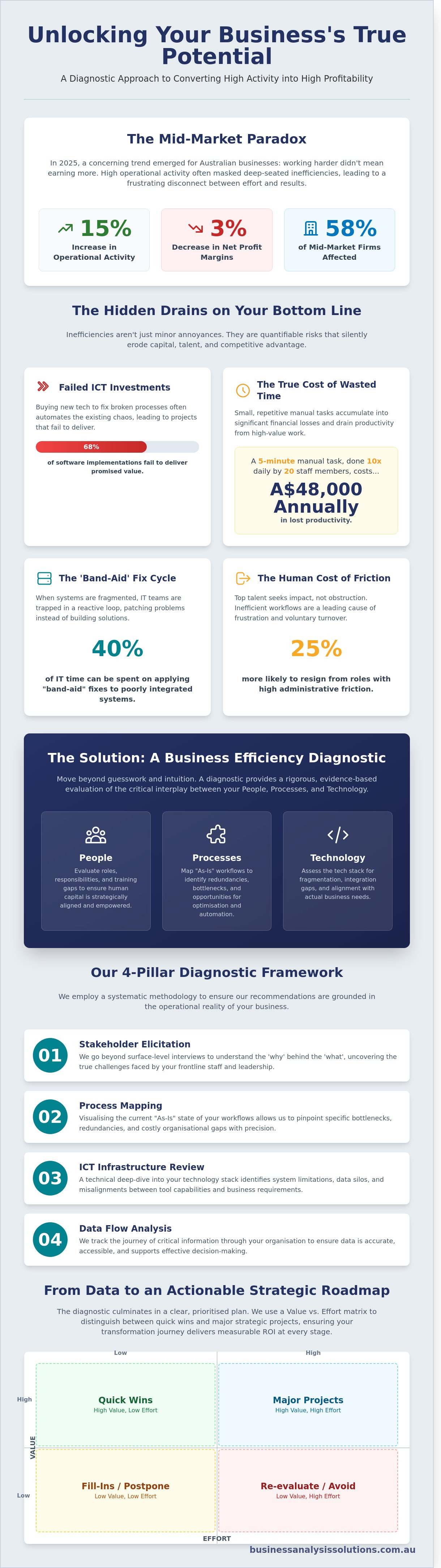
A 15% increase in operational activity shouldn't result in a 3% decrease in net profit margins, yet this was the reality for 58% of Australian mid-market firms throughout 2025. You've likely felt this friction within your own organization, where a structured business efficiency diagnostic is often the only way to uncover the truth. High activity levels often mask deep-seated inefficiencies. Fragmented tech stacks and manual workarounds quietly erode your bottom line, making it difficult to justify further technology spend when you don't have a clear view of which processes will actually deliver a tangible return on investment.
You understand that technology should be an accelerator, not a source of complexity. This guide demonstrates how a diagnostic identifies operational bottlenecks and provides a logical roadmap for digital transformation and growth. We'll explore the methodology for validating your technology investments and establishing a strategic alignment that turns fragmented systems into a cohesive engine for profit in 2026.
Key Takeaways
Distinguish between mere activity and genuine operational performance by evaluating the critical interplay between your people, processes, and technology.
Leverage a structured business efficiency diagnostic to pinpoint operational bottlenecks and establish a logical, evidence-based path for digital transformation.
Move beyond reactive compliance audits to adopt a proactive assessment model focused on long-term strategic growth and measurable ROI.
Master the art of stakeholder engagement and process mapping to visualise your current "As-Is" state and eliminate costly organisational redundancies.
Transform diagnostic findings into an actionable strategic roadmap by prioritising improvements through a rigorous Value vs. Effort matrix.
Table of Contents What is a Business Efficiency Diagnostic and Why Does it Matter? The Anatomy of a Comprehensive Efficiency Assessment Diagnostic vs. Traditional Audit: Choosing the Right Path From Data to Action: The Digital Transformation Blueprint Implementing Solutions with Business Analysis & Solutions
What is a Business Efficiency Diagnostic and Why Does it Matter?
A business efficiency diagnostic is a rigorous, evidence-based evaluation of an organisation's processes, technological stack, and human capital. It's designed to expose the specific performance gaps that drain capital and stall growth. Unlike a casual internal audit, this diagnostic applies the formal discipline of Business analysis to ensure every operational component serves a defined strategic purpose. It's the difference between guessing where a leak is and using thermal imaging to pinpoint the exact pipe failure.
The 2026 Australian market presents unique challenges that make this level of precision mandatory. With skilled labor costs in sectors like professional services and mining exceeding A$55 per hour for administrative support, the cost of inefficiency has never been higher. Many leaders confuse activity with productivity. A team can work 60-hour weeks and still see declining margins if their effort is spent fighting legacy systems or correcting data entry errors. Efficiency isn't about increasing the intensity of work; it's about optimising the ratio of output to input through structured systems.
Reliance on intuition is a significant liability in complex organisational structures. While a manager might sense that "things are slow," they often lack the data to identify whether the bottleneck is a software limitation, a training gap, or a redundant approval step. Gut feeling fails to account for the cumulative impact of micro-inefficiencies. For instance, a five-minute manual workaround performed ten times a day by a team of twenty people costs an Australian business approximately A$48,000 annually in lost time. A business efficiency diagnostic transforms these vague frustrations into a quantified roadmap for improvement.
Failed ICT projects represent one of the greatest risks to corporate stability. Industry data indicates that 68% of software implementations fail to deliver their promised value because they were built on top of broken processes. When an organisation buys new technology to "fix" efficiency without first conducting a diagnostic, they often just automate their existing mess. A professional diagnostic mitigates this risk by validating requirements and ensuring that technical investments align with actual business needs before a single line of code is written or a subscription is signed.
The Core Objectives of a Professional Diagnostic
A professional diagnostic focuses on uncovering "hidden" costs that don't appear on a standard P&L statement. These are often buried in manual workarounds and data silos where information is trapped in spreadsheets rather than shared across the enterprise. By identifying these gaps, we establish a concrete baseline for measuring future Return on Investment (ROI). This baseline is essential for justifying capital expenditure on new systems. Furthermore, the diagnostic ensures strategic alignment. It verifies that the daily activities of every department actually contribute to the company-wide goals set by the board, rather than drifting into isolated, low-value tasks.
Signs Your Organisation is Due for an Efficiency Review
Operational friction often manifests as recurring technical debt. If your IT department spends 40% of its time applying "band-aid" fixes to software that doesn't talk to other platforms, your infrastructure is failing you. High staff turnover is another critical indicator. Australian employees in the current market are 25% more likely to resign from roles where administrative friction and inefficient workflows prevent them from achieving meaningful work. If your staff are frustrated by processes that feel like obstacles, it's time to evaluate the health of your operations. You can begin by identifying these 5 Signs Your Perth Business Needs a Process Map to see where your workflows are breaking down.
The Anatomy of a Comprehensive Efficiency Assessment
A business efficiency diagnostic requires a structured methodology to move beyond anecdotal evidence and gut feelings. It's a technical deep dive into the four pillars of operational health: stakeholder engagement, process mapping, ICT infrastructure, and data flow. This systematic framework ensures that the final recommendations are grounded in the actual operational reality of the Australian business environment. By applying a logical lens to these areas, an analyst can pinpoint exactly where resources are being depleted without a corresponding return on investment.
Stakeholder Elicitation: Beyond the Surface Level
Professional business analysts don't just ask staff what they do; they investigate why they do it. While a CEO might report that lead conversion is slow, a frontline sales representative in a Brisbane-based firm might reveal that the CRM requires 14 manual data entries for a single lead. This discrepancy is where the most valuable insights reside. Requirements elicitation serves as the bridge between user needs and technical solutions. Analysts use structured interviews and job shadowing to uncover hidden friction points that management often overlooks. When staff feel heard, they're more likely to adopt the eventual changes. This engagement uncovers the "workarounds" employees have created to bypass broken systems, which are often the clearest indicators of systemic failure.
Process Mapping as a Diagnostic Tool
Visualising the current state, or "As-Is" model, is a non-negotiable step before any "To-Be" dreaming occurs. You can't fix what you haven't accurately measured and documented. To improve business efficiency, one must look at operational areas ranging from supply chain logistics to internal payroll cycles. Mapping these paths reveals bottlenecks where work sits idle for 48 hours or more; a common occurrence in manual approval chains. It also exposes single points of failure where a process relies entirely on one individual's tribal knowledge. Understanding What is Business Process Mapping? allows organisations to see these redundancies in high relief. Identifying these gaps early prevents the common mistake of digitising a broken process, which only results in making mistakes faster.
ICT Infrastructure and Data Flow Analysis
The ICT infrastructure audit evaluates the current tech stack against 2024 industry standards. In the Australian market, where SaaS adoption grew by 18% in the last financial year, failing to integrate cloud solutions often leads to significant technical debt. Many Australian SMEs still lose an average of A$12,500 per employee annually due to outdated legacy systems that require constant manual intervention. We examine whether your software supports your strategic objectives or acts as a barrier to growth.
Data flow analysis then tracks how information moves through these systems. We identify where data is siloed, where it's duplicated, and where it becomes stagnant. When information is trapped in manual spreadsheets, the risk of human error increases by approximately 40% according to recent data integrity studies. If data gets stuck in a silo rather than flowing into a centralised database, the business loses its ability to make real-time decisions. Tracking this movement ensures that the right information reaches the right person at the right time. If your current workflows feel disjointed, a professional assessment can provide the clarity needed to streamline operations and recover lost time.
Diagnostic vs. Traditional Audit: Choosing the Right Path
A traditional audit serves as a defensive mechanism. It focuses on compliance, historical data, and regulatory adherence to ensure your organization meets statutory obligations. While necessary, it rarely uncovers the root causes of operational friction. In contrast, a business efficiency diagnostic is a forward-looking, strategic exercise. It prioritizes performance and scalability over simple rule-following. By shifting the focus from "did we follow the process?" to "is the process actually effective?", leaders can identify growth inhibitors that an auditor would likely overlook.
This strategic approach is also the foundation of internationally recognized frameworks like ISO 9001, which formalize the process of continuous improvement. If you're considering this path to operational excellence, you can discover Align Quality and their expertise in certification.
Viewing a diagnostic as an expense is a common strategic error. It's a proactive investment. A 2023 report by the Australian Productivity Commission indicated that inefficient internal processes can cost firms up to 15% of their annual revenue. For a mid-sized enterprise with A$10 million in turnover, that represents A$1.5 million in lost potential. A diagnostic identifies these leakages before they become terminal. It transforms vague operational concerns into a structured roadmap for optimization.
Many executives argue that their internal teams can handle these reviews. While internal staff possess deep functional knowledge, they often suffer from institutional blindness. They're part of the system they're trying to fix. An objective, third-party perspective provides the necessary distance to challenge long-standing assumptions. It removes the emotional attachment to legacy systems and focuses purely on logical outcomes.
The Limits of Internal Reviews
Internal politics frequently compromise the integrity of efficiency reports. Staff may feel incentivized to downplay bottlenecks to protect their departments or job security. A 2022 study by the Australian Institute of Management found that 42% of internal process reviews failed to identify critical flaws due to departmental silos. External consultants provide a broader market context, comparing your Perth operations against national benchmarks. This prevents the "we've always done it this way" mindset from stifling innovation.
Quantifying the Value of Professional Insight
Professional diagnostics replace qualitative complaints with quantitative data. Instead of hearing that a task "takes too long," you'll see that a specific process costs A$62 per transaction compared to an industry average of A$28. This clarity prevents "shiny object syndrome" during technology procurement. It ensures you don't invest in expensive software to solve a problem that actually requires process realignment. One Perth-based logistics firm recently saved A$85,000 in annual licensing fees by identifying redundant software through a business efficiency diagnostic, proving that the right requirements elicitation saves more than it costs.
From Data to Action: The Digital Transformation Blueprint
The conclusion of a business efficiency diagnostic marks the shift from observation to execution. Data alone doesn't improve a bottom line; it requires a structured synthesis to create a roadmap that's both ambitious and achievable. We translate every identified bottleneck and redundant touchpoint into a specific project milestone. This ensures the transition from current state to future state is managed with surgical precision. We don't just hand over a report; we build a functional strategy that serves as a guide for your entire leadership team.
Prioritisation is the most critical step in this phase. We utilise a "Value vs. Effort" matrix to categorise findings. This allows leadership teams to identify "Quick Wins" that can deliver a return on investment within the first 45 days. By focusing on high-impact, low-effort improvements, businesses often see a 12% to 18% increase in operational capacity before the larger digital overhauls even begin. We don't recommend change for change's sake; we recommend change that generates measurable AUD value. Every recommendation is backed by a cost-benefit analysis that justifies the allocation of capital and human resources.
Developing Your Strategic Blueprint
The blueprint defines your "To-Be" state; a vision of your organisation where processes are lean and scalable. This isn't a static document. It's a dynamic framework that identifies specific ICT solutions, such as cloud-based ERPs or integrated CRM systems, tailored to the Australian regulatory environment. Recent 2023 industry data suggests that 64% of digital transformations fail due to rigid planning. Our blueprints remain flexible; they adapt as market conditions shift, ensuring your technology stack never becomes a liability. We focus on bridging the gap between your technical requirements and your overarching business objectives.
Once this strategic blueprint is defined, formalizing it into a comprehensive business plan is the critical next step for securing stakeholder buy-in and guiding implementation. AI-powered platforms like GrowthGrid are designed to accelerate this process, enabling teams to generate the necessary documents to articulate their new vision efficiently.
Automation: The Logical Conclusion of Efficiency
A fundamental rule in business analysis is that you cannot automate a broken process. Doing so only accelerates inefficiency. The business efficiency diagnostic prevents this by refining workflows before any code is written. We select tools based on functional logic; whether that involves the Microsoft Power Platform for rapid deployment or bespoke ICT integrations for complex requirements. Successful execution relies on rigorous project management. We ensure that every automation script or software deployment aligns with the original business objectives established during the elicitation phase. This methodical approach reduces the risk of technical debt and ensures a seamless integration with existing systems.
Realistic timelines are essential for maintaining organisational morale. A comprehensive transformation rarely happens overnight. We typically map out a 12 to 24-week implementation schedule, depending on the complexity of the legacy systems involved. This phased approach allows for continuous testing and stakeholder feedback, which reduces the risk of operational friction. It's about building a foundation that supports long-term growth rather than a temporary fix. By the end of this stage, your business isn't just faster; it's more resilient and better positioned to capture market share in a competitive Australian landscape.
Ready to turn your operational data into a high-performance roadmap? Consult with our expert analysts to begin your transformation journey.
Implementing Solutions with Business Analysis & Solutions
Business Analysis & Solutions leverages over 20 years of experience to untangle the organizational complexities that hinder growth. Our methodology isn't based on theoretical models but on two decades of practical application in the Australian market. We understand that technical requirements often drift away from core business objectives. This misalignment creates friction, slows down decision-making, and erodes profit margins. We act as the bridge, ensuring every piece of technology and every internal process serves a specific commercial purpose.
Perth businesses trust our approach because it's methodical and rooted in logic. We don't offer generic advice or marketing fluff. Instead, we provide a structured path to optimization. When we conduct a business efficiency diagnostic, we
Securing Your Organisation's Operational Future
Navigating the complexities of 2026 requires more than a standard audit; it demands a precise alignment of technical infrastructure with strategic objectives. Organisations that prioritise a structured business efficiency diagnostic gain a clear roadmap for digital transformation, moving beyond data collection to tangible performance gains. This process ensures that every process map and requirement elicitation translates directly into measurable ROI for the 2026 financial year. By focusing on the intersection of technology and human capital, you can eliminate the redundancies that typically stall growth in Australian enterprises.
Business Analysis Solutions brings over 20 years of industry experience to this challenge. As Perth-based experts with a national reach across Australia, we specialise in bridging the gap between technical requirements and business objectives. Our methodology is grounded in international standards and designed to deliver clarity in high-stakes environments. We don't just identify gaps; we engineer the solutions that drive sustainable growth and operational excellence. It's time to replace ambiguity with a methodical, results-driven strategy that delivers long-term value.
Request a Business Efficiency Diagnostic for Your Organisation to begin your transition toward a more streamlined, logical, and profitable operational model. Your path to precision starts here.
Frequently Asked Questions
How long does a typical business efficiency diagnostic take to complete?
A business efficiency diagnostic typically requires 14 to 21 days to complete from the initial engagement to the final report delivery. This timeframe includes 5 business days of intensive stakeholder engagement and requirements elicitation to map your current state. Larger organisations with more than 150 employees might require up to 35 days to ensure every complex departmental process is captured accurately.
What is the difference between business analysis and a simple IT audit?
Business analysis focuses on strategic alignment and process optimisation while an IT audit specifically examines hardware health and security protocols. While an audit checks if your servers are running, a business efficiency diagnostic evaluates if your workflows actually generate tangible value. We look at how 100% of your operational steps contribute to your bottom line, rather than just checking software version numbers.
Will a diagnostic disrupt my daily business operations?
You'll experience minimal disruption as we limit stakeholder interviews to 45 minute sessions scheduled around your peak operational periods. Most data gathering happens in the background through observational studies and document reviews. We aim for zero downtime in your primary operations, ensuring your team stays focused on their 38 hour work week while we identify hidden bottlenecks.
How much does a business efficiency diagnostic cost in Australia?
A standard diagnostic for an Australian SME typically ranges from A$5,500 to A$12,500 plus GST. This investment covers a comprehensive review of up to 10 core processes and delivers a detailed ROI roadmap. Larger enterprises requiring deep-dive analysis across multiple states can expect costs to scale based on the 40 to 60 hours of professional analysis required to complete the assessment.
Can a diagnostic help with Microsoft Power Platform or automation projects?
Yes, our diagnostic identifies specific tasks where Power Automate or Power BI can reduce manual data entry by up to 85%. We pinpoint the exact processes that meet the criteria for automation, preventing you from wasting capital on low-impact technical builds. This ensures your ICT budget targets the 20% of activities that drive 80% of your organisational output.
What kind of data do I need to provide for a successful assessment?
You need to provide access to your current organisational charts, 3 months of volume metrics, and a list of your existing software subscriptions. We also require a list of your top 5 operational pain points to guide our requirements elicitation. Providing accurate payroll data and transaction volumes allows us to calculate potential cost savings with 95% precision during the final analysis.
Do you provide the software solutions, or just the diagnostic?
We function as an independent analytical partner, meaning we provide the strategic roadmap and technical specifications rather than selling proprietary software. This objectivity ensures our recommendations are based on what's best for your A$10 million plus revenue goals, not a sales quota. If the business efficiency diagnostic identifies a need for new tools, we'll help you select the vendor that offers the highest return on investment.
What happens if the diagnostic reveals we need significant ICT changes?
We provide a phased implementation plan that prioritises changes based on their immediate impact on your cash flow and operational stability. If the data suggests a 40% overhaul of your legacy systems is necessary, we break this down into manageable A$15,000 to A$25,000 projects. This structured approach prevents budget blowouts and ensures your team adopts new technologies without a drop in productivity levels.



Comments