Technology Project Recovery Services: A Strategic Framework for 2026
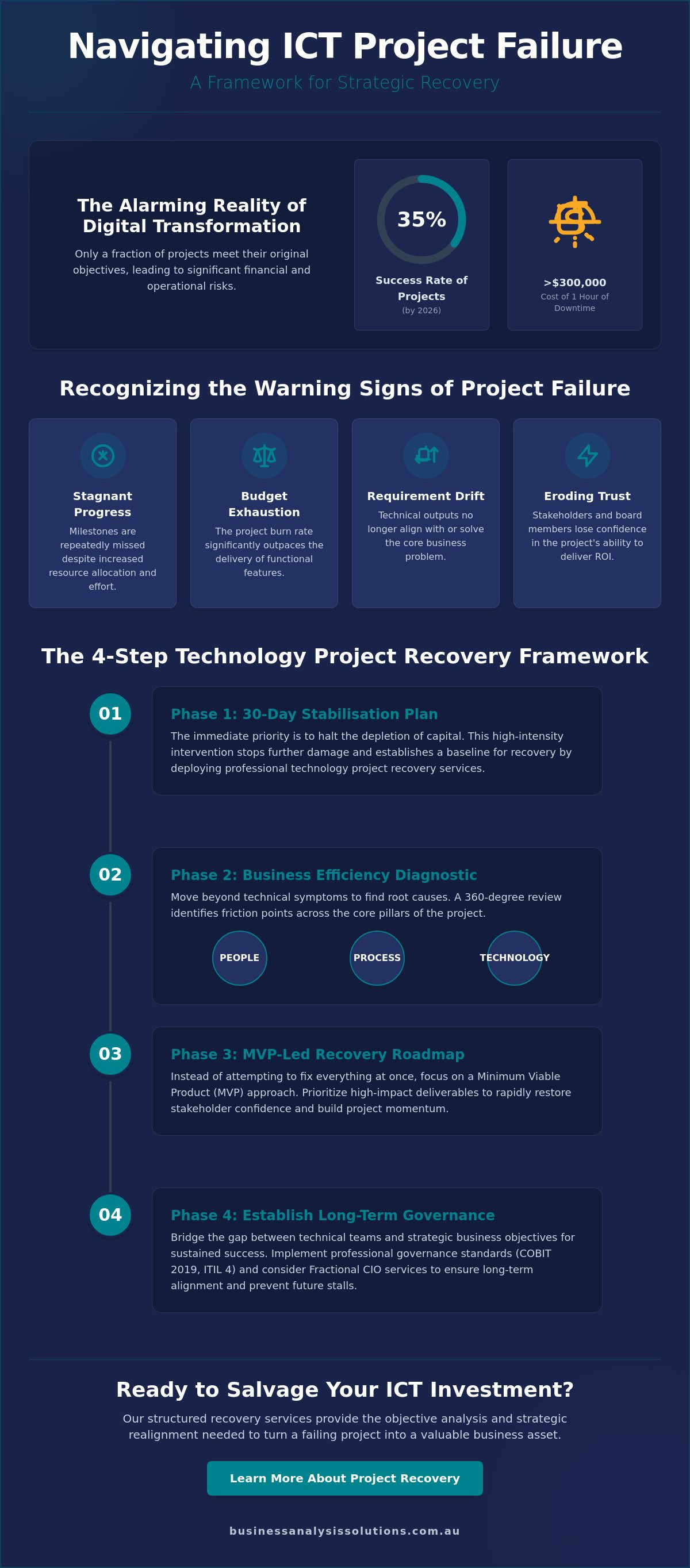
With only 35% of digital transformation projects achieving their stated objectives in 2026, the primary challenge for leadership isn't just identifying a stall; it's determining if the initiative can be salvaged. You've likely experienced the mounting pressure of the sunk cost fallacy as technical outputs drift away from your core business needs. It's difficult to maintain stakeholder trust when you lack objective visibility into the true health of your ICT investments. Considering that the cost of an hour of downtime for large enterprises can now exceed $300,000, the price of inaction is often higher than the cost of a structured rescue.
This article outlines a logical framework for technology project recovery services that prioritizes stabilization and strategic realignment over simple technical patches. You'll learn how to diagnose the root causes of failure, protect your existing capital, and deliver the tangible business value your board expects. We'll move through a methodical diagnostic phase, establish a roadmap to recovery, and discuss how to restore confidence through professional governance standards like COBIT 2019 and ITIL 4.
Key Takeaways
Recognize the critical indicators of ICT project failure, such as budget exhaustion and requirement drift, to assess if an initiative remains viable.
Deploy a structured 30-day stabilisation plan through professional technology project recovery services to immediately halt the depletion of organizational capital.
Use a Business Efficiency Diagnostic to identify root causes across people and processes rather than focusing solely on technical symptoms.
Adopt an MVP-led recovery roadmap that prioritizes high-impact deliverables to restore stakeholder confidence and project momentum.
Establish long-term ICT governance through Fractional CIO services to bridge the gap between technical teams and strategic business objectives.
Table of Contents
The Anatomy of a Failing Technology Project in 2026
Project failure in 2026 rarely occurs as a sudden event; it's typically the result of a gradual erosion in alignment between technical execution and business strategy. When an initiative begins to stall, standard project management often lacks the objective distance required to identify the root causes of the friction. Technology project recovery services represent a structured, high-intensity intervention designed to realign these failing ICT initiatives with their intended commercial outcomes. It's not about simple troubleshooting. It's a strategic recalibration that ensures your capital investment translates into operational performance.
Identifying the need for recovery requires recognizing specific red flags that indicate a project has moved beyond routine delays. These indicators include:
Stagnant Progress: Milestones are missed repeatedly despite increased resource allocation.
Budget Exhaustion: The burn rate outpaces the delivery of functional features or system capabilities.
Requirement Drift: The technical output no longer addresses the primary business problem it was commissioned to solve.
Eroding Trust: Stakeholders and board members lose confidence in the project's ability to deliver a return on investment.
The cost of failure extends far beyond the initial financial loss. It degrades organizational morale, creates operational bottlenecks, and can lead to significant downtime costs. Standard project management focuses on execution within established parameters; however, a recovery phase is a period of triage. It demands a different skill set centered on objective analysis, rapid stabilization, and the courage to make difficult decisions about project scope and direction.
Why ICT Projects Stagnate
Stagnation frequently stems from a disconnect between technical specifications and actual business requirements. In the 2026 enterprise environment, the complexity trap is a significant factor. Modern technology stacks are highly interdependent; a single failure in an automated workflow or a data integration layer can stall an entire digital transformation. Poor vendor management and a lack of clear internal ICT leadership often exacerbate these issues. Without a cohesive strategy, technical teams may focus on solving interesting engineering problems rather than delivering the specific functionality the business needs to remain competitive.
The Sunk Cost Fallacy vs. Strategic Pivot
Admitting that a project is failing is often a political challenge rather than a technical one. Stakeholders may fear the loss of professional credibility associated with a stalled initiative, leading to the sunk cost fallacy. This psychological trap encourages continued investment in a failing venture simply because significant resources have already been spent. Decisions must be based on a rigorous Business Efficiency Diagnostic to determine if recovery is viable or if decommissioning is the more responsible path. The point of no return for an ICT investment occurs when the projected cost to achieve a minimum viable outcome exceeds the remaining strategic value the project can realistically deliver.
The Technology Project Recovery Diagnostic: Identifying Root Causes
Effective technology project recovery services begin with a clinical assessment, not a rush to write more code. Most technical failures are symptoms of deeper organizational friction that code alone cannot resolve. The first step in our framework is a Business Efficiency Diagnostic. This diagnostic provides a 360-degree review of the initiative by examining the interplay between people, processes, and technology. It's not enough to look at the software. We must understand how the human elements and operational workflows have diverged from the original goals. This methodical approach identifies why technical deliverables aren't translating into business performance.
A rigorous audit of the existing digital transformation blueprint is essential to pinpoint the exact deviation point. This process balances objective data collection, such as system logs and milestone reports, with subjective stakeholder interviews. Data reveals what's happening. Interviews explain why it's happening. We look for discrepancies between what the technical team believes they're building and what the end-users require for daily operations. This dual approach ensures we don't just find the error. We find the underlying cause of the misalignment.
Process Mapping as a Recovery Tool
Detailed process mapping reveals where technology fails to support the actual business requirements. It exposes bottlenecks that were often ignored during the initial implementation phase. By mapping the current state, we gain the visibility needed to reset the 'Definition of Done' based on operational reality rather than outdated technical specifications. This visibility is the foundation of any successful Project Management intervention. It allows leadership to see exactly where the logic of the system breaks down in a real-world environment.
Requirement Validation and Gap Analysis
Recovery requires a ruthless re-evaluation of the original Business Requirements Document. We conduct a detailed gap analysis to separate critical 'must-haves' from the 'nice-to-haves' that contribute to project bloat. In a failing project, scope creep is often the primary driver of budget exhaustion. We establish a baseline for technical feasibility versus business utility. This ensures the recovered project delivers the specific outcomes the board originally authorized. By refocusing on core requirements, we reduce complexity and accelerate the path to a functional delivery.
Salvaging Value: Stabilisation vs. Strategic Realignment
Following the diagnostic phase, the priority shifts to halting the immediate depletion of organizational capital. Professional technology project recovery services deploy a 30-day stabilisation plan to stop the "bleeding" of time and resources. This isn't a push for completion; it's a controlled pause to secure the environment and prevent further technical or financial regression. During this period, we re-establish project governance by clarifying lines of authority and decision-making protocols. High-intensity stabilization provides the breathing room necessary to move from reactive firefighting to proactive management, allowing leadership to audit vendor contracts without the pressure of an active, failing sprint.
Strategic realignment ensures the project's trajectory matches the strategic guide to business efficiency. We evaluate the remaining backlog against current operational needs, often pruning features that no longer offer a clear return on investment. Communicating this "New Reality" requires a straightforward approach with all stakeholders. It's about presenting a revised roadmap that prioritizes functional utility over the original, perhaps overly ambitious, scope. This honesty is essential for maintaining the project's long-term viability and ensuring that the final output delivers actual commercial value rather than just technical completion.
Rebuilding Stakeholder Trust
Transparency is the only way to restore eroding trust after a project stalls. We implement reporting structures that highlight both setbacks and recovery progress with objective data, removing the ambiguity that fuels board-level anxiety. By setting smaller, achievable milestones, the team can demonstrate consistent wins that build momentum. Managing expectations during this transition is a delicate but necessary task. It requires shifting the focus from what was lost to what will be gained through the new, realigned delivery schedule. Reliable delivery on these smaller promises is what eventually restores the confidence required for continued investment.
Optimising Resource Allocation
A failing project often suffers from a mismatch between available skills and the demands of a recovery phase. We audit the current team to ensure the right personnel are in the right roles, often introducing external specialists to provide an unbiased perspective. These experts help bypass internal politics that might have contributed to the initial stagnation. Effective recovery leadership depends on active agency, where leaders take direct responsibility for driving change rather than merely observing the process. We ensure every hour of effort aligns with the redefined strategic outcomes, maximizing the value of the remaining budget and preventing a return to inefficient patterns.
A Methodical Framework for Project Recovery in 2026
Recovery demands precision. Moving a project from a state of failure to one of functional delivery requires more than just increased effort; it necessitates a sequence of logical, high-impact actions. Professional technology project recovery services utilize a five-step framework designed to eliminate ambiguity and restore operational control. This methodology ensures that every resource spent from this point forward contributes directly to a defined strategic outcome.
Step 1: Execute a comprehensive ICT project audit and diagnostic. This involves a deep dive into the technical debt, documentation gaps, and process failures identified during the initial assessment.
Step 2: Define a Minimum Viable Product (MVP) for the recovery phase. We prune the project scope to focus exclusively on the core features required to deliver immediate business value, allowing for a faster exit from the recovery state.
Step 3: Re-align project workflows with expert project management standards. We replace ad-hoc processes with disciplined governance, ensuring that reporting, task allocation, and milestone tracking are transparent and accurate.
Step 4: Implement rigorous change management and quality assurance protocols. We establish new testing standards and communication loops to ensure technical outputs meet the redefined business requirements.
Step 5: Handover to a sustainable governance model for long-term success. The final phase involves transitioning the recovered project back to the internal team with the tools and training needed to maintain its health.
If your current initiative is struggling to meet its objectives, a structured Project Management intervention can protect your remaining capital and realign the team with your strategic goals.
The Recovery Roadmap
A recovery roadmap functions as a time-bound contract between the recovery team and executive leadership. It outlines specific exit criteria for the recovery phase, ensuring the project doesn't remain in a perpetual state of "rescue." We often integrate Automation Implementation within this roadmap to accelerate delayed timelines and reduce the manual error rates that frequently contribute to project stagnation. The goal is to balance rapid, visible wins with the long-term system harmony required for a stable production environment.
Quality Assurance and Risk Mitigation
To prevent a project from veering off-course again, we implement "fail-safe" mechanisms and continuous monitoring of executive-level KPIs. This includes establishing a proactive risk register specifically for the recovery phase, which identifies potential technical or political blockers before they impact the schedule. By focusing on data-driven quality assurance, we ensure that the recovered system is not just functional but resilient enough to support future organizational growth without further intervention.
Beyond the Rescue: Establishing Long-Term ICT Governance
Stabilizing a failing initiative is a significant milestone, yet treating it as an isolated event often invites future regression. True resilience requires shifting from reactive technology project recovery services to a model of sustained governance. This transition ensures that the alignment achieved during the recovery phase becomes a permanent feature of your organizational structure. Without ongoing oversight, the same disconnects between technical delivery and board-level strategy that caused the initial stall will likely reappear. Effective governance isn't a technical constraint; it's a strategic framework that ensures every dollar of ICT spend delivers measurable performance.
A sustainable model relies on bridging the gap between technical teams and executive leadership. This is achieved by developing a culture of accountability where every technical decision is rooted in a validated business requirement. Implementing a continuous business technology assessment allows the organization to detect early signs of project decay before they escalate into systemic failures. It transforms ICT from a black box of technical debt into a transparent driver of operational efficiency. Regular reviews ensure that the project doesn't just meet its launch date but continues to adapt as your business objectives evolve.
The Role of the Fractional CIO in Recovery
Many organizations lack the budget for a full-time executive but require the high-level IT advisory that only a seasoned leader can provide. Fractional CIO services offer a pragmatic solution by providing strategic oversight on a part-time or project basis. This role ensures that all future technology investments remain strictly aligned with your financial performance goals. By acting as a strategic partner, a Fractional CIO helps refine your digital transformation blueprints, ensuring they're technically sound and commercially viable. This leadership prevents the isolation of technical teams, keeping them focused on outcomes that the board values.
Creating a Resilient ICT Strategy
Learning from past failures is a critical component of institutional growth. We advocate for a rigorous 'post-mortem' process that moves beyond blame to identify systemic improvements for future initiatives. This data-driven analysis informs the standardization of project management methodologies across the organization, creating a unified language for delivery. By institutionalizing these lessons, you prevent the recurrence of the 'complexity trap' and ensure that your technology project recovery services investment yields dividends in the form of improved governance. A resilient strategy is one that anticipates risk and prioritizes requirement-led technology adoption over speculative technical trends.
If your current ICT initiatives are showing signs of stagnation or requirement drift, prompt intervention is the most effective way to protect your capital. Contact Business Analysis & Solutions for a Project Recovery Diagnostic to begin the process of stabilization and strategic realignment.
Securing Your ICT Investment for Future Performance
A stalled project doesn't have to result in a total loss of capital. By shifting the focus from technical symptoms to root cause diagnostics and strategic realignment, organizations can salvage significant value from failing initiatives. Professional technology project recovery services provide the methodical framework needed to move beyond the sunk cost fallacy and restore stakeholder confidence through transparent, outcome-led delivery.
With over 20 years of industry experience, Business Analysis & Solutions specializes in bridging the gap between technical requirements and broader business objectives. Our proven methodology prioritizes resolution and tangible results, ensuring your technology stack serves your operational goals rather than hindering them. Whether you require a high-intensity stabilization plan or long-term Fractional CIO oversight, we provide the clarity required to navigate complex organizational challenges.
Don't let requirement drift compromise your strategic vision. Book a Technology Project Recovery Diagnostic today to realign your ICT roadmap with your business needs. It's possible to transform a failing initiative into a stable, high-performance asset.
Frequently Asked Questions
What are the first signs that a technology project needs recovery services?
Stalled milestones, budget exhaustion, and requirement drift are the primary indicators that an initiative is failing. When a project consistently fails to deliver functional value despite increased resource allocation, it requires an objective assessment. You might notice technical teams focusing on low-impact features while core business problems remain unresolved. This lack of alignment between technical output and commercial needs signals that standard management is no longer sufficient.
How do project recovery services differ from standard project management?
Recovery services prioritize triage, stabilization, and strategic realignment over routine execution. While standard project management operates within established parameters, technology project recovery services involve a high-intensity intervention to redefine those parameters entirely. This process requires an external perspective to identify systemic failures in governance or process mapping that the original team may have overlooked due to internal biases or political pressure.
Can a project that is 50% over budget still be saved?
A project can often be saved if the remaining strategic value outweighs the cost to achieve a functional outcome. we determine viability by conducting a Business Efficiency Diagnostic to see if core requirements can be delivered through a pruned, high-impact roadmap. If the foundational logic of the project remains sound, we can often salvage the investment by refocusing resources on a Minimum Viable Product that addresses immediate business needs.
How long does the typical technology project recovery process take?
A standard recovery timeline often begins with a 30-day stabilization phase followed by a 90-day execution roadmap. The duration depends on the complexity of the technical debt and the level of organizational misalignment. The initial diagnostic phase usually takes one to two weeks, providing the clarity needed to establish realistic milestones. The goal is to exit the recovery state as rapidly as possible to resume normal operations.
What is the role of a Business Analyst in tech project recovery?
The Business Analyst acts as the primary bridge between technical delivery and organizational objectives. In a recovery context, they perform requirement validation to distinguish critical needs from scope creep. By using process mapping, the analyst identifies exactly where the system logic has failed end-users. This ensures the realigned project delivers tangible business value rather than just technical completion, protecting the organization's long-term interests.
Is it better to hire a recovery specialist or a new software development firm?
A recovery specialist is generally more effective because they focus on governance, strategy, and business alignment. Hiring a new development firm often results in the same technical issues if the underlying process failures aren't addressed. Technology project recovery services focus on the root causes of the failure, ensuring that the project is either stabilized or strategically pivoted to meet actual business requirements before any further development occurs.
How do you measure the success of a project recovery intervention?
Success is measured by the achievement of defined business outcomes and the restoration of stakeholder trust. We track specific KPIs, such as the delivery of an MVP within the revised budget and the reduction of operational bottlenecks. A successful intervention also leaves the organization with a sustainable governance model, ensuring the project continues to deliver value without requiring further emergency stabilization or technical intervention.
What happens if the diagnostic suggests the project should be cancelled?
We provide a clear, data-driven rationale for decommissioning to prevent further capital loss. Admitting failure is often the most responsible financial decision when the cost of recovery exceeds the potential strategic benefit. In these cases, we assist with a controlled shutdown and a post-mortem analysis. This process helps the organization learn from the failure and redirect resources toward more viable ICT solutions or automation implementation.



Comments