Streamlining Business Operations: A Strategic Guide to Organisational Efficiency
- jonesaqayalo
- Apr 10
- 11 min read
Updated: Apr 20
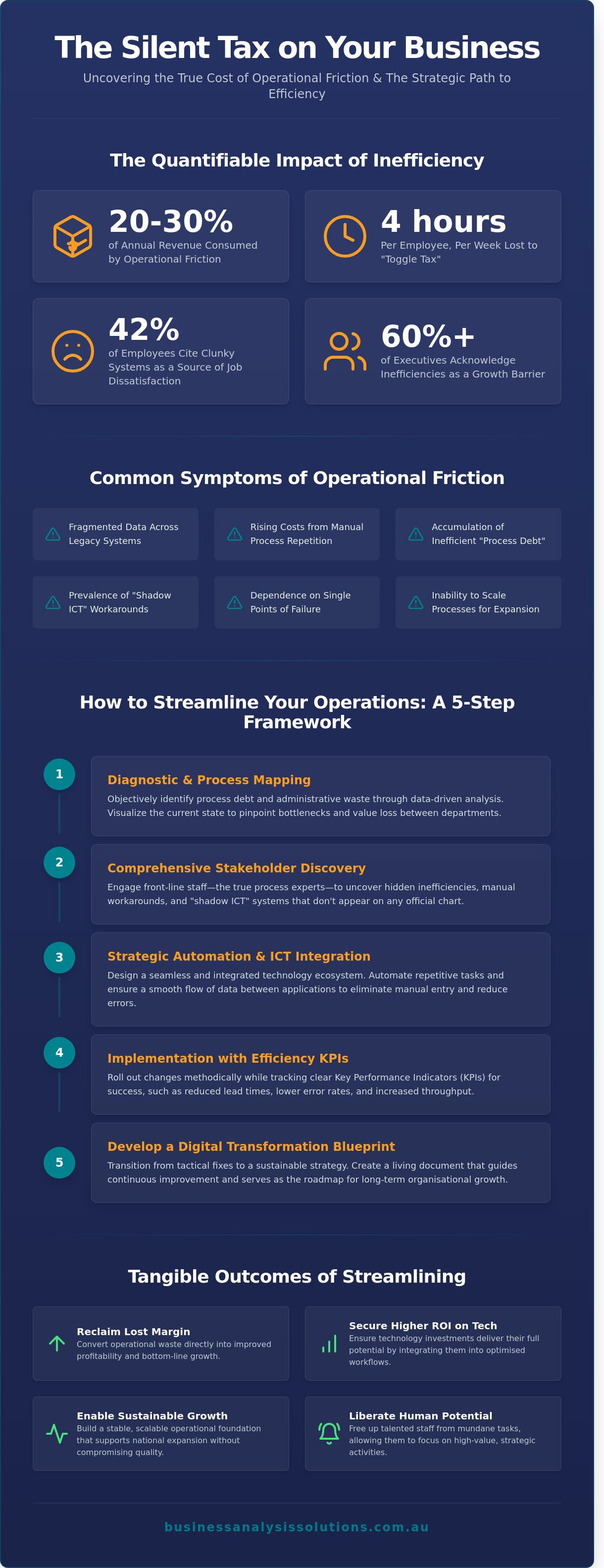
Operational friction is a silent tax on your Australian bottom line that often consumes 20% to 30% of an organisation’s annual revenue according to industry benchmarks. You likely see the symptoms every day in fragmented data across legacy systems and the rising costs of manual process repetition. While over 60% of executives acknowledge these inefficiencies as a barrier to growth, streamlining your operations is the most direct path to reclaiming lost margin. It's a logical necessity for any firm looking to maintain a competitive edge in the current economic climate.
You know that your current workflows aren't built for the scale you're targeting. This article provides the precise, methodical framework you need to identify hidden friction and implement high-impact strategies for sustainable growth. We'll outline a clear roadmap for operational improvement that clarifies stakeholder roles and secures a higher ROI on your technology investments. By the end, you'll have the strategic alignment required to transform complex manual tasks into scalable processes that support national expansion.
Key Takeaways
Pinpoint operational friction by identifying process debt through objective, data-driven diagnostics tailored for large-scale organisational structures.
Eliminate manual inefficiencies and ensure seamless data flow between disparate applications through strategic automation and ICT integration.
Implement a methodical 5-step framework for streamlining your operations, focusing on clear efficiency KPIs and comprehensive stakeholder discovery.
Transition from tactical improvements to a sustainable digital transformation blueprint that serves as a living document for long-term organisational growth.
Table of Contents Defining Streamlining: Beyond the Aerodynamic Metaphor The Business Efficiency Diagnostic: Identifying Operational Friction Core Pillars of Modern Streamlining: Automation and ICT Integration How to Streamline Your Operations: A 5-Step Strategic Framework Sustaining Efficiency with a Digital Transformation Blueprint
Defining Streamlining: Beyond the Aerodynamic Metaphor
Streamlining often evokes images of sleek vehicles cutting through air resistance. In a professional Australian business context, the term describes the rigorous removal of waste to improve throughput. It's not just about speed; it's about precision. Leaders often mistake mere "simplifying" for true optimisation. While simplification might remove a step, optimisation ensures every remaining step adds measurable value to the bottom line. This distinction is vital for organisations aiming for national scale where small inefficiencies compound into massive losses.
This discipline requires a commitment to Business process management as a recurring strategic pillar. It's not a one-off project that concludes with a final report. It's a continuous cycle of assessment and refinement. The core objective remains the reduction of operational friction to accelerate value delivery to the client. When you remove a bottleneck, you don't just save time. You liberate capital and human potential for higher-order tasks.
The 2026 Context: Why Streamlining is Mandatory
Physical paperwork has largely vanished from Australian boardrooms, yet digital clutter has taken its place. By 2026, fragmented ICT solutions have become the primary cause of organisational inertia. Employees lose up to 4 hours per week switching between disconnected software platforms. This "toggle tax" erodes agility and frustrates talented staff. Modern streamlining is the alignment of people, processes, and technology.
Economic and Operational Drivers
The cost of "business as usual" is quantifiable and often staggering. Research indicates that Australian firms lose approximately 25% of their potential annual revenue to operational inefficiencies. This isn't just a line item; it's a direct hit to your competitive advantage. Beyond the balance sheet, broken processes drive talent away. A 2024 industry survey found that 42% of employees cite clunky internal systems as a primary reason for job dissatisfaction. Streamlining provides the structural stability required for national expansion. You can't scale a process that's fundamentally broken at the local level. True efficiency creates the surplus margin needed to fund growth into new territories like Perth or Brisbane without diluting service quality. For those interested in how high standards and resilience are maintained in the care sector, you can learn more about Im with you and their advocacy for excellence.
The Business Efficiency Diagnostic: Identifying Operational Friction
Operational friction isn't always visible on a balance sheet. It often manifests as "process debt," the accumulation of inefficient workarounds that develop when systems don't evolve alongside the business. Before any streamlining initiative begins, an objective, data-driven assessment is required to untangle these complexities. Relying on internal perceptions is risky; staff often become "nose-blind" to the inefficiencies they encounter daily.
Stakeholder engagement is the most effective tool for uncovering these hidden bottlenecks. By interviewing those on the front lines, we identify the manual spreadsheets and "shadow ICT" systems used to bypass broken workflows. This collaborative approach ensures that the diagnostic isn't just a top-down mandate but a reflection of operational reality. An external perspective is essential to dismantle the "this is how we've always done it" mindset. It provides the logical distance needed to question legacy habits that might be costing the organisation 20% or more in lost capacity.
The Methodology of Process Mapping
Visualising the current state allows leaders to see where value is lost between departments. We categorise every action to distinguish between high-value strategic activities and administrative waste. Detailed business process mapping serves as the definitive blueprint for change. It highlights gaps where information drops off or where redundant approvals stall progress. Effective streamlining requires more than just removing steps; it requires a structural understanding of how work flows through the entire enterprise. This methodology ensures that any proposed changes are grounded in the actual mechanics of the business, preventing the introduction of new friction points during the transition.
Data-Driven Friction Analysis
Precision is the hallmark of effective optimisation. We use ICT diagnostics to track lead times and resource allocation, identifying exactly where a workflow breaks down. A common finding is the "single point of failure," where a critical process depends on one individual or an outdated legacy application. This rigorous analysis mirrors the logic used to create a streamlined regulatory and permitting system, where reducing complexity directly improves economic outcomes. We prioritise friction points by their impact on the bottom line, ensuring that the most costly delays are addressed first. If your organisation is facing stagnant growth, engaging with professional business analysts can help identify the precise levers for improvement.
Core Pillars of Modern Streamlining: Automation and ICT Integration
Modern streamlining relies on two foundational elements: automation and the strategic integration of Information and Communication Technology (ICT). Many Australian organisations still struggle with fragmented data silos that require manual intervention. This creates unnecessary friction and increases the margin for error. By focusing on a robust automation implementation, businesses can eliminate repetitive tasks like manual data entry. Industry data suggests that administrative errors and manual rework can consume up to 20% of an employee's productive time. Removing these human-error bottlenecks ensures that data entered once propagates accurately through the entire ecosystem.
Successful integration ensures data flows between separate applications without human interference. This connectivity transforms isolated departmental tools into a cohesive engine. However, speed shouldn't come at the cost of safety. Adopting a "security by design" philosophy ensures that every automated workflow adheres to Australian privacy standards and protection protocols from the outset. According to the Australian Cyber Security Centre (ACSC), small to medium enterprises remain high-value targets, making built-in security a prerequisite for any digital workflow optimization.
Leveraging the Microsoft Power Platform
The Microsoft Power Platform serves as a critical bridge for organisations operating with a mix of legacy on-premise software and modern cloud tools. Power Automate allows for the creation of sophisticated logic flows that connect these disparate environments seamlessly. Instead of relying on fragile, spreadsheet-based tracking systems that often lead to version control issues, teams can deploy custom business applications. These low-code solutions address specific departmental inefficiencies without the high cost of bespoke software development. For a deeper technical roadmap on these tools, consult our Microsoft Power Platform strategic guide.
Strategic Technology Alignment
True efficiency requires a transition away from "shadow IT", where departments procure software independently of the broader organisational strategy. This fragmentation often leads to redundant costs and security gaps. A unified business technology stack ensures that every tool serves the overarching corporate objective. Engaging a Fractional CIO provides the high-level expertise needed to select high-ROI software while ensuring that ICT solutions support, rather than dictate, existing business processes. This alignment guarantees that technology remains an enabler of growth rather than a source of complexity, ensuring every investment delivers measurable value to the bottom line.
How to Streamline Your Operations: A 5-Step Strategic Framework
Operational streamlining requires a structured methodology to move beyond superficial fixes and achieve lasting efficiency. A 2023 analysis of Australian digital transformations found that 62% of projects fail when they lack a defined framework. Success depends on a logical progression from initial diagnostic baselines to post-implementation evaluation.
Preparation hinges on defining specific efficiency KPIs. You can't improve what you don't measure. Establishing metrics such as cycle time reduction or cost-per-transaction provides the objective data needed to justify the investment. Australian firms that set baseline metrics before a rollout saw 24% higher ROI than those that relied on anecdotal evidence of improvement.
Phase 1 & 2: Elicitation and Visualisation
Requirements elicitation identifies the technical and functional needs of the business through structured stakeholder interviews. This isn't a passive exercise; it's a rigorous investigation into how work actually happens on the ground. By engaging with staff at all levels, you uncover the shadow processes that often bypass official procedures.
Developing a process map that stakeholders actually understand and adopt is the next critical step. This visualisation serves as the single source of truth for the current "as-is" state. A map without stakeholder buy-in is just a drawing. It must reflect the lived experience of the team to be useful for identifying bottlenecks or redundancies that hinder progress.
Phase 3 & 4: From Blueprint to Execution
Translating business requirements into technical ICT specifications ensures that the "to-be" state is technologically feasible. This design phase bridges the gap between high-level business goals and integrated software solutions. It prevents the common mistake of purchasing expensive automation tools that don't align with existing operational logic.
The implementation phase carries the highest risk of failure due to human factors. Managing the cultural shift is essential, as 40% of staff typically resist new workflows if they feel the changes are imposed rather than collaborative. To address these human elements, Business Reimagined offers leadership development and talent initiatives that help teams embrace organisational change. Phased rollouts allow teams to adapt gradually while you iron out technical glitches in a controlled environment. The transition requires expert project management to maintain momentum and mitigate risks during the "go-live" period.
Evaluation is the final, ongoing stage. By measuring results against the initial diagnostic baseline, you confirm whether the streamlining efforts delivered the promised value. This data-driven approach allows for continuous refinement, ensuring that the organisation remains agile as market conditions in Australia evolve. If you're ready to remove complexity from your business, you can optimise your operational workflows with our proven strategic framework.
Sustaining Efficiency with a Digital Transformation Blueprint
Operational streamlining serves as the prerequisite for meaningful digital evolution. Attempting to automate inefficient manual workflows only accelerates organisational friction. By refining processes first, leadership ensures that technology investments yield a measurable return on investment. This structured approach requires a digital transformation blueprint for business. This document isn't a static file; it's a living framework that evolves alongside market shifts and internal growth.
Maintaining long-term health often requires high-level expertise that mid-sized Australian firms may not need on a full-time basis. Fractional CIO services provide this strategic oversight without the overhead of a C-suite salary. These experts bridge the gap between technical requirements and business objectives, ensuring that systems remain scalable as the company grows. They help shift the organisation from reactive problem-solving, which often consumes 30% of an IT team's capacity, to proactive efficiency management. This transition allows the business to anticipate bottlenecks before they impact the bottom line.
Building an Efficiency-First Culture
A successful strategy relies on the people executing it daily. Staff should be trained to identify and report friction points as they arise, creating a bottom-up feedback loop. Regular "health checks" for ICT systems and business processes, ideally conducted every six months, keep operations lean. When efficiency is positioned as a driver for innovation rather than a cost-cutting exercise, employees feel empowered to contribute to the firm's growth. This cultural shift turns streamlining into a continuous improvement cycle that attracts top-tier talent looking for modern, friction-free work environments.
Next Steps for Executive Leadership
The journey begins with a Business Efficiency Diagnostic. This assessment provides an objective view of current performance gaps and identifies high-impact areas for improvement. Executive sponsorship is vital here. Without clear support from the top, initiatives often stall at the implementation phase. Leaders must champion these changes to ensure alignment across all departments. To begin your journey toward a more resilient and agile organisation, Request a consultation with Business Analysis & Solutions today. Our team delivers the clarity and direction required to turn operational complexity into a competitive advantage.
Securing Your Operational Competitive Advantage
Effective streamlining isn't a one-off event. It's a continuous commitment to removing operational friction and aligning technical infrastructure with clear business goals. By applying a structured 5-step framework, your organisation moves from reactive troubleshooting to proactive growth. Successful digital transformation requires more than just new software; it demands a blueprint that bridges the gap between complex technical requirements and high-level strategic objectives.
Business Analysis Solutions brings over 20 years of industry experience to this process. We specialise in untangling organisational complexities for clients across Australia, ensuring every process delivers measurable value. Our team provides national expertise in creating digital transformation blueprints that turn ICT integration into a tangible return on investment. We focus on the logic of your operations to ensure no resource is wasted.
If your current workflows feel bogged down by legacy systems or manual bottlenecks, it's time for a professional assessment. Book a Business Efficiency Diagnostic with our expert consultants to identify your path toward seamless integration. We'll help you build a more resilient, efficient enterprise.
Frequently Asked Questions
What is the difference between streamlining and downsizing?
Streamlining is the process of improving efficiency by removing unnecessary steps, while downsizing is the reduction of a workforce to cut costs. While downsizing often results in a loss of institutional knowledge, a 2023 report by the Australian Productivity Commission highlights that efficiency gains through process optimisation lead to more sustainable long-term growth. It's a strategic choice to work smarter, not simply with fewer people.
How long does a typical business streamlining project take?
A typical business streamlining project takes between three and six months to move from initial analysis to full implementation. This timeline depends on the scope of the requirements elicitation phase and the complexity of the existing architecture. Industry data from 2023 suggests that 65% of successful organisational changes achieve their primary objectives within this 180 day window when managed by a dedicated analyst.
Can streamlining be done without implementing new software?
You can achieve significant gains by optimising manual workflows without purchasing new software. Lean methodology principles demonstrate that 80% of process waste is identified through value stream mapping rather than technical upgrades. By refining stakeholder engagement and removing redundant approval loops, firms often see immediate improvements. It's about fixing the logic of the work before adding a digital layer.
What are the most common signs that a process needs streamlining?
The most common signs include a high volume of rework and persistent bottlenecks in project delivery. If staff spend more than 15% of their 38 hour work week correcting errors or waiting for approvals, your operational structure is failing. These inefficiencies often manifest as missed deadlines or a 20% increase in customer complaints, indicating that your current workflows don't meet professional standards.
How do we measure the ROI of a streamlining initiative?
You measure ROI by calculating the reduction in cycle time and the associated labour cost savings against the initial project investment. If a streamlining initiative reduces a process from 10 hours to 6 hours, the 40% time saving represents a direct financial gain. Australian benchmarks indicate that well-executed process improvements typically deliver a full return on investment within the first 12 months of operation.
Is streamlining only for large corporations or can SMEs benefit too?
Small and Medium Enterprises (SMEs) often benefit more than large corporations because they can implement changes with greater agility. The Australian Small Business and Family Enterprise Ombudsman reported in 2023 that streamlining just one core administrative task saves owners up to 10 hours of manual labour weekly. Smaller teams don't have the heavy bureaucracy of multinationals, allowing for faster strategic alignment and quicker results.
What happens if employees resist the new streamlined processes?
Employee resistance is managed through structured change management and early stakeholder engagement to ensure buy-in. Prosci's 2023 research indicates that projects with effective change management are six times more likely to succeed than those without. When staff understand how a new process reduces their daily friction, resistance drops. It's vital to provide clear training and demonstrate the tangible benefits of the new system.
How does process mapping differ from standard operating procedures (SOPs)?
Process mapping provides a high-level visual representation of a workflow, while Standard Operating Procedures (SOPs) offer granular, step-by-step instructions. Mapping identifies the strategic alignment and hand-off points between departments. SOPs act as the technical manual for execution. A 2022 survey of Australian analysts found that using both methods together reduces new employee onboarding time by 40% compared to using text-based instructions alone.



Comments