Streamlining Business Operations: A Strategic Guide to Efficiency in 2026
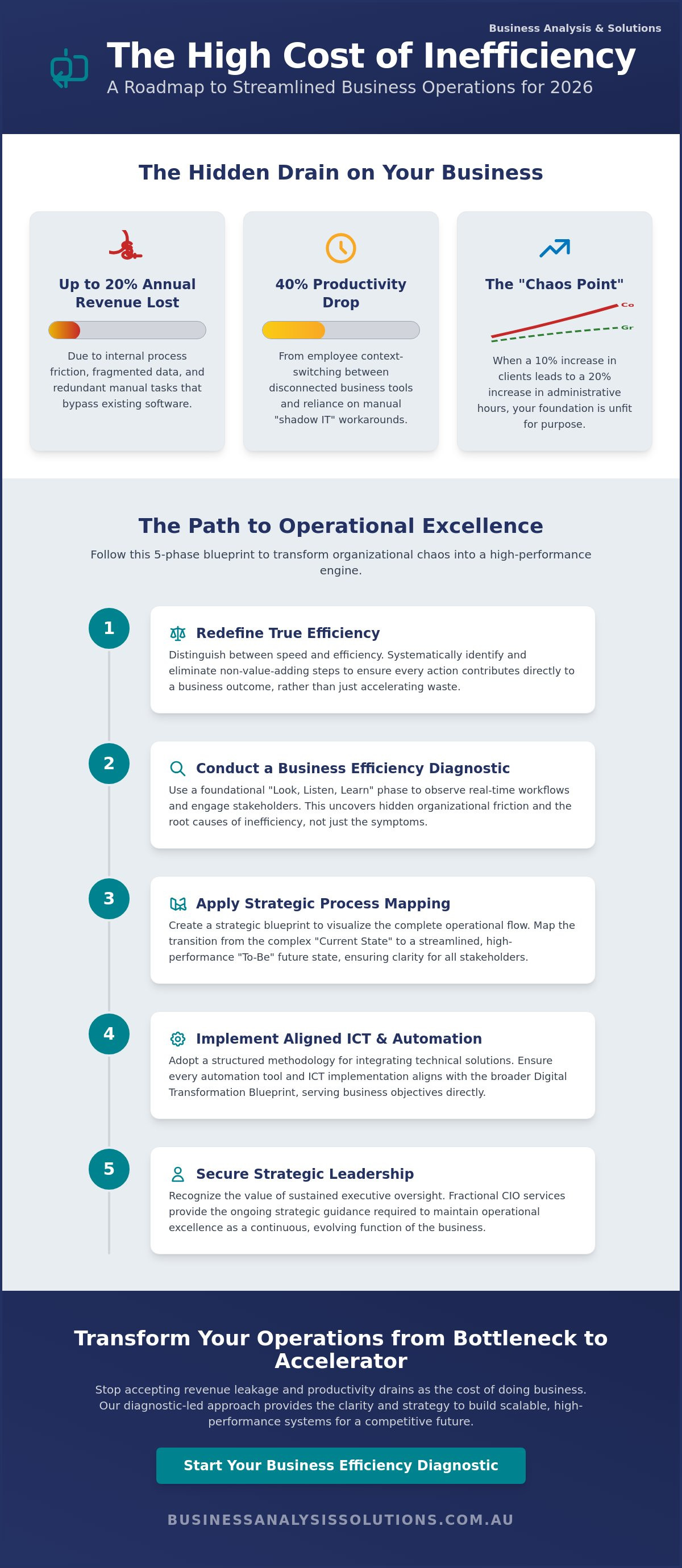
Recent industry analysis suggests that Australian enterprises often lose up to 20% of their annual revenue to internal process friction and redundant manual tasks. This financial leakage usually stems from fragmented data platforms and manual workarounds that bypass your existing software. If your headcount is rising but your output remains stagnant, the problem isn't your team; it's your architecture. Successfully streamlining business operations requires more than just new software. It demands a methodical, diagnostic-led approach to bridge the gap between technical requirements and business objectives.
You've likely invested heavily in digital tools only to find your data trapped in silos, forcing staff to manage tasks that should be automated. It's frustrating to see technology become a bottleneck rather than an accelerator. This guide provides a clear roadmap to transform that organizational chaos into a high-performance engine. You'll learn how to achieve better ROI from your current investments and build scalable operations that don't require constant manual oversight. We'll examine the specific steps for process mapping and strategic alignment to ensure your firm is ready for the competitive landscape of 2026.
Key Takeaways
Distinguish between mere operational speed and true efficiency by identifying and eliminating non-value-adding steps within your core workflows.
Understand the necessity of a Business Efficiency Diagnostic as the foundational phase for streamlining business operations and uncovering hidden organisational friction.
Learn to apply process mapping as a strategic blueprint to visualise the transition from current state complexities to a high-performance "To-Be" future.
Adopt a structured methodology for integrating automation and ICT solutions, ensuring all technical implementations align with a broader Digital Transformation Blueprint.
Recognise the strategic value of Fractional CIO services in Australia for providing the sustained executive oversight required to maintain operational excellence as a continuous function.
Table of Contents What Does Streamlining Business Operations Actually Mean? The Diagnostic Approach: Identifying Operational Bottlenecks Process Mapping: The Blueprint for Operational Clarity Implementing Automation and ICT Solutions Safely Strategic Leadership: The Role of the Fractional CIO
What Does Streamlining Business Operations Actually Mean?
In the context of 2026, streamlining business operations is defined as the systematic identification and removal of non-value-adding steps within a workflow. It's a common misconception among Australian business leaders that efficiency is synonymous with speed. While doing things faster has its merits, true optimization is about doing fewer unnecessary things. If a process contains redundant approvals or manual data handovers, performing those tasks faster only accelerates waste. True streamlining ensures that every action taken by a staff member or a software system contributes directly to a defined business outcome.
Achieving this level of clarity requires a precise fusion of business analysis and ICT strategy. We no longer live in an era where technology is a separate department; it's the nervous system of the organisation. Modern streamlining relies on the principles of Business Process Management to map out how information flows across a company. Without this structural view, businesses often suffer from operational bloat. This usually manifests as redundant data entry across multiple platforms and communication silos where departments fail to share critical insights, leading to duplicated efforts and missed opportunities.
The Symptoms of Operational Inefficiency
One of the most visible indicators of a failed process is the rise of "shadow IT." This occurs when employees bypass official corporate systems to use unapproved third-party apps because the internal tools are too cumbersome. When manual spreadsheets become the primary "glue" holding your departments together, your systems have failed. These workarounds create a significant hidden cost through context-switching. Research indicates that toggling between disconnected business tools can reduce an employee's productive output by as much as 40%. Organisations must identify the "chaos point," which is the specific stage where growth begins to outpace current systems. If a 10% increase in new client acquisition leads to a 20% increase in administrative hours, the operational foundation is no longer fit for purpose.
Operational Efficiency vs. Business Growth
Scaling an inefficient business doesn't lead to higher profits; it simply scales the existing problems. If a workflow is fractured at a small scale, it will become a catastrophic bottleneck when transaction volumes increase. Prioritising business efficiency is the most effective way to protect profit margins against rising operational costs in the Australian market. This requires a shift from reactive problem-solving to proactive strategic alignment. Instead of hiring more staff to manage a messy process, leaders must interrogate the process itself. This methodical approach ensures that every resource, whether human or digital, is aligned with the firm's long-term objectives rather than just managing daily fires.
The Diagnostic Approach: Identifying Operational Bottlenecks
A structured Business Efficiency Diagnostic serves as the logical anchor for any transformation. Before investing in new infrastructure, leaders need to pinpoint exactly where friction resides. This involves a "Look, Listen, Learn" phase where we observe workflows in real-time. By engaging stakeholders at every level, we expose the disconnect between official policy and the "shadow processes" staff use to navigate daily hurdles. Streamlining business operations requires this level of granular visibility to ensure the solution matches the problem.
Quantifying the cost of manual intervention is essential for a robust business case. A 2023 report by the Australian Productivity Commission suggested that administrative complexity can drain up to 15% of a firm's total revenue. For an Australian enterprise with a A$20 million turnover, that equates to A$3 million lost to inefficiency annually. We must distinguish between symptoms, such as delayed client reporting, and root causes, like a lack of automated data synchronisation between accounting and project management tools. Identifying these underlying issues prevents the common mistake of treating the effect while the cause remains active.
Stakeholder Engagement and Requirements Elicitation
Effective elicitation uncovers the unspoken rules that govern daily work. While management might believe a process is linear, frontline staff often create workarounds to bypass rigid legacy systems. Bridging this gap requires a culture of transparency where employees feel empowered to highlight bottlenecks without fear of criticism. Using techniques like contextual inquiry and structured workshops allows us to document the "as-is" state with precision. This ensures that the roadmap for streamlining business operations is built on reality, not assumptions.
The ROI of Strategic Diagnostics
A formal diagnostic prevents the expensive error of applying technology to a broken process. By establishing measurable KPIs at the outset, such as a 30% reduction in manual data entry or a 15% improvement in order fulfilment speed, firms can track their progress accurately. Data-driven insights allow us to prioritise high-impact changes that offer the fastest payback. If your team is struggling with fragmented workflows, a professional business analysis review can provide the clarity needed to move forward. This methodical approach ensures that every adjustment contributes to measurable scalability and long-term performance.
Process Mapping: The Blueprint for Operational Clarity
Process mapping serves as the diagnostic foundation for any effort involving streamlining business operations. It's a rigorous exercise that moves beyond abstract ideas to document the granular reality of how work actually happens. We begin by capturing the "As-Is" state, which often reveals a significant gap between perceived workflows and daily practice. This visibility is vital for designing the "To-Be" state, a streamlined version of the process that eliminates redundancy and aligns with your 2026 strategic goals.
A functional process map requires four distinct elements to be effective:
Inputs: The specific data, materials, or information required to begin a task.
Triggers: The precise event or condition that initiates the workflow.
Actions: The sequential steps and decisions that transform inputs into value.
Outcomes: The measurable result that satisfies a customer or internal stakeholder requirement.
During the mapping phase, we frequently identify "dead ends" where information is gathered but never utilised, or circular logic where tasks bounce between departments without reaching a resolution. In Australian professional services, these logic gaps can account for up to 22% of wasted administrative time. Once these maps are finalised, they don't just sit in a folder. They become active training tools. They provide staff with clear benchmarks for accountability, ensuring everyone understands their specific role in the value chain.
From Process Mapping to Digital Strategy
A process map is the primary document used to inform the selection of ICT solutions. Many organisations make the mistake of purchasing software before they've defined their requirements, leading to expensive systems that don't fit the business. Technology must serve the process, not dictate it. This methodical approach is a central pillar of a successful digital transformation blueprint for business. By mapping first, you ensure that every dollar spent on tech delivers a measurable return on investment.
Standardisation as a Prerequisite for Automation
You can't automate chaos. If a process isn't standardised, any attempt at automation will simply accelerate existing errors. We apply the "Simplify, Standardise, Automate" framework to ensure operational success. First, we remove non-value-adding steps. Next, we ensure every team member follows the same optimised path. This eliminates variation, which is the primary enemy of quality. In the Australian market, streamlining business operations through standardisation ensures that your outputs remain predictable and meet local regulatory standards before you commit to high-level automation tools.
Implementing Automation and ICT Solutions Safely
Success in streamlining business operations hinges on a disciplined deployment cycle. It's not enough to purchase software; the implementation must follow a logical sequence to mitigate risk and ensure a return on investment. Organizations that bypass structured planning often find themselves with fragmented systems that increase, rather than decrease, administrative overhead. A methodical five-step approach ensures technology serves the strategy.
Step 1: Selection. Identify tools that align strictly with your Digital Transformation Blueprint. This prevents the acquisition of redundant features that don't address specific operational bottlenecks.
Step 2: Architecture Design. Map the integration architecture to ensure data flows between systems without manual intervention. Precision at this stage prevents data silos.
Step 3: Pilot Phase. Test the streamlined workflow in a controlled environment. Use a small department or a specific product line to validate the process before a full-scale rollout.
Step 4: Change Management. Prioritize staff training. Adoption rates determine the ultimate success of any ICT solution; if the team doesn't understand the "why," they won't embrace the "how."
Step 5: Iterative Improvement. Monitor performance post-launch. Use real-time data to identify friction points and refine the automation rules.
Leveraging Modern Technology Platforms
The Microsoft Power Platform has become a cornerstone for custom business automation in 2026. It allows for the creation of low-code solutions that bridge the gap between legacy systems and modern requirements. By integrating communication services like Microsoft Teams or Slack directly into automated workflows, firms can reduce internal email volume by up to 40%. All implementations must adhere to Australian cybersecurity standards. Following the ACSC Essential 8 framework is mandatory to protect organizational data during the transition to more connected ICT environments.
The Risks of Poor Implementation
Effective project management represents the thin line between a successful transition and the creation of "shelfware." When tools are deployed without clear requirements, they sit unused while the business continues to pay subscription fees. Leaders must avoid the sunk cost fallacy. If a tool fails to meet performance benchmarks during the pilot phase, it's more cost-effective to pivot than to persist with a flawed solution. Failing to do so creates technical debt, where future streamlining business operations becomes harder because of poorly integrated past choices.
Our consultants provide the logical framework needed to execute these transitions without disrupting your core activities. Optimise your operational architecture with our proven business analysis methodologies.
Strategic Leadership: The Role of the Fractional CIO
Streamlining business operations requires continuous executive attention rather than a periodic audit. By 2026, the pace of digital change means a static operational model becomes obsolete within 18 months. For mid-sized Australian enterprises, maintaining this momentum often exceeds the internal capacity of a traditional COO or IT Manager. Strategic leadership must bridge the gap between high-level vision and the granular technical requirements needed to execute it.
This is where Fractional CIO services Australia provide a scalable solution. These leaders translate business objectives into technical roadmaps, ensuring every software investment supports the bottom line. They act as objective architects, reviewing processes without the bias of internal office politics or legacy attachments. This ensures long-term strategic alignment as both the business and the technology landscape evolve.
Executive Oversight vs. Technical Support
A CIO operates at a fundamentally different level than a managed IT helpdesk provider. While a helpdesk ensures uptime and resolves individual tickets, a Fractional CIO focuses on business outcomes and return on investment. They address risk mitigation at the board level, aligning technology with the ASD Essential Eight or specific industry regulations. Having an objective, third-party perspective is vital during operational reviews. It allows for a cold, logical assessment of where streamlining business operations will yield the highest impact. This leadership ensures that technology serves the business strategy, not the other way around.
Building a Future-Proof Business
Efficiency in 2026 hinges on scaling operations without a linear increase in administrative overhead. Leading firms use business technology as a competitive lever, automating low-value tasks to free up human capital for strategic growth. This approach ensures that if revenue grows by 25%, back-office costs don't follow the same trajectory. Successful streamlining business operations relies on selecting tools that integrate seamlessly rather than creating new silos. A Fractional CIO acts as the essential catalyst for sustained operational excellence by ensuring that every technical decision is rooted in a pragmatic business case.
A Fractional CIO acts as a catalyst for sustained operational excellence by bridging the gap between executive vision and technical execution.
Driving Sustainable Growth through Operational Precision
Achieving efficiency in 2026 requires more than surface-level adjustments. It demands a rigorous commitment to streamlining business operations by identifying systemic bottlenecks and applying precise process mapping. Transitioning from manual legacy systems to integrated ICT solutions isn't just a technical upgrade; it's a strategic move that aligns your technical capabilities with your core business objectives. For Australian organisations, this alignment is the primary differentiator between stagnation and scalable success.
Business Analysis Solutions brings over 20 years of strategic ICT experience to help you navigate these complexities. We've developed a proven diagnostic framework specifically for the Australian market, designed to bridge the gap between technical requirements and business needs. Our methodology ensures that every automation or process change delivers a measurable return on investment. You don't have to guess where your inefficiencies lie when you can rely on data-driven clarity and expert guidance.
Taking the first step toward a more efficient future creates the momentum your organisation needs to thrive in a competitive landscape. We're ready to help you build a more resilient, high-performing business today.
Frequently Asked Questions
What is the first step in streamlining business operations?
The first step in streamlining business operations is conducting a comprehensive audit through process mapping to identify your current "as-is" state. This analytical phase requires documenting every workflow to pinpoint redundancies or hidden bottlenecks. By establishing this baseline, you gain the clarity needed to align operational changes with strategic objectives. We recommend starting with high-impact areas where inefficiencies cost the most time or capital.
How long does it take to see results from a streamlining project?
Most organisations observe measurable improvements within 3 to 6 months of implementation. While cultural shifts take longer, technical optimisations often deliver immediate gains. According to 2024 industry benchmarks, 72% of Australian firms report a return on investment within the first fiscal year. We focus on delivering quick wins through targeted adjustments while maintaining a long-term roadmap for systemic change.
Can a small business afford professional business analysis?
What is the difference between streamlining and simple automation?
Streamlining involves re-engineering a process to remove waste, while automation simply applies technology to execute a task. Automating a broken process only results in faster errors. Effective streamlining business operations requires you to simplify the workflow before introducing software. This logical sequence ensures that your digital tools support a lean, high-performing operation rather than complicating an already inefficient system.
Do I need to replace all my existing software to streamline operations?
You don't need to replace your entire technology stack; many legacy systems can be integrated via APIs or middleware. The focus should be on seamless data flow between existing platforms. In 2024, 65% of Australian enterprises chose to optimise their current software through better configuration rather than full replacement. We evaluate your current assets to determine if they meet technical requirements before suggesting new capital expenditure.
How do I handle staff resistance to new, streamlined processes?
Managing resistance requires transparent stakeholder engagement and clear communication of the personal benefits for employees. Staff often resist change when they fear job insecurity or increased complexity. By involving team members in the requirements elicitation phase, you foster a sense of ownership. Providing structured training and demonstrating how new processes reduce daily friction can lower resistance levels by 40% based on recent studies.
What are the most common mistakes when trying to streamline operations?
The most common mistake is prioritising software purchases over thorough process analysis. Many leaders rush into implementation without a clear understanding of their strategic alignment. Another error is failing to define measurable KPIs, which leaves 55% of projects unable to prove their value. Avoiding these pitfalls requires a disciplined approach that values data over assumptions and ensures every change serves a specific, documented business objective.
Is streamlining operations a one-off project or a continuous process?
Streamlining is a continuous cycle of improvement rather than a single event; market conditions and technologies evolve constantly. A process that's efficient today may become a bottleneck by 2027 as your business grows. Adopting a mindset of ongoing optimisation allows your organisation to remain agile. Regular reviews every 6 to 12 months ensure your operations stay lean and continue to deliver maximum value as you scale.



Comments