Strategic Technology Solutions: A Guide to High-Performance Business Alignment
Updated: Apr 21
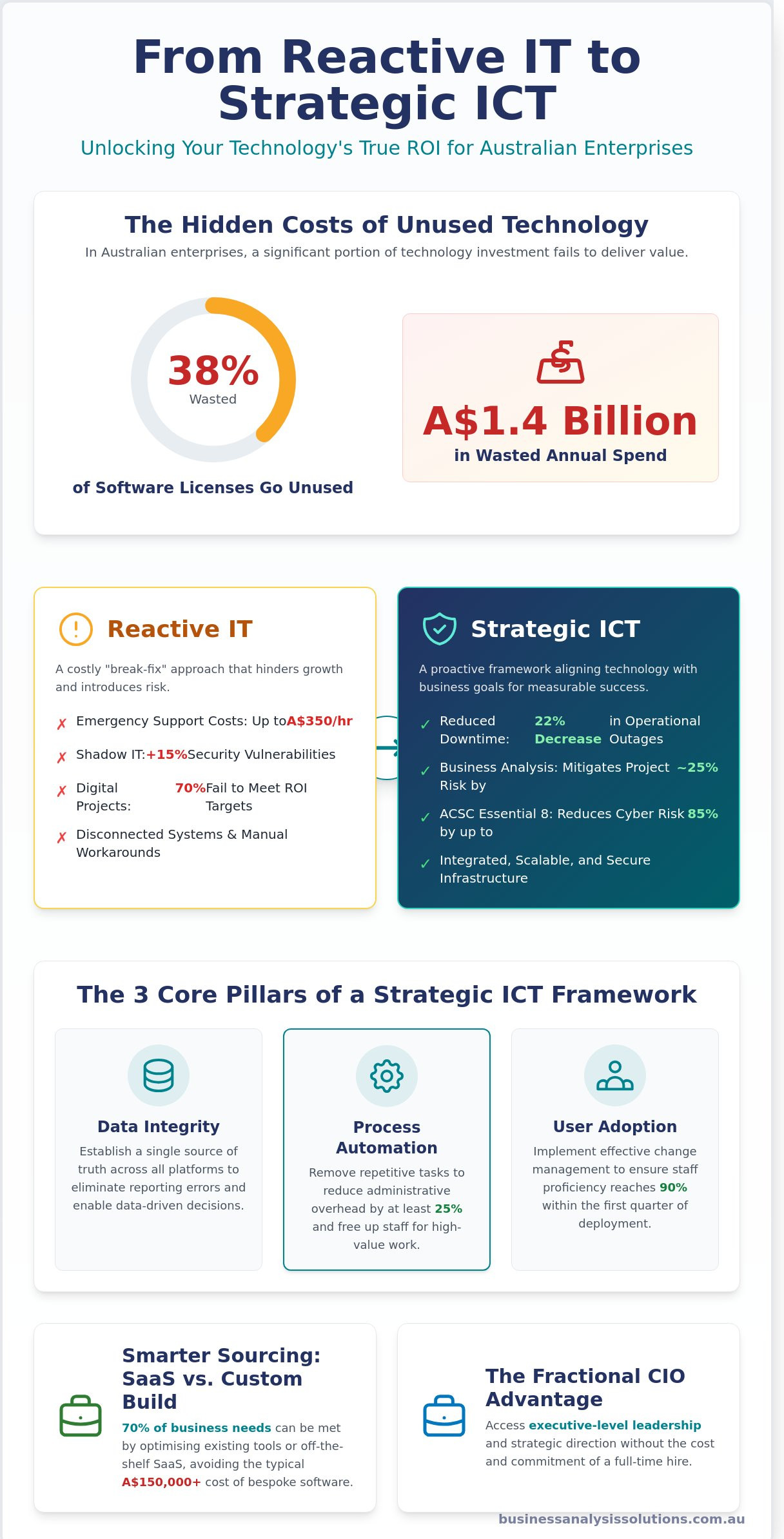
Did you know that 38% of software licenses in Australian enterprises go unused? This represents an estimated A$1.4 billion in wasted annual spend according to recent industry benchmarks. When your IT department spends its time reacting to broken systems rather than driving growth, your organization loses its competitive edge. Implementing strategic technology solutions isn't just about buying the latest software; it's about ensuring every digital investment directly supports your operational objectives. You've likely felt the frustration of disconnected systems that don't communicate, forcing your team into manual workarounds that drain productivity.
It's clear that a fragmented tech stack creates friction that slows down your entire business. You deserve a clear path forward that replaces reactive fixes with a structured, high-performance roadmap. This guide will show you how to move beyond basic maintenance to implement a technology strategy that drives measurable efficiency and long-term ROI. We'll explore how to achieve operational excellence through automation and build a scalable infrastructure that grows alongside your business ambitions.
Key Takeaways
Identify the critical transition from reactive IT maintenance to strategic technology solutions that align ICT infrastructure with long-term organizational growth.
Master the core pillars of business alignment by prioritising data integrity, process automation, and user adoption to ensure measurable efficiency.
Evaluate potential technology partners using a Total Cost of Ownership (TCO) framework to secure maximum return on investment for your Australian enterprise.
Mitigate implementation risks and project overruns through structured management techniques that bridge the gap between technical requirements and business objectives.
Leverage the Fractional CIO model to access executive-level leadership and strategic direction without the cost of a full-time hire.
Table of Contents What Are Strategic Technology Solutions in 2026? The Core Pillars of a Strategic ICT Framework Evaluating Strategic Technology: A Buying Guide for Leaders Implementation and Risk Mitigation Strategies Partnering for Success: The Fractional CIO Advantage
What Are Strategic Technology Solutions in 2026?
In the current Australian business environment, strategic technology solutions represent the intentional orchestration of ICT tools to meet specific organizational objectives. It's no longer sufficient to view IT as a background utility. Instead, it's a primary driver of competitive advantage. True strategic alignment ensures that every software license, hardware procurement, and cloud subscription serves a documented business purpose. This methodology moves beyond simple digitisation; it focuses on creating a cohesive ecosystem where technology and business goals operate in lockstep.
For those in industrial and mining sectors, this ecosystem must also account for sustainability; to discover how to optimise your energy footprint and decarbonisation strategy, you can visit Super Smart Energy.
Many organisations still fall into the "technology-first" trap. They purchase expensive platforms before defining the problems they need to solve. Industry data from 2025 indicates that approximately 70% of digital transformation projects fail to meet their initial ROI targets due to this lack of foresight. A robust Technology Strategy acts as a safeguard against these costly missteps. It transforms the technology roadmap from a static list of upgrades into a living business document that evolves with market shifts and internal growth milestones.
Reactive vs. Strategic ICT: The Critical Difference
The distinction between reactive and strategic ICT is often measured in the bottom line. Reactive IT follows a "break-fix" mentality. This approach is expensive; emergency technical support in Australian capital cities can reach A$350 per hour in unbudgeted costs. More importantly, reactive environments foster "Shadow IT." This occurs when departments bypass official channels to implement their own SaaS solutions, leading to a 15% increase in security vulnerabilities and fragmented data silos.
Strategic strategic technology solutions prioritise long-term stability and scalability. By moving from a reactive stance to a proactive one, firms typically see a 22% reduction in operational downtime. The hallmark of a strategic solution is its ability to deliver measurable ROI. It doesn't just keep the lights on; it provides the infrastructure for expansion while ensuring all systems remain integrated and secure under a single governance framework.
The Role of Business Analysis in Technology Success
Effective technology implementation starts long before a single line of code is written. Requirements elicitation is the most critical phase of any ICT project. Without it, technical teams often build features that stakeholders don't need while missing the ones they do. Our Business Analysis consultancy approach focuses on untangling complex operations to find the most efficient path forward. We act as the bridge between technical specialists and business leaders.
This structured methodology reduces project risk by roughly 25%. By identifying bottlenecks and mapping processes during the discovery phase, we ensure the final solution solves the right problems. This professional rigour prevents the scope creep that often plagues large-scale deployments. It provides the clarity needed to make informed investment decisions, ensuring that the chosen technology delivers tangible value to the organisation and its clients.
The Core Pillars of a Strategic ICT Framework
Strategic technology solutions aren't merely software purchases; they're integrated systems designed to drive measurable ROI. A truly strategic framework prioritizes data integrity and user adoption over flashy features. If your team doesn't embrace the tool, the investment is lost. In Australia, ICT governance must now adhere to the ACSC Essential 8 framework. Implementing these eight mitigation strategies can reduce cyber risk by up to 85%. Organizations often rush into custom software development, yet 70% of business requirements can typically be met by optimizing existing tools or off-the-shelf SaaS platforms. This avoids the A$150,000 price tag often associated with bespoke builds.
For organizations looking to implement these off-the-shelf platforms, you can discover NaviWorld (Thailand) Co., Ltd. to see how they leverage Microsoft Dynamics 365 to drive operational efficiency.
Reliable strategic technology solutions require three foundational elements:
Data Integrity: Ensuring a single source of truth across all platforms to prevent costly reporting errors.
Process Automation: Removing repetitive manual tasks to reduce administrative overhead by at least 25%.
User Adoption: Implementing change management protocols so staff proficiency reaches 90% within the first quarter of deployment.
Process Mapping and Operational Efficiency
Before applying tech, you must understand the current state. Business process mapping reveals bottlenecks that software alone cannot fix. Process mapping is a visual blueprint for organizational logic. Moving from manual workflows to automated digital processes requires this clarity to ensure 100% of edge cases are covered. This structured approach prevents the common mistake of digitizing a broken process. Engaging a consultant to perform a strategic gap analysis ensures these pillars remain upright and aligned with your commercial goals.
Digital Transformation Blueprints
The digital transformation blueprint serves as a multi-year strategy to navigate the 2026 tech landscape. It's a roadmap that prioritizes technology investments based on their direct impact on the bottom line. Future-proofing means selecting scalable systems that can handle a 40% increase in data volume without requiring a total overhaul. By 2026, Australian businesses that haven't integrated AI-driven analytics into their blueprints will likely face a 15% disadvantage in operational speed compared to their peers. This blueprint ensures that every dollar spent on ICT is a deliberate step toward long-term stability rather than a reactive fix for a temporary problem.
Evaluating Strategic Technology: A Buying Guide for Leaders
Procurement decisions shouldn't rest on the initial sticker price. While a software license might appear affordable at A$50,000, the Total Cost of Ownership (TCO) often reveals a different reality. Analysis of Australian digital transformations shows that licensing typically accounts for only 22% of the total cost over five years. The remaining 78% is consumed by integration, data migration, and ongoing maintenance. Investing in strategic technology solutions requires a shift from viewing IT as an expense to treating it as a capital asset that demands a rigorous valuation framework.
Vendor neutrality remains a non-negotiable requirement for any consulting partner. If a consultant receives commissions from specific software providers, their advice is compromised. You need a partner who prioritises your business requirements over their own referral fees. Vet your consultants by asking for specific examples where they recommended a lower-cost or open-source alternative over a high-commission enterprise platform. Their ability to articulate how a solution maps to your specific process bottlenecks is the only metric that matters.
The "Business-First" Evaluation Checklist
Before committing to a multi-year contract, run every proposal through this logical filter to ensure alignment with your operational goals:
Pain Point Resolution: Does this solution solve a documented business pain point identified in your last 12 months of performance data?
Ecosystem Integration: How will this integrate with your existing ICT ecosystem without requiring expensive custom middleware?
User Adoption and ROI: What is the projected timeline for full user adoption? A 15% increase in operational efficiency is meaningless if the staff won't use the tool.
Build vs. Buy vs. Optimize
Choosing between custom development and off-the-shelf software is a high-stakes decision. Custom builds offer a perfect fit but carry significant risks, including long development cycles and "key person" dependency. Conversely, configuring off-the-shelf solutions is faster, though it may force you to change your processes to fit the software. Success depends on understanding business technology capabilities within your internal team before signing any contracts.
Legacy systems don't always need replacing. In approximately 64% of cases, implementing targeted automation can extend the life of older systems by five to seven years. This optimization approach avoids the disruption of a full-scale replacement while delivering immediate gains in data accuracy. By selecting strategic technology solutions that offer long-term stability and scalability, you ensure that your infrastructure supports growth rather than hindering it. Focus on pragmatic outcomes that deliver a measurable 10% to 20% reduction in technical debt within the first year of implementation.
Implementation and Risk Mitigation Strategies
The most common objection encountered in the Australian mid-market is the "we tried this before and it didn't work" sentiment. This skepticism is often justified; a 2023 report indicated that 68% of IT projects in Australia fail to meet their original objectives due to poor scoping. Failure is rarely a technical limitation. It's usually a failure of alignment. Strategic technology solutions require a rigorous project management framework to ensure that every A$1 invested translates into measurable operational capacity. Professional project management maintains delivery within a 15% variance threshold, preventing the budget blowouts that plague unmanaged implementations.
Rigour starts with a formal requirements document. Attempting to implement technology without this blueprint increases the risk of project failure by 40%. This document eliminates ambiguity and serves as a legal and functional benchmark for vendors. Without it, businesses fall into the trap of reactive decision-making. Effective delivery relies on:
Defined Governance: Clear accountability structures for every phase of the rollout.
Milestone Tracking: Using data-driven benchmarks to measure progress against the initial business case.
Risk Registers: Identifying potential bottlenecks, such as data migration issues, before they disrupt the timeline.
Stakeholder Engagement and Adoption
Change management is a human problem, not a technical one. While the boardroom focuses on a projected A$250,000 increase in annual efficiency, front-line staff are often concerned with how a new system disrupts their daily habits. Buy-in requires a dual-track strategy. Executives need data-backed ROI projections, while staff need to see a reduction in manual "busy work." The debate between "training vs. intuition" is also critical; modern software should be intuitive, but 54% of Australian employees still report feeling undersupported during digital transitions. To bridge this gap, identify internal "champions" to lead the change. These are high-performing staff members who advocate for the digital strategy, providing peer-to-peer support that carries more weight than any external consultant's manual.
The Business Efficiency Diagnostic
A Business Efficiency Diagnostic is a professional audit of organizational health designed to identify operational gaps before they become financial liabilities. This diagnostic functions as a primary risk-mitigation tool. It prevents "feature creep," a phenomenon that inflates ICT project costs by an average of 30% through the addition of unnecessary functionalities. By conducting a formal assessment, firms ensure their strategic technology solutions are built on a foundation of logic. This process maps current workflows against future-state goals, ensuring the technology serves the business, rather than the business serving the technology.
To ensure your next project stays on track and delivers genuine ROI, you need a structured approach to requirements. Book a Business Efficiency Diagnostic to identify your growth constraints today.
Partnering for Success: The Fractional CIO Advantage
Accessing executive-level IT leadership shouldn't require the A$265,000 median salary typically commanded by a full-time CIO in major Australian hubs like Sydney or Melbourne. Many mid-market firms find themselves caught in a cycle of reactive spending, where technical debt accumulates because there is no one at the boardroom table to translate business goals into a technical roadmap. Leveraging Fractional CIO services in Australia solves this by providing high-calibre expertise on a flexible, part-time basis. This approach ensures that strategic technology solutions are selected based on their ability to drive measurable ROI, not just because a vendor provided a convincing pitch.
A significant portion of this role involves rigorous vendor management. When you outsource this function to a strategic partner, you eliminate the friction of dealing with aggressive sales cycles and complex licensing agreements. We act as your advocate; we ensure that service providers meet their contractual obligations and that your software stack remains integrated rather than siloed. Business Analysis & Solutions functions as the pragmatic partner, focusing on business improvement through structured logic and reliable data. We help you avoid the common trap of over-provisioning services you don't actually need.
What to Expect from a Strategic Partnership
The core benefit is the transition from constant firefighting to proactive strategic alignment. Statistics indicate that businesses without a clear digital roadmap spend 35% more on redundant software subscriptions. Our role is to serve as a neutral advisor between your organisation and the technical market. We draw on 20+ years of industry experience to vet every proposal, ensuring that recommendations are objective and free from vendor bias. This partnership prioritises precision, turning your IT department from a cost centre into a driver of efficiency.
The First Step Toward Efficiency
Your path to an optimised environment starts with a comprehensive diagnostic of current ICT effectiveness. We avoid vague generalities; instead, we focus on process mapping and requirements elicitation to find exactly where your systems fail you. This no-nonsense approach identifies the gap between your current state and a high-performance future. Once the diagnostic is complete, we provide a clear, phased implementation plan for your strategic technology solutions. Business Analysis & Solutions offers the clarity needed to execute a digital strategy that delivers tangible results and long-term stability.
Securing Your Competitive Advantage in 2026
Implementing strategic technology solutions isn't just about software updates; it's about engineering a framework where ICT pillars support every business objective. You've seen how fractional CIO leadership and automated workflows can eliminate the friction between technical requirements and operational reality. Business Analysis Solutions brings over 20 years of industry experience to this process. We specialize in bridging the business-technology gap through deep expertise in Microsoft Power Platform and intelligent automation. We've helped Australian firms replace manual bottlenecks with scalable, high-performance systems that deliver a measurable return on investment. You don't need more tools. You need the right architecture to drive growth. We're ready to help you untangle organizational complexities with a methodical, logic-driven approach. Book your Strategic Business Efficiency Diagnostic today to start optimizing your operations for the year ahead. Your path to professional clarity starts with a single, structured step.
Frequently Asked Questions
What is the difference between an IT consultant and a strategic technology partner?
An IT consultant typically focuses on tactical problem-solving and specific technical implementations, while a strategic technology partner integrates technology into your long-term business objectives. This partnership involves continuous stakeholder engagement and process mapping to ensure every technical decision drives commercial value. While a consultant might fix a server; a partner ensures your infrastructure supports a 20% increase in operational capacity over the next 24 months.
How much should a business invest in strategic technology solutions?
Australian SMEs typically allocate between 4% and 6% of their annual revenue toward strategic technology solutions to maintain a competitive edge. For a firm with A$10 million in turnover, this equates to an annual investment of A$400,000 to A$600,000. This budget covers hardware, software licensing, and the professional services required for strategic alignment and requirements elicitation to ensure a measurable return on investment.
Why do most digital transformation projects fail?
Approximately 70% of digital transformation projects fail because they prioritize software features over business process mapping and stakeholder needs. These failures often stem from a lack of clear requirements elicitation before procurement begins. Without a structured methodology, businesses waste an average of 25% of their project budget on features that don't solve core operational bottlenecks or improve productivity for the end users.
What are the benefits of a fractional CIO for Australian SMEs?
A fractional CIO provides Australian SMEs with executive-level technology leadership for approximately 30% of the cost of a full-time hire. This model allows businesses earning between A$5 million and A$50 million to access sophisticated guidance without the A$250,000 annual salary commitment. It ensures that IT investments comply with Australian Privacy Principles and support high-performance business alignment through expert oversight and objective decision-making.
Can strategic technology help with cybersecurity compliance?
Strategic technology planning directly facilitates compliance with the Australian Signals Directorate (ASD) Essential Eight framework. By integrating security into the initial process mapping stage, organizations reduce their risk of data breaches by up to 60%. This proactive approach ensures your systems meet the mandatory reporting requirements of the Notifiable Data Breaches (NDB) scheme while protecting your commercial reputation and your sensitive intellectual property assets.
How long does it take to see ROI from a digital transformation blueprint?
Most organizations begin to see a measurable return on investment within 6 to 18 months of implementing a digital transformation blueprint. Initial gains often appear as a 15% reduction in manual data entry errors within the first 90 days. By the 12-month mark, the cumulative efficiency gains from streamlined workflows and better data visibility typically cover the initial consultancy costs and drive further growth.
Do we need to replace all our current software to be strategic?
You don't need to replace your entire software stack to achieve strategic alignment; instead, the focus is on seamless integration and optimizing existing assets. Often, 40% of legacy software can be retained and enhanced through API connections or improved process mapping. The goal is to eliminate data silos and ensure that your current tools effectively support your specific business requirements and performance targets.
What is a business efficiency diagnostic and why do I need one?
A business efficiency diagnostic is a systematic evaluation of your current workflows to identify technical debt and operational waste. You need one because it uncovers the 20% of redundant processes that typically consume 80% of your staff's administrative time. This diagnostic provides the data-driven roadmap required to implement strategic technology solutions that deliver tangible, long-term improvements in output and organizational profitability.



Comments