Strategic Technology Adoption Strategy for Employees: The 2026 Framework
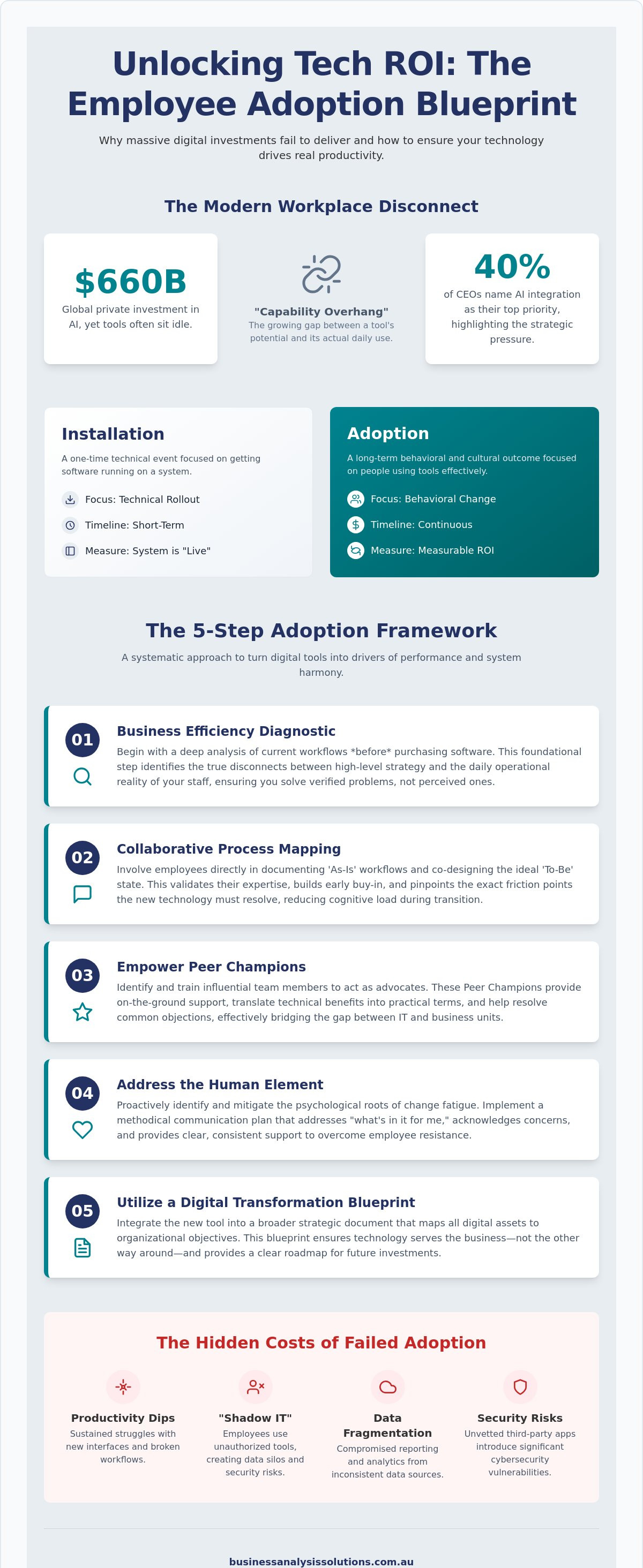
Why does a $660 billion global investment in AI often fail to move the needle on your internal productivity? Despite 40% of CEOs identifying AI integration as their top priority in 2026, many organizations still struggle with a "capability overhang" where sophisticated tools sit idle. You've likely experienced the frustration of deploying expensive software only to face employee resistance and a surge in helpdesk tickets. Developing a robust technology adoption strategy for employees isn't just about technical rollouts; it's about ensuring your digital investments actually translate into operational efficiency.
We understand that bridging the gap between a tool's potential and its daily use is a complex organizational challenge. You need a method that resolves friction between IT and business units while eliminating the silos that stall progress. This article provides a clear roadmap to ensure your technology investments deliver measurable ROI through full workforce engagement. We'll examine the 2026 Framework, focusing on process alignment and strategic coordination to turn your digital transformation from a source of fatigue into a driver of performance and system harmony.
Table of Contents
What is a Technology Adoption Strategy for Employees?
A technology adoption strategy for employees is the systematic alignment of digital tools with the actual workflows of the human workforce. It's a critical distinction to make. Installation is a technical event. Adoption is a behavioral outcome. You can install a CRM in a weekend, but adoption only occurs when your sales team uses it to drive revenue rather than seeing it as an administrative burden. In 2026, this distinction is even more vital. With private investment in AI reaching $660 billion, the tools entering the workplace are no longer passive. They are agentic and interactive. This requires a deeper level of cognitive engagement from staff, making a structured adoption framework essential for organizational survival.
This process follows the principles of the Diffusion of Innovations theory, which suggests that adoption is a social process as much as a technical one. When alignment fails, organizational efficiency erodes. It's a silent drain on financial performance. If a tool isn't used as intended, the investment is functionally a loss. This isn't just about "getting used" to a tool. It's about ensuring that every digital asset adds tangible value to the workflow without creating new bottlenecks.
The Cost of a Failed Adoption Strategy
Failed adoption isn't just a missed opportunity; it's a financial liability. Organizations often focus on the upfront cost of software licenses, yet the hidden costs of poor implementation are far more damaging. These include sustained productivity dips as staff struggle with unfamiliar interfaces and the eventual rise of "Shadow IT." When official systems feel cumbersome, employees pivot to unauthorized, easier alternatives. This fragmentation creates data silos that compromise your reporting and introduces significant cybersecurity risks. Without a cohesive technology adoption strategy for employees, you're essentially paying for tools that your staff is actively trying to bypass.
Adoption vs. Change Management
While often used interchangeably, adoption is a specific, results-oriented subset of broader organizational change management. Change management prepares the culture for a shift. Adoption ensures the technical tools actually deliver their promised value. Achieving system harmony requires that every digital tool fits into a larger, logical workflow. This process begins with understanding business technology as a strategic asset rather than a departmental expense. By focusing on how tools interact with human logic, leaders can reduce friction and ensure that technology serves the business, not the other way around.
The Foundation: Business Analysis and Process Mapping
Successful technology adoption doesn't begin during the training session. It starts in the boardroom and the workshop long before a single software license is procured. Developing a robust technology adoption strategy for employees requires a deep, analytical understanding of how work is actually performed within your organization. If you implement a tool that follows a broken or inefficient process, you aren't transforming the business; you're simply automating frustration. This is why a Business Efficiency Diagnostic is the essential first step in any rollout. This diagnostic phase identifies the disconnects between management's high-level vision and the staff's daily operational reality.
By utilizing a digital transformation blueprint, organizations can set precise, logical expectations for how new tools will integrate into existing systems. This structured approach leads to more enthusiastic adoption of new technologies because the solution is designed to solve a verified problem rather than a perceived one. When employees see that a tool has been selected based on their specific needs, their natural resistance to change diminishes significantly.
Mapping the 'As-Is' vs. 'To-Be' Workflows
Involving employees in the process mapping phase is a strategic necessity. It builds early buy-in by validating their expertise and acknowledging the daily challenges they face. By documenting the 'As-Is' workflow, you can pinpoint specific friction points where current technology fails to support the user. Defining the 'To-Be' state then becomes a collaborative effort to bridge these gaps. Process mapping reduces cognitive load for employees by clarifying exactly how a new tool simplifies their specific tasks. This clarity is the antidote to the ambiguity that often fuels employee skepticism during digital transitions.
Aligning ICT Solutions with Organisational Objectives
Your technology adoption strategy for employees must mirror your broader business strategy. Every digital tool should serve a specific organizational objective, whether that is reducing lead times or improving data accuracy. It's vital to avoid 'feature bloat,' as simpler, highly aligned tools consistently achieve higher adoption rates than complex systems with excessive, unused functionalities. This alignment requires expert project management to ensure the implementation doesn't drift from its original intent. Conducting a Business Efficiency Diagnostic ensures that every technical decision remains rooted in operational reality, providing a stable foundation for long-term digital success.
5 Steps to Build a Successful Technology Adoption Strategy
A comprehensive technology adoption strategy for employees requires a systematic approach that moves beyond simple software deployment. It involves a sequence of deliberate actions designed to align technical capability with organizational intent. Without this structure, even the most advanced tools fail to deliver their promised value. Follow these five steps to ensure your next implementation is both effective and sustainable.
Step 1: Conduct a Business Efficiency Diagnostic. Before selecting a tool, validate the operational need. This ensures the technology solves a verified gap rather than a perceived problem.
Step 2: Identify and Empower Peer Champions. Select influential staff members across different units to act as advocates. Their peer-to-peer influence is often more persuasive than executive mandates.
Step 3: Develop Multi-modal Training. Create role-based learning paths. A one-size-fits-all approach ignores the unique ways different teams interact with the system.
Step 4: Execute a Phased Rollout. Implement the tool in stages. Use clear feedback loops to refine the process and resolve issues before a full-scale launch.
Step 5: Establish Ongoing Governance. Set clear rules for system use to prevent "system drift," where employees revert to old habits or create inefficient workarounds.
Identifying Your Internal Champions
Peer-to-peer influence consistently outperforms top-down mandates in driving behavioral change. When selecting champions, prioritize individuals who possess both technical aptitude and high social influence within their respective teams. These advocates don't just demonstrate how to use a tool; they model the benefits in a real-world context. Providing these individuals with advanced resources and direct access to the project team ensures they can resolve minor issues before they escalate into widespread resistance. Many successful strategies to help employees adopt new technology rely on these internal advocates to maintain momentum during the critical middle phases of a rollout.
Person-Centric Training Models
Generic webinars often fail because they ignore the specific context of an employee's role. Shift your focus toward role-based micro-learning that provides "just-in-time" support. This means providing assistance at the exact moment a user encounters a challenge within their workflow. You can use business efficiency metrics to gamify the learning process, encouraging staff to reach proficiency milestones that correlate with improved operational outcomes. This approach ensures that training is perceived as a professional development opportunity rather than an administrative chore, leading to a more resilient technology adoption strategy for employees.
Overcoming Resistance: Addressing the Human Element
Resistance to digital change is often a rational response to perceived instability rather than a lack of technical ability. Change fatigue has become a significant psychological barrier as organizations accelerate their digital transformation efforts. When employees claim "the old way was faster," they are usually describing the immediate friction of a new interface. A successful technology adoption strategy for employees must address this by demonstrating how the new system reduces long-term operational waste, even if the initial learning curve is steep. Transparency regarding the "why" behind an implementation is essential, particularly with AI tools, to reduce anxiety about job security and role displacement.
Providing authoritative reassurance requires strategic leadership that can translate technical goals into business value. A Fractional CIO can bridge the communication gap between technical departments and business units, ensuring that the strategic intent is clearly articulated to every level of the workforce. This leadership is a cornerstone of a resilient technology adoption strategy for employees that prioritizes human engagement alongside technical performance. This role provides the objective oversight needed to validate that a tool is actually fit for purpose, which builds trust among skeptical staff.
The Psychology of Technology Resistance
Employees often fear new systems due to a perceived loss of control or concerns about increased performance monitoring. Addressing these fears requires active listening to capture and resolve specific user frustrations before they solidify into permanent resistance. By involving staff in the resolution of these pain points, you shift their role from passive recipients to active participants in the rollout. High levels of user confidence directly correlate with accelerated system proficiency and reduced error rates.
Creating a Culture of Continuous Improvement
Effective adoption moves beyond a "one-off implementation" mindset toward a model of ongoing optimization. This requires a cultural shift where teams are rewarded for adoption and innovative use of digital tools. Integrating user feedback into your long-term digital strategy ensures that the technology evolves alongside the business. This feedback loop prevents the tools from becoming obsolete and maintains the system harmony established during the initial rollout phase. To identify the hidden barriers in your current workflows, consider a Business Efficiency Diagnostic to align your human and technical resources.
The Strategic Advantage of a Digital Transformation Blueprint
The Digital Transformation Blueprint serves as the master roadmap that consolidates every element of your adoption effort into a single, actionable strategy. It prevents the common pitfall of treating software implementation as an isolated IT event. By using this blueprint, you ensure your technology adoption strategy for employees is grounded in operational logic rather than technical speculation. This document explicitly bridges the gap between what IT can deliver and what the business actually requires to maintain its competitive edge. It provides the clarity needed to move from fragmented tool usage to a state of complete system harmony.
Engaging an external consultant provides an objective diagnostic that internal stakeholders might overlook due to organizational bias. This fresh perspective identifies systemic inefficiencies that a new tool alone cannot fix. High-level Fractional CIO services provide the specialized oversight necessary to execute this blueprint correctly. They ensure that every phase of the adoption process remains aligned with your long-term organizational objectives and financial performance targets. This strategic leadership ensures that the technical requirements never overshadow the broader business goals.
Why Executive Oversight Matters
Without a unifying strategy, technology projects often become siloed, leading to redundant tools and fragmented data. Executive oversight ensures that digital investments support the entire enterprise rather than just individual departments. A Fractional CIO offers this high-level IT advisory without the prohibitive cost of a full-time executive. This leadership keeps technical teams focused on business outcomes, ensuring that your technology adoption strategy for employees remains a priority. It ensures that every dollar spent on software contributes directly to measurable ROI and operational efficiency.
Next Steps for Your Organisation
Initiating a Business Efficiency Diagnostic is the most effective way to start this journey. This assessment reveals the current state of your workflows and identifies the specific technical requirements needed to drive progress. Preparing your team involves more than just scheduling training; it requires a commitment to the structured approach outlined in the 2026 Framework. You must move toward a culture that values precision and methodical problem-solving over quick, unaligned fixes. To secure your digital future and ensure your investments deliver results, Partner with Business Analysis & Solutions to develop a tailored adoption framework for your workforce.
Driving Measurable ROI Through Strategic Alignment
Technology investments only deliver value when they're fully integrated into the daily workflows of your workforce. A successful technology adoption strategy for employees requires moving beyond technical installation to achieve true utilized capability. By prioritizing process mapping and conducting a rigorous Business Efficiency Diagnostic, you ensure that every digital tool solves a verified operational challenge rather than creating new friction.
Our national Australian consultancy brings over 20 years of strategic ICT experience to help you bridge the gap between technical requirements and organizational objectives. We specialize in creating system harmony that reduces change fatigue and maximizes financial performance. You don't have to navigate the complexities of digital transformation without a clear roadmap.
Secure your Digital Transformation Blueprint with our expert consultants today.
With the right framework in place, your organization can turn technical potential into sustained operational excellence.
Frequently Asked Questions
What is the most common reason technology adoption strategies fail?
The primary reason for failure is the disconnect between the software's functionality and the employee's actual workflow. When tools are selected without a deep understanding of daily operations, they become hurdles rather than assets. This misalignment leads to staff reverting to manual workarounds or unauthorized alternatives. Resolving this requires a shift from viewing technology as a standalone solution to seeing it as a component of a broader organizational process.
How do you measure the success of a technology adoption programme?
Success is measured through a combination of technical utilization rates and qualitative operational outcomes. You should monitor metrics such as helpdesk ticket volume, task completion speed, and the accuracy of data entry within the new system. A reduction in friction between business units and a measurable increase in output indicate that the tool is effectively integrated. These data points provide the objective proof needed to calculate the actual ROI of your investment.
How long does it typically take for employees to fully adopt new technology?
Full adoption typically stabilizes within three to six months, depending on the complexity of the system. While employees may reach basic proficiency within the first few weeks, the transition to habitual use takes longer. This period allows for the resolution of initial friction points and the normalization of new workflows. Consistent reinforcement and peer support are essential during this window to prevent staff from slipping back into legacy habits.
Can we fix a technology adoption problem after the software has already launched?
Yes, you can correct a failing rollout by performing a retrospective Business Efficiency Diagnostic. This assessment identifies the specific points where the technical implementation has diverged from user needs. Once these gaps are identified, you can re-map the processes and provide targeted micro-learning to address the friction. It's often more effective to pause and realign than to push forward with a broken adoption model.
What role does leadership play in technology adoption for employees?
Leadership must provide the strategic vision and the authoritative "why" that justifies the transition. A robust technology adoption strategy for employees requires executives to model the new behaviors and prioritize the necessary resources for training. When leadership demonstrates a commitment to the tool's success, it reduces staff anxiety and builds trust. This top-down support is critical for maintaining momentum when the initial learning curve becomes challenging.
How do we handle employees who are completely resistant to new digital tools?
Persistent resistance is handled by identifying the root cause through active listening and process analysis. If the tool truly makes a task harder, the process must be adjusted to restore efficiency. If the resistance is psychological, providing clear governance and demonstrating the personal benefits to the employee can lower barriers. In many cases, empowering these individuals as Peer Champions during the refinement phase can turn skeptics into advocates.
Is a Fractional CIO necessary for managing technology adoption?
A Fractional CIO is highly effective for organizations that lack the internal expertise to bridge the gap between IT and business strategy. They provide the objective, high-level oversight required to ensure a Digital Transformation Blueprint is executed with precision. This role is particularly valuable for mid-sized businesses that need sophisticated IT leadership without the expense of a full-time executive. They ensure that every technical decision remains rooted in operational reality.
How often should we update our technology adoption strategy?
You should review and update your technology adoption strategy for employees at least annually or following any major organizational shift. The rapid pace of digital evolution in 2026 means that a static strategy quickly becomes obsolete. Regular updates allow you to integrate new feedback, adjust for system drift, and ensure that your digital tools continue to support your evolving business objectives. This iterative approach maintains long-term system harmony.



Comments