Strategic On-Demand CIO Services: Bridging the Gap Between Technology and Business Growth
Updated: Jun 22
Why does your technology budget continue to expand while your operational efficiency remains stagnant? Many organizations find themselves trapped in a cycle of reactive spending, accumulating technical debt and misaligned tools that fail to drive high-level objectives. Utilizing on-demand CIO services allows you to break this cycle by integrating executive-level technical leadership into your strategic planning without the financial burden of a full-time executive hire.
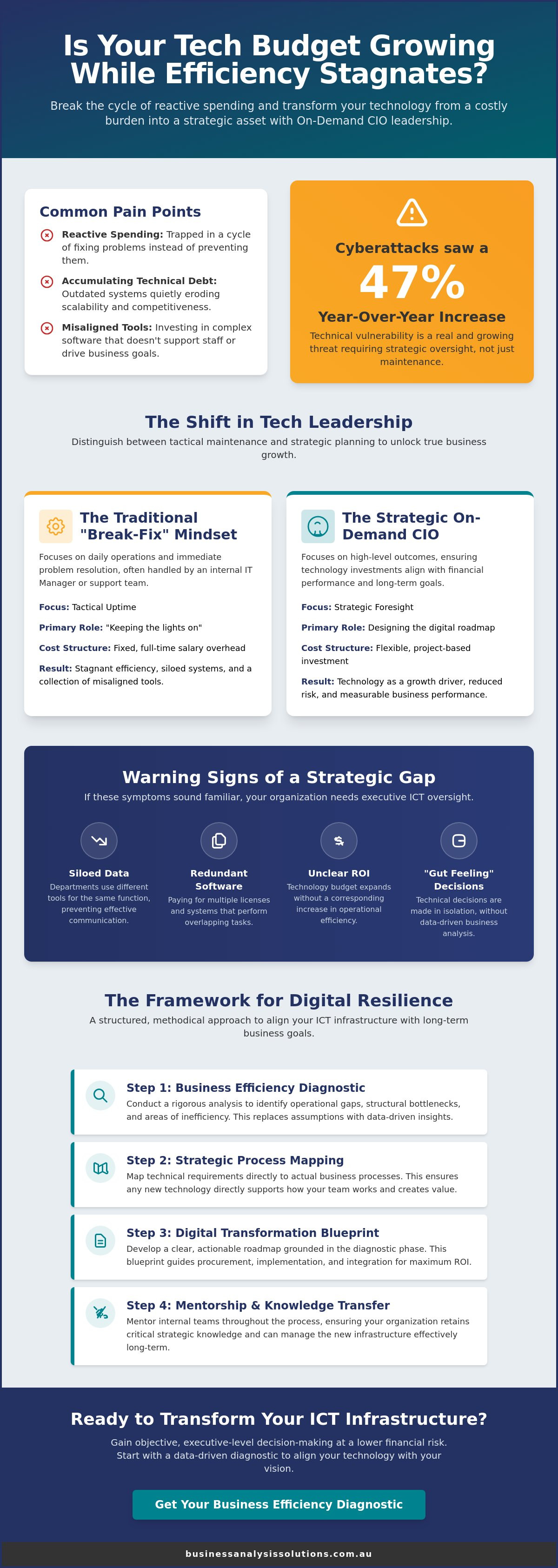
It's frustrating to watch IT investments vanish into complex systems that don't actually support your staff or your bottom line. With cyberattacks seeing a 47% year-over-year increase in 2025, the anxiety surrounding technical vulnerability is a logical response to a real threat. You recognize that technology should be a lever for growth, yet the path to a cohesive digital roadmap often feels obscured by immediate technical hurdles. This article explores how a fractional approach to leadership provides the precision and professional oversight needed to transform your ICT infrastructure into a streamlined asset. We'll examine the methodology behind creating a digital transformation blueprint and how strategic process mapping can reduce operational risk while driving measurable business performance.
Table of Contents
Defining On-Demand CIO Services in the 2026 Business Landscape
The traditional model of a permanent, high-salaried Chief Information Officer is often an inefficient allocation of capital for mid-market organizations. Instead, on-demand CIO services provide a scalable alternative that offers executive-grade technology leadership precisely when and where it's needed. Rather than managing daily technical maintenance or helpdesk tickets, these professionals focus on high-level strategic outcomes. Their core objective is to ensure that every piece of ICT infrastructure serves a specific organizational goal, turning technology from a cost center into a documented driver of business growth.
This transition toward agile, project-based advisory reflects a shift in how modern enterprises handle technical complexity. It's no longer enough to have someone who simply "keeps the lights on." Leaders now require a strategic partner who understands how system harmony impacts financial performance. By decoupling executive leadership from a full-time headcount, businesses gain access to specialized expertise that aligns digital strategy with the broader corporate vision.
On-Demand vs. Fractional vs. Interim CIOs
Understanding the distinction between executive engagement models is vital for Australian mid-market firms looking to optimize their leadership structure. A Fractional CIO typically maintains an ongoing, part-time presence, providing consistent guidance over a long duration. In contrast, on-demand CIO services are often structured around specific strategic milestones or technical transitions. This project-based approach is ideal when an organization needs to navigate a discrete challenge, such as a major system overhaul or a shift in digital strategy, without committing to a long-term contract. While interim roles fill a temporary gap during a search for a permanent hire, the on-demand model prioritizes the delivery of a specific outcome within a defined timeframe.
The Role of Business Analysis in Executive IT Leadership
Effective technology leadership cannot exist in a vacuum. A CIO must first be a master of business analysis to ensure technical decisions aren't made in isolation. Before any procurement occurs, a rigorous business efficiency diagnostic is essential for identifying operational gaps and structural bottlenecks. This methodical approach replaces "gut feeling" with data-driven insights. By mapping technical requirements to actual business processes, leadership can avoid the trap of investing in tools that look impressive but fail to deliver tangible value. Precision in the diagnostic phase ensures that the resulting digital roadmap is grounded in the practical reality of the organization's needs.
Identifying Strategic Gaps: When Does Your Organisation Need a CIO?
Many mid-market firms fall into the "Break-Fix" trap. It's a state where technology is viewed solely through the lens of maintenance and immediate resolution. While your IT support team is essential for operational continuity, they aren't equipped to design a high-level digital roadmap. Relying on support staff for strategy often leads to a collection of misaligned tools that don't communicate effectively. This is where on-demand CIO services provide the necessary separation between tactical uptime and strategic foresight.
A common objection from leadership is that their internal IT manager "has it covered." While an IT manager focuses on the "how" of technology management, they often lack the professional distance to evaluate the "why" of technology investment. Executive ICT consultancy isn't about managing helpdesks or software development; it's about ensuring that every technical decision aligns with financial performance and organizational coordination. Without this oversight, technical debt accumulates, quietly eroding your national competitiveness and long-term scalability.
Symptoms of a missing strategy are usually visible in siloed data and redundant software licenses. If your departments are using different tools for the same function, you're paying for inefficiency. To resolve these coordination challenges, a structured, methodical approach is required. You might consider a business efficiency diagnostic to pinpoint exactly where these disconnects occur.
The Distinction Between Tactical Support and Strategic Leadership
Signs of Strategic Drift in Your ICT Environment
Strategic drift occurs when your technology department’s output no longer matches boardroom goals. You might notice frequent project delays or budget overruns in digital initiatives that were promised to be "transformative." Another red flag is the inability to extract meaningful business intelligence from your current systems. If you're making executive decisions based on "gut feeling" because your data is inaccessible, your infrastructure is failing you. Resolving these gaps requires a move toward system harmony and results-driven phrasing in your technical planning.
The ROI of On-Demand Leadership: A Practical Analysis
Evaluating the financial performance of executive technology leadership requires looking beyond the monthly fee. The total cost of ownership (TCO) for a full-time CIO often includes high six-figure salaries, executive benefits, and significant payroll taxes. For many mid-market firms, this creates a heavy financial burden that doesn't always correlate with immediate output. By utilizing on-demand CIO services, organizations can access the same level of expertise while only paying for the strategic value delivered during specific project phases.
External experts provide an objective perspective that internal hires often lack. They aren't influenced by internal politics or historical "sunk costs" that can cloud judgment. This professional distance allows for more precise technology procurement and a focus on resolution over consensus-building. It accelerates the speed of implementation, as the consultant's primary mandate is to achieve specific strategic outcomes rather than managing departmental bureaucracy. When you consider that cyberattacks saw a 47% year-over-year increase in 2025, the cost of a "bad" technology decision or a delayed security roadmap can be catastrophic for the bottom line.
Direct Cost vs. Strategic Value
The value of 20+ years of cross-industry experience cannot be overstated. An on-demand consultant brings a library of proven frameworks and lessons learned from dozens of previous technical transitions. This prevents the costly "trial and error" phase that often accompanies less experienced internal leadership. Below is a comparison of the engagement models:
Agility in the 2026 Market
Market volatility requires executive resources that can scale up or down based on project needs. fractional CIO services Australia provide this necessary flexibility. You can engage deep expertise for a major digital transformation and then reduce the engagement once the systems are stable. This model reduces long-term liability while maintaining high-level ICT governance.
This approach allows your internal talent to focus on daily operations. While the on-demand CIO services handle the transformation and strategic blueprinting, your existing IT manager can ensure system reliability. This division of labor creates a more efficient organizational structure where each role is aligned with its core competency, ensuring that technology supports business efficiency rather than hindering it.
The Framework for Success: From Diagnostic to Implementation
Success in technical leadership isn't accidental; it's the result of a rigorous, repeatable methodology. While many view on-demand CIO services as a temporary fix for technical issues, the actual value lies in the creation of a digital transformation blueprint for business. This document serves as the architectural foundation for all future technology investments, ensuring that every software purchase or system change contributes directly to operational efficiency and financial performance.
Central to this framework is process mapping. By visualizing the current state versus the desired future state, a CIO identifies the specific friction points that hinder productivity. This clarity allows for the strategic management of automation implementation at the executive level. It ensures that new tools are integrated into a cohesive ecosystem rather than added as isolated silos that create more work for your staff. To begin this process for your organization, you can explore our business analysis and strategy services to identify your primary operational gaps.
Phase 1: The Business Efficiency Diagnostic
A business efficiency diagnostic is the essential first step in any engagement. It involves a comprehensive audit of existing systems, workflows, and personnel capabilities. This isn't just a technical inventory; it's an analysis of how information flows through the organization. We identify "low-hanging fruit"—immediate improvements that provide quick wins—while establishing a logical baseline for all future technology investments. This phase removes ambiguity and provides a clear picture of your current technical debt.
Phase 2: Developing the Strategic Roadmap
The strategic roadmap prioritizes projects based on business impact and documented ROI. Precision is required here to select vendor-neutral solutions that avoid proprietary lock-in, which often limits future flexibility. A viable digital strategy must cover a 12 to 36 month horizon, allowing it to evolve as the business scales. By focusing on long-term system harmony, on-demand CIO services ensure that your technology stack remains an asset rather than a liability during periods of rapid growth.
Phase 3: Managed Implementation and Governance
Implementation requires expert project management to oversee third-party vendors and maintain data integrity. This phase focuses on establishing ICT policies that protect against cybersecurity threats while ensuring that new systems are adopted correctly by the workforce. Effective governance ensures that the transformation remains on track, stays within budget, and delivers the promised results without disrupting core business operations.
Partnering for Long-Term Digital Resilience
Resilience is not a static state but a managed capability. The ultimate value of on-demand CIO services lies in the ability to leave an organization fundamentally stronger than it was before the engagement. Strategic leadership is not merely about deploying new software; it's about embedding a culture of continuous improvement and ensuring that technical decisions remain aligned with long-term commercial objectives. By focusing on business technology as a core competency, organizations can move beyond reactive maintenance toward proactive innovation.
Sustainable growth requires that an organization retains critical knowledge once an executive engagement ends. A professional consultant doesn't create dependency. Instead, they build a logical framework for ICT governance that your internal team can maintain. This ensures that the digital transformation remains a permanent asset rather than a temporary spike in efficiency. The goal is to create system harmony that persists through market shifts and technical evolutions.
Knowledge Transfer and Team Empowerment
The CIO serves as a vital bridge between your technical staff and non-technical leadership. Often, internal IT teams are highly capable at maintenance but lack the executive perspective needed to drive organizational coordination. By mentoring existing staff, on-demand CIO services elevate the entire department. This process involves up-skilling teams to manage new automated processes and ensuring they understand the strategic "why" behind technical changes. When your staff is empowered with a clear digital roadmap, they become more effective contributors to business efficiency.
Measuring Success in an On-Demand Engagement
Success in executive IT leadership must be quantifiable. We prioritize Key Performance Indicators (KPIs) that track improvements in operational efficiency and significant reductions in redundant spending. Logic dictates that a successful engagement is visible in the transition from "firefighting"—constantly reacting to technical failures—to strategic innovation. Metrics might include:
Reduction in technical debt and legacy system maintenance costs.
Improved data integrity and accessibility for executive decision-making.
Faster time-to-market for digital initiatives and automation projects.
Documented alignment between ICT spend and departmental output.
Strategic leadership is the catalyst that bridges the gap between complex technology and tangible business growth. By utilizing a fractional model, you gain the precision and authoritative oversight required to navigate the 2026 technical landscape without the overhead of a full-time hire. This methodical approach ensures that your infrastructure doesn't just function; it performs. Ultimately, the right leadership transforms technology from a necessary expense into a documented driver of financial performance and organizational resilience.
Securing Your Technical Future Through Strategic Leadership
Precision in technology leadership is no longer a luxury; it's a fundamental requirement for organizations navigating a complex digital environment. By integrating on-demand CIO services, businesses can effectively bridge the gap between technical requirements and overarching organizational objectives. This methodical approach ensures that every ICT investment is grounded in logic and contributes to documented financial performance. You've seen how moving beyond the "break-fix" cycle reduces operational risk while fostering a culture of continuous improvement through system harmony.
Transitioning from a reactive technical posture to a proactive digital strategy requires a structured framework and seasoned expertise. With over 20 years of industry experience, Business Analysis & Solutions specializes in creating Digital Transformation Blueprints that deliver long-term resilience. We provide the authoritative oversight needed to ensure your systems support your staff rather than hindering their efficiency. Our focus remains on resolution and practical, end-to-end results for every client engagement.
Request a Business Efficiency Diagnostic with Business Analysis & Solutions
Your organization's technical maturity is within reach through disciplined leadership and a clear strategic roadmap.
Frequently Asked Questions
What is the primary difference between an on-demand CIO and an IT consultant?
An on-demand CIO operates at the executive level to align technology with business strategy, whereas an IT consultant typically addresses specific technical problems or implementations. While a consultant provides a solution for a defined task, the CIO ensures that every technical decision supports financial performance and organizational coordination. This role focuses on long-term system harmony rather than isolated project delivery.
How much do on-demand CIO services typically cost for a mid-sized business?
Fees are generally structured around specific strategic milestones or as a retainer based on the level of executive involvement required. This model eliminates the overhead of a full-time executive salary, benefits, and payroll taxes. Organizations pay for high-level expertise during critical transformation phases, ensuring that the investment correlates directly with delivered strategic value.
Does our business need to be a certain size to benefit from on-demand leadership?
Any organization that has outgrown reactive IT support but doesn't require a permanent executive headcount will benefit from these services. Mid-market firms often reach a stage where technical debt and siloed data begin to hinder scalability. On-demand CIO services provide the necessary leadership to resolve these coordination challenges regardless of the specific employee count.
Can an on-demand CIO help with cybersecurity and Essential 8 compliance?
Establishing robust risk management frameworks and ensuring Essential 8 compliance are core components of strategic ICT governance. A CIO translates technical security requirements into business risk assessments for the boardroom. This ensures that cybersecurity investments are prioritized based on their impact on operational continuity and data integrity.
How long does a typical on-demand CIO engagement last?
Engagement length depends on the complexity of the digital transformation blueprint and the specific milestones identified during the diagnostic phase. Some organizations require a focused three to six month engagement to navigate a major system overhaul. Others prefer an ongoing fractional presence to provide consistent strategic oversight as the business scales.
Will an external CIO replace our existing IT manager or support team?
The CIO role is designed to mentor and elevate your existing IT staff rather than replace them. Internal teams focus on daily operations and technical uptime, while the on-demand CIO provides the strategic roadmap and executive direction. This division of labor allows your current staff to become more effective by working within a structured, results-driven framework.
What specific deliverables should I expect from an on-demand CIO?
Primary deliverables include a comprehensive business efficiency diagnostic, a 12 to 36 month digital strategy, and detailed process mapping. You should also expect a documented on-demand CIO services framework for ICT governance and security policies. These outputs provide a clear architectural foundation for all future technology investments and operational changes.
How do on-demand CIO services handle vendor selection and management?
Professional CIO leadership ensures vendor-neutral analysis to avoid proprietary lock-in and misaligned software purchases. The process involves identifying technical requirements based on business analysis and managing the procurement process to find the most effective solution. This objective oversight prevents vendors from driving your technology roadmap and ensures system harmony across the organization.



Comments