Strategic IT Consulting Services: A 2026 Executive Guide to Business Alignment
- jonesaqayalo
- Apr 11
- 11 min read
Updated: Apr 21
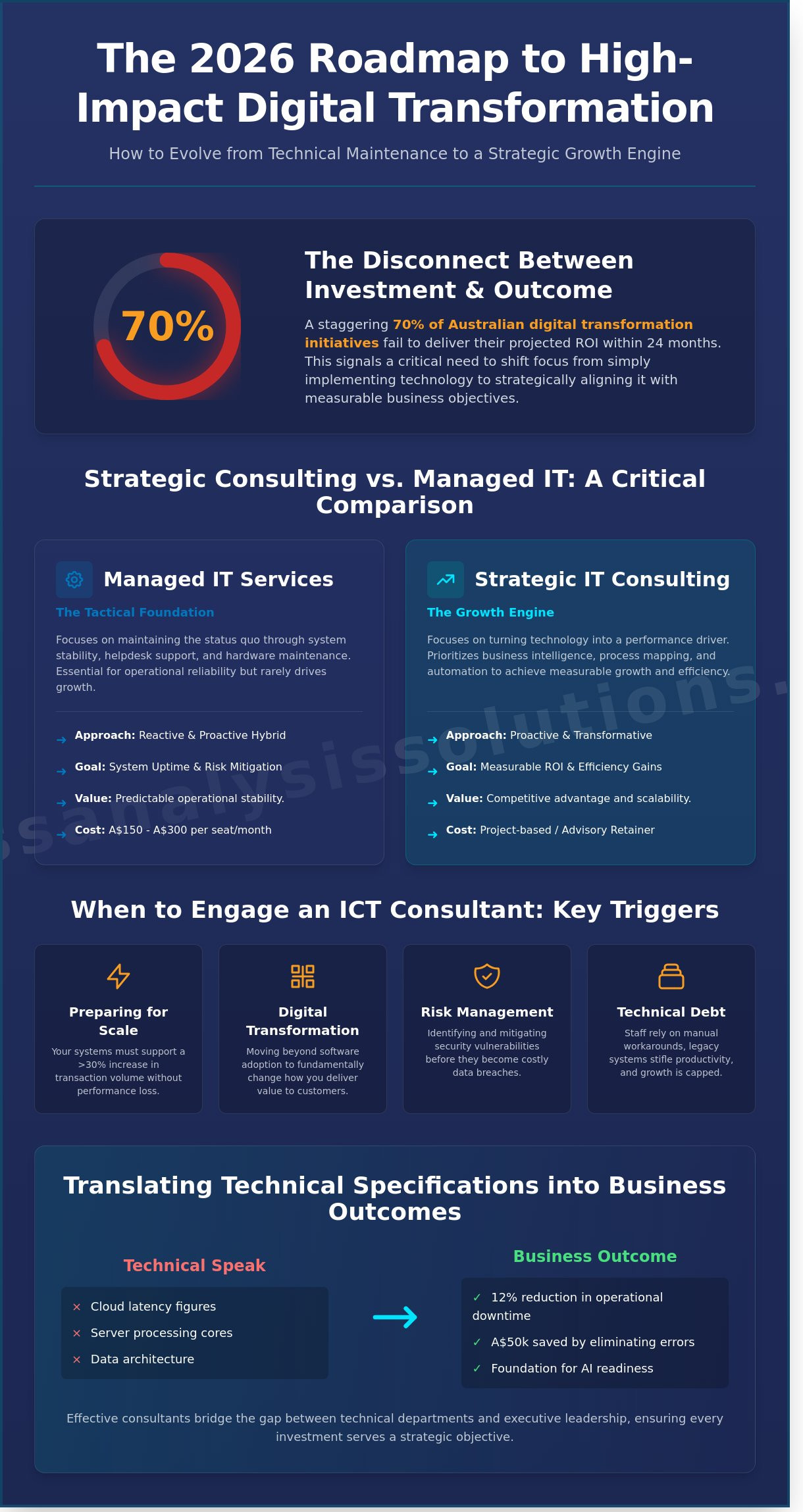
Why do 70% of Australian digital transformation initiatives fail to deliver their projected ROI by the 24-month mark? It's a staggering figure that highlights a systemic disconnect between technical investment and actual business outcomes. You've likely felt this friction when significant capital expenditure on new systems fails to improve your bottom line or streamline workflows. Leveraging expert it consulting services is no longer about maintaining hardware; it's about ensuring every dollar spent on technology serves a specific, measurable strategic objective.
We understand that the complexity of modern ICT projects often leads to executive-level fatigue and misaligned priorities. This guide provides a definitive 2026 roadmap to help you regain control over your digital strategy. You'll discover how to transition from reactive troubleshooting to proactive leadership through structured automation and expert ICT project management. We'll examine the specific methodologies required to turn your technical infrastructure into a high-performance engine for organisational growth.
Key Takeaways
Understand why modern it consulting services must transition from basic technical vendor relationships to strategic partnerships that prioritise organisational intelligence.
Distinguish between tactical managed services and strategic consulting to ensure your technology investments drive measurable efficiency rather than simple maintenance.
Discover the core pillars of a 2026 digital transformation framework that bridges the gap between complex process mapping and rigorous software selection.
Identify the essential criteria for selecting an ICT partner, focusing on a methodology-driven approach and a proven track record in professional business analysis.
Learn how a structured Business Efficiency Diagnostic can untangle operational complexities to align technical infrastructure with your overarching commercial objectives.
Table of Contents Defining IT Consulting Services for Strategic Business Alignment Strategic IT Consulting vs. Managed IT Services: A Critical Comparison Core Pillars of a Modern Digital Transformation Framework How to Select the Right ICT Consulting Partner for Your Organisation Driving Efficiency Through Professional Business Analysis and ICT Strategy
Defining IT Consulting Services for Strategic Business Alignment
IT consulting is often misunderstood as a simple technical vendor relationship. In reality, it's a strategic partnership designed to align technology with specific organizational goals. By 2026, the focus of ICT consultancy has shifted from basic infrastructure maintenance to the deployment of business intelligence. This evolution means that it consulting services now prioritize data architecture and AI readiness over hardware procurement. A consultant's primary value lies in their ability to view a business as a series of interconnected systems rather than a collection of computers.
Business analysis serves as the essential prerequisite for any technology implementation. Without a deep dive into existing workflows, new software often becomes an expensive layer of complexity. Consultants spend significant time in the requirements elicitation phase to identify operational bottlenecks that stifle productivity. For instance, if a logistics firm is losing A$50,000 annually due to manual data entry errors, the consultant focuses on automation logic rather than just suggesting a new server. This methodical approach ensures that every dollar spent on it consulting services results in a measurable increase in efficiency.
The Core Purpose of IT Advisory
The fundamental role of an IT advisor is to bridge the communication gap between technical departments and executive leadership. They translate complex technical specifications into tangible business outcomes that resonate with a board of directors. Instead of discussing cloud latency, they focus on how a specific migration will reduce operational downtime by 12% over the next fiscal year. This clarity ensures that technology investments aren't made in isolation. Every project must support a strategic objective, whether it's improving customer retention or streamlining a country-wide supply chain.
When Should a Business Seek Professional ICT Consultancy?
Organizations typically require external expertise when technical debt begins to hinder daily operations. If your staff relies on manual workarounds to bypass inefficient legacy systems, your growth is capped. Other critical triggers include:
Preparing for Scale: Ensuring that your digital foundation can support a 30% increase in transaction volume without performance degradation.
Digital Transformation: Moving beyond simple software adoption to fundamentally change how value is delivered to customers.
Risk Management: Identifying security vulnerabilities—including physical surveillance gaps—before they result in costly data breaches or regulatory fines. Many organisations explore Hikvision IP Cameras to ensure their physical security is integrated into their broader ICT risk management strategy.
Seeking consultancy early prevents the accumulation of "shadow IT," where departments buy their own software because the central system doesn't meet their needs. A structured advisory engagement provides the roadmap needed to navigate these complexities with confidence.
Strategic IT Consulting vs. Managed IT Services: A Critical Comparison
Choosing between managed services and strategic consulting requires a clear understanding of your current operational maturity. Managed IT services provide the tactical foundation necessary for daily stability. This model focuses on uptime, helpdesk support, and hardware maintenance. It’s a reactive and proactive hybrid designed to ensure your systems remain functional. While essential, a helpdesk-centric approach rarely addresses organizational efficiency or long-term growth. It maintains the status quo rather than challenging it.
Managed IT: The Tactical Foundation
Managed services operate on a predictable monthly retainer, often ranging from A$150 to A$300 per seat in the Australian market. The primary deliverables include patch management, security monitoring, and technical support. This model excels at risk mitigation and system availability; for an example of how these services are delivered to small and medium-sized enterprises, you can learn more about Gradient Data Solutions, Inc.. However, its limitations become apparent when a business needs to scale or pivot. Managed service providers (MSPs) typically lack the mandate to perform deep process mapping. Their priority is the infrastructure, not the business logic that runs upon it.
Strategic Consulting: The Growth Engine
Strategic it consulting services shift the focus from maintenance to measurable performance. This model prioritizes strategic technology solutions that align digital assets with commercial objectives. Instead of simply fixing broken hardware, consultants engage in rigorous requirements elicitation to understand what your stakeholders actually need. They deliver high-level blueprints that integrate automation and process optimization into the core of the business.
The consultative approach involves several core deliverables that drive efficiency:
Detailed process mapping to identify operational bottlenecks and manual redundancies.
Comprehensive stakeholder engagement to ensure cross-departmental buy-in for new initiatives.
Strategic alignment between technical roadmaps and long-term business goals.
Advanced requirements elicitation for bespoke software or complex infrastructure projects.
A project-based consulting engagement often yields a higher return on investment because it targets specific inefficiencies. While an MSP keeps your email running, a consultant identifies why your order fulfillment process takes three days instead of three hours. For Perth businesses looking to move beyond basic maintenance, engaging with Business Analysis & Solutions provides the clarity needed to transform IT from a cost center into a competitive advantage. Your current stage determines the model: use managed services for stability, but leverage it consulting services for transformation.
Core Pillars of a Modern Digital Transformation Framework
Digital transformation is not a simple software acquisition; it's a structural realignment of the business. Professional it consulting services build a comprehensive digital transformation blueprint that prioritises long-term scalability over quick fixes. This framework ensures that every technical decision supports a specific commercial objective. By auditing the existing ICT ecosystem, consultants identify gaps where legacy systems hinder growth or create unnecessary security risks. The goal is to move from reactive troubleshooting to a proactive, strategy-led environment where technology acts as a force multiplier.
Business Process Mapping and Optimisation
Efficiency begins with total visibility. We start by visualising the current state of operations to identify redundancies that often consume 20% to 30% of an organisation's operational capacity. Developing "To-Be" models allows us to select software based on functional requirements rather than marketing promises. This clarity is vital for user adoption. When staff see a logical map of how new tools reduce their manual workload, resistance to change drops significantly. Clear process mapping ensures that the software fits the business, rather than forcing the business to bend to the software's limitations.
Fractional CIO Services: Executive Leadership On-Demand
Mid-market firms in Perth often lack the budget for a full-time technology executive but require high-level IT governance to remain competitive. This is where Fractional CIO services Australia provide a strategic advantage. You gain access to decades of industry experience on a part-time basis. These it consulting services deliver strategic technology roadmapping and vendor management without the A$250,000 annual salary typically associated with a permanent hire. It ensures your technology investments are governed by logic and long-term ROI rather than short-term convenience.
Leveraging automation is the most effective way to remove human error from repetitive workflows. Manual data entry errors can impact up to 3% of total revenue in logistics and professional services sectors through billing mistakes and lost time. By implementing automated validation rules, we ensure data integrity across the entire ICT ecosystem. This structured approach also strengthens security. We align your data handling protocols with the Australian Privacy Principles to protect sensitive information from both external threats and internal mismanagement. This methodical layering of process, leadership, and automation creates a resilient foundation for any Perth business looking to scale.
How to Select the Right ICT Consulting Partner for Your Organisation
Selecting a partner for it consulting services requires a shift in focus from technical proficiency to analytical depth. You should prioritise firms that demonstrate a proven 20-year track record in business analysis. This longevity indicates a consultant has navigated multiple technology cycles and understands that business logic outlasts specific software versions. A seasoned expert doesn't just look at your servers; they evaluate your entire operational workflow to identify bottlenecks that hinder growth.
A consultant's value is fundamentally tied to their project management methodology. Structured frameworks ensure that every project phase, from requirements elicitation to final implementation, follows a logical sequence. Without this, technology projects often suffer from scope creep or budget overruns. You need a partner who prioritises strategic alignment over quick fixes. They must demonstrate the ability to bridge the gap between technical requirements and your high-level business objectives.
Technical certifications are common, but they often matter less than business acumen. While a consultant might be certified in a specific cloud platform, this doesn't mean they understand your supply chain or customer journey. Effective consulting is about problem-solving, not just product installation. Assess their diagnostic process early. If a consultant recommends a solution before conducting a thorough audit of your current state, they aren't listening. They're simply selling a pre-packaged answer. Professional consultants listen first to ensure the eventual recommendation is rooted in evidence.
Key Criteria for Consultant Evaluation
A professional consultant demonstrates ROI through rigorous diagnostic results and detailed case studies. They use process mapping to show exactly where inefficiencies cost your organisation money. Transparency is vital. You should receive clear project timelines and cost breakdowns that align with international standards, such as the BABOK Guide or ISO/IEC 38500 for corporate governance of IT. Reliability is built on these objective benchmarks. They provide the clarity needed to make informed decisions for your Perth business.
The Red Flags of IT Consulting
Be cautious of consultants who lead with a specific product or software vendor. This often indicates a commission-driven agenda rather than a solution-driven one. If their proposal lacks a focus on human elements or existing business processes, it's likely to fail during the adoption phase. Technology doesn't fix broken processes; it only accelerates them. Vague deliverables are another warning sign. A one-size-fits-all blueprint rarely accounts for the unique operational nuances of your organisation. You deserve a bespoke strategy that targets your specific pain points with precision.
Ready to move beyond generic technology blueprints? Contact our team today to optimise your organisational structure through expert analysis.
Driving Efficiency Through Professional Business Analysis and ICT Strategy
Specialized it consulting services provide the clarity required to navigate Perth's increasingly complex technical landscape. We focus on untangling legacy systems that restrict growth and create operational bottlenecks. The Business Efficiency Diagnostic serves as our foundational tool, offering a structured assessment of current state operations to uncover hidden costs. According to data from the Australian Bureau of Statistics, digital adoption can increase productivity by up to 10%, yet many firms struggle with fragmented workflows that negate these gains. We ensure automation doesn't just sit on top of a broken process; it integrates into a refined, logical workflow.
The long-term sustainability of ICT improvements depends on a methodical approach. We prioritize solutions that are scalable and resilient, ensuring that technology investments made today remain functional as the business expands. By aligning technical requirements with specific commercial objectives, we transform IT from a cost center into a primary driver of organizational performance.
The Diagnostic and Blueprinting Process
Our diagnostic methodology pinpoints the specific origins of operational friction. We don't settle for surface-level symptoms. Instead, we perform deep-dive requirements elicitation to understand how data flows across your organization. This results in a tailored ICT implementation plan that serves as a technical blueprint. Engaging professional it consulting services ensures that this blueprint is both ambitious and achievable. Success depends on stakeholder engagement. Research from the Project Management Institute indicates that 47% of projects fail due to poor requirements management. We mitigate this risk by involving key personnel from the start, ensuring the final solution meets the actual needs of the end users.
Expert Implementation and Project Oversight
Transitioning from a high-level strategy to technical execution requires rigorous project oversight. We maintain momentum by breaking complex digital transformations into manageable milestones, preventing the project fatigue that often stalls large-scale changes. Our approach bridges the gap between technical requirements and business objectives, ensuring that every software deployment or infrastructure change serves a strategic purpose.
We measure success through a formal post-implementation review. This process validates that the 15% to 20% efficiency gains often targeted in our ICT strategies are actually realized. By analyzing performance metrics after the go-live date, we can fine-tune systems for optimal output. This commitment to precision ensures that your Perth business achieves a tangible return on investment while maintaining a stable, high-performing technical environment.
Future-Proofing Your Organisation for 2026 and Beyond
Success in the 2026 Australian business landscape requires a shift from reactive maintenance to proactive strategic alignment. It's no longer enough to simply manage hardware; leaders must integrate their technical architecture with core commercial objectives to maintain a competitive edge. By leveraging professional it consulting services, your organisation gains the framework necessary to bridge the gap between complex ICT requirements and tangible business outcomes. This approach ensures that every digital investment translates into measurable efficiency and long-term growth.
Business Analysis Solutions offers over 20 years of industry experience, providing the precision and logic required to untangle organisational complexities. We've specialised in delivering Fractional CIO expertise and robust Digital Blueprints that turn technical challenges into strategic advantages. Our methodical approach focuses on bridging business goals with technical ICT solutions, ensuring your strategy is as reliable as it's effective. We look forward to helping you build a more resilient, efficient future.
Book a Business Efficiency Diagnostic with our expert consultants today.
Frequently Asked Questions
What is the primary difference between IT consulting and managed IT services?
The primary difference lies in the scope and duration of the engagement. IT consulting services provide strategic, project-based guidance to align technology with specific business goals. In contrast, managed IT services offer ongoing operational support and maintenance of existing infrastructure. While a managed service provider keeps your systems running, a consultant identifies how those systems should evolve to drive long-term growth.
How can IT consulting services help reduce my operational costs?
IT consulting reduces operational costs by identifying architectural redundancies and automating manual workflows. According to data from the Australian Bureau of Statistics, businesses that adopt advanced digital technologies see a 15 percent increase in productivity on average. We target specific inefficiencies, such as legacy hardware maintenance or fragmented software licenses, to reallocate capital toward growth-oriented initiatives instead of maintenance.
What is a business efficiency diagnostic, and why do I need one?
A business efficiency diagnostic is a structured audit that evaluates your current technology stack against your operational workflows to identify bottlenecks. You need one because it provides a data-driven baseline for your digital maturity. This process uncovers hidden technical debt that often costs Perth businesses up to 20 percent of their annual IT budget in wasted resources and inefficient manual workarounds.
Do I need an IT consultant if I already have an internal IT manager?
You should engage an IT consultant even with an internal manager to gain specialized expertise and an objective external perspective. Internal managers often focus on daily firefighting and lack the capacity for high-level strategic planning. A consultant acts as a bridge, providing the technical roadmap that allows your internal team to execute complex projects with greater precision and speed.
How long does a typical digital transformation project take?
A typical digital transformation project takes between 6 and 18 months, depending on the complexity of your legacy systems. Small-scale integrations might conclude within 12 weeks; however, enterprise-wide overhauls require a phased approach over several quarters. We define specific milestones during the initial discovery phase to ensure the project remains on schedule and delivers value at every stage of the implementation.
What role does business process mapping play in IT consulting?
Business process mapping creates a visual representation of your organization's workflows to ensure that technology solutions support actual business logic. It prevents the common mistake of applying software to a broken process. By documenting every step from lead generation to final delivery, we ensure that new it consulting services implementations integrate seamlessly with your existing operations without causing service disruptions.
How do you measure the ROI of strategic IT consulting services?
We measure the ROI of strategic IT consulting by tracking specific KPIs such as reduced system downtime, decreased labor hours per transaction, and improved output volume. For example, if a strategic overhaul reduces manual data entry by 30 hours per week, the ROI is calculated by the annual salary savings and the value of redeployed staff time. This data-driven approach ensures every investment delivers a measurable financial benefit.



Comments