Strategic ICT Consultancy: A Comprehensive Guide for Australian Business Leaders in 2026
By 2026, industry analysts project that Australian enterprise IT spending will exceed A$130 billion, yet many organisations will continue to struggle with fragmented systems that don't talk to each other. This lack of integration often leads to bloated budgets that fail to deliver a clear return on investment. Engaging in strategic ICT consultancy is the most effective way to bridge this gap, ensuring that every dollar spent on technology serves a specific business objective rather than adding to your technical debt.
You probably feel the frustration of managing high level goals while your underlying systems create constant operational friction. Efficiency is the priority. This guide shows you exactly how to align your technology investments with your organisational objectives to drive measurable growth. We'll outline a clear digital transformation blueprint and explain how executive level oversight can turn your IT infrastructure into a streamlined, high performance asset.
Key Takeaways
Differentiate between reactive IT maintenance and the proactive methodology of strategic ICT consultancy to ensure technology serves as a driver for organisational objectives.
Learn how to conduct a forensic business efficiency diagnostic to identify hidden "tech debt" and eliminate redundant digital processes that impede operational flow.
Understand the critical distinction between managed helpdesk support and strategic direction to ensure your leadership team prioritises long-term architecture over daily maintenance.
Discover the step-by-step process for implementing a digital transformation blueprint that transitions your current-state infrastructure into a scalable, future-proof architecture.
Evaluate the advantages of executive-level Fractional CIO services, providing mid-sized Australian firms with high-level technical leadership and strategic oversight without the full-time overhead.
Table of Contents Defining Strategic ICT Consultancy in the 2026 Business Landscape The Business Efficiency Diagnostic: Identifying Operational Friction Strategic ICT Consultancy vs. Managed IT Services: Choosing Your Path Implementing a Digital Transformation Blueprint for Sustainable Growth Fractional CIO Services: Executive Leadership Without the Overhead
Defining Strategic ICT Consultancy in the 2026 Business Landscape
Strategic ICT consultancy represents a methodical alignment where technology serves as a deliberate lever for business objectives. It's a departure from traditional, reactive models that focus solely on hardware procurement or troubleshooting technical failures. In the Australian market, where digital integration is no longer optional, Information technology consulting must transition from a support function to a core driver of value. This approach ensures that every A$ invested in digital infrastructure facilitates a specific, measurable business outcome.
Ambiguity is the primary enemy of efficient ICT implementation. When leaders fail to define the "why" behind a technology shift, they risk creating fragmented systems that hinder rather than help. Precision in planning prevents the common trap of adopting technology for its own sake. To move beyond mere survival, leaders should follow the strategic guide to business efficiency to ensure their operational logic remains sound as they scale.
The Core Pillars of a Modern ICT Strategy
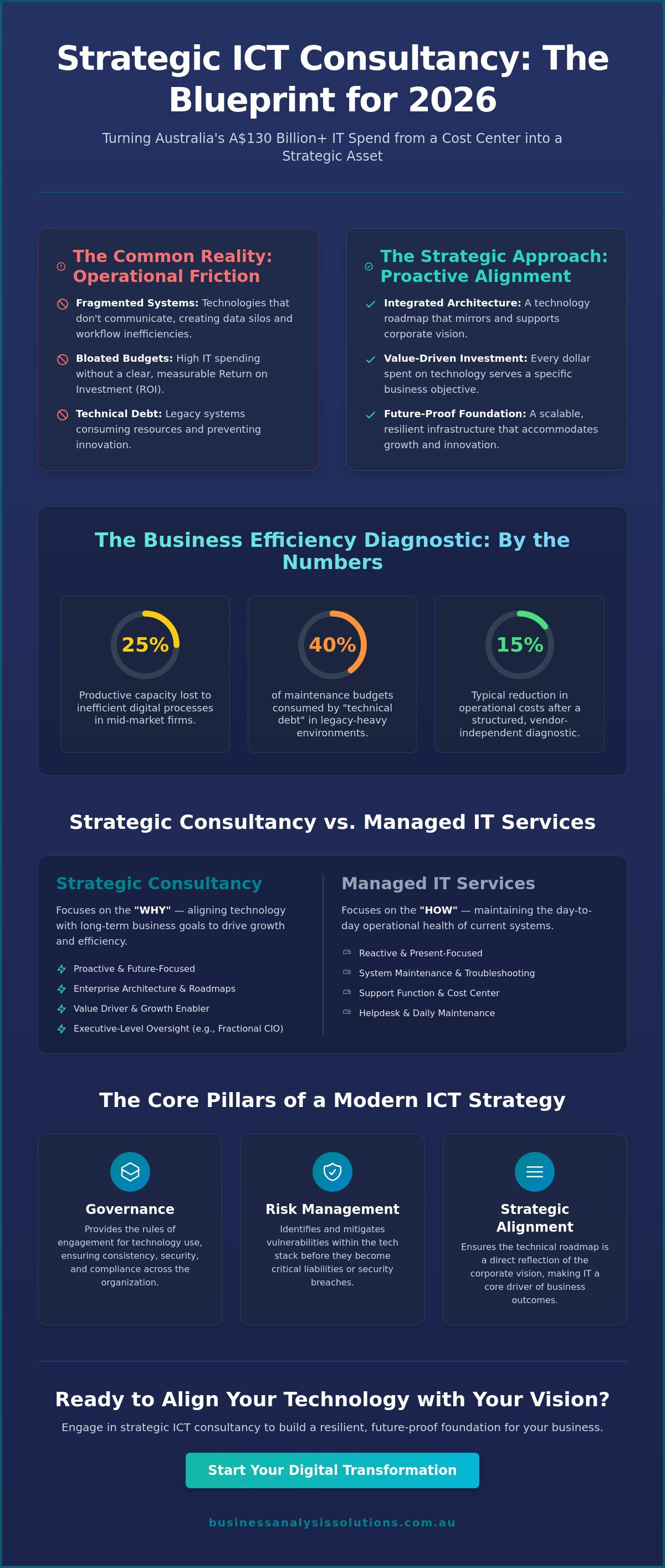
A robust strategic ICT consultancy framework rests on three pillars: governance, risk management, and strategic alignment. Governance provides the rules of engagement for technology use; risk management identifies vulnerabilities before they become liabilities; and strategic alignment ensures the technical roadmap mirrors the corporate vision. Enterprise architecture acts as the blueprint for this integration, allowing Australian firms to scale without the friction of legacy bottlenecks. Strategic ICT is not about the tools you buy, but how those tools serve your operational logic. By focusing on the structural integrity of the business first, leaders create a resilient foundation that accommodates future innovation without constant, costly overhauls.
Why Business Analysis is the Foundation of ICT Success
Software mismatches and failed implementations often stem from a lack of rigorous business analysis. Requirements elicitation is the process of uncovering the true needs of the organisation, rather than just the perceived ones. It requires deep stakeholder engagement at every level, from the boardroom to the front line, to ensure the proposed solutions solve actual problems. Without this clarity, businesses often end up with expensive platforms that staff don't use or that don't integrate with existing workflows.
Engaging in strategic business analysis allows organisations to identify these true needs early in the lifecycle. This methodical approach reduces the risk of project creep and ensures that the final technical solution is a perfect fit for the operational reality. When the requirements are clear, the path to efficiency becomes a logical progression rather than a series of expensive guesses.
The Business Efficiency Diagnostic: Identifying Operational Friction
Strategic ICT consultancy begins with a forensic examination of your current operational state. It isn't a superficial audit; it's a deep dive into the workflows that either propel or paralyze your organization. In 2024, data suggested that mid-market Australian firms lose up to 25% of their productive capacity to inefficient digital processes. A diagnostic identifies these specific points of friction, uncovering where manual workarounds have replaced automated excellence. This process exposes technical debt, which often accounts for 40% of maintenance budgets in legacy-heavy environments. By identifying redundant software licenses and overlapping platforms, the diagnostic provides a clear path to reclaiming wasted capital.
The value of this assessment lies in its vendor-independent nature. Without the bias of a software reseller, the diagnostic focuses purely on logic and strategic alignment. It treats your technology stack as a toolset for business outcomes rather than an end in itself. When you eliminate the noise of sales-driven recommendations, you gain an objective view of your infrastructure's health. This clarity translates directly into a measurable return on investment. Organizations that undergo a structured diagnostic typically see a 15% reduction in operational costs within the first nine months of implementation. To begin untangling these complexities, business leaders should consult with a specialist analyst to define their unique requirements.
Process Mapping as a Diagnostic Tool
Effective process mapping reveals the hidden bottlenecks that "gut feeling" management often misses. It transforms anecdotal complaints into data-driven insights by documenting every step of a transaction or project lifecycle. This visualization bridges the gap between technical requirements and business objectives, ensuring that every A$1 spent on technology serves a functional purpose. Mapping the current state allows you to see where data silos prevent a single source of truth, which is a critical step for any strategic ICT consultancy engagement. It provides the empirical evidence needed to justify structural changes to the board.
Bridging the Gap Between Vision and Execution
The diagnostic results serve as the primary input for your digital transformation blueprint. It ensures your strategy covers all departments, preventing the common mistake of optimizing the IT silo while leaving finance or operations in the dark. This holistic approach aligns with the Australian Government's Data and Digital Government Strategy, which emphasizes seamless, data-driven service delivery as a national standard. By categorizing findings into "quick wins" and long-term strategic shifts, leaders can build momentum. Quick wins, such as automating a single repetitive reporting task, provide the immediate ROI needed to fund more complex, multi-year initiatives.
Strategic ICT Consultancy vs. Managed IT Services: Choosing Your Path
Many Australian executives assume their Managed Service Provider (MSP) handles their long-term technology vision. This is a costly misconception. A helpdesk resolves immediate technical tickets; it doesn't align technology with your five-year commercial objectives. Strategic ICT consultancy is a distinct discipline that excludes managed helpdesk support and software development. It focuses on high-level architecture, requirements elicitation, and business analysis to ensure your infrastructure supports your growth targets.
The difference lies in the relationship model. An MSP acts as a service provider, governed by Service Level Agreements (SLAs) focused on uptime and hardware maintenance. A consultant operates as a Trusted Advisor. They use process mapping and stakeholder engagement to ensure every technical investment delivers a measurable return. You need the MSP to maintain the engine, but you need the consultant to map the route. Organizations must distinguish between these roles to avoid the "strategy gap" where technical debt accumulates because no one is looking at the horizon.
When to Engage a Strategic ICT Consultant
Engagement is necessary when your organization experiences recurring project delays or stagnant operational efficiency. Internal IT teams often lack the objectivity required for high-level oversight. They're focused on daily throughput and immediate troubleshooting. A consultant applies professional business analysis standards to identify gaps that internal staff might overlook due to operational blindness. If your 2026 roadmap lacks clear milestones or fails to account for emerging regulatory changes in the Australian market, it's time for external expertise. Objective oversight ensures that technical decisions are driven by logic rather than internal politics or vendor bias.
The Problem with Reactive IT Support
Reactive support is a defensive strategy. It prioritizes "fixing what's broken" over "building what's needed." This approach leads to a fragmented digital environment where systems don't communicate. When ICT systems aren't strategically aligned, the productivity loss is substantial. According to 2024 industry benchmarks, Australian firms without a clear ICT strategy spend 22% more on emergency repairs than those with a documented roadmap.
Understanding The 4 Tiers of Digital Transformation allows leaders to move beyond basic maintenance into true operational excellence. Relying on a reactive model ensures you're always paying for the past instead of investing in the future. The ROI of strategic planning is realized through optimized capital allocation and seamless integration, while the cost of reactive fixes represents a permanent tax on your net profit.
Implementing a Digital Transformation Blueprint for Sustainable Growth
A digital transformation blueprint serves as the definitive roadmap for converting diagnostic insights into operational reality. It outlines the precise sequence of technical and cultural shifts required to move from fragmented legacy systems to a cohesive future-state architecture. By 2026, Australian firms that fail to document these transitions see project failure rates exceed 70% according to recent industry benchmarks. This phase requires expert project management to maintain momentum and ensure that technical milestones translate into tangible business value. A well-constructed blueprint doesn't just list software; it defines how people, processes, and technology interact to drive efficiency.
Step 1: Stakeholder Alignment and Requirements Gathering
Effective strategic ICT consultancy relies on meticulous requirements elicitation. Leaders must capture needs from the C-suite, focused on ROI and market positioning, and operational staff, who prioritize usability and workflow efficiency. Proceeding without formal requirements documents introduces a 45% higher risk of scope creep. We use structured workshops and process mapping to ensure every technical specification aligns with the broader organizational vision. This prevents the common pitfall of deploying technology that solves the wrong business problem. It's about creating a shared language between technical teams and business units to ensure the final solution is fit for purpose.
Step 2: Designing the Future-State ICT Solution
The design phase integrates scalable technologies with existing business processes to create a resilient ecosystem. This involves a robust cloud strategy and the implementation of data-driven tools like Microsoft Power BI for real-time visibility. Automation plays a central role here; it streamlines repetitive tasks to recover up to 20% of staff capacity for high-value activities. Your future-state architecture must be modular to adapt to the 2026 market conditions. We focus on selecting platforms that offer seamless integration via APIs, ensuring your data remains fluid and accessible across the enterprise. It’s about building a foundation that supports growth without requiring a total overhaul every three years.
Automation Integration: Identifying manual bottlenecks in accounts payable or customer onboarding to reduce processing times by 30% or more.
Cloud Scalability: Transitioning to hybrid cloud environments that allow for rapid resource adjustment based on seasonal demand.
Data Intelligence: Deploying Power BI dashboards to turn raw data into actionable insights for executive decision-making.
Successful implementation requires a partner who understands that digital transformation is a continuous journey, not a one-off event. By aligning technical architecture with strategic goals, businesses can achieve a level of agility that competitors using legacy frameworks simply can't match.
Ready to refine your operations and secure your market position? Consult with our business analysis experts to build your strategic roadmap.
Fractional CIO Services: Executive Leadership Without the Overhead
The Fractional CIO represents the logical conclusion of a mature strategic ICT consultancy engagement. Many mid-sized Australian firms reach a stage where technical complexity outpaces their internal management capacity, yet they cannot justify the A$250,000 to A$350,000 annual salary required for a full-time Chief Information Officer. This service model provides executive-level IT leadership on-demand, allowing businesses to access high-level strategy without the permanent C-suite overhead. By integrating a seasoned expert into the leadership team, organizations ensure their technology decisions are driven by business outcomes rather than reactive troubleshooting.
The role extends beyond mere technical oversight. A Fractional CIO focuses on board-level technology reporting and comprehensive risk management. They provide the clarity necessary for directors to fulfill their governance obligations, particularly regarding data privacy and cybersecurity resilience. This approach ensures that ICT is no longer a "black box" to the board but a transparent, measurable component of the corporate strategy. For a deeper dive into how this model functions, consult our Fractional CIO services guide.
Bridging the Executive Knowledge Gap
A primary challenge for Australian business leaders is the disconnect between technical requirements and commercial objectives. The Fractional CIO acts as a translator, stripping away jargon to focus on business value and strategic alignment. They provide an objective perspective that is not tied to software vendor commissions or specific hardware sales. This independence is vital for maintaining integrity in the procurement process.
This role embodies the Australian professional character of direct, no-nonsense advisory. Instead of vague promises, you receive a clear assessment of what works and what doesn't. This analytical partner prioritizes logic and precision, ensuring that every dollar spent on technology serves a specific operational purpose. They facilitate stakeholder engagement at all levels, ensuring that the staff on the ground and the directors in the boardroom are moving toward the same digital goals.
Long-Term Strategic Stewardship
Digital transformation often fails not from a lack of vision, but from a lack of consistent execution. A Fractional CIO maintains the momentum of the strategic ICT consultancy blueprint over the long term. They don't just deliver a report; they own the results. Through regular strategic reviews, they ensure that ICT infrastructure keeps pace with business growth and market shifts. Key responsibilities include:
Quarterly Strategic Reviews: Assessing the performance of the current technology stack against pre-defined KPIs.
Budget Optimization: Identifying redundant subscriptions or underutilized assets to reallocate capital toward innovation.
Vendor Management: Holding third-party providers accountable to service level agreements and performance standards.
Security Governance: Ensuring the organization remains compliant with evolving Australian data protection regulations.
This steady, methodical oversight prevents the accumulation of technical debt and ensures the business remains agile. It provides a structured path from organizational complexity to optimized performance. To determine how these services can benefit your specific operation, start your journey with a Business Efficiency Diagnostic.
Secure Your Competitive Advantage for 2026
As the Australian business landscape evolves toward 2026, the distinction between simple IT maintenance and high-level strategic ICT consultancy becomes a critical factor for sustainable growth. Success requires moving beyond basic managed services to adopt a structured digital transformation blueprint. By utilizing fractional CIO services, your organisation gains executive-level foresight without the overhead of a full-time hire. This approach allows you to identify and resolve operational friction through a methodical, logic-driven process.
Business Analysis & Solutions brings over 20 years of industry expertise to every engagement. We provide vendor-independent strategic advisory, ensuring your technology investments align perfectly with your commercial objectives. Our proven track record in delivering digital transformation blueprints has helped numerous Australian firms modernise their operations with precision. It's time to replace ambiguity with a clear, actionable roadmap for your technical infrastructure. Taking this step ensures your business remains resilient and competitive in an increasingly complex market.
Book a Business Efficiency Diagnostic with Business Analysis & Solutions to begin optimising your organisational performance today. We look forward to helping you build a more efficient future.
Frequently Asked Questions
What exactly does a strategic ICT consultancy do?
A strategic ICT consultancy aligns your technology roadmap with your organizational objectives to drive measurable growth. They perform detailed process mapping and requirements elicitation to ensure every technical investment supports a specific business outcome. This approach moves beyond simple troubleshooting. Research from the 2024 ACS Digital Pulse report indicates that strategic technology alignment can boost national productivity by A$6.5 billion annually by 2030.
How does strategic ICT consultancy differ from managed IT support?
Strategic ICT consultancy provides high-level architectural planning, whereas managed IT support focuses on day-to-day maintenance and technical troubleshooting. While a managed service provider ensures your servers stay online, a strategic ICT consultancy evaluates if those servers actually serve your 2026 growth targets. It's the difference between fixing a broken tool and determining which tools you need to outperform your competitors in the Australian market.
Why do Australian businesses need a digital transformation blueprint in 2026?
Australian businesses require a digital transformation blueprint to manage the 55% increase in cloud-native operational requirements forecasted for 2026. This document serves as a structured roadmap for navigating complex regulatory changes and infrastructure upgrades like the NBN business fiber rollout. Without a formal plan, 70% of digital initiatives fail to meet their original goals, according to 2023 McKinsey data. It ensures your investments remain purposeful and logical.
Can a strategic ICT consultant help with automation implementation?
A strategic consultant facilitates automation by identifying manual bottlenecks through rigorous process mapping and stakeholder engagement. They don't just suggest software; they quantify the potential time savings and select vendors that integrate with your existing stack. Deloitte's 2024 Global Technology Report shows that 74% of organizations now use automation to bridge labor gaps. Consultants ensure these tools deliver a logical return on investment for your firm.
What is the typical ROI of a business efficiency diagnostic?
A business efficiency diagnostic typically identifies cost-saving opportunities that can reduce operational overhead by 15% to 25% within the first year. By uncovering redundant software subscriptions and manual data entry points, the diagnostic provides a clear path to improved margins. Forrester research from 2023 suggests that structured process optimization delivers a 301% ROI over a three-year period. It turns organizational ambiguity into a data-driven action plan.
Does strategic ICT consultancy include custom software development?
Strategic ICT consultancy focuses on the analytical phase of technology adoption, such as requirements elicitation and vendor selection, rather than writing the code itself. The consultant acts as an objective advisor who defines what the software must achieve to meet business goals. This ensures you don't overspend on custom features that don't add value. They bridge the gap between your operational needs and the technical execution team.
How much time does a digital transformation blueprint take to develop?
Developing a digital transformation blueprint generally takes between 8 and 12 weeks, depending on the complexity of your organizational structure. This timeframe allows for thorough stakeholder interviews, current-state audits, and future-state modeling. A structured 10-week engagement ensures that every department's needs are captured. It prevents the rushed decisions that often lead to technical debt or system incompatibility. This timeline provides the precision required for long-term success.
Is a Fractional CIO suitable for small to medium-sized businesses?
A Fractional CIO is an ideal solution for SMEs that need executive-level strategy without the A$250,000 plus annual salary of a full-time executive. You get access to the same high-level expertise used by ASX 200 companies but on a part-time or project basis. The 2024 Hays Salary Guide confirms that top-tier IT leadership costs are rising. A fractional model allows smaller firms to maintain strategic alignment and competitive technical standards.



Comments