Strategic Business Technology Roadmap Template: A 2026 Framework for Growth
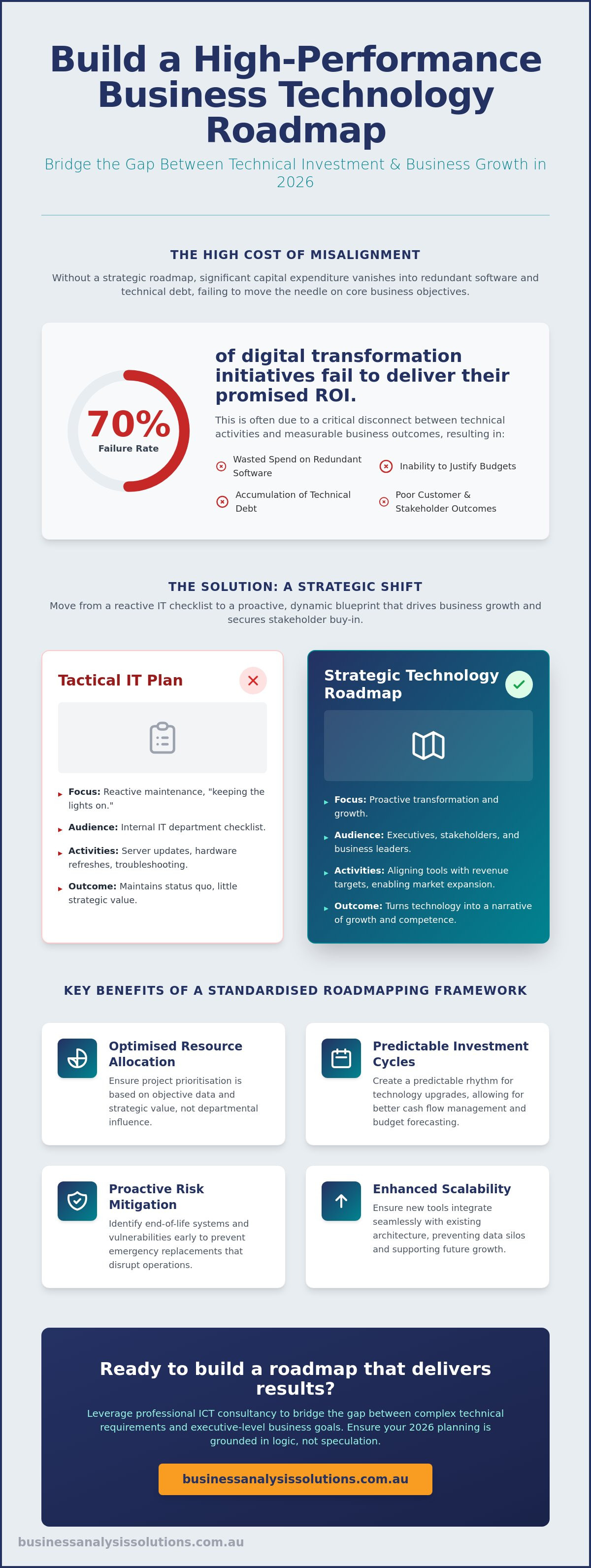
Why do 70% of digital transformation initiatives fail to deliver their promised ROI despite record-high ICT spending across Australian enterprises? You likely recognize the frustration of seeing significant capital expenditure vanish into redundant software or technical debt that fails to move the needle on your core objectives. It's difficult to justify a million-dollar budget request when stakeholders can't see how a server migration translates into better customer outcomes or improved bottom-line performance.
Mastering a structured business technology roadmap template is the only way to ensure your 2026 planning remains grounded in logic rather than speculation. This framework allows you to bridge the gap between technical requirements and executive vision, turning complex ICT data into a clear narrative of progress. In this article, we'll provide the exact methodology needed to align your technical assets with measurable business efficiency, providing you with the tools to secure budget approvals and eliminate redundant technology spend before it impacts your margins.
Key Takeaways
Learn why a high-performance business technology roadmap template must evolve from a static Gantt chart into a dynamic strategic blueprint that drives long-term growth.
Discover how to conduct a comprehensive business efficiency diagnostic to identify current pain points and ensure your technology investments deliver tangible value.
Master a systematic five-step process for stakeholder engagement and requirements elicitation to build a resilient foundation for digital transformation.
Understand the critical role of strategic alignment in mapping your ICT infrastructure to specific organisational objectives within the Australian market.
Explore how leveraging a Fractional CIO or professional ICT consultancy can bridge the gap between complex technical requirements and executive-level business goals.
Table of Contents What is a Business Technology Roadmap and Why Does It Matter in 2026? Core Components of a High-Performance Technology Roadmap Why Most Technology Roadmap Templates Fail to Deliver Results The 5-Step Process to Building Your Strategic Roadmap From Template to Transformation: Leveraging Professional ICT Consultancy
What is a Business Technology Roadmap and Why Does It Matter in 2026?
A technology roadmap is a high-level strategic document that outlines how an organisation's technical infrastructure supports its long-term commercial goals. By 2026, these documents have moved beyond static Gantt charts. They're now dynamic blueprints designed to handle rapid shifts in the Australian market. Using a robust business technology roadmap template allows leaders to move from reactive troubleshooting to proactive scaling. It provides a visual timeline that connects technical capabilities to business outcomes, ensuring every stakeholder understands the path forward.
The 2026 landscape demands a focus on three pillars: seamless integration, AI readiness, and cybersecurity resilience. Organisations that treat technology as an afterthought risk operational bottlenecks and data vulnerabilities. Effective planning directly impacts business efficiency. It ensures that every software investment delivers a measurable return on investment by aligning with documented process requirements. This strategic alignment prevents the common mistake of adopting tools before the underlying business needs are fully understood.
The Difference Between a Tactical IT Plan and a Strategic Roadmap
Tactical plans focus on maintenance and keeping the lights on. They're internal checklists for the IT department, covering server updates or hardware refreshes. A strategic roadmap focuses on transformation. It bridges the gap between technical requirements and business objectives by aligning digital tools with revenue targets. This alignment is vital for securing stakeholder buy-in for major ICT projects. When executives see how a system upgrade facilitates market expansion, they're more likely to approve the necessary capital expenditure. Roadmaps turn technical jargon into a narrative of growth and professional competence.
Key Benefits of a Standardised Roadmapping Framework
A standardised business technology roadmap template provides a structured approach to organisational growth. It reduces "shadow IT" and redundant software subscriptions, which cost Australian firms thousands in wasted licensing fees annually. By centralising the vision, firms can achieve several logic-driven outcomes:
Optimised Resource Allocation: Project prioritisation is based on objective data rather than departmental influence.
Predictable Investment Cycles: It creates a predictable rhythm for technology upgrades, allowing for better cash flow management.
Risk Mitigation: Identifying end-of-life systems early prevents emergency replacements that disrupt daily operations.
Enhanced Scalability: Ensuring new tools integrate seamlessly with existing architecture prevents "siloed" data environments.
This methodical approach ensures that technology serves the business, rather than the business serving the technology. It provides the clarity required to navigate 2026's complex digital environment with confidence.
Core Components of a High-Performance Technology Roadmap
A robust business technology roadmap template functions as a strategic blueprint that bridges the gap between high-level ambition and technical execution. It isn't merely a schedule of upgrades; it's a logic-driven framework where every technical initiative serves a specific commercial objective. To deliver tangible value, the roadmap must prioritise strategic alignment, ensuring that if a project doesn't improve operational efficiency or reduce costs by a measurable percentage, it doesn't make the cut.
The Infrastructure Layer: Beyond Hardware
Modern infrastructure requires a shift from physical assets to flexible, hybrid environments. Australian enterprises are increasingly adopting multi-cloud strategies to ensure service continuity and data sovereignty. When building a technology roadmap, you must account for the connectivity requirements of a distributed national workforce. This involves assessing NBN Enterprise Ethernet capabilities or 5G integration to maintain low-latency performance across state borders.
Cloud Migration: Transitioning from on-premise servers to Azure or AWS to reduce capital expenditure.
Scalability: Designing systems that handle a 25% increase in transaction volume without requiring a total architecture overhaul.
Technical Debt: Identifying legacy bottlenecks that cost Australian mid-market firms an average of A$45,000 annually in maintenance and lost productivity.
The Application Layer: Software with Purpose
The application layer focuses on utility and the elimination of data silos. Many organisations suffer from "software bloat," where redundant tools overlap in functionality. Application rationalisation is the process of streamlining software to reduce complexity. By auditing your current stack, you can identify opportunities for automation implementation, which allows teams to redirect hours from manual data entry toward high-value analysis.
Interoperability is the standard for 2026. Your business technology roadmap template should prioritise SaaS solutions that offer open APIs, ensuring your CRM, ERP, and financial systems communicate seamlessly. This level of integration is essential for maintaining a single source of truth across the organisation. Identifying these integration points early prevents the fragmented reporting that often plagues rapid growth phases.
Security and compliance are no longer afterthoughts in the planning process. In Australia, integrating the ACSC Essential 8 framework into your timeline is a baseline requirement. With the average cost of a data breach in Australia reaching A$4.03 million in 2023, security must be baked into every infrastructure and application update. This methodical approach ensures your digital ecosystem is both high-performing and resilient against evolving threats. If your current path feels fragmented, engaging a partner for structured business analysis can provide the clarity needed to align these technical layers with your long-term vision.
Why Most Technology Roadmap Templates Fail to Deliver Results
Many leaders fall into the "Template Trap" by selecting a business technology roadmap template based on its visual design rather than its analytical depth. A polished slide deck cannot compensate for a lack of rigorous data. Without conducting a comprehensive business efficiency diagnostic first, the roadmap is built on assumptions rather than operational reality. This oversight often results in a 30% increase in unforeseen integration costs during the implementation phase. Precision in the diagnostic stage ensures that every A$ invested aligns with a specific performance metric.
Ambiguity in ownership represents another critical failure point. When a roadmap lacks clear accountability, it becomes a static document rather than a strategic driver. Successful ICT execution requires a defined hierarchy where specific stakeholders own individual workstreams. If the human element is ignored during the requirements elicitation phase, the project loses the necessary buy-in from the people who will actually use the systems. Research indicates that 70% of digital transformations fail due to cultural resistance and lack of management support. Engaging stakeholders early ensures the roadmap addresses genuine pain points rather than perceived ones.
The Danger of Ambiguity in Technical Requirements
Vague requirements are the primary catalyst for scope creep. In Australian ICT projects, poorly defined technical needs often lead to budget blowouts exceeding 25% of the initial project estimate. Ambiguity is the enemy of progress. Professional business analysis mitigates this risk by translating high-level business goals into granular, testable requirements. This precision ensures that the technology serves the strategy, not the other way around. It's about creating a functional bridge between the executive vision and the technical execution. A robust business technology roadmap template must account for these granular details to remain viable.
Overcoming Resistance to Digital Change
Resistance isn't a sign of failure; it's often a sign of poor communication. Identifying internal champions early helps navigate institutional inertia and builds momentum. The roadmap's value proposition must be articulated in terms that resonate with non-technical teams, focusing on time savings and reduced friction. To remain effective, the roadmap must function as a living document that adapts to market shifts through 2026. If it sits on a shelf, it isn't a strategy; it's an archive. Regular reviews every 90 days keep the plan aligned with the evolving Australian regulatory environment and shifting consumer demands.
The 5-Step Process to Building Your Strategic Roadmap
Transitioning from a high-level vision to operational execution requires a structured, logical methodology. This 5-step process ensures your business technology roadmap template reflects actual operational reality rather than optimistic guesswork. By following a methodical path, you transform technical debt into a strategic asset that supports long-term growth.
Step 1 & 2: Diagnosis and Discovery
Effective roadmap development begins with a clinical assessment of current operations. Process mapping serves as the primary diagnostic tool here; it allows us to visualise every workflow stage and pinpoint exactly where manual interventions or legacy software create friction. For example, if a mid-sized Australian firm identifies that staff spend 15 hours weekly on manual data reconciliation between silos, that process is a prime candidate for automation.
Stakeholder engagement must go beyond cursory emails. We utilise structured workshops and one-on-one interviews with department heads to uncover hidden requirements that technical logs often miss. Precise requirements elicitation acts as a critical financial safeguard by ensuring every dollar of ICT spend directly addresses a validated business need rather than a perceived technical preference.
Step 3 & 4: Analysis and Prioritisation
Gap analysis defines the distance between your current infrastructure and the capabilities required to meet your 2026 objectives. During this phase, we calculate a projected ROI for every initiative by measuring expected productivity gains against implementation costs. If an A$60,000 software upgrade is projected to save 250 billable hours annually, the logical basis for the investment is clear and defensible to the board.
To manage the project pipeline effectively, we apply the MoSCoW method to categorise every proposed initiative:
Must-have: Non-negotiable infrastructure required for business continuity or compliance.
Should-have: High-impact improvements that drive significant operational efficiency.
Could-have: Desirable features that provide value but can be deferred if budgets tighten.
Won’t-have: Items explicitly out of scope for the current strategic cycle to prevent scope creep.
Success requires balancing "quick wins," such as automated reporting tools that deliver value in 90 days, with long-term strategic transformations like full-scale ERP migrations. This dual-track approach maintains stakeholder buy-in while the organisation builds its future-state architecture.
Step 5: Visualisation and Communication
The final stage involves synthesising these findings into a visual business technology roadmap template. This document functions as a living communication tool that aligns the IT department with the executive board. It translates complex technical dependencies into a chronological sequence that everyone can understand. Clear communication ensures that every team member recognises the logic behind technical changes, which significantly reduces cultural resistance during the rollout phase.
Refining these steps requires a blend of technical insight and business acumen. If your current strategy lacks this level of analytical rigour, partnering with a professional business analyst can provide the clarity needed to execute your technology initiatives with confidence.
From Template to Transformation: Leveraging Professional ICT Consultancy
A business technology roadmap template serves as a functional starting point, but it isn't a substitute for strategic execution. For complex Australian organisations, a static document can't account for the intricate dependencies between legacy systems and emerging AI capabilities. Moving from a theoretical framework to a Digital Transformation Blueprint requires a level of precision that goes beyond simple planning. It's about translating high-level goals into actionable, technical reality.
This is where executive-level leadership becomes essential. Engaging a Fractional CIO allows your business to access high-tier technology expertise without the overhead of a full-time C-suite executive. They translate your board's growth targets into technical requirements, ensuring every A$1 spent on infrastructure yields a measurable return on investment. Business Analysis & Solutions delivers this end-to-end result by bridging the gap between your current state and your 2026 objectives through structured, methodical intervention.
The Value of an External Perspective
Internal teams frequently struggle with cognitive bias. They're often too close to existing workflows to identify the hidden inefficiencies that stall growth. By introducing an external consultant, you bypass "the way we've always done it" mentality. Our firm provides access to 20+ years of industry experience in project management, applying rigorous international standards to your specific challenges. This objectivity ensures your business technology roadmap template evolves into a robust, defensible strategy that withstands stakeholder scrutiny and delivers tangible value.
Next Steps for Your Organisation
The journey toward a more efficient future begins with a business efficiency diagnostic. This structured assessment identifies the exact friction points in your current operations. When you partner with a strategic ICT consultant, you're not just buying a report; you're securing a partner dedicated to your long-term success. You can expect a clear, logical progression toward digital maturity. The process follows a sequence designed to build trust and performance:
A comprehensive audit of your existing technology stack and process architecture.
Direct alignment between your ICT spend and your 2026 commercial goals.
A tailored Digital Strategy designed for national operations across Australia.
Stakeholder engagement sessions to ensure organisational buy-in at every level.
Don't let your roadmap become another forgotten document. Request a tailored strategy session to ensure your organisational complexities are untangled and your growth is systematically managed. It's time to move beyond the template and start the transformation that your business requires for the 2026 market.
Future-Proof Your 2026 Digital Strategy
A robust business technology roadmap template is more than a static document; it's a strategic engine for growth. Success in the 2026 landscape depends on your ability to maintain strategic alignment while navigating rapid technical shifts. You've identified that high-performance roadmaps require more than just a list of tools. They demand a deep understanding of how technical requirements intersect with your specific business objectives. This clarity prevents the common pitfalls where technology investments fail to yield a measurable return.
Business Analysis & Solutions brings over 20 years of industry experience to this process. We provide high-level ICT advisory and Fractional CIO services designed to untangle organisational complexities. By focusing on stakeholder engagement and precise process mapping, we ensure your technology investments deliver tangible value. We don't just provide a framework; we offer the precision needed to transform your digital infrastructure into a competitive advantage. Our methodical approach ensures that every technical decision supports your long-term commercial goals.
Book a Strategic Consultation with Business Analysis & Solutions to start building your high-performance framework today. We're ready to help you navigate the path forward with confidence.
Frequently Asked Questions
How often should a business technology roadmap be updated?
You should review your technology roadmap quarterly and conduct a comprehensive update annually. This cadence ensures your technical infrastructure remains aligned with shifting market conditions and internal performance data. According to 2023 industry benchmarks, 67% of high-performing IT teams use quarterly reviews to pivot their resource allocation effectively. Regular adjustments prevent the accumulation of technical debt and ensure your 2026 growth targets remain achievable through precise execution.
What is the difference between a product roadmap and a technology roadmap?
A product roadmap outlines the specific features and functional improvements delivered to the end-user; however, a technology roadmap focuses on the back-end infrastructure required to support those features. Your business technology roadmap template should prioritise architectural stability and scalability. While the product team might focus on a new user interface, the technology team ensures the underlying cloud environment can handle a 25% increase in concurrent traffic. Both documents must align to ensure the technical foundation supports the commercial vision.
Who should be involved in the technology roadmapping process?
The roadmapping process requires active participation from the CIO, CTO, and heads of department to ensure strategic alignment across the board. You must involve your finance team to validate capital expenditure and operational costs. Effective stakeholder engagement involves 4 to 6 key decision-makers who can bridge the gap between technical requirements and commercial outcomes. This collaborative approach ensures that the final roadmap reflects the practical needs of the entire organisation rather than just the IT department's preferences.
Can a small business benefit from a technology roadmap template?
Small businesses benefit significantly from using a business technology roadmap template because it prevents fragmented spending on redundant software. Research from the Australian Bureau of Statistics indicates that approximately 60% of small businesses now adopt cloud-based solutions to drive efficiency. A structured roadmap helps these firms avoid the A$10,000 to A$50,000 in wasted annual licensing fees that often result from unplanned tech adoption. It provides a clear path for scaling operations without the burden of legacy system constraints.
What are the most common mistakes when creating a technology roadmap?
The most common mistake is failing to align technical projects with specific business objectives, which leads to a 30% higher project failure rate according to PMO studies. Organisations often underestimate the time required for data migration and user training, resulting in missed milestones. Another frequent error is ignoring the "business as usual" maintenance load, which typically consumes 60% of an IT team's total capacity. You must account for these operational realities to maintain a realistic delivery schedule that doesn't burn out your staff.
How do I align my technology roadmap with my annual budget?
You align your roadmap with your annual budget by categorising every initiative as either capital expenditure (CapEx) or operating expense (OpEx). In Australia, businesses often leverage the Instant Asset Write-Off scheme for eligible technology purchases under A$20,000 to optimise their tax position. Your roadmap should include a detailed cost-benefit analysis for each phase. This logical connection between spend and strategy ensures that your A$250,000 infrastructure upgrade is justified by a clear and measurable return on investment.
What software tools are best for creating a visual technology roadmap?
Professional architects often use visual platforms like Lucidchart, Miro, or specialised roadmapping software such as Roadmunk to create dynamic visualisations. These tools allow you to map dependencies and timelines with precision, making it easier to communicate the strategy to stakeholders. Using a dedicated tool rather than a static spreadsheet can improve stakeholder engagement by 40% because the visual data is more accessible. These platforms support real-time collaboration, which is essential for maintaining an accurate 2026 framework as your business evolves.
How does a technology roadmap support cybersecurity goals?
A technology roadmap supports cybersecurity goals by scheduling mandatory security patches and compliance audits, such as those required for the Australian Signals Directorate (ASD) Essential Eight. You can plan the phased implementation of multi-factor authentication and zero-trust architecture over a 12-month period. This proactive approach reduces the risk of data breaches, which cost Australian businesses an average of A$4.37 million per incident in 2023. By treating security as a strategic roadmap item, you ensure it's funded and executed systematically rather than as a reactive measure.



Comments