Strategic Benefits of Business Process Mapping for Organisational Efficiency in 2026
- jonesaqayalo
- May 28
- 11 min read
With the global Business Process Management market projected to reach $25.88 billion in 2026, why do so many organisations still struggle with inconsistent service delivery and high operational costs? The reality is that you cannot effectively automate what you don't fully understand. You likely feel the friction caused by undocumented tribal knowledge and a lack of visibility into your end-to-end operations. This lack of clarity often leads to redundant tasks that erode your margins. By focusing on the strategic benefits of business process mapping, you can transform these hidden inefficiencies into a structured framework for sustainable growth.
This article demonstrates how process mapping serves as the critical foundation for operational excellence, risk mitigation, and successful digital transformation. We'll explore how standardising your workflows using BPMN 2.0 standards provides a reliable roadmap for automation and waste elimination. You'll discover how a methodical approach to documentation not only ensures compliance with 2026 regulatory standards but also delivers a tangible impact on your bottom-line performance through improved system harmony and professional precision.
Key Takeaways
Formalise undocumented workflows to eliminate the "tribal knowledge" trap and establish a reliable source of truth for cross-departmental coordination.
Identify and remove non-value-adding tasks to reduce operational overhead and ensure consistent service quality across all functional areas.
Discover the strategic benefits of business process mapping as a prerequisite for building a functional digital transformation blueprint and avoiding the automation of inefficiency.
Quantify the tangible return on investment by measuring time saved, error reduction, and strengthened compliance with Australian regulatory standards.
Transition from static documentation to a sustainable culture of continuous improvement through executive-led transparency and methodical process governance.
Table of Contents
The Strategic Importance of Process Visibility and Clarity
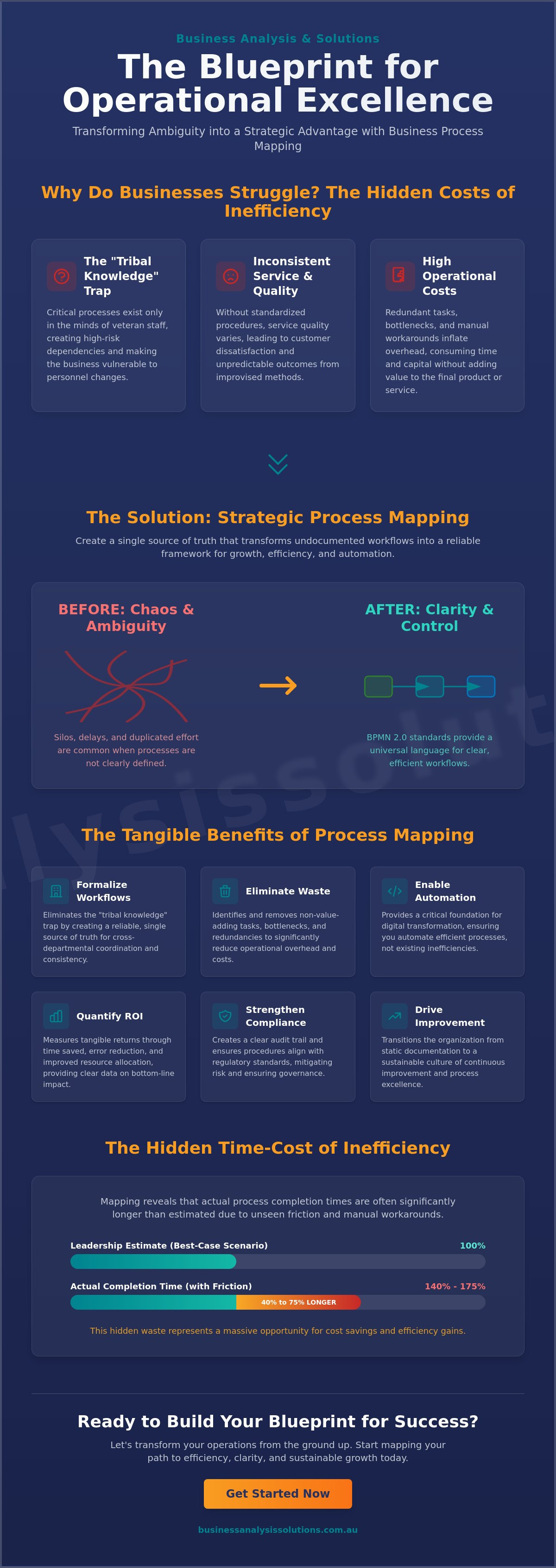
Process visibility is the total elimination of operational ambiguity. Many organisations operate under the shadow of tribal knowledge, where critical procedures exist only in the minds of veteran staff. This creates a high-risk environment. If a key team member leaves, the logic behind their actions disappears with them. Formalising these undocumented workflows through Business process mapping creates a durable asset. It transforms individual expertise into institutional intelligence, ensuring that the organisation remains resilient during personnel transitions and maintains its momentum.
Beyond documentation, the benefits of business process mapping extend to the cultural and operational heart of the company. Establishing a single source of truth ensures that cross-departmental coordination no longer relies on verbal instructions or fragmented email chains. A visual, logic-based process flow serves as a universal language for the entire organisation. This clarity provides several immediate advantages:
Accelerated Onboarding: New hires reach peak productivity faster when they have access to clear, step-by-step visual guides of their responsibilities.
Consistent Customer Experience: By identifying every touchpoint in the service chain, leadership can refine interactions to ensure quality remains high, regardless of which staff member manages the request.
Operational Reliability: Standardised procedures prevent the errors and service inconsistencies that typically arise from undocumented or improvised methods.
Bridging the Gap Between Silos
Projects frequently stall because of hidden cross-functional dependencies that aren't visible on a traditional org chart. A department might finish its work only to find the next team isn't ready or hasn't received the necessary data in the correct format. Mapping reveals these friction points by visualising how individual tasks contribute to broader organisational objectives. It allows staff to see the impact of their work on their colleagues. Clarifying hand-off points and responsibilities reduces delays and fosters a culture of professional collaboration. This level of coordination is essential for maintaining system harmony in complex operations.
Establishing Clear Accountability and Ownership
Ambiguity is the enemy of performance. When everyone is responsible, no one is. Effective mapping defines specific activity owners for every step in a workflow. This structure supports precise KPI alignment, as managers can track outcomes back to specific actions. One of the key benefits of business process mapping is this ability to align daily tasks with high-level performance metrics. It ensures that responsibility is never left to chance. For leadership, this provides a clear view of how the strategic vision is being executed on the ground, bridging the gap between planning and daily results.
Enhancing Operational Efficiency and Waste Elimination
Visibility is the precursor to action. To achieve a tangible return, you must move from observing the process to refining it. One of the primary benefits of business process mapping is the ability to isolate non-value-adding tasks that inflate your operational overhead. These are activities that consume time and capital without contributing to the final output or customer satisfaction. By stripping away these inefficiencies, you create a leaner, more responsive organisation that's better positioned for growth.
Leveraging process mapping for efficiency allows you to understand the true time-cost of internal workflows. Most leadership teams estimate process durations based on best-case scenarios. However, mapping often reveals that actual completion times are 40% to 75% longer due to friction points and manual workarounds. This data is critical for a comprehensive business efficiency diagnostic, providing the evidence needed to reallocate resources where they drive the most value.
Identifying Bottlenecks and Redundancies
Bottlenecks often hide in the spaces between departments. While each team may believe they're working optimally, the wait states between hand-offs can account for the majority of a project's lead time. Visual mapping highlights these hidden delays, showing exactly where work sits idle. It also uncovers duplicated efforts, such as multiple teams performing similar data entry tasks in disparate systems. By identifying over-processing and unnecessary approval layers through visual cues, you can streamline decision-making and accelerate throughput without compromising on quality.
Standardisation as a Growth Lever
Scaling a business requires a repeatable framework. Without standardised procedures, service quality fluctuates across different national sites, which erodes brand reliability. One of the core benefits of business process mapping is that it provides a blueprint for expansion. When you document a high-performing workflow, you create a template that can be integrated into new locations with minimal friction. This reduces the variance in service delivery and ensures that your strategic vision is executed consistently, regardless of geography. If you're ready to identify these gaps in your own operations, a professional Business Efficiency Diagnostic can provide the necessary clarity and direction.
Laying the Foundation for Automation and Digital Strategy
Digital strategy often fails when organisations attempt to automate broken processes. Technology is a force multiplier; if applied to an inefficient workflow, it merely accelerates the rate of error. One of the primary benefits of process mapping is the ability to refine and optimise a workflow before any code is written or software is purchased. This preventative measure ensures that your investment in ICT solutions delivers a genuine return rather than just digitising existing friction. By establishing this logical baseline, you prevent the common pitfall of the "automation of inefficiency."
Strategic benefits of business process mapping include the creation of a clear, functional requirements document that informs all future ICT procurement decisions. Instead of being led by vendor-specific features, you can identify the exact capabilities your business needs to maintain system harmony. This evidence-based approach ensures that new automation implementations integrate seamlessly with legacy tools, creating a unified technical ecosystem that supports your broader organisational objectives.
Mapping as a Requirements Gathering Tool
Process maps serve as the definitive technical documentation for software developers and vendors. They translate complex business logic into a visual format that eliminates ambiguity during the build phase. This level of detail is essential for reducing "scope creep," which frequently occurs when requirements are poorly defined. When your IT infrastructure is aligned with actual business needs rather than perceived requirements, project timelines become more predictable. This methodical preparation is the core of a successful digital transformation blueprint, ensuring that every technical change serves a specific strategic purpose.
Preparing for Automation and AI Integration
With 88% of enterprises now using AI automation in at least one function, the pressure to integrate these tools is high. However, successful AI deployment requires high-quality data and structured environments. Mapping allows you to identify high-volume, low-complexity tasks that are prime candidates for Robotic Process Automation (RPA). It also ensures data integrity by tracing how information flows between disparate systems. Process mapping is the mandatory first step for any AI strategy because an algorithm cannot intelligently optimise a workflow that remains structurally undefined. By providing this structure, you enable your organisation to achieve the average 5.8x ROI that companies are seeing from AI agents within 14 months of implementation.
Quantifying the Benefits: ROI and Risk Mitigation
Strategic leadership requires more than just operational intuition; it demands quantifiable data. One of the most significant benefits of business process mapping is the ability to convert abstract workflows into measurable financial outcomes. By documenting every step in a service chain, you can assign precise costs to labour and materials. This level of granularity allows for a clear calculation of your current operational baseline. It's the only reliable way to demonstrate a tangible return on investment to stakeholders when proposing structural changes or technology upgrades.
From the perspective of a Fractional CIO, process mapping is an indispensable tool for risk management and governance. It reveals single points of failure, such as a critical task that depends entirely on a single individual's undocumented knowledge. Identifying these vulnerabilities before they escalate into service disruptions is a core part of professional risk mitigation. This proactive approach ensures that your organisation meets Australian regulatory standards by building compliance and internal controls directly into the workflow design rather than treating them as an afterthought.
Risk Identification and Mitigation
Gaps in internal controls often lead to financial leakage or security breaches. Process maps allow you to audit these controls by visualising exactly where approvals occur and who has access to sensitive information. This transparency supports cybersecurity efforts by mapping data permission levels against actual business requirements. If a disruption occurs, having documented, resilient operational workflows reduces recovery time and minimises the associated costs. It provides a clear recovery procedure that maintains business continuity during unforeseen events, protecting both your reputation and your bottom line.
Measuring the Financial Impact of Process Improvement
To secure executive buy-in for process changes, you must present a logical financial case. According to verified industry data, businesses implementing process automation report a 90% decrease in human errors and 25-50% lower operational costs. This methodical approach ensures that the benefits of business process mapping are clearly visible in your financial performance:
Step 1: Baseline current process costs by calculating the time-cost of labour and any material overheads involved in the "As-Is" state.
Step 2: Identify specific waste areas, such as excessive wait times between departments, redundant data entry, or high error rates.
Step 3: Estimate the cost-reduction potential of the "To-Be" process, factoring in the impact of automation or streamlined hand-offs.
Step 4: Track post-implementation performance against your baseline to verify the actual ROI and adjust the strategy if necessary.
If you're looking to identify these high-impact improvement areas within your own organisation, our Business Efficiency Diagnostic provides the structured analysis required to move from observation to resolution.
Implementing a Systematic Approach to Process Excellence
Achieving operational excellence requires a shift from viewing process maps as static documentation to treating them as the foundation for a culture of continuous improvement, or Kaizen. One of the primary benefits of business process mapping is that it establishes a clear, objective baseline for all future changes. Without this documented starting point, organisational change remains reactive and fragmented. By formalising these workflows, leadership can ensure that every adjustment is a deliberate step toward greater system harmony rather than a temporary fix for a localised symptom.
Executive leadership plays a critical role in this transition by championing transparency. When the C-suite prioritises process clarity, it signals to the entire organisation that efficiency is a strategic objective. This top-down support is essential for ensuring that process maps remain living documents. As the business evolves to meet new market demands in 2026, these maps must be updated to reflect refined workflows. This methodical upkeep ensures that the benefits of business process mapping are sustained over the long term, preventing the gradual creep of undocumented workarounds and tribal knowledge.
The Role of Professional Business Analysis
Internal teams often struggle to identify process flaws because they're too close to the daily operations. They may accept inefficiencies as standard procedure, failing to see the underlying waste. Engaging an expert for professional Business Analysis provides an unbiased, high-level diagnostic that internal staff might overlook. These professionals act as a vital bridge between technical IT teams and business stakeholders. They translate complex operational needs into clear requirements for ICT scalability, ensuring that your digital strategy is always grounded in functional logic and results-driven outcomes.
Next Steps for Your Organisation
Transitioning to a process-centric model doesn't need to happen overnight. Start with a high-level process audit to identify "quick wins"—specific areas where waste elimination or minor workflow adjustments can deliver immediate financial or operational relief. Engaging stakeholders early in this audit is essential. When staff see that mapping removes their daily frustrations, such as redundant tasks or ambiguous hand-offs, they're more likely to support the broader strategic vision. This collaborative approach builds the momentum needed for a full-scale transformation.
If you're ready to move beyond operational ambiguity and establish a clear roadmap for growth, the first step is a professional evaluation of your current state. Schedule a Business Efficiency Diagnostic with our expert consultants to identify the specific opportunities for optimisation within your organisation today.
Advancing Toward Operational Maturity
The transition from operational ambiguity to a high-performance culture requires a structured, methodical approach. By prioritising the benefits of business process mapping, you secure more than just documentation; you establish the functional logic required for successful digital transformation and long-term risk mitigation. This clarity ensures that your investments in automation and ICT solutions are grounded in actual business needs rather than technical assumptions. It's the difference between simply digitising a workflow and truly optimising it for the future.
At Business Analysis & Solutions, we specialise in bridging the gap between technical requirements and broader organisational objectives. With over 20 years of business analysis experience and expert Fractional CIO advisory, we provide the precision needed to resolve complex organisational challenges. Our focus remains on delivering practical, end-to-end results that improve your bottom-line performance through waste elimination and system harmony. We help you build a resilient framework that evolves alongside your business.
Ready to transform your workflows into a strategic asset? Request a Strategic Consultation for Business Process Mapping today and begin your journey toward sustainable operational excellence. Your organisation's maturity depends on the clarity of its foundation.
Frequently Asked Questions
What is business process mapping and why is it important?
Business process mapping is the visual documentation of every step, input, and output within a specific workflow. It's a critical management tool because it eliminates operational ambiguity and provides a structured baseline for all strategic improvements. Understanding the benefits of business process mapping allows leadership to move beyond guesswork and make informed decisions based on the objective reality of their operations.
How does business process mapping improve organisational efficiency?
It improves efficiency by highlighting non-value-adding tasks and hidden bottlenecks that inflate operational overhead. By identifying redundant activities, such as duplicated data entry across departments, organisations can streamline their throughput. Verified industry data indicates that automating these refined processes can lead to a 40% to 75% reduction in completion time and a 90% decrease in human errors.
What are the primary benefits of process mapping for senior leadership?
For senior leadership, the primary benefits of business process mapping include established accountability and improved risk mitigation. It allows executives to align daily tasks with high-level KPIs by defining specific activity owners for every workflow step. This transparency ensures that the strategic vision is executed consistently while identifying single points of failure before they cause service disruptions.
How do you calculate the ROI of a process mapping project?
ROI is calculated by comparing the labour and material costs of the current "As-Is" process against the projected costs of the optimised "To-Be" state. You must baseline current error rates and wait times to quantify the financial impact of improvements. Tracking performance post-implementation allows you to verify the actual savings achieved through waste elimination and increased productivity.
What is the difference between a flowchart and a strategic process map?
A flowchart is a basic diagram of task sequences, whereas a strategic process map incorporates technical requirements, data flows, and cross-functional dependencies. Strategic maps often follow BPMN 2.0 standards to provide a comprehensive diagnostic of the business ecosystem. This level of detail is necessary for informing ICT procurement and ensuring system harmony across the organisation.
Is process mapping necessary before implementing new software?
Yes, mapping is a mandatory prerequisite for successful software implementation to avoid the "automation of inefficiency." It serves as the functional requirements document that guides developers and vendors during the build phase. By refining the process before applying technology, you ensure the new system supports actual business needs rather than digitising existing friction.
How often should business process maps be updated?
Process maps should be treated as living documents and updated whenever a significant change occurs in technology, regulation, or organisational structure. At a minimum, a formal review should take place annually to ensure procedures reflect current best practices. This methodical upkeep prevents the re-emergence of undocumented tribal knowledge and maintains operational consistency.
Can process mapping help with Australian regulatory compliance?
Process mapping strengthens compliance by building internal controls and audit trails directly into the workflow design. This is particularly relevant for Australian regulatory standards where documented evidence of governance is required. It allows organisations to move from reactive compliance to a proactive model where adherence to legal requirements is a standard part of every operation.



Comments