Retirement for Business Owners: Strategic Exit Planning and Operational Continuity in 2026
- jonesaqayalo
- Apr 14
- 12 min read
Updated: Apr 20
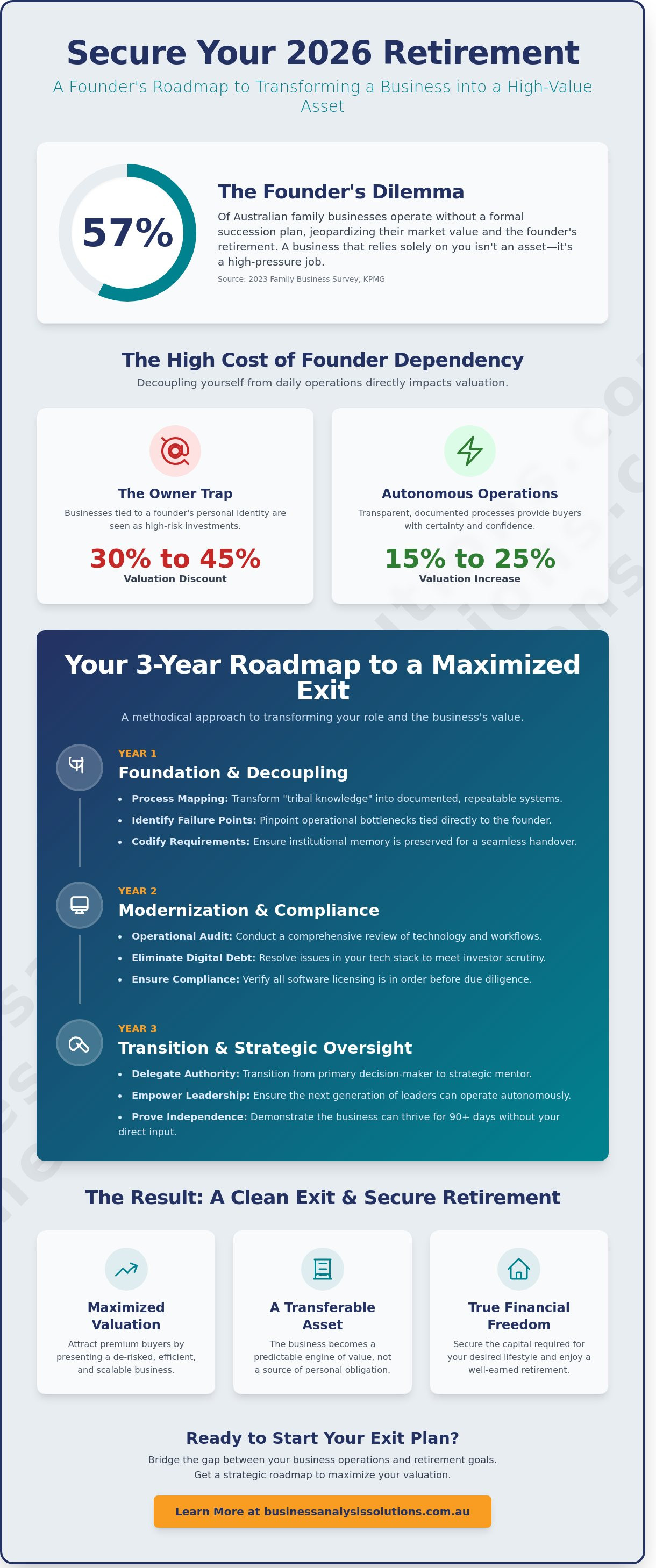
According to the 2023 Family Business Survey by KPMG, 57% of Australian family businesses operate without a formal succession plan, which often complicates the path to a stable retirement. You've likely spent decades building your enterprise, yet you probably feel that its daily survival still rests entirely on your shoulders. It's a common frustration to realize that without your constant input, documented processes, or a clear handle on digital debt, the market value of your life's work could plummet when you're ready to step away. We understand that a business that can't function without its founder isn't an asset; it's a high-pressure job.
This article provides the clarity you need to transform your business into a self-sustaining, high-value asset that attracts premium buyers. You'll discover how to move from daily operations to a position of strategic oversight through rigorous process mapping and stakeholder engagement. We'll outline a methodical three to five year roadmap that prioritizes operational continuity and the elimination of digital debt, ensuring you achieve a maximized valuation and a clean exit by 2026.
Key Takeaways
Learn how to decouple your personal identity from daily operations through rigorous process mapping, transforming the business into a high-value, transferable asset.
Identify and resolve "digital debt" within your technology stack to ensure your operational systems meet the scrutiny of sophisticated Australian investors.
Conduct a comprehensive operational audit to eliminate technical debt and ensure licensing compliance before entering the formal due diligence phase.
Establish a structured three-year roadmap that secures your retirement by transitioning the founder role from a primary decision-maker to a strategic mentor.
Discover how to bridge the gap between technical requirements and business objectives to maximize your valuation in the 2026 market landscape.
Table of Contents Defining Retirement for the Business Owner: Beyond Superannuation Decoupling the Founder: The Role of Process Mapping Digital Transformation: Multiplying Business Valuation for Exit Operational Due Diligence: Preparing for the Scrutiny The 3-Year Retirement Roadmap: From Diagnostic to Freedom
Defining Retirement for the Business Owner: Beyond Superannuation
For most Australian entrepreneurs, retirement represents a fundamental shift in asset management rather than a simple cessation of work. While employees focus on Superannuation contributions, business owners must reconcile their personal financial goals with the operational reality of their enterprise—a process often requiring the expertise of firms like Brown Hamilton Partners. The 2026 economic environment presents a specific challenge; founder-dependent firms are increasingly difficult to liquidate. Data from recent Australian exit surveys indicates that businesses tied to a founder's personal identity trade at a 30% to 45% discount compared to those with autonomous management structures.
Many owners fall into the "Owner Trap" where their personal expertise becomes the primary bottleneck for growth and delivery. To secure a viable exit, you've got to transition from being a job owner to a business investor. This requires a methodical approach to documenting processes and delegating authority. If the business can't function for 90 days without your direct intervention, it isn't an asset; it's a high-pressure job. Shifting this mindset is the prerequisite for any successful transition.
The Strategic Alignment of Exit Goals
Success requires bridging the gap between your current business value and your required retirement capital. You should establish a clear timeline, ideally five years before your intended departure date. If your desired lifestyle requires a post-tax income of A$160,000 annually, your business valuation and Super balance must support that draw-down. Strategic alignment ensures that every operational improvement you make today directly increases the final sale price. It turns the business into a predictable engine of value rather than a source of professional obligation.
Succession vs. Sale: Choosing Your Path
Choosing between an internal handover and an external sale depends on your organizational maturity. An internal succession planning process focuses on mentoring the next generation of leadership to maintain continuity. This path often preserves the company culture but may require a longer earn-out period. Conversely, an external sale requires you to maximize appeal to competitors or private equity firms who value transparent data and scalable systems. Your ability to achieve either depends on business efficiency, as buyers in 2026 prioritize lean, automated operations over legacy structures. Logical preparation reduces ambiguity, ensuring the business remains a valuable legacy rather than a burden.
Decoupling the Founder: The Role of Process Mapping
A business that cannot function without its founder isn't an asset; it's a high-pressure job. For owners targeting a 2026 retirement, the transition from primary decision-maker to strategic mentor is the most critical phase of exit planning. Documented processes serve as the primary engine of value during this period. They transform "how things are done" from a series of personal habits into a repeatable, scalable system that exists independently of the owner’s presence. This shift ensures the business maintains its momentum even when the architect is no longer at the helm.
Process mapping identifies single points of failure that often remain hidden during daily operations. If a specific client relationship or technical workflow halts because the founder is unavailable, the business carries a high-risk profile. A 2023 industry benchmark report suggests that operational transparency can increase a firm's valuation by 15% to 25% because it provides buyers with the certainty that revenue won't evaporate on day one. By mapping every critical path, you provide the clarity required for a seamless handover, effectively reducing the "risk premium" a buyer might otherwise apply to the purchase price.
Eliciting Knowledge from the Founder
The greatest risk to operational continuity is "tribal knowledge," which includes the unwritten rules and historical context only the founder possesses. We use structured requirements elicitation to capture these nuances. This process is a cornerstone of small business succession planning, ensuring that institutional memory is codified into formal business requirements. Engaging stakeholders early in this transition phase allows the team to take ownership of these processes, creating a culture of documentation that persists long after the founder exits.
Standardising Operations for Scalability
Standardisation reduces service delivery variability, which is essential for maintaining profit margins. Applying techniques from a Business analysis consultancy Perth allows owners to align local operational excellence with national exit strategies. In the final 36 months before retirement, the focus shifts to the ROI of standardisation. Eliminating just 12% of operational waste through structured workflows can significantly improve the bottom line, making the entity far more attractive to private equity or internal successors. If you're looking to solidify your legacy, investigating professional process audits can reveal exactly where your workflows need strengthening to ensure a clean break.
Digital Transformation: Multiplying Business Valuation for Exit
Digital debt isn't just an IT issue; it's a direct deduction from your retirement nest egg. In the 2026 market, investors don't just buy your cash flow. They buy your systems. If your business relies on fragmented legacy software or manual, founder-led processes, you're presenting a high-risk profile. This technical friction often results in a lower EBITDA multiple during valuation. Modernising your technology stack is a strategic investment that attracts high-tier buyers who prioritise scalable, cloud-native operations over businesses burdened by technical obsolescence.
System Modernisation: Replace outdated hardware and siloed software to reduce maintenance costs. Investors pay a premium for "turnkey" digital environments.
Founder Decoupling: Use automation to replace tasks that currently require your personal oversight. If the business can't run without you, it's a job, not a saleable asset.
Data Liquidity: Ensure your business intelligence is structured and accessible. Clean data sets allow buyers to perform due diligence faster and with more confidence.
Data is now a saleable asset in its own right. A business that can demonstrate its performance through real-time dashboards is worth significantly more than one relying on manual spreadsheets. By ensuring your data is accessible and integrated, you provide the transparency that institutional investors demand.
Building a Digital Strategy for the Future
Maximising your exit value requires a digital transformation blueprint for business that focuses on long-term scalability. You don't need to digitise every process simultaneously. Instead, focus on high-impact automation that reduces operational overhead. Current Australian benchmarks show that businesses with integrated cloud solutions can reduce administrative costs by up to 18%. This efficiency directly boosts the bottom line, making your retirement transition far more lucrative.
The Fractional CIO as a Transition Partner
Most mid-sized Australian firms don't require a full-time Chief Information Officer, yet they desperately need high-level technical strategy. Leveraging Fractional CIO services Australia allows you to access executive-level leadership during the critical years before your exit. These professionals bridge the gap between technical requirements and your business objectives. They mitigate ICT risks, manage vendor relationships, and ensure that the digital transition is seamless. This professional oversight provides potential buyers with the assurance that the company's technical infrastructure is robust and future-proof.
Operational Due Diligence: Preparing for the Scrutiny
In the 2026 acquisition market, buyers prioritize operational resilience over historical revenue alone. You must conduct a comprehensive pre-exit audit of every business process and ICT system to ensure the organization remains viable after your retirement. This scrutiny involves identifying "Technical Debt," which refers to the implied cost of additional rework caused by choosing easy, short-term solutions instead of better approaches. Unresolved technical debt or non-compliant software licensing can lead to a 15% reduction in business valuation during final negotiations. Professionals look for a clean ledger where all digital assets are accounted for and legally transferable.
Cybersecurity readiness is no longer optional for Australian SMEs. Buyers will evaluate your security posture against the Australian Signals Directorate (ASD) Essential 8 framework. Achieving a Level 2 or 3 maturity rating provides the buyer with confidence that the business is protected against common cyber threats. All project management documentation, including process maps and standard operating procedures, must be current. If your operational knowledge exists only in the minds of staff, the perceived risk increases, lowering the sale price.
The Business Efficiency Diagnostic
The Business Efficiency Diagnostic is a tool for exit-readiness verification. This diagnostic identifies hidden risks, such as redundant software subscriptions or manual bottlenecks that drain resources. By quantifying efficiency gains, such as a 22% improvement in order fulfillment speed, you provide objective proof of business health. This data-driven approach removes ambiguity and allows potential buyers to see the tangible return on investment they can expect post-purchase.
ICT Risk Management and Compliance
Business continuity plans must be robust and entirely independent of the founder. If critical systems require your personal authorization or "key person" knowledge to function, the deal is at risk. 65% of mid-market acquisitions in Australia face delays because of poorly managed intellectual property (IP) transfers. You need a structured registry of all digital assets, domain names, and proprietary code to facilitate a seamless transition.
Mitigating key person dependency is vital during the due diligence phase. You should document every workflow to ensure that a new management team can maintain operations without a dip in performance. A business that runs itself is a business that sells for a premium. To ensure your systems are ready for professional inspection, you can optimise your operational workflows with a structured audit. This preparation ensures that when you finally reach retirement, the legacy you've built remains intact and profitable for the next owner.
The 3-Year Retirement Roadmap: From Diagnostic to Freedom
Achieving a successful retirement requires more than a simple handover; it demands a structured 36-month transition to maximise valuation and ensure operational continuity. Business owners often find that a rushed exit leads to a 20% to 30% reduction in sale price due to perceived operational risks. A three-year horizon provides the necessary window to transform a founder-led business into a systems-driven asset.
Year 1: Diagnostic and discovery. This phase focuses on identifying gaps in operational continuity. We conduct a thorough audit of existing workflows to find single-point-of-failure risks where knowledge is trapped in the owner's head.
Year 2: Implementation. During this period, we execute the digital strategy and comprehensive process mapping. This moves the business from manual reliance to automated reliability.
Year 3: Optimisation and exit. The final twelve months involve fine-tuning the machine for the new owners. We focus on proving that the business scales without the founder's daily intervention.
Professional project management ensures this roadmap stays on track. Without a disciplined approach to milestones, the complexities of Australian regulatory compliance and technical integration can delay an exit by years. We provide the oversight needed to maintain momentum.
Executing the Digital Transformation Blueprint
Succession fails when systems are opaque. We phase automation implementation to avoid operational disruption, ensuring that every new tool serves a specific business objective. Training the successor team on new business technology platforms is a core component of this phase. We don't just install software; we embed a sustainable rhythm of continuous improvement. This ensures the team can manage and evolve the tech stack long after the founder departs. By 2026, buyers will prioritise firms with high digital literacy and integrated data environments.
Final Strategic Alignment and Handover
The final stage of the retirement journey involves rigorous validation. We review fractional CIO reports to confirm technical readiness and ensure all cybersecurity protocols meet current Australian standards. This technical due diligence protects the business legacy and justifies a premium valuation. We finalise the exit strategy with a focus on long-term stability, ensuring the transition is seamless for both staff and clients. Clarity is the ultimate goal, both for your business and your personal health; to maintain your vision for the future, you may visit Bright Sight Eye Specialists for expert ophthalmology services. Contact Business Analysis & Solutions for a comprehensive efficiency diagnostic to begin your three-year journey toward a clean, profitable exit.
Securing Your Legacy Through Strategic Operational Readiness
Strategic retirement for an Australian business owner isn't just a financial milestone; it's an operational achievement. You've spent years building an asset that shouldn't depend on your presence for every decision. By prioritizing process mapping and digital transformation now, you increase your business valuation and simplify the due diligence process for future buyers. Our 3-year roadmap provides the specific milestones needed to move from diagnostic stages to total operational freedom.
Business Analysis Solutions provides over 20 years of experience in strategic business analysis and ICT consultancy to guide this transition. We excel at bridging the gap between technical requirements and business objectives, using a proven methodology that successfully decouples founders from daily operations. We focus on delivering clarity through logic and precision, ensuring your exit strategy is both profitable and seamless.
Your legacy deserves a transition that's as professional as the business you've built.
Frequently Asked Questions
How far in advance should a business owner start planning for retirement?
You should begin your exit planning at least 3 to 5 years before your intended departure date. This timeframe allows for a comprehensive operational audit and the implementation of process optimisations that maximise value. The Australian Small Business and Family Enterprise Ombudsman (ASBFEO) suggests that early planning significantly increases the likelihood of a successful transition. It ensures you have enough time to address any structural weaknesses that could detract from the final sale price.
Can I retire if my business processes are not documented?
You can retire without documentation, but you will likely face a valuation discount of 20% to 30% during the sale process. Undocumented processes represent a significant risk to buyers who fear the business cannot function without your personal oversight. Professional process mapping transforms individual knowledge into institutional capital. This transition ensures the entity remains a viable, turnkey asset that generates consistent returns for the next owner without requiring your daily intervention.
What is the "Owner Trap" and how does it affect my business valuation?
The "Owner Trap" refers to a situation where a business is entirely dependent on the founder's personal relationships or technical skills to function. This dependency negatively impacts your valuation because buyers view the business as a high-risk investment. When you plan for retirement, you must decouple your identity from the operations. Industry data indicates that businesses with high owner-independence command much higher multiples than those where the founder manages 80% of client interactions.
How does digital transformation increase the value of my business for sale?
Digital transformation increases value by replacing manual, error-prone workflows with scalable, automated systems that improve profit margins by an average of 15%. Modernised ICT infrastructure provides transparent data for due diligence, giving buyers confidence in your financial reporting. By 2026, institutional investors will prioritise targets that have already integrated cloud-based solutions and data analytics. These technologies reduce future capital expenditure for the buyer, making your business a more attractive and competitive prospect.
What is the role of a Fractional CIO during a business exit or retirement?
A Fractional CIO provides the strategic technology leadership required to align your digital infrastructure with your specific exit objectives. They address technical debt and ensure your systems are robust enough for a seamless hand-over. This role is critical during retirement planning because it bridges the gap between high-level business goals and technical execution. They provide the analytical oversight needed to ensure your technology stack supports a premium valuation and long-term operational continuity.
Is a business efficiency diagnostic necessary for a small to medium enterprise?
A business efficiency diagnostic is essential because it identifies structural bottlenecks that waste approximately 26% of an SME's productive time. For Australian enterprises, this structured assessment provides a clear roadmap for streamlining workflows before a sale. It offers the analytical clarity needed to prove to potential buyers that the business operates at peak performance. This diagnostic acts as a formal validation of your operational health, supporting a higher asking price during negotiations.
How do I ensure my ICT solutions are compliant before I sell the business?
You must conduct a formal audit against Australian standards, specifically the Essential Eight cybersecurity framework and the Privacy Act 1988. Compliance failures represent major legal liabilities that can derail a sale during the due diligence phase. Ensuring your data handling and security protocols meet current Australian regulations protects the transaction integrity. It prevents post-sale litigation and demonstrates to the buyer that the business follows a disciplined, risk-mitigated approach to information management.
What happens to my business automation projects after I retire?
Properly implemented automation projects function as permanent assets that continue to deliver value and operational stability long after you leave. If these projects are documented and integrated into the core business architecture, they provide a seamless transition for the new leadership. Automation ensures that critical 24/7 processes remain active without human intervention. This consistency maintains revenue stability and ensures that the business's performance does not fluctuate during the ownership change.



Comments