Part-Time CIO Services for SMEs: Strategic IT Leadership in 2026
- jonesaqayalo
- May 21
- 12 min read
What if your IT budget stopped feeling like a black hole and started functioning as a high-yield investment portfolio? For many leadership teams, technical debt and misaligned software tools act as a silent brake on growth, creating a disconnect between digital spend and tangible ROI. Utilizing part-time CIO services for SMEs allows you to install executive-level leadership that bridges the gap between complex technical infrastructure and your core business objectives. This strategic alignment ensures that every dollar spent on technology is a deliberate step toward organizational maturity.
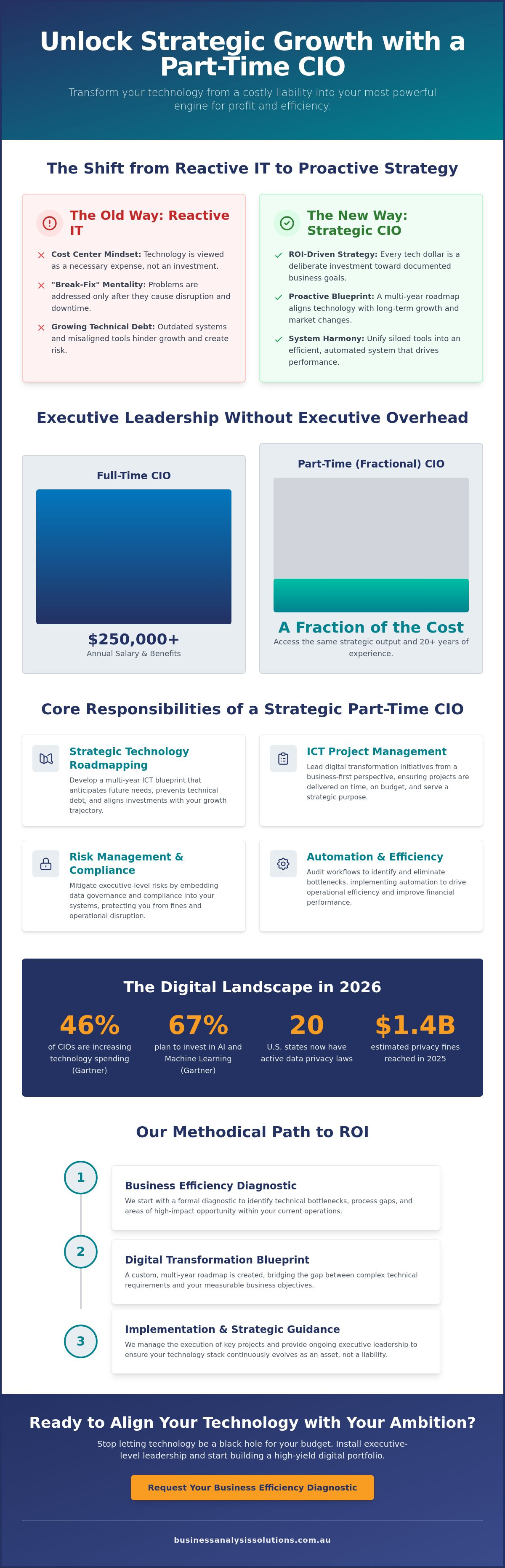
It's understandable if you feel that technology has become more of a burden than an asset. With 46% of CIOs reporting increased technology spending in 2026 according to Gartner, the pressure to invest correctly has never been higher. We will demonstrate how fractional executive leadership provides a Digital Transformation Blueprint and strategic ICT solutions without the $250,000 annual salary often required for a full-time executive. You'll discover how a structured approach to digital strategy and process mapping can reduce risk and turn your technology into a primary engine for profit.
Key Takeaways
Transition from reactive maintenance to a proactive digital strategy that aligns technical infrastructure with your long-term business growth.
Understand how part-time CIO services for SMEs provide high-level ICT project management and automation implementation without the overhead of a full-time executive salary.
Distinguish between the operational focus of managed IT services and the strategic, ROI-driven guidance of a fractional CIO.
Learn the methodical steps to implementation, starting with a formal business efficiency diagnostic to identify technical bottlenecks and process gaps.
Discover how a Digital Transformation Blueprint bridges the gap between complex technical requirements and measurable organizational objectives.
Table of Contents
Bridging the Executive Gap: What are Part-Time CIO Services for SMEs?
A part-time CIO is not a remote support technician or a high-level helpdesk manager. Instead, this role functions as a strategic business partner who integrates deeply with your leadership team to align technology with commercial objectives. The shift toward part-time CIO services for SMEs reflects a fundamental change in how modern organizations view their digital assets. In 2026, technology is no longer a back-office utility; it's the primary driver of operational efficiency and market competitiveness.
Traditional IT models often rely on a reactive "break-fix" mentality. This approach addresses problems only after they occur, leading to significant technical debt and stagnant growth. A Fractional CIO replaces this cycle with a proactive digital strategy. By accessing 20+ years of executive experience, smaller organizations can secure the same caliber of leadership found in enterprise environments. The financial logic is straightforward. While a full-time CIO in major markets can command salaries exceeding $200,000, fractional leadership provides the same strategic output at a fraction of that cost. This allows capital to be redeployed into core business operations while still benefiting from expert-level ICT solutions.
The Role of the Fractional CIO in 2026
The modern fractional executive focuses on bridging the gap between high-level business objectives and granular technical requirements. They don't just recommend tools; they architect systems that facilitate long-term stability and system harmony. This involves providing objective, vendor-agnostic advice that prioritizes your organization's financial performance over specific software preferences. By leading digital transformation initiatives from a business-first perspective, they ensure that every implementation serves a documented strategic purpose.
Why SMEs Specifically Need Strategic IT Oversight
Small and mid-sized enterprises face unprecedented complexity in 2026. With 67% of CIOs planning to invest in AI and machine learning according to Gartner, the risk of mismanaged technical debt is high. Without strategic oversight, these investments often fail to deliver a tangible return. Additionally, the regulatory environment is increasingly punitive. As of early 2026, 20 U.S. states have active comprehensive data privacy laws. A strategic leader mitigates executive-level risks by ensuring data governance and compliance are baked into your Digital Transformation Blueprint. This proactive stance protects the business from the rising tide of privacy fines, which reached an estimated $1.4 billion in 2025. Leveraging part-time CIO services for SMEs ensures that your technology stack remains an asset rather than a liability.
The Core Responsibilities of a Strategic Part-Time CIO
A strategic fractional executive does not simply manage hardware; they manage the technological trajectory of the entire organization. The primary objective of part-time CIO services for SMEs is to ensure that every software selection and infrastructure change serves a documented business goal. This requires a shift from reactive problem-solving to a structured framework of technical governance. By establishing clear risk management protocols, a fractional leader protects the business from operational disruptions and data liabilities that often plague unguided IT departments.
Beyond risk mitigation, the role focuses heavily on driving operational efficiency through automation implementation and ICT project management. This involves auditing existing workflows to identify where manual processes create bottlenecks. By applying rigorous professional business analysis, a part-time CIO transforms the technology stack from a collection of siloed tools into a unified system. This system harmony is essential for maintaining financial performance in an increasingly complex digital market.
Strategic Technology Roadmapping
Successful scaling requires a multi-year ICT blueprint that anticipates future needs rather than just reacting to current failures. A fractional CIO prioritizes technical investments based on a logical assessment of impact, cost, and complexity. This roadmap is not static; it involves regular review cycles to ensure your technology keeps pace with market changes and emerging AI capabilities. This methodical approach prevents the accumulation of technical debt and ensures that capital is allocated to the highest-value initiatives.
Vendor Management and ICT Procurement
One of the most immediate benefits of part-time CIO services for SMEs is the creation of a professional buffer between the business and technology vendors. A fractional executive speaks the language of providers but remains firmly on the side of the client. They negotiate contracts with a focus on long-term value and system integration rather than just initial purchase price. Every new tool is evaluated against a formal digital transformation blueprint for business. This ensures that new acquisitions don't create future compatibility issues or redundant costs. By centralizing procurement oversight, the business gains better terms, more reliable support, and a stack that actually supports the organizational vision.
Fractional CIO vs. Managed IT: Understanding the Strategic Difference
Many organizations confuse operational IT support with strategic leadership. Managed IT services primarily function as the "engine" of your business; they focus on uptime, helpdesk tickets, and routine maintenance. While these services are essential for daily stability, they don't provide the high-level navigation required to steer a company toward its long-term goals. Engaging part-time CIO services for SMEs introduces the "navigator" to your leadership team. This role ensures that the technical engine is actually driving the organization in the right direction, rather than just running smoothly in place.
Relying solely on a Managed Service Provider (MSP) for strategic advice often leads to vendor lock-in. Because MSPs typically profit from technical billable hours or specific hardware margins, their recommendations may prioritize their own service model over your specific business requirements. An independent, objective ICT consultancy removes this conflict of interest. By maintaining a separation between the strategic advisor and the technical implementer, you gain a partner who is solely committed to your organization's financial performance and system harmony.
Operational Support vs. Strategic Leadership
The boundary between an IT helpdesk and executive leadership is defined by the focus of the conversation. Helpdesk support is reactive; it solves a problem that has already occurred. In contrast, a fractional CIO operates at the leadership table, translating technical possibilities into commercial opportunities. This executive presence ensures that your technical providers are held accountable to specific KPIs. Instead of accepting generic reports on server uptime, you receive analysis on how your digital assets are contributing to business growth. This level of oversight ensures that your technology investments remain aligned with your Digital Transformation Blueprint.
Addressing the Conflict of Interest
Your strategic advisor shouldn't necessarily be your hardware provider. Maintaining an agnostic approach to software and platform selection is critical for achieving true operational efficiency. A part-time CIO focuses on business efficiency rather than technical maintenance. This allows for a meticulous evaluation of tools based on their ability to resolve process bottlenecks and drive profit. When you utilize part-time CIO services for SMEs, you're investing in a partner who prioritizes the most effective solution over the easiest one to bill. This distinction is vital for SMEs that must maximize every dollar of their technology spend while avoiding the pitfalls of misaligned technical debt.
How to Implement Part-Time CIO Services in Your Business
Successful implementation of executive IT leadership requires more than just hiring a consultant; it demands a structured methodology that prioritizes organizational outcomes over technical hardware. Most small and mid-sized enterprises fail in their digital transitions because they attempt to select software before they've defined their strategic requirements. Implementing part-time CIO services for SMEs follows a disciplined, four-step process designed to move your business from a state of technical friction to one of operational harmony. This phased approach ensures that every change is grounded in logic and focused on financial performance.
The transition begins with a formal assessment of your current state. By following a methodical sequence, a fractional CIO removes the ambiguity from your technical roadmap. This process involves identifying high-impact areas where technology can resolve existing process bottlenecks, ensuring that your capital is deployed where it will generate the highest return.
Starting with a Business Efficiency Diagnostic
The foundation of any successful engagement is a Business Efficiency Diagnostic. This isn't a simple IT audit; it's a deep analysis of the workflows that drive your daily operations. During this phase, the fractional CIO assesses the maturity of your current ICT systems and evaluates your data security protocols against 2026 standards. This diagnostic identifies specific automation opportunities that can reduce manual labor and human error. Most importantly, it establishes a clear baseline for measuring future technology ROI, allowing you to track the tangible value of your strategic investments over time.
Once the diagnostic is complete, the focus shifts to developing a Digital Transformation Blueprint. This document serves as your organization's master architectural plan. It outlines how specific ICT solutions will be integrated to support your long-term scaling goals. By creating this blueprint early, you avoid the common pitfall of fragmented tool adoption, ensuring that every new system works in concert with your existing infrastructure.
Execution and Project Oversight
Strategy only delivers value through precise execution. A part-time CIO provides the high-level project management necessary to navigate complex digital transitions without disrupting your core business. This involves managing change within the organization, ensuring that your team understands and adopts new workflows. The executive maintains a seat at the leadership table to provide ongoing monitoring of system performance and strategic alignment.
This persistent oversight ensures that as market conditions change, your technology stack evolves accordingly. If you're ready to replace technical uncertainty with a structured roadmap, you can book a business efficiency diagnostic to begin the process. Utilizing part-time CIO services for SMEs ensures that your organization benefits from professional project oversight and a commitment to end-to-end results.
Maximizing ROI with Business Analysis & Solutions
Business Analysis & Solutions brings over 20 years of experience in strategic leadership to every engagement. Our primary focus is bridging the gap between technical requirements and broader organizational objectives, ensuring that technology serves the business rather than the other way around. By utilizing a methodology grounded in international standards and functional logic, we provide a level of precision that is often missing in general IT consulting. We deliberately exclude helpdesk support and hardware sales from our offerings. This separation maintains our strategic objectivity, allowing us to recommend part-time CIO services for SMEs that are entirely aligned with your organization's financial performance.
Our approach is meticulous. We don't just describe problems; we provide clear direction and resolution. This commitment to practical results ensures that your technology stack becomes a stable, predictable engine for growth. By prioritizing system harmony and operational efficiency, we help leadership teams regain control over their digital investments.
A Methodical Approach to Business Improvement
We move systematically from an initial Business Efficiency Diagnostic to a tangible Digital Transformation Blueprint. This framework is designed to ensure that every dollar allocated to technology contributes directly to the bottom line. We use process mapping to identify high-impact automation opportunities, resolving bottlenecks that slow down organizational progress. Our results-driven phrasing and professional directness ensure that stakeholders understand exactly how each strategic initiative drives value. This structured approach eliminates the ambiguity of technical debt and replaces it with a clear roadmap for success.
Your Partner in Strategic Growth
Our fractional CIO services Australia provide a distinct competitive advantage for organizations seeking to scale in a complex digital environment. We are committed to delivering end-to-end results without the unnecessary technical complexity that often stalls progress. By focusing on strategic ICT solutions and expert project management, we ensure your business remains agile and compliant with evolving data standards. If you're ready to align your technology with your long-term vision, request a consultation to begin your business efficiency diagnostic. Utilizing part-time CIO services for SMEs is the most effective way to secure high-level leadership and drive sustainable business improvement.
Securing Your Strategic Technical Advantage
The shift toward fractional leadership is a logical response to the increasing complexity of the 2026 digital landscape. Transitioning from reactive maintenance to a proactive Digital Transformation Blueprint ensures that your technology remains a high-yield investment rather than a mounting cost. By separating strategic oversight from day-to-day support, your organization can eliminate conflicts of interest and maintain a seat at the leadership table for critical IT discussions. Utilizing part-time CIO services for SMEs provides the specialized expertise required to navigate these challenges with precision.
Business Analysis & Solutions brings over 20 years of experience to every engagement, specializing in Business Efficiency Diagnostics that identify and resolve hidden process bottlenecks. We excel at bridging technical and organizational gaps to ensure your systems drive tangible profit. Our methodical approach replaces technical uncertainty with a clear, results-driven roadmap. Book a Strategic Consultation with Business Analysis & Solutions to begin optimizing your operations. A more streamlined and profitable future is within reach through structured, methodical leadership.
Frequently Asked Questions
What is the difference between a virtual CIO and a fractional CIO?
A fractional CIO operates as a strategic executive member of your leadership team, whereas a virtual CIO is frequently a title used by Managed Service Providers to describe basic account management. While both roles involve remote collaboration, a fractional leader focuses on business alignment and ROI rather than just technical maintenance. This distinction is critical because it moves the focus from simply keeping the lights on to driving organizational growth and long-term digital strategy.
How many hours a month does a part-time CIO typically work for an SME?
Engagement levels typically range from 10 to 40 hours per month, depending on the complexity of your Digital Transformation Blueprint. For some organizations, this involves a consistent weekly presence to oversee ongoing project management. For others, the focus is concentrated on specific phases, such as an initial Business Efficiency Diagnostic or the implementation of new ICT solutions. This flexibility allows you to scale executive oversight without the burden of a full-time salary.
Can a part-time CIO help with cybersecurity and compliance?
Yes, a fractional executive establishes the high-level governance frameworks necessary to manage cybersecurity and regulatory compliance effectively. With 20 U.S. states having active comprehensive data privacy laws as of early 2026, strategic oversight is essential to mitigate financial and legal risks. The CIO ensures that your technical infrastructure meets these standards through rigorous process mapping and data governance. This proactive approach protects the organization from the rising costs of data breaches and regulatory fines.
Does our business need to be a certain size to benefit from CIO services?
Business complexity and growth objectives are better indicators of need than employee headcount alone. Organizations experiencing rapid scaling or those managing fragmented technical systems often find that part-time CIO services for SMEs provide the necessary structure to stabilize operations. If your technology spending feels like a cost center without a clear return on investment, you've likely reached the stage where strategic leadership is required to align your tools with your commercial goals.
Will a part-time CIO replace our current IT support team?
A part-time CIO does not replace your internal or outsourced IT support team; instead, they provide the strategic direction that those teams often lack. While your helpdesk focuses on immediate technical issues, the CIO ensures that their efforts align with your broader digital strategy. This relationship creates a clear division between operational maintenance and executive leadership. The CIO holds your technical providers accountable, ensuring they deliver value according to your established roadmap and specific KPIs.
How do you measure the ROI of fractional CIO services?
ROI is measured through tangible improvements in operational efficiency, reduced technical debt, and optimized technology spending. By conducting a Business Efficiency Diagnostic, we establish a baseline to track how automation implementation reduces manual labor costs. Success is also seen in the mitigation of executive-level risks and the successful delivery of complex ICT projects on time and within budget. These outcomes directly contribute to improved financial performance and organizational maturity over the long term.
What industries benefit most from part-time CIO leadership?
Any industry facing high regulatory pressure or rapid technological change benefits from this leadership model. Professional services, manufacturing, and distribution firms often utilize part-time CIO services for SMEs to streamline complex supply chains and ensure data compliance. These sectors frequently deal with legacy systems that require a structured Digital Transformation Blueprint to remain competitive. Any organization where technical bottlenecks are slowing down business growth will find significant value in methodical, expert-led strategic planning.
What is the first step in engaging a fractional CIO?
The engagement process begins with a formal Business Efficiency Diagnostic to assess your current technical and operational state. This assessment identifies process bottlenecks and technical gaps that hinder your organizational objectives. From this baseline, we develop a strategic roadmap that prioritizes high-impact initiatives. This methodical first step ensures that any subsequent digital strategy or ICT solution is grounded in logic and designed to deliver a measurable return on your technology investment.



Comments