Outsourced CIO Services Australia: Strategic IT Leadership for 2026
- jonesaqayalo
- Jun 1
- 12 min read
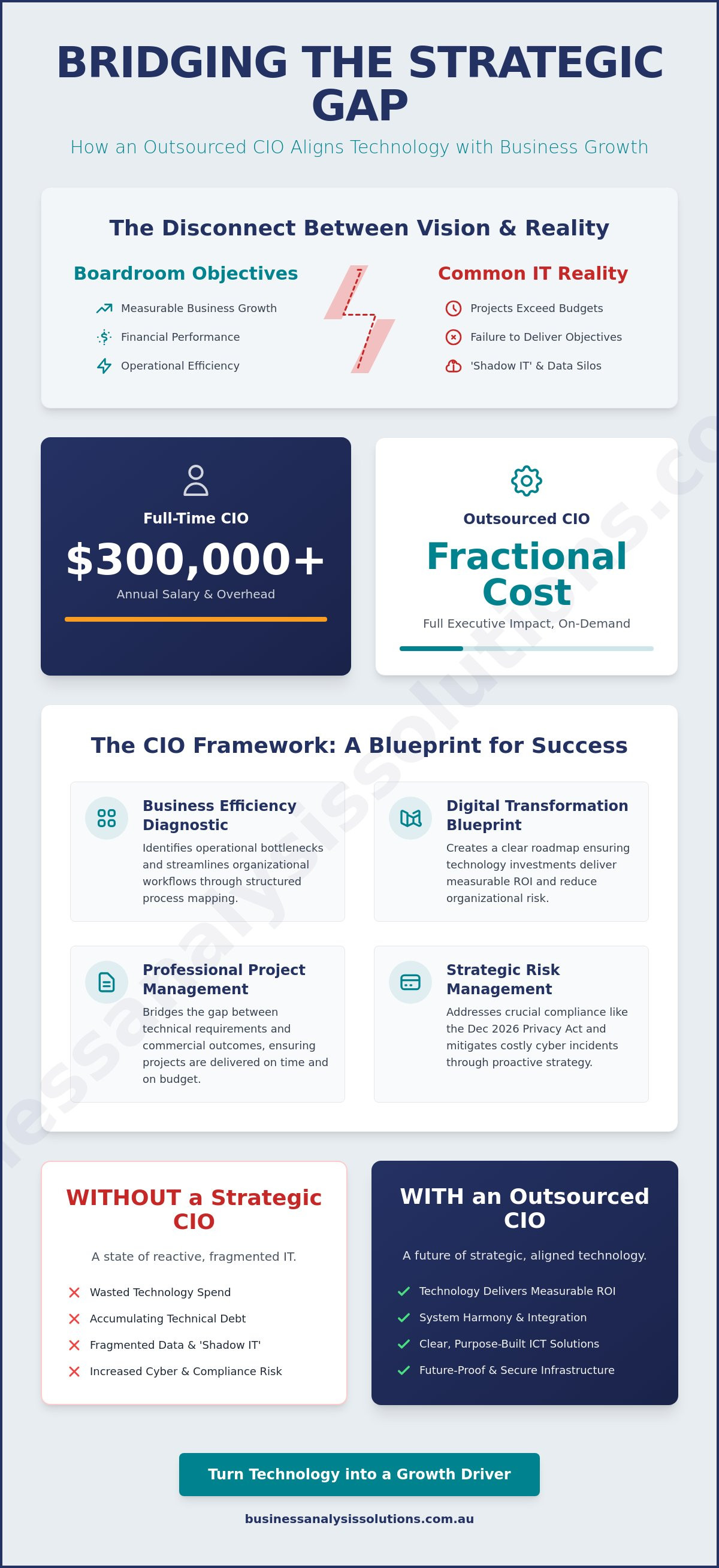
Why are you paying for high-end technology only to watch your IT projects consistently exceed their budgets and fail to deliver on boardroom objectives? For many leaders, the disconnect between technical implementation and commercial strategy isn't just a frustration; it's a significant operational risk. You likely agree that technology should serve the business, yet finding the balance between system harmony and financial performance often feels impossible without a full-time executive presence. This is where outsourced CIO services Australia provide a critical bridge, offering the high-level digital strategy you need without the $300,000 annual overhead of a permanent hire.
In this guide, you'll discover how a fractional leader translates complex technical requirements into a clear digital transformation blueprint. We'll explore how structured process mapping and professional project management can stabilize your infrastructure and improve your technology ROI. You'll also learn why this strategic approach is essential for meeting the December 2026 Privacy Act requirements and managing the increasing costs of cyber incidents. We'll move from high-level vision to the granular details of how a seasoned consultant drives measurable business growth through disciplined ICT solutions.
Key Takeaways
Understand the distinction between a technical support provider and a strategic partner who aligns digital infrastructure with boardroom objectives.
Discover how a structured Business Efficiency Diagnostic and Process Mapping identify operational bottlenecks and streamline your organizational workflows.
Learn the critical criteria for selecting outsourced CIO services Australia, focusing on vendor neutrality and the depth of experience required to manage complex environments.
Identify the core components of a Digital Transformation Blueprint that reduces risk and ensures your technology investments deliver measurable financial performance.
Explore how professional Project Management and Business Analysis bridge the gap between technical requirements and long-term organizational growth.
Table of Contents
Defining Outsourced CIO Services in the Australian Business Landscape
Bridging the Gap: Why Strategic IT Leadership is Essential for Growth
The Operational Framework: How a Fractional CIO Optimises Efficiency
Selection Criteria: Evaluating Outsourced CIO Providers in Australia
Driving Measurable Results with Business Analysis & Solutions
Defining Outsourced CIO Services in the Australian Business Landscape
The term "Outsourced CIO" often triggers a specific confusion in the Australian market. In many corporate circles, OCIO refers to an outsourced Chief Investment Officer, a role focused on asset management and financial portfolios. However, as the digital economy matures, a different definition has become vital for operational success. We are seeing a significant shift toward the technology-focused Chief Information Officer (CIO), a leader responsible for the systems, data, and digital strategy that underpin every modern business function. For mid-market firms, accessing this level of expertise through outsourced CIO services Australia has transitioned from a luxury to a strategic necessity.
An outsourced CIO, often referred to as a vCIO or Fractional CIO, serves as a high-level partner rather than a technical technician. Their objective isn't to troubleshoot individual workstations but to ensure that every investment in ICT solutions directly supports the broader organizational goals. This represents a fundamental move away from reactive IT management. Instead of waiting for systems to fail, a fractional leader applies a structured methodology to align technology with financial performance and operational efficiency. They provide the clarity needed to turn technology from a recurring expense into a driver of measurable business growth.
The Information vs. Investment Distinction
Understanding the distinction between information and investment is critical for leadership teams. While an investment officer manages capital, a technology-focused CIO manages the digital infrastructure that generates that capital. Businesses today require more than just technical support; they need a cohesive digital strategy that bridges the gap between the boardroom and the server room. The CIO translates executive vision into a Digital Transformation Blueprint, ensuring that technical implementation never drifts from the intended commercial outcome. This alignment reduces technical debt and prevents the costly misalignment often seen in unguided IT projects.
The Rise of the Fractional CIO Model
Mid-market Australian firms frequently face a dilemma. They require sophisticated leadership to manage complex digital transformations, yet the cost of a full-time executive, often ranging between $200,000 and $300,000 per year, is prohibitive. The fractional model resolves this by providing on-demand access to 20+ years of industry expertise without the permanent overhead. This approach allows growing businesses to leverage professional Business Analysis and Project Management on a scale that fits their current trajectory. It's a pragmatic solution for organizations that value precision and seek to resolve complex challenges through a methodical, logic-driven approach rather than ad hoc technical fixes.
Bridging the Gap: Why Strategic IT Leadership is Essential for Growth
Many Australian organizations suffer from a persistent disconnect between their commercial vision and their technical reality. This "strategic gap" often manifests as IT projects that stall mid-implementation or technology spending that fails to yield a measurable return on investment. When leaders engage outsourced CIO services Australia, they gain the oversight necessary to identify and close these gaps before they compromise financial performance. It's a move toward system harmony and away from the friction of misaligned tools.
Without executive guidance, departments often bypass formal IT processes to procure their own software solutions. This "Shadow IT" creates fragmented data silos and significant technical debt, where the cost of maintaining legacy systems eventually outweighs the value they provide. The CIO acts as the strategic architect, developing a Digital Transformation Blueprint that ensures all ICT solutions are purpose-built for the organization's specific requirements. This structured approach prevents the accumulation of redundant tools and ensures every digital asset serves a defined business purpose.
Beyond the Helpdesk: Strategy vs. Support
Managed IT helpdesk providers excel at maintaining uptime and resolving ticketed issues. Their focus is inherently reactive. They fix what's broken, but they don't necessarily plan for what's next. A helpdesk is not a strategic advisor. Relying on support staff for high-level digital strategy often leads to a "break-fix" mentality that ignores long-term scalability. Outsourced CIO services Australia provide independent, vendor-neutral technology advice. This ensures that software and hardware recommendations are based on operational efficiency rather than the sales targets of a specific vendor.
Mitigating Risk through Executive Oversight
Cybersecurity is a core business risk, not just a technical one. According to current data, cybercrime costs the average Australian small business over $46,000 per incident. Strategic leadership integrates risk management into the very fabric of the organization's digital strategy. This level of oversight is essential for navigating the 2026 Privacy Act reforms, which include penalties for serious breaches that can reach $50 million or more. Managing these complex shifts requires expert project management to ensure compliance and security protocols are implemented without disrupting daily operations. For firms seeking to resolve these inefficiencies, a Business Efficiency Diagnostic serves as the logical starting point for structural improvement.
The Operational Framework: How a Fractional CIO Optimises Efficiency
Successful technology integration is never an accident. It's the result of a deliberate, four-phase framework that prioritizes business logic over technical trends. When utilizing outsourced CIO services Australia, the engagement follows a methodical progression from high-level discovery to granular automation. This structured approach ensures that every ICT solution implemented is justified by its contribution to the bottom line. It provides the clarity needed to move from a collection of disparate tools to a unified digital ecosystem.
The framework begins with a rigorous assessment of the current state. You can't optimize what you haven't accurately measured. By following a logical sequence, a fractional leader ensures that technology serves the process, rather than forcing the process to adapt to the technology. This sequence includes:
Phase 1: The Business Efficiency Diagnostic to identify current bottlenecks.
Phase 2: Process Mapping to visualise and streamline organisational workflows.
Phase 3: Developing a Digital Strategy that supports financial performance.
Phase 4: Automation Implementation to reduce manual overhead and errors.
The Diagnostic Approach to Business Efficiency
A baseline assessment is the only way to avoid the "shiny object syndrome" that often plagues IT procurement. The business efficiency diagnostic evaluates technical debt and identifies the gap between existing capabilities and desired outcomes. This logic-driven approach ensures no new technology is purchased until the underlying business requirement is fully understood. A fractional CIO monitors key performance indicators like system utilization rates and operational lead times to ensure the subsequent strategy is rooted in reality. It's a pragmatic filter that protects your capital.
Process Mapping and System Harmony
System harmony occurs when disparate software tools communicate effectively, creating a unified data environment. Process mapping reveals redundancies in your current technology stack, allowing the CIO to consolidate tools and optimize licensing costs. This visibility is essential for identifying where manual interventions cause delays. Beyond internal systems, the CIO manages external vendor relationships and Service Level Agreements (SLAs). This oversight ensures that third-party providers remain accountable and that their performance meets the standards required for your organizational growth. It's about creating a stable, predictable partner environment that supports long-term momentum.
Selection Criteria: Evaluating Outsourced CIO Providers in Australia
Selecting a partner for outsourced CIO services Australia requires a fundamental shift in perspective. You aren't simply hiring an elevated technical resource; you're engaging a strategic collaborator who must operate at the intersection of technology and commerce. The ideal provider should demonstrate at least 20 years of experience across diverse industries. This depth of background ensures they possess the pattern recognition necessary to navigate complex organizational challenges and avoid the pitfalls of unproven technical trends. Precision in selection is the first step toward achieving long-term system harmony.
Vendor neutrality is a non-negotiable requirement. If a consultant is incentivized to resell specific software or hardware, their advice is compromised by a conflict of interest. A true CIO remains objective, focusing on the most effective ICT solutions for your specific requirements rather than what generates the highest commission. Your provider should prioritize business analysis over pure technical troubleshooting. While a helpdesk focuses on fixing what's broken, a CIO focuses on why the system isn't delivering the desired financial performance in the first place.
Expertise Beyond Technical Certification
A capable CIO understands a balance sheet as thoroughly as a server architecture. Their role is to ensure that digital strategy remains financially viable and operationally sustainable. This requires sophisticated communication skills to bridge the gap between technical teams and the boardroom. Without this ability to translate complex data into actionable executive insights, even the most advanced technology will fail to gain the necessary internal momentum. Look for strategic business analysis as a core competency rather than an optional add-on. It's the mechanism that ensures technology investments align with your overarching business goals.
The Importance of a Methodology-First Approach
Avoid consultants who jump straight to software recommendations during the initial consultation. A professional engagement must follow a structured methodology, starting with a Business Efficiency Diagnostic and moving toward a formal Digital Transformation Blueprint. This disciplined approach prevents "ad-hoc" advice that often leads to fragmented systems and technical debt. Furthermore, your provider must demonstrate a deep understanding of Australian-specific regulatory standards. This includes the December 2026 Privacy Act reforms regarding automated decision-making and the July 2026 APRA CPS 230 deadline for operational risk management. Practical compliance is a technical control, not just a policy document. If you're ready to stabilize your digital infrastructure through logic-driven leadership, explore our fractional CIO services to begin your transformation.
Driving Measurable Results with Business Analysis & Solutions
Business Analysis & Solutions operates as a logic-driven partner for Australian firms navigating the complexities of modern digital infrastructure. We recognize that technology is a tool for commercial advancement, not an end in itself. By providing outsourced CIO services Australia, we deliver the strategic momentum required to convert technical potential into tangible value. Our approach prioritizes clarity and reliability, ensuring that every recommendation is rooted in a deep understanding of your operational requirements and financial performance. We function as a seasoned expert who understands that in a technical field, ambiguity must be avoided to achieve predictable results.
We provide a comprehensive suite of executive-level services designed to resolve organizational friction and drive progress. Our core offerings include:
Fractional CIO Services for high-level leadership and advisory.
Digital Strategy development to align technology with business goals.
ICT Solutions that optimize existing infrastructure.
Process Mapping and Project Management for disciplined implementation.
Business Efficiency Diagnostic to uncover operational bottlenecks.
Automation Implementation to reduce manual errors and overhead.
Our Commitment to Logical Resolution
Our philosophy centers on the elimination of ambiguity through logical resolution. In a technical field where marketing jargon often masks operational inefficiency, we provide meticulous precision and clear direction. We don't just describe organizational problems; we move systematically from an identified challenge to a strategic outcome. As your analytical collaborator, we work alongside your leadership team to create system harmony through a Digital Transformation Blueprint. It's the mechanism that ensures your digital transformation remains objective, methodical, and deeply committed to finding the most effective solution rather than the easiest one.
Next Steps: Securing Your Digital Future
The technology landscape of 2026 demands a proactive stance from leadership. With the December 10, 2026, deadline for Privacy Act reforms and the July 1, 2026, APRA CPS 230 requirements approaching, reactive management is no longer a viable option. Securing your digital future requires a structured framework that prioritizes risk reduction and ROI. You can initiate this process by engaging with our Fractional CIO services Australia. We recommend starting with a Business Efficiency Diagnostic to establish a baseline for your transformation. This initial assessment provides the professional competence and results-driven delivery necessary to drive practical, end-to-end results for your organization. Contact us to begin your transition toward a more efficient, high-performance digital environment.
Securing Your Competitive Advantage Through Logical IT Leadership
Transitioning from reactive technical support to a logic-driven digital strategy is essential for Australian firms seeking to maintain operational momentum. By implementing a structured Business Efficiency Diagnostic and mapping core processes, organizations can eliminate technical debt and ensure their infrastructure supports measurable growth. This shift ensures that technology remains a driver of efficiency rather than a source of recurring friction.
High-performance digital transformation requires more than just new software; it demands the specialized oversight provided by outsourced CIO services Australia. This model provides the executive presence needed to align technical requirements with broader organizational objectives. It ensures that every ICT solution is justified by its contribution to financial performance and long-term system harmony.
Business Analysis & Solutions brings over 20 years of industry experience to help you resolve complex operational challenges. Our methodology focuses on bridging the gap between technical complexity and boardroom strategy to deliver practical results. You can initiate your journey toward a more stable and predictable digital environment today. Book a Strategic Consultation with Business Analysis & Solutions to secure your digital future. Achieving clarity in your technology roadmap is the most effective way to ensure your business is prepared for the challenges of 2026 and beyond.
Frequently Asked Questions
What is the difference between an Outsourced CIO and a Managed IT Service Provider (MSP)?
An Outsourced CIO provides strategic executive leadership focused on business alignment, while an MSP manages tactical daily support and maintenance. While an MSP ensures your systems are running, outsourced CIO services Australia focus on why those systems exist and how they drive financial performance. The CIO acts as a strategic architect who oversees technical delivery to ensure it matches boardroom objectives.
How much does an Outsourced CIO service typically cost for an Australian business?
The cost of engaging a fractional leader depends on the scope of the digital strategy and the frequency of the engagement. While a full-time CIO for an Australian SME can cost between $200,000 and $300,000 annually, the fractional model allows businesses to access this expertise at a fraction of that overhead. Organizations should evaluate their specific operational complexity to determine the required investment for high-level advisory.
Does an Outsourced CIO replace my existing internal IT team?
No, an Outsourced CIO doesn't replace your internal IT team; they provide the strategic direction that internal teams often lack. The CIO empowers your existing staff by creating a clear Digital Transformation Blueprint and providing professional project management. This leadership ensures your internal resources are focused on high-value tasks that align with long-term growth rather than just reactive troubleshooting.
How often does a Fractional CIO interact with my business?
Interaction frequency is determined by your organization's specific needs and the complexity of your ICT solutions. A typical engagement might involve weekly strategic meetings, monthly boardroom reporting, and on-demand advisory for critical projects. This flexibility allows businesses to scale executive oversight up or down based on the current phase of their digital transformation or specific regulatory deadlines.
Can an Outsourced CIO help with cybersecurity and compliance?
Yes, a CIO is essential for navigating cybersecurity governance and the 2026 Privacy Act reforms. They move beyond simple policy documents to implement technical controls that demonstrate "fair and reasonable" data handling. By integrating risk management into your digital strategy, the CIO ensures your organization meets the July 2026 APRA CPS 230 standards and mitigates the financial impact of potential cyber incidents.
What industries benefit most from Outsourced CIO services in Australia?
Mid-market organizations in regulated sectors like financial services, healthcare, and professional services benefit most from outsourced CIO services Australia. These industries face complex compliance requirements and rely heavily on system harmony to maintain operational efficiency. Any business where technology is a critical driver of revenue or where data security is a primary risk will find significant value in fractional executive leadership.
What is the typical duration of a Digital Transformation Blueprint engagement?
A Digital Transformation Blueprint typically requires a multi-month engagement to ensure thoroughness and precision. The process begins with a Business Efficiency Diagnostic and moves through process mapping before the final framework is delivered. While the exact duration depends on organizational size, most firms can expect a structured roadmap to be finalized within three to six months, providing a clear path for automation implementation.
How do I know if my business is large enough to need an Outsourced CIO?
Need is determined by operational complexity rather than employee count alone. If your IT projects frequently exceed budgets, or if there is a clear disconnect between your technical tools and business goals, you require strategic leadership. Generally, Australian firms with over 20 employees or those managing significant digital assets find that the ROI on a fractional CIO far outweighs the cost of unguided technology spending.



Comments