Operational Efficiency Consulting: A Strategic Framework for 2026
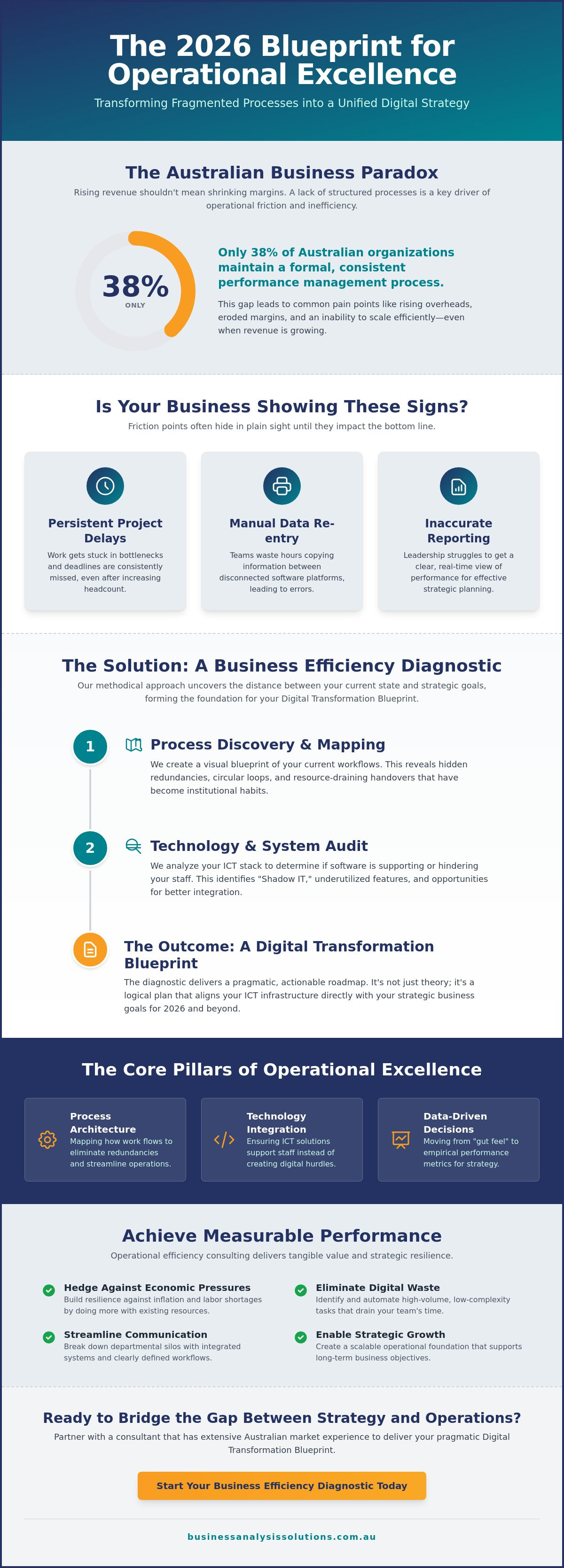
Only 38% of Australian organizations currently maintain a formal, consistent performance management process with clear criteria and regular reviews. This lack of structural oversight often leads to a common paradox: rising overheads that erode margins even as revenue increases. If your internal systems don't communicate and your team lacks the specialized expertise to map complex workflows, you're likely feeling the weight of operational friction. Engaging with professional operational efficiency consulting is not a mere cost-cutting exercise. It is a logical, strategic alignment that transforms fragmented processes into a unified digital blueprint.
You understand that manual workarounds and technical debt are unsustainable for long-term growth. This article provides a clear roadmap for digital transformation, showing you how to bridge the gap between technical requirements and business objectives. We will explore a methodical framework for 2026 that leverages a business efficiency diagnostic and process mapping to ensure your ICT solutions drive tangible value and measurable performance.
Key Takeaways
Learn how a structured framework uses workflow analysis to hedge against modern economic pressures like inflation and labour shortages.
Understand why a Business Efficiency Diagnostic is the necessary foundation for identifying the distance between current operations and your strategic objectives.
Discover how professional operational efficiency consulting bridges the gap between ICT strategy and business analysis to prevent technical project failure.
Identify high-volume, low-complexity tasks suitable for automation implementation to eliminate digital waste and streamline communication.
Recognize the value of selecting a partner with extensive Australian market experience to deliver a pragmatic Digital Transformation Blueprint.
Table of Contents
What is Operational Efficiency Consulting?
Operational efficiency consulting is the methodical practice of auditing and refining an organization's internal mechanics. It focuses on the strategic analysis of workflows, technology, and human capital to ensure every resource is utilized to its highest potential. While many view it as a simple cost-reduction strategy, it's actually about maximizing the output generated from every unit of input. In a technical sense, Operational Efficiency represents the ratio between the effort expended and the results achieved.
The 2026 economic environment in Australia demands this level of precision. With business development and process improvement ranking as top priorities for 59% and 50% of industry leaders respectively, the focus has shifted toward structural resilience. High inflation and labor shortages make operational efficiency consulting a primary hedge against rising overheads. It allows a business to scale without a linear increase in costs, providing a buffer against market volatility.
It's vital to distinguish between efficiency and effectiveness. Efficiency is "doing things right," which involves reducing waste and friction within a process. Effectiveness is "doing the right things," ensuring that those processes align with overarching business goals. A consultant provides an objective lens to identify "invisible" bottlenecks that internal teams often overlook due to institutional habit. They bring a structured methodology to resolve complex organizational challenges that have become part of the furniture.
The Core Pillars of Operational Excellence
A successful engagement rests on three fundamental pillars. First is process architecture, which maps how work flows through the organization to eliminate redundancies. Second is technology integration, ensuring that ICT solutions support staff rather than creating digital hurdles. Finally, data-driven decision making moves the organization away from "gut feel" toward empirical performance metrics. This shift ensures that every strategic move is backed by hard data.
Signs Your Organisation Requires External Analysis
Certain symptoms indicate a need for professional intervention. These friction points often remain hidden until they begin to impact the bottom line:
Persistent project delays that occur despite an increased headcount.
High rates of manual data re-entry across disconnected software platforms.
Leadership's inability to extract accurate, real-time reporting for strategic planning.
Operational efficiency consulting addresses these issues by replacing fragmented workarounds with a cohesive Digital Transformation Blueprint. This methodical approach ensures that your technical infrastructure and business goals are in total harmony.
The Business Efficiency Diagnostic: A Methodical Approach
Effective change cannot happen in a vacuum. Every engagement begins with a Business Efficiency Diagnostic, a rigorous audit designed to uncover the structural realities of your organization. This phase is about identifying the "gap," which is the measurable distance between your current operational state and your 2026 strategic goals. By capturing insights from the shop floor to the boardroom, we ensure that the resulting strategy isn't just high-level theory but a practical response to daily friction. This diagnostic output serves as the foundation for an actionable Digital Transformation Blueprint.
Professional operational efficiency consulting relies on this empirical evidence to drive results. Without a deep-dive audit, organizations risk implementing solutions for the wrong problems, which leads to wasted capital and employee frustration. A structured diagnostic ensures that every subsequent investment in technology or process change is rooted in a logical necessity rather than a trend.
Step 1: Process Discovery and Mapping
Visualizing the current state allows us to identify redundancies, circular loops, and unnecessary handovers that drain resources. We use process mapping to reveal technical debt within existing ICT systems, highlighting where legacy methods are holding back modern growth. Process mapping is the foundational step of any efficiency project. By documenting these workflows, we create a shared language for improvement that transcends departmental silos and provides clarity for leadership.
Step 2: Technology and System Audit
The next stage involves evaluating whether your current software suites are being utilized to their full potential. Many organizations suffer from "Shadow IT," where staff use unauthorized tools to bypass inefficient official systems. This fragmentation compromises security and creates data silos. During this audit, we assess the feasibility of automation implementation for repetitive, high-volume tasks, ensuring your technology investments deliver a measurable return.
Step 3: Strategic Blueprinting
A successful strategy prioritizes improvements based on ROI and ease of implementation. We develop a phased roadmap that focuses on high-impact wins first, which helps avoid operational burnout and builds momentum for larger changes. This phase links our diagnostic findings to a comprehensive Digital Transformation Blueprint for Business. Through expert operational efficiency consulting, we move from observation to execution, ensuring your business remains competitive in a tightening market.
Bridging the Gap Between ICT Strategy and Business Analysis
Technical solutions often fail because they lack operational context. When an organization implements "best in class" software without a deep understanding of its internal workflows, the result is usually a digital layer that adds complexity rather than resolving friction. High-level operational efficiency consulting addresses this by ensuring that ICT strategy is never developed in a vacuum. It requires a rigorous business analysis phase to translate executive vision into functional technical requirements that developers and vendors can actually execute.
In 2026, 49% of Australian businesses plan to increase spending on technology. This investment priority makes vendor-neutral advice essential. Without it, organizations risk purchasing expensive tools that solve isolated problems while creating new bottlenecks elsewhere. A seasoned consultant ensures that solutions are "fit for purpose," focusing on system harmony and long-term utility rather than the latest marketing trends. This pragmatic approach prevents the common trap of over-engineering a simple process or under-serving a complex one.
The role of the Business Analyst is to act as a translator. They bridge the divide between what the leadership wants to achieve and what the technology is capable of delivering. By maintaining a focus on the desired outcome, they ensure that every ICT solution is a direct response to a diagnosed operational need. This discipline keeps the project scope tight and the budget focused on high-impact results.
The Fractional CIO Advantage
Mid-market firms frequently require executive-level IT leadership but cannot justify a full-time C-suite salary. This is where Fractional CIO Services Australia provide a distinct advantage. By aligning technology spend with broader efficiency goals, a fractional leader ensures that every ICT solution serves the organizational objective. They provide the strategic oversight necessary to manage complex digital transformations without the overhead of a permanent role, ensuring that technology remains an asset rather than a liability.
Process Mapping as a Technical Requirement
Detailed process maps are not just administrative exercises; they are critical technical requirements. They prevent expensive mistakes during software procurement by identifying exactly where a new system must integrate with existing workflows. When you clearly define these integration points, you significantly reduce the risk of ICT project failure. This methodical approach to operational efficiency consulting ensures that your digital infrastructure is built on a foundation of proven logic. It eliminates the guesswork that often leads to technical debt and ensures that your systems are ready to scale when you are.
Practical Outcomes: Automation and Streamlined Operations
Strategic operational efficiency consulting delivers tangible results by identifying and eliminating "Muda," a term used to describe waste within a workflow. In a digital context, this waste often manifests as redundant communication, excessive approval layers, or manual data entry that serves no strategic purpose. By refining these processes, an organization can redirect its resources toward high-value activities that directly impact the bottom line. This shift improves financial performance not by cutting staff, but by optimizing how they spend their time.
The primary vehicle for this optimization is automation implementation. The focus remains on high-volume, low-complexity tasks that consume disproportionate amounts of administrative effort. When these processes are streamlined, the reduction in operational friction is immediate. Leadership gains better visibility into performance, while teams are empowered to focus on complex problem-solving rather than rote repetition. This methodical approach ensures that every automated step is a logical response to a documented inefficiency.
Automation vs. Human Capital
Successful automation is never about replacing human talent. It's about freeing staff from administrative drudgery so they can contribute to high-level strategy. Utilizing tools like the Microsoft Power Platform allows businesses to create custom workflows that bridge the gap between disparate systems. This "people-first" approach is critical. When employees see automation as a tool that enhances their capability rather than a threat to their role, change management becomes significantly more effective. This alignment ensures that the digital transformation is sustainable and supported across all levels of the organization.
Measuring the ROI of Efficiency Consulting
The return on investment for operational efficiency consulting is measured through both short-term wins and long-term structural savings. Immediate improvements often appear as reduced cycle times and lower error rates in transactional processes. Over time, these efficiencies translate into improved overhead ratios and greater organizational agility. Tracking these metrics requires a robust framework of measurable KPIs that move beyond simple revenue figures to assess true operational health. Metrics such as cycle time, error rates, and resource utilization provide the empirical data needed to justify ongoing optimization.
For a deeper dive into performance frameworks, refer to our Strategic Guide to Business Efficiency. This resource provides the granular detail needed to sustain improvements over the long term. If you're ready to identify the specific bottlenecks in your current workflow, our team can help you develop a clear path forward through a professional Business Efficiency Diagnostic.
Choosing the Right Operational Efficiency Consulting Partner in Australia
Selecting a partner for operational efficiency consulting is a decision that dictates the long-term success of your digital strategy. In the Australian market, the choice often lies between the high-level theoretical frameworks of the Big 4 and the pragmatic, hands-on approach of boutique specialists. While large firms offer prestige, they frequently struggle with the "implementation gap." This is the space between a strategic recommendation and its actual execution within your daily workflows. A consultant with over 20 years of experience in the Australian landscape brings a nuanced understanding of local industry standards and regulatory requirements that theoretical models cannot replicate.
Technical depth is equally critical. You need a partner who understands ICT solutions as deeply as they understand business analysis. If a consultant doesn't grasp the technical constraints of your infrastructure, their recommendations will likely lead to expensive, unworkable projects. The ideal collaborator stays through the execution phase, ensuring that the transition from current state to the optimized future state is seamless and logically sound. This commitment to end-to-end results is what separates a successful transformation from a failed IT project.
Key Questions for Prospective Partners
Before engaging a consultant, you must verify their ability to deliver practical value. Ask these specific questions to gauge their suitability for your organization:
Do you provide vendor-neutral technology recommendations, or are you incentivized to sell specific software suites?
What is your specific methodology for bridging the gap between business analysis and IT implementation?
Can you provide a clear Digital Transformation Blueprint as a formal project milestone?
How do you measure the tangible reduction in operational friction after a project is completed?
The Business Analysis & Solutions Difference
Our approach is fundamentally rooted in logic and professional precision. We specialize in bridging the gap between technical requirements and broader organizational objectives. This ensures that every ICT solution we propose is a direct response to a diagnosed business need. We don't just describe problems; we provide the clarity and direction required to resolve them through a structured, methodical framework.
The Business Analysis & Solutions difference lies in the depth of our Business Efficiency Diagnostic. We believe this is the most thorough audit in the market, designed to uncover the "invisible" bottlenecks that stall growth. By combining expert process mapping with fractional CIO services, we deliver a commitment to practical, end-to-end results. Our goal is to transform your fragmented systems into a high-performance digital blueprint that drives measurable, sustainable growth for years to come. Through professional operational efficiency consulting, we help you navigate the complexities of 2026 with confidence and clarity.
Future-Proofing Your Operational Framework
The transition toward a unified digital blueprint is essential for Australian organizations facing rising overheads and labor constraints. By prioritizing a methodical Business Efficiency Diagnostic, you can bridge the critical gap between technical ICT strategy and core business objectives. This process ensures that automation and process mapping serve a logical purpose, delivering measurable returns rather than added complexity. Professional operational efficiency consulting provides the objective lens necessary to identify and resolve the structural bottlenecks that impede sustainable growth.
Business Analysis & Solutions brings over 20 years of national industry experience to every engagement. As a boutique and vendor-neutral advisory, we prioritize your specific organizational requirements over software trends. We're committed to delivering practical, end-to-end results that align your technology spend with long-term financial performance. Take the first step toward a more resilient, high-performance operation. Book your Business Efficiency Diagnostic with Business Analysis & Solutions today. Your organization's transition from fragmented workflows to a streamlined digital future is within reach.
Frequently Asked Questions
What exactly does an operational efficiency consultant do?
An operational efficiency consultant conducts a rigorous audit of your internal processes to identify friction and waste. They use methodologies like process mapping and business analysis to bridge the gap between technical infrastructure and organizational goals. By providing an objective lens, they help leadership move from manual workarounds to a structured Digital Transformation Blueprint that supports sustainable growth. Their focus is on ensuring every resource is utilized to its highest potential.
How is operational efficiency different from cost-cutting?
Operational efficiency focuses on maximizing output from existing inputs, whereas cost-cutting often involves the blunt reduction of resources. Efficiency is about "doing things right" to improve margins through better resource allocation and streamlined workflows. While cost-cutting may provide short-term relief, operational efficiency consulting creates a resilient framework that allows a business to scale without a linear increase in overheads. It is a strategic growth tool rather than a defensive measure.
How long does a typical efficiency consulting engagement take?
The duration of an engagement varies based on organizational complexity and the project's scope. A standard Business Efficiency Diagnostic typically requires several weeks to capture data and map current workflows accurately. Larger transformations involving automation implementation or fractional CIO services can span several months. We deliver these projects in logical phases to ensure that each milestone provides immediate value without disrupting your daily operations or causing staff burnout.
What is the expected ROI of hiring an operations consultant?
ROI is measured through reduced cycle times, lower error rates, and improved overhead ratios. By eliminating waste in digital workflows, businesses often see significant structural savings over the long term. Beyond financial metrics, the return includes better alignment between ICT strategy and business goals. These improvements provide a distinct competitive advantage in a market characterized by high labor costs and inflation, as they allow for scaling without proportional cost increases.
Do I need to replace my existing software to improve efficiency?
Software replacement isn't always necessary to achieve performance gains. We first evaluate if your current ICT solutions are being utilized to their full potential or if "Shadow IT" is creating unnecessary silos. Often, efficiency is improved by refining how existing tools are integrated or by implementing targeted automation to bridge gaps between platforms. Our goal is to provide vendor-neutral advice that prioritizes functional outcomes over the purchase of expensive new software licenses.
How do you identify which processes should be automated first?
We prioritize processes that are high-volume, low-complexity, and prone to human error. During the process mapping phase, we identify repetitive tasks that consume disproportionate staff time but offer low strategic value. Automating these "low-hanging fruit" tasks provides immediate relief to your team and a faster return on investment. This methodical approach ensures that automation implementation is a logical response to documented bottlenecks rather than a trend-driven decision without clear utility.
What industries benefit most from operational efficiency consulting?
Any organization with complex workflows and multiple technical systems benefits from operational efficiency consulting. We see the most significant impact in mid-market firms within professional services, manufacturing, and logistics. These industries often struggle with fragmented systems that don't communicate, leading to rising overheads despite increasing revenue. Our framework is designed to resolve these specific challenges by creating system harmony and ensuring that technical requirements support broader organizational objectives.
How does a Fractional CIO fit into an efficiency project?
A Fractional CIO provides executive-level IT leadership to ensure technology spend aligns with long-term efficiency goals. They oversee the implementation of the Digital Transformation Blueprint and manage the technical requirements of the project. This role is essential for mid-market firms that need strategic oversight but don't require a full-time C-suite executive. They act as a bridge between leadership vision and technical execution, ensuring that ICT solutions remain fit for purpose and logically sound.



Comments