Legacy System Modernization Strategy: The Strategic Guide for 2026
- jonesaqayalo
- May 6
- 11 min read
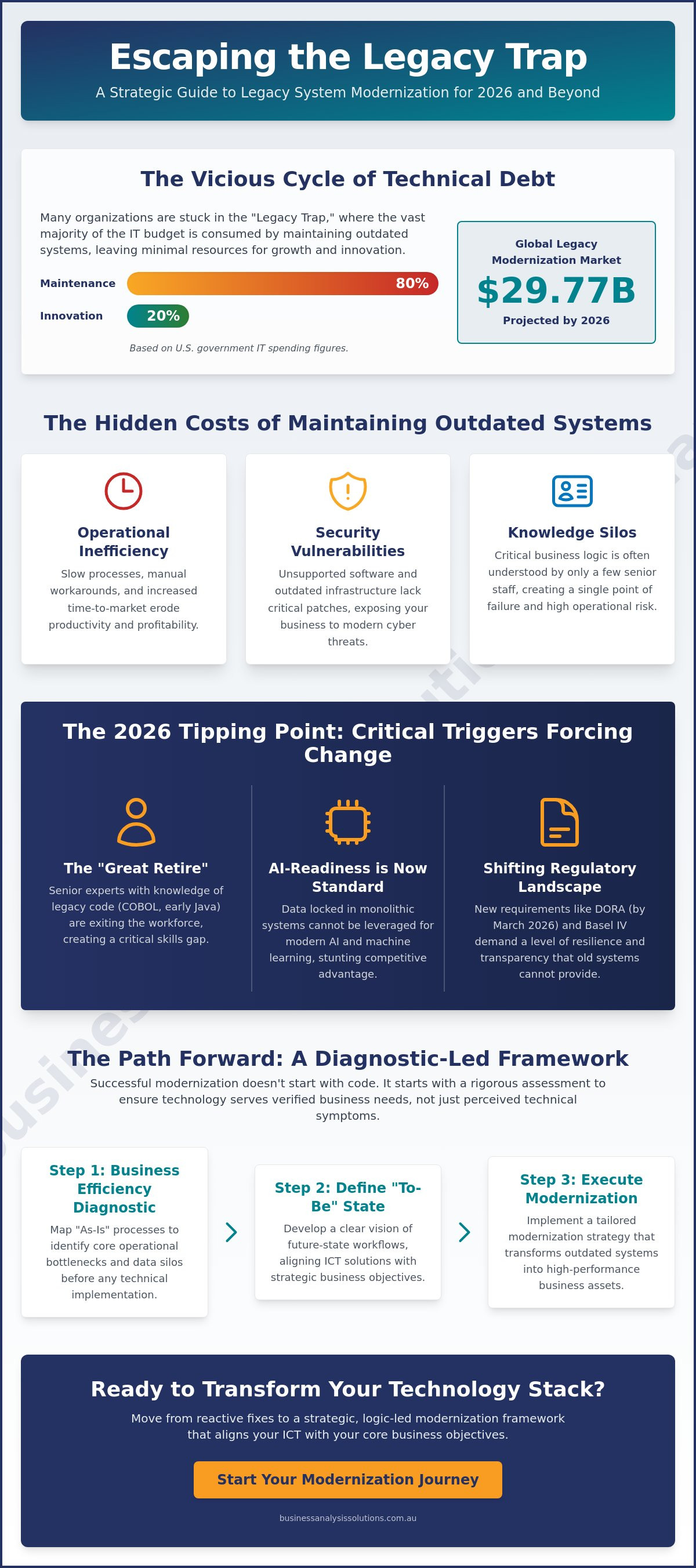
If your IT budget is subsidizing technical inertia rather than driving innovation, you're not just managing debt; you're losing your competitive edge. The U.S. government currently allocates 80% of its IT spend simply to maintain existing systems. This reality, coupled with the global legacy modernization market hitting $29.77 billion in 2026, highlights a critical pivot point for business leaders. Implementing a logic-led legacy system modernization strategy is no longer optional, especially with DORA reporting deadlines arriving in March 2026 and Basel IV requirements looming.
You understand that high maintenance costs and the departure of senior staff create significant operational risk. It's clear that your existing stack often lacks the agility required for modern automation. We'll demonstrate how to transform these outdated systems into high-performance assets using a diagnostic-led modernization framework. This guide provides a clear path to reduce technical debt and ensure your ICT solutions align perfectly with your broader business objectives.
Key Takeaways
Learn how to execute a legacy system modernization strategy that replaces reactive code fixes with a structured, diagnostic-led framework.
Evaluate the seven distinct modernization pathways to identify the specific trajectory that balances technical performance with organizational risk tolerance.
Discover how a Business Efficiency Diagnostic serves as a logical prerequisite for identifying operational bottlenecks before initiating technical change.
Understand how Fractional CIO services provide the strategic leadership required to bridge the gap between ICT requirements and business objectives.
Master a step-by-step roadmap for securing executive stakeholder buy-in and ensuring long-term strategic alignment throughout the transformation process.
Table of Contents Defining Legacy System Modernization in the 2026 Landscape The Business Efficiency Diagnostic: Assessing Modernization Readiness Evaluating the 7 Modernization Strategies: A Comparative Framework Developing Your Modernization Roadmap: A Step-by-Step Guide Navigating Transformation with Strategic ICT Leadership
Defining Legacy System Modernization in the 2026 Landscape
Legacy system modernization is the strategic transformation of outdated ICT infrastructure to support contemporary business objectives. It's not a mere technical patch or a series of isolated updates. Instead, it's a comprehensive realignment of your technology stack to ensure it facilitates growth rather than obstructing it. Strategic software modernization requires a deep understanding of how existing workflows interact with modern digital requirements to create a high-performance business asset.
Many organizations currently find themselves caught in the "Legacy Trap." This occurs when 80% of the IT budget is consumed by the maintenance of aging systems, leaving only 20% for innovation and new ICT solutions. This cycle is exacerbated by technical debt. Technical debt is the compounded cost of choosing easy, short-term workarounds over long-term strategic solutions. When left unaddressed, this debt creates a glass ceiling on your operational efficiency and limits your ability to adopt a successful legacy system modernization strategy.
The urgency for transformation has reached a critical point in 2026. Several external triggers are forcing the hand of executive leadership. First, the "Great Retire" of legacy code experts has reached its peak, with many senior staff who understand COBOL or early Java frameworks exiting the workforce. Second, AI-readiness has become a baseline requirement for market competitiveness. If your data is locked in siloed, monolithic architectures, you can't leverage the predictive power of modern machine learning tools. Finally, shifting regulatory landscapes demand a level of transparency and resilience that older systems simply weren't designed to provide.
The Real Cost of Maintaining Outdated Systems
Operational inefficiencies directly erode your bottom line by slowing down employee productivity and increasing the time to market for new services. Beyond speed, security vulnerabilities represent a significant risk; unsupported software versions often lack the patches necessary to defend against 2026-era cyber threats. Perhaps the most overlooked expense is the hidden cost of knowledge silos. When only one or two individuals understand a critical business process, they become a single point of failure that threatens organizational continuity.
Strategic Alignment: Why Modernize Now?
Modernization ensures your organization is prepared for cloud-native environments and integrated communication services. It's a prerequisite for achieving compliance with the Essential 8 cybersecurity framework, which is now a standard expectation for Australian enterprises. By integrating tools like Power BI into a refreshed technology stack, you move from reactive troubleshooting to data-driven decision-making. A robust legacy system modernization strategy ensures that every technical change serves a specific business outcome, providing a clear return on investment through improved efficiency and reduced risk.
The Business Efficiency Diagnostic: Assessing Modernization Readiness
A successful legacy system modernization strategy doesn't begin with code; it begins with a rigorous assessment of operational health. Jumping straight into technical implementation without a prior Business Efficiency Diagnostic often leads to "paving the cow path," where outdated, inefficient processes are simply digitized into newer, faster systems. This diagnostic acts as a logical filter, ensuring that every ICT investment addresses a verified business bottleneck rather than a perceived technical symptom.
Modernization is a high-stakes investment. Leaders must follow best practices for legacy modernization by first defining what the business actually needs the system to do in May 2026. This involves deep requirements elicitation to bridge the gap between technical possibilities and commercial necessities. By aligning your technology with the principles found in our Strategic Guide to Business Efficiency, you ensure that your transformation delivers measurable value rather than just a refreshed interface.
Mapping Your Business Processes
Process mapping provides the clarity needed to untangle organizational complexity. We start by visualizing the current "As-Is" state to reveal where legacy code creates friction or data silos. This stage often identifies redundancies that can be eliminated before a single line of code is moved. We then define the "To-Be" state, which represents how the business should operate independently of current software limitations. Engaging stakeholders across departments is vital here. It ensures that the final solution reflects the practical needs of those on the front lines, creating a unified vision for the project.
Evaluating Technical vs. Functional Value
Not every system requires a full overhaul. We utilize the Gartner TIME model to categorize assets into four quadrants: Tolerate, Invest, Migrate, or Eliminate. This objective framework helps determine if a system provides high functional value despite its age, or if it has become a liability that drains the 80% of IT budgets typically spent on maintenance. Calculating the potential ROI for each path allows for a prioritized roadmap. For systems requiring a complete rethink, a comprehensive Digital Transformation Blueprint provides the structural foundation for a successful transition, ensuring your modernization effort is both scalable and secure.
Evaluating the 7 Modernization Strategies: A Comparative Framework
Choosing the correct path for your legacy system modernization strategy requires a logical assessment of risk against anticipated business value. Technical teams often gravitate toward the most sophisticated solution, yet the most effective choice is the one that minimizes operational disruption while maximizing strategic alignment. A recent GAO report on modernizing legacy systems emphasizes that successful transformations depend on selecting a method that matches the organization's specific technical maturity and risk appetite.
The industry standard framework involves seven distinct approaches, often referred to as the "7 Rs." These range from low-intervention methods like Encapsulation and Rehosting to high-impact transformations such as Rearchitecting and Rebuilding. For a risk-averse national enterprise, a "Big Bang" approach often proves too volatile. Instead, an incremental rollout provides a controlled environment where ICT solutions can be validated in stages, reducing the likelihood of systemic failure. This methodical progression ensures that your Digital Transformation Blueprint remains the primary driver for every technical decision.
Low-Impact Strategies: Rehosting and Replatforming
Rehosting, or "Lift and Shift," involves moving existing applications to the cloud with minimal code alterations. It's a rapid solution for exiting expensive physical data centres, but it doesn't resolve underlying inefficiencies. Replatforming goes a step further by making minor adjustments to leverage modern database features or cloud-native scaling. While these strategies are cost-effective in the short term, they carry the risk of "paving the cow path." Without process mapping to identify redundancies, you simply move existing bottlenecks to a more expensive environment.
High-Impact Strategies: Rearchitecting and Rebuilding
When legacy code is beyond repair or no longer supports business objectives, high-impact strategies become necessary. Rearchitecting involves breaking monolithic applications into microservices, which allows for maximum scalability and easier integration with modern automation tools. Rebuilding is a total overhaul where the core logic is rewritten on a modern stack, such as the Microsoft Power Platform. This path offers the highest long-term business value but requires significant investment and precise project management to ensure the new system meets all elicitation requirements identified during the diagnostic phase. Your legacy system modernization strategy must balance these intensive efforts against the immediate need for operational stability.
Developing Your Modernization Roadmap: A Step-by-Step Guide
A successful legacy system modernization strategy requires a structured sequence of actions that prioritize business outcomes over technical novelty. Without a logical roadmap, organizations risk sinking resources into fragmented updates that fail to deliver a cohesive ROI. Given the global modernization market is projected to grow at a CAGR of up to 17.64% through 2032, a disciplined approach is essential for maintaining a competitive edge. The following five steps provide a professional framework for a controlled, high-performance transformation.
Step 1: ICT Audit and Diagnostic. We begin with a high-level audit and a Business Efficiency Diagnostic to identify where current infrastructure fails to support core operations.
Step 2: Strategic Alignment. Secure executive stakeholder buy-in by demonstrating how the project directly impacts the bottom line and long-term business goals.
Step 3: Strategy Selection. Determine the appropriate "R" from the seven modernization strategies based on a rigorous analysis of risk, cost, and functional value.
Step 4: Project Management. Execute the plan through disciplined ICT project management to ensure the project remains within scope, on time, and on budget.
Step 5: Phased Rollout. Implement the solution in manageable stages, incorporating rigorous testing and comprehensive user training to minimize operational downtime.
Phase 1: Discovery and Requirements Elicitation
Precision during the discovery phase is non-negotiable. We document functional and non-functional requirements with granular detail to ensure the final solution meets the actual needs of the business in 2026. This involves identifying complex dependencies between legacy databases and modern cloud integrations. A robust risk mitigation plan is developed at this stage, specifically addressing data migration integrity and business continuity during the transition period. We prioritize clarity to ensure that technical requirements never drift from the original business objectives.
Phase 2: Execution and Change Management
The success of the execution phase depends on expert project management to bridge the gap between technical teams and business stakeholders. We don't just manage code; we manage cultural change. Helping employees adapt to new digital workflows is essential for ensuring the system is actually utilized to its full potential. Continuous validation ensures that every milestone achieved during the rollout delivers the business efficiency promised in the initial diagnostic phase. If you're ready to secure your technology stack, explore our strategic ICT solutions to begin your transformation.
Navigating Transformation with Strategic ICT Leadership
Modernization projects frequently falter when technical execution lacks a governing strategic vision. While the frameworks discussed in previous sections provide the technical "how," they don't provide the executive leadership required to navigate organizational politics or shifting market demands. Many enterprises find that their internal teams are too immersed in daily operations to manage a complex legacy system modernization strategy effectively. This gap in high-level oversight often leads to scope creep and misaligned outcomes that fail to justify the initial investment.
An objective third-party consultant provides a level of neutrality that internal teams or software vendors cannot match. Vendors often push specific products to meet sales targets, but a strategic partner focuses exclusively on the right solution for your operational needs. At Business Analysis & Solutions, we act as the Analytical Partner that ensures technology serves the business, rather than forcing the business to adapt to the limitations of a new tool. This independent perspective is critical during vendor selection and ongoing project governance.
The Role of the Fractional CIO in Modernization
Small to mid-sized national enterprises often don't need a full-time executive, yet they require executive-level guidance to succeed. Fractional CIO services offer a cost-effective leadership solution for these organizations. These advisors translate technical roadmaps into clear business outcomes for the Board, ensuring that the investment is understood and supported at the highest level. They provide the necessary project governance to prevent budget blowouts, maintaining a strict focus on the strategic goals established during your diagnostic phase.
Bridging the Gap: Business Analysis as a Success Factor
Business analysts serve as the essential glue between ICT departments and business units. They excel at requirements elicitation, ensuring that any automation implementation delivers a tangible return on investment rather than just a technical upgrade. By focusing on process mapping and strategic alignment, we ensure that the new technology stack actually solves the problems identified in the Business Efficiency Diagnostic. This methodical approach reduces friction during the transition and ensures that the final stack is both scalable and secure. Modernization is not a destination but a continuous process of aligning technology with evolving business strategy.
Securing Your Operational Future Through Strategic Modernization
Transitioning from monolithic inertia to a high-performance technology stack requires more than just technical migration; it demands a total alignment of ICT resources with commercial goals. We've established that 80% of IT budgets are typically consumed by maintenance. Reversing this trend involves a disciplined legacy system modernization strategy that prioritizes high-ROI outcomes over technical complexity. By utilizing a diagnostic-led framework, you can identify exactly where your current infrastructure creates operational friction and address it through the most appropriate modernization pathways.
Success in 2026 hinges on independent leadership and precise business analysis. With over 20 years of strategic ICT consultancy experience, Business Analysis & Solutions specializes in bridging the gap between technical requirements and business objectives. We provide the objective oversight needed to govern complex transformations and prevent budget blowouts. Don't let outdated technology dictate your operational limits.
Book a Business Efficiency Diagnostic to assess your modernization needs.
Your organization's complexities can be untangled through a structured, methodical approach. We're ready to help you build a secure, scalable future.
Frequently Asked Questions
What is the most common reason legacy system modernization projects fail?
Modernization projects fail most frequently due to a lack of strategic alignment between technical requirements and business objectives. When organizations treat transformation as a purely technical task, they often ignore the operational workflows that drive actual value. This disconnect results in systems that are technically functional but operationally redundant, failing to deliver the efficiency gains promised to stakeholders.
How do I know if my business should rebuild or just rehost a legacy system?
The decision depends on the outcome of a Business Efficiency Diagnostic and the current level of technical debt. Rehosting is suitable for organizations needing a rapid exit from physical data centres with minimal code changes. Conversely, rebuilding is necessary when existing code is so brittle that it prevents modern automation or when the functional value of the system no longer meets 2026 market standards.
What are the primary security risks of delaying legacy system modernization in 2026?
Delaying modernization in 2026 exposes your organization to critical vulnerabilities, specifically an inability to comply with the Essential 8 cybersecurity framework. Outdated systems often lack the architecture required for modern multi-factor authentication and automated patching. Financial entities that fail to modernize also risk missing DORA reporting deadlines, such as the March 20, 2026, submission date for the Netherlands.
Can business process mapping really reduce the cost of IT modernization?
Process mapping significantly reduces modernization costs by identifying operational redundancies before any technical implementation begins. By visualizing the "As-Is" state, we often find that a specific percentage of legacy functions are no longer required by the business. Eliminating these requirements early prevents the expensive mistake of digitizing inefficient manual workarounds into a new technology stack.
How long does a typical legacy system modernization strategy take to implement?
A comprehensive legacy system modernization strategy typically requires between 6 and 18 months for full execution. The duration is dictated by the complexity of the chosen strategy; a simple rehost may take 3 to 5 months, while a full rearchitecting of a monolithic system involves multiple phases of requirements elicitation. A phased rollout ensures that business continuity is maintained throughout this period.
What is the role of a Fractional CIO during a system transformation?
A Fractional CIO provides executive-level ICT advisory and project governance without the expense of a full-time hire. They serve as the lead strategist who translates technical milestones into clear business outcomes for the Board. Their objective perspective is essential for managing vendor selection and ensuring that the project remains within its defined scope and budget throughout the transition.
How does technical debt affect my business valuation and growth potential?
High technical debt directly reduces business valuation by increasing the "cost to carry" for any potential acquirer. When 80% of an IT budget is dedicated to maintenance, there's little room for growth-oriented innovation. Investors in 2026 view legacy systems as a liability that necessitates immediate capital expenditure, which frequently leads to a lower purchase price during professional due diligence.
Is it possible to modernize a system without disrupting daily business operations?
Yes, it's possible to modernize without disrupting daily operations by employing an incremental rollout strategy rather than a "Big Bang" replacement. Using techniques like API wrapping allows modern applications to interact with legacy data while the underlying system is updated in stages. This methodical approach ensures that critical business processes remain online while the technology stack is systematically refreshed and optimized.



Comments