Justifying IT Investment to the Board: A Strategic Framework for 2026
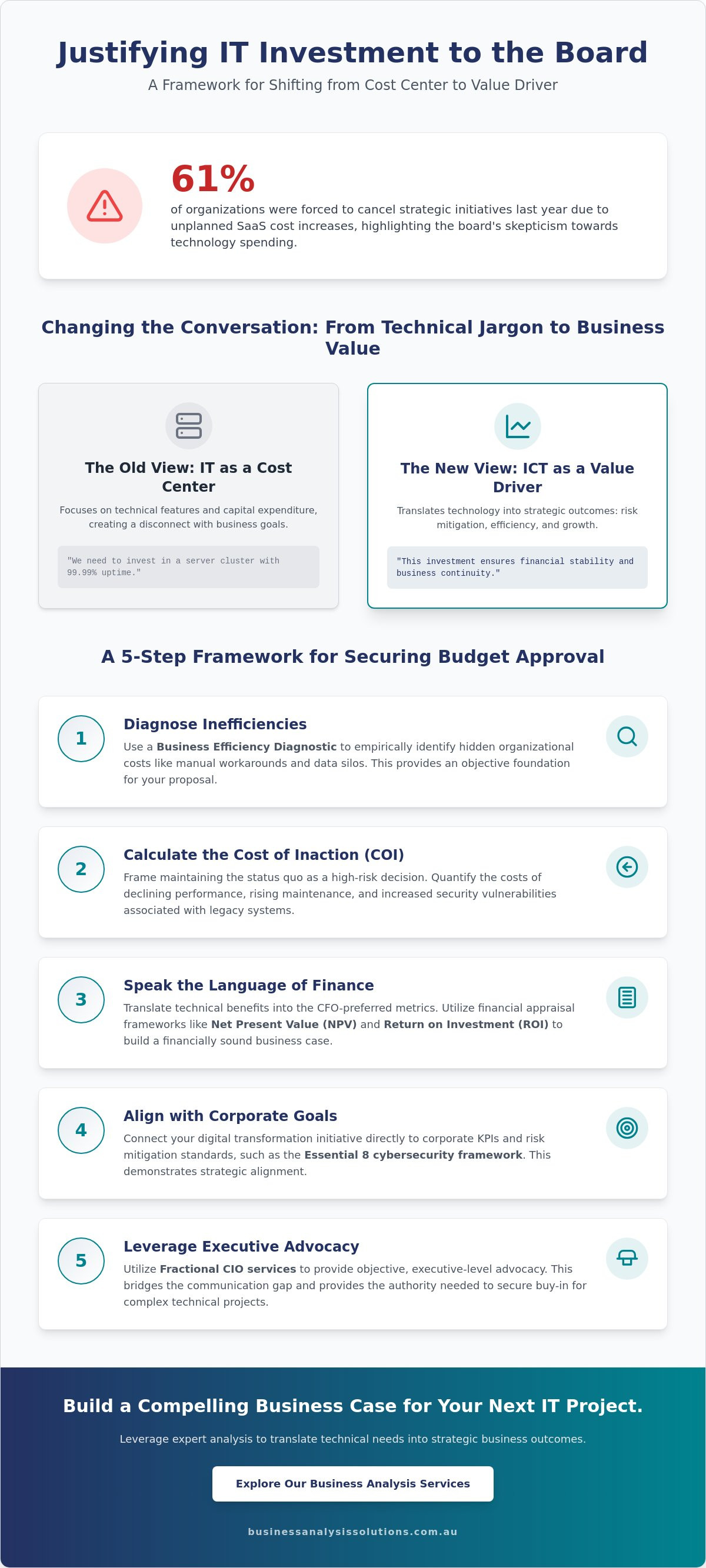
61% of organizations were forced to cancel strategic initiatives last year due to unplanned SaaS cost increases. This statistic highlights why many directors view technology spending with skepticism. When you're justifying IT investment to the board, the challenge isn't the technical validity of your proposal. It's the perceived disconnect between high-cost ICT solutions and tangible business outcomes. You likely feel the frustration of presenting a vital digital transformation blueprint only to have it treated as a discretionary expense rather than a strategic asset.
Mastering this high-stakes communication requires moving beyond technical jargon to focus on financial performance and system harmony. You'll learn how to build a compelling business case that translates complex requirements into the language of ROI and operational efficiency. This guide provides a methodical framework for securing budget sign-off and long-term buy-in. We'll examine the shift toward value-based justification, the integration of fractional CIO expertise, and the specific metrics required to track success after your project goes live.
Table of Contents
The Board’s Perspective: Shifting ICT from Cost Center to Value Driver
The historical friction between IT leadership and the boardroom often stems from a fundamental difference in perspective. While technical teams focus on the mechanics of infrastructure, boards typically evaluate requests through the narrow lens of capital expenditure. This creates a perception of IT as a black hole where investment disappears without a clear return. To overcome this, the conversation must shift toward treating ICT as a primary driver of operational capacity rather than a recurring cost.
When justifying IT investment to the board, success depends on aligning technical needs with the three pillars of corporate interest: risk mitigation, cost efficiency, and revenue growth. In 2026, the global economy rewards agility and punishes technical debt. Maintaining the status quo is no longer a safe bet; it's often the highest-risk strategy an organization can pursue. Outdated systems don't just slow down workflows. They create vulnerabilities that competitors will exploit and lead to missed market opportunities.
Why Technical Language Fails at the Board Level
Board members don't need to understand the nuances of microservices or cloud latency. They need to understand how those elements impact the bottom line. Feature-speak focuses on what the technology does, whereas outcome-speak focuses on what the business achieves. For example, instead of discussing 99.99% system uptime, frame the discussion around financial stability and business continuity. This transition requires abstracting technical complexity to highlight the strategic resolution. Proper Corporate Governance of IT ensures that every technical decision is rooted in a clear business objective, making the investment case logical and defensible.
The 2026 Strategic ICT Landscape in Australia
In the Australian market, corporate governance has evolved to demand higher levels of technology oversight. Boards are moving away from siloed software purchases toward integrated business technology that supports the entire enterprise lifecycle. There's a growing requirement for evidence-based ICT roadmaps that demonstrate how a project will scale and deliver tangible value. This trend reflects a sophisticated audience that values precision and expects technology leaders to act as analytical collaborators. By providing a structured, methodical approach to justifying IT investment to the board, you demonstrate the professional competence required to drive meaningful change in a complex environment.
Quantifying Efficiency: Using Diagnostics and Process Mapping to Build the Case
Boards often push back on technology spend because the data used to support the request is anecdotal rather than empirical. A Business Efficiency Diagnostic provides the objective foundation required to change this narrative. By auditing current operations, you can pinpoint exactly where data silos and manual workarounds are draining resources. These inefficiencies represent bottom-line leakage that often goes unnoticed in high-level financial reports. A digital transformation blueprint for business acts as the strategic roadmap, showing the board that your request is part of a calculated, long-term plan rather than a reactive fix.
Identifying the Cost of Inaction (COI)
The most powerful tool when justifying IT investment to the board is often the Cost of Inaction. Maintaining legacy systems for another 12 months isn't a neutral choice. It's a decision to accept declining performance, rising maintenance costs, and increased risk. In a financial environment where the prime rate sits at 6.75% as of July 2026, capital must be deployed where it generates the highest yield. Diagnostics reveal the true cost of these aging systems, framing the proposed project as a necessary resolution to identified organizational pain points. You can explore our business analysis services to see how diagnostic-led strategies provide the clarity boards demand.
The Role of Business Process Mapping in Justification
Visual evidence is essential for bridging the gap between technical requirements and executive understanding. Business process mapping allows leadership to see the "As-Is" state versus the "To-Be" state. This comparison demonstrates tangible change by showing exactly how many steps are removed or automated. This data is critical when you evaluate your next technology investment, as it feeds directly into financial models.
Consider the current landscape where organizations manage an average of 305 applications. Without clear mapping, the board sees only the cost of another license. With mapping, they see the resolution of a data silo that currently costs the business thousands in manual reconciliation. Instead of a high-risk implementation, process mapping allows for a logical sequence of improvements that build confidence through measurable, incremental success.
Financial Appraisal Frameworks: Speaking the Language of the CFO
Once the operational diagnostics have identified the specific areas of friction, the focus must shift to financial modeling. Justifying IT investment to the board requires a transition from technical feasibility to fiscal viability. CFOs and directors evaluate capital allocation through standardized metrics that allow them to compare a digital transformation project against other competing priorities, such as physical infrastructure or market expansion. Understanding these frameworks ensures your proposal is viewed as a rigorous business case rather than a simple purchase request.
Net Present Value (NPV) remains the primary tool for evaluating long-term ICT projects. It calculates the current value of all future cash flows generated by the investment, adjusted for the time value of money. If the NPV is positive, the project is expected to add value to the organization. Complementing this is the Internal Rate of Return (IRR), which represents the annualized percentage return. Boards use the IRR to determine if the project exceeds the company's "hurdle rate," or the minimum acceptable return on investment. While the payback period is often a favorite metric because it highlights how quickly the initial outlay is recovered, it's frequently flawed for ICT. It ignores the total lifecycle value and the ongoing efficiency gains that occur after the break-even point.
Beyond the Spreadsheet: Intangible Benefits
A common mistake in justifying IT investment to the board is failing to quantify "soft" benefits. You can assign financial value to improved customer experience by linking it to historical retention rates and lifetime value data. Similarly, enhanced employee morale can be quantified through reduced recruitment costs and lower turnover rates. Using a weighted scoring model allows you to combine these qualitative strategic benefits with hard financial data. This provides a holistic view of how the project supports the broader corporate strategy while maintaining financial discipline.
Accounting for Technical Debt and Risk
Successful financial appraisals must account for the reduction of technical debt. This is the cumulative cost of maintaining aging, inefficient systems that hinder agility. By factoring this reduction into your long-term ROI, you demonstrate a deep understanding of the total cost of ownership. You should also include a sensitivity analysis within your business case. This illustrates how the ROI changes if variables shift, such as if the implementation takes longer than expected or if the project runs 20% over budget. This level of transparency builds trust and highlights your commitment to methodical risk management. In the context of business efficiency, Return on Investment is the ratio between the net financial gains derived from optimized workflows and the total cost of ownership of the underlying technology.
Risk Mitigation and Strategic Alignment: The Final Pillars
While financial metrics provide the quantitative "why" for a project, risk mitigation provides the strategic "must." In 2026, justifying IT investment to the board requires a dual focus on growth and protection. A project that increases efficiency but leaves the organization vulnerable to disruption is a liability, not an asset. By aligning ICT solutions with established risk frameworks, you move the conversation from discretionary spending to essential enterprise resilience. This alignment ensures that technology serves the business strategy rather than dictating it.
The Essential 8 and Cybersecurity Justification
Cybersecurity has transitioned from a technical concern to a board-level fiduciary duty. In the Australian market, adhering to the Essential 8 is the baseline for professional competence. With global cybersecurity spending projected to reach $212 billion in 2026, boards expect a clear link between IT investment and the mitigation of catastrophic business interruption. Framing security as a competitive advantage allows the organization to assure clients and partners of its operational stability. This protective layer is a core component when justifying IT investment to the board, as it prevents the value erosion caused by data breaches or system failures.
Ensuring Strategic Harmony
Every dollar allocated to ICT must map directly to a corporate KPI. Whether the goal is ESG reporting accuracy or rapid market expansion, the technology should act as the enabler. When directors ask, "What if we do nothing?", the answer must be framed in terms of competitive decline and increased compliance exposure. Establishing clear post-implementation review (PIR) metrics during the initial justification phase ensures accountability. It shows the board that you aren't just asking for capital; you're committing to a specific, measurable outcome.
To ensure these outcomes are met, utilizing structured project management frameworks is essential. These frameworks provide the board with confidence in delivery success. A phased implementation strategy further reduces risk by delivering value in manageable increments rather than a single, high-stakes release. This methodical approach allows for course correction and ensures that the business begins seeing a return on its investment as early as possible. You can contact our team for a Digital Transformation Blueprint to begin aligning your technology with your corporate strategy.
Fractional CIO Services: Bridging the Executive ICT Gap
Many mid sized enterprises face a significant hurdle when justifying IT investment to the board: the absence of a dedicated, strategic technology leader at the executive table. While internal IT managers are often highly capable at maintaining operations, they may lack the financial vocabulary or the objective distance required to argue for large scale capital expenditure. This leadership gap is increasingly filled by external experts. Approximately 65% of mid sized enterprises reported using at least one fractional C suite leader in 2026, reflecting a shift toward agile, high caliber leadership models.
Engaging Fractional CIO services in Australia provides organizations with the "quiet confidence" that boards respect. These advisors bring a wealth of experience from multiple industries, allowing them to validate technical requirements against broader market standards. Because they operate on a part time or project basis, with monthly retainers typically starting around $2,999, they provide the strategic oversight of a full time executive at a fraction of the cost. This model ensures that your Digital Transformation Blueprint is not just a document, but a managed process from initial justification through to final execution.
Objective Advocacy vs. Internal Bias
Boards are naturally cautious of internal proposals that may be influenced by departmental politics or personal preferences. An external consultant provides an objective layer of validation that removes these biases. By conducting a third party Business Efficiency Diagnostic, a Fractional CIO can present an empirical, data driven case for investment. They act as the "Translation Layer," converting technical system harmony into the language of financial performance. This objective advocacy is often the deciding factor in justifying IT investment to the board, as it provides directors with a reliable, independent perspective on risk and return.
Securing Your 2026 ICT Budget
The path to a signed off budget requires a methodical approach that starts long before the boardroom presentation. To secure the necessary funding for your 2026 initiatives, consider these immediate steps:
Conduct a comprehensive diagnostic to identify current operational friction points.
Develop a structured business case using the NPV and IRR frameworks discussed in earlier sections.
Map every proposed dollar to a specific corporate KPI or risk mitigation requirement.
Engage an external advisor to provide objective oversight and executive level advocacy.
Success in the boardroom is the result of precision, logic, and a commitment to tangible business outcomes. If you are ready to move beyond "feature speak" and build a defensible, strategic case for your technology projects, contact Business Analysis & Solutions for a strategic consultation. Our team provides the analytical depth and professional distance required to turn complex ICT requirements into compelling business cases that drive organizational progress.
Securing Your Strategic Digital Future
Success in the boardroom depends on your ability to reframe ICT as a fundamental driver of operational capacity. By moving from technical descriptions to rigorous financial models like NPV and IRR, you provide directors with the clarity they need to approve capital expenditure. Utilizing a Business Efficiency Diagnostic ensures that your proposal is rooted in empirical data rather than anecdotal need. This structured approach is the most effective method for justifying IT investment to the board while ensuring long-term strategic alignment.
Business Analysis & Solutions brings over 20 years of strategic ICT experience to your organization. We are specialists in Business Efficiency Diagnostics with a proven track record in Australian corporate digital transformation. Our methodical approach removes internal bias and provides the objective advocacy required to secure your 2026 budget. You can Book a Strategic ICT Consultation with a Fractional CIO to begin building your defensible business case today. We look forward to helping you transform your technology into a high-performance financial asset.
Frequently Asked Questions
How do I justify an IT project that has no direct revenue increase?
Justify it through risk mitigation and operational capacity. If a project doesn't drive revenue, it must protect it. For example, upgrading infrastructure to meet Essential 8 standards prevents catastrophic downtime. Justifying IT investment to the board in these cases requires calculating the financial impact of a system failure versus the cost of the upgrade. Frame the project as an insurance policy for business continuity.
What is the most important financial metric for justifying IT to the board?
Net Present Value (NPV) is the most critical metric for long-term capital allocation. It allows the board to compare the current value of future efficiency gains against the initial investment. While the Internal Rate of Return (IRR) helps determine if the project meets the company's hurdle rate, NPV provides the most accurate picture of total value creation over the project's lifecycle.
How can I prove the ROI of 'soft' benefits like employee productivity?
Proving ROI for productivity requires converting reclaimed time into a dollar value. If process mapping identifies that automation saves five hours per week for twenty employees, you've recovered 100 labor hours weekly. Multiply these hours by the average hourly rate to quantify the efficiency gain. This empirical approach transforms a "soft" benefit into a hard financial metric that directors can easily evaluate.
What happens if the board rejects my ICT investment proposal?
A rejection is an opportunity to refine your strategic alignment. You should analyze the specific objections, which are usually rooted in perceived risk or unclear ROI. Re-examine your Business Efficiency Diagnostic to see if you missed a critical pain point. Justifying IT investment to the board often requires multiple iterations to ensure the proposal perfectly matches the organization's current risk appetite and capital constraints.
How often should I update the board on the progress of an IT investment?
Update the board quarterly on major ICT investments to maintain transparency and trust. These reports should focus on high-level milestones, budget tracking, and realized benefits rather than technical details. If the project is in a high-risk phase, monthly briefings may be appropriate. Consistent communication ensures that any necessary course corrections are handled through a collaborative, methodical approach rather than a crisis.
Can a Fractional CIO help with the actual board presentation?
A Fractional CIO acts as an objective advocate during board presentations. They provide the professional distance and financial vocabulary required to validate your proposal. By presenting the case through an external lens, they remove internal biases and focus strictly on logical outcomes. This executive-level presence builds board confidence and ensures the technical requirements are clearly translated into strategic business goals.
What is the difference between a business case and a project plan?
A business case is a strategic document used to secure investment by proving the project's value and ROI. It answers why the organization should spend capital. In contrast, a project plan is a tactical roadmap created after approval. It details the granular tasks, resource allocation, and timelines. You can't have a successful project plan without a defensible business case as its foundation.
How do I account for ongoing maintenance costs in my initial justification?
Use a Total Cost of Ownership (TCO) framework to include all recurring expenses. Initial capital expenditure is only one part of the financial story. You must factor in annual licensing, cloud consumption costs, and internal support requirements over at least three years. Providing this full lifecycle view demonstrates professional competence and prevents the board from being surprised by "hidden" costs after the project begins.



Comments