IT Strategy Consulting Firms in Australia: A Strategic Selection Guide for 2026
- jonesaqayalo
- May 9
- 12 min read
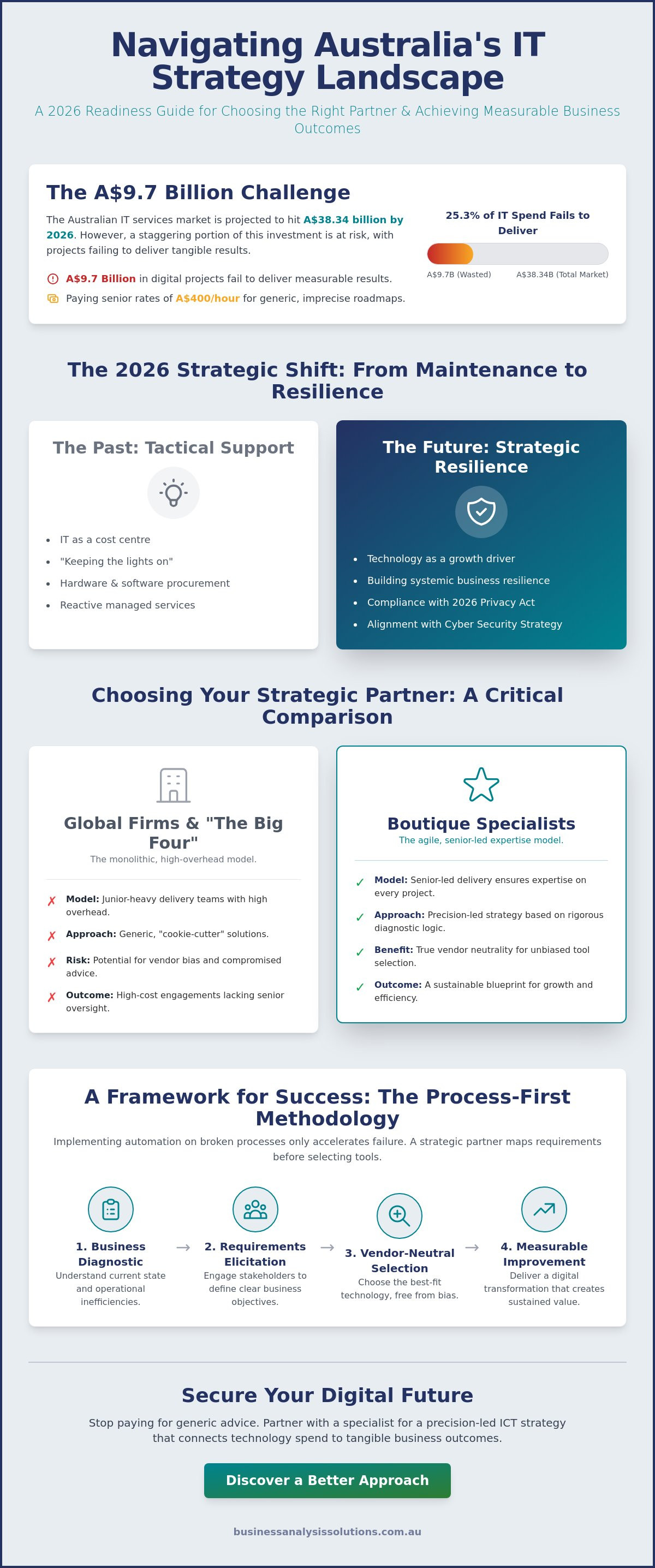
With the Australian IT services market forecast to reach A$38.34 billion in 2026, the primary challenge isn't finding a provider; it's ensuring your investment doesn't get lost in the A$9.7 billion landscape of digital projects that fail to deliver measurable results. You've likely felt the frustration of paying senior rates of A$400 per hour only to receive a generic roadmap that lacks the precision your operations require. It's common to see a misalignment between technical spend and business outcomes, especially when global IT strategy consulting firms Australia prioritize their own margins over your long term ICT governance.
This guide provides a logical framework to help you identify a partner who bridges the gap between technical requirements and strategic objectives. We'll outline how to evaluate firms based on their methodology, their readiness for the December 2026 Privacy Act amendments, and their ability to scale with Horizon 2 of the 2023-2030 Cyber Security Strategy. You'll learn how to secure a trusted advisor who offers a clear digital transformation blueprint designed for operational efficiency and sustained business value.
Key Takeaways
Understand the 2026 shift from basic infrastructure management to business resilience and how this evolution redefines the criteria for selecting a strategic partner.
Learn why a comprehensive business efficiency diagnostic is the essential prerequisite for any technology roadmap that aims to deliver measurable operational improvements.
Discover a structured framework for evaluating IT strategy consulting firms Australia to mitigate the risk of high-cost engagements that lack senior-level technical oversight.
Identify the critical roles of stakeholder engagement and requirements elicitation in bridging the gap between complex technical requirements and core business objectives.
Evaluate the strategic advantages of the boutique consultancy model, focusing on senior-led delivery and the long-term value of fractional CIO services.
Table of Contents
The Evolving Landscape of IT Strategy Consulting in Australia
The Australian business environment has reached a critical inflection point. By 2026, the demand for IT strategy consulting firms Australia has transitioned from tactical support to a requirement for systemic resilience. Historically, organisations viewed IT as a cost centre focused on hardware procurement and software licensing. Today, that perspective is obsolete. The federal government's A$9.7 billion investment in digital projects highlights a national shift toward technology as a primary driver of competitiveness. It's no longer enough to "keep the lights on"; technology must now actively drive market share.
Many Australian enterprises are intentionally distancing themselves from monolithic consulting models. While the "Big Four" once dominated government and enterprise advisory, their influence has contracted as leaders seek more agile, senior-led expertise. Organizations now prioritize partners who can navigate the complexities of Horizon 2 of the 2023-2030 Cyber Security Strategy without the overhead of junior-heavy delivery teams. This shift reflects a broader trend toward specialized, high-value advisory that prioritizes logic over brand name.
Defining Strategic ICT Consultancy
It's vital to distinguish between reactive managed services and proactive strategic advisory. Managed services focus on operational uptime, whereas IT strategy consulting focuses on long term organizational health. ICT consultancy is the alignment of technology with organisational goals. This objective, third party perspective is essential during technology selection. It prevents internal biases from driving procurement and ensures that every software investment serves a pre-defined business requirement. Without this distance, firms often find themselves locked into expensive ecosystems that don't fit their actual workflows.
The 2026 Digital Imperative
The integration of generative and agentic AI is no longer a future prospect; it's a current operational necessity. However, Australian businesses face significant risks when they adopt a "technology-first" approach. Implementing automation on top of broken processes simply accelerates failure. A "process-first" strategy ensures that digital transformation roadmaps are grounded in reality. By mapping requirements before selecting tools, leaders avoid the common pitfall of expensive, underutilised software.
With the Privacy Act 1988 amendments taking effect on 10 December 2026, transparency in automated decision-making is now a legal requirement. Firms must link their ICT investments directly to business efficiency to remain compliant and profitable. This alignment ensures that digital strategy isn't just about adopting new tools, but about creating a sustainable blueprint for growth in a volatile market. Success in this landscape requires a partner who understands that technical requirements must always serve the broader business objective.
Core Competencies of Top-Tier IT Strategy Firms
Effective IT strategy isn't a product of technical expertise alone; it's a product of rigorous diagnostic logic. Many organisations confuse managed IT services with strategic advisory. While a managed service provider ensures your servers are operational, top-tier IT strategy consulting firms Australia focus on whether those servers should exist at all. This distinction is critical for leaders who want to avoid the high cost of global firms that often deploy junior staff to implement cookie-cutter solutions. A true strategic partner prioritizes stakeholder engagement and requirements elicitation to ensure that every investment serves a specific business outcome.
Vendor neutrality is another hallmark of professional excellence. In a crowded software market, it's common for consultants to receive commissions from specific vendors, which inherently compromises their advice. A seasoned expert maintains independence, focusing solely on the logic of the solution rather than the brand of the tool. Aligning with the government's digital transformation agenda requires this level of objectivity. It ensures that your technology stack remains flexible and isn't burdened by unnecessary licensing costs or proprietary lock-ins that hinder long term agility.
Business Analysis as a Foundation
Successful IT strategy is built on the back of professional business analysis. Implementing technology on top of broken processes is one of the most expensive mistakes a business can make. It doesn't solve the problem; it simply makes the inefficiency happen faster. Through professional process mapping, consultants identify hidden bottlenecks that technical teams often overlook. This diagnostic phase ensures that the final ICT solutions are designed to fix the root cause of operational friction rather than just treating the symptoms. If you're unsure where your current technical debt is accumulating, a business efficiency diagnostic can provide the clarity needed to move forward.
Strategic Technology Roadmapping
A digital transformation blueprint serves as the bridge between a high level vision and granular execution. It must balance short term wins, such as automation implementation, with the long term goal of reducing technical debt. For Australian organisations, this means ensuring that ICT solutions are scalable and future proofed for 2026 and beyond. This roadmap doesn't just list products. It identifies the sequence of changes required to reach a state of increased operational efficiency. By following a structured method, businesses can move away from reactive spending and toward a model of proactive ICT governance that delivers sustained value.
Global Firms vs. Boutique Consultancies: A Strategic Comparison
Selecting between a global powerhouse and a specialized boutique is a decision that dictates the quality of senior level attention your project receives. While the global IT consulting firm rankings often highlight the "Big Four" for their immense scale and brand recognition, these attributes don't always translate to value for mid-market Australian organisations. A common risk with large scale firms is the "bait and switch" model. You're pitched by a senior partner, but the actual delivery is often handed to junior consultants with billing rates between A$80 and A$150 per hour who lack deep industry experience. This results in a generic strategy that fails to address the unique complexities of your business processes.
Boutique IT strategy consulting firms Australia offer a different value proposition centered on senior led delivery and agile execution. In these firms, the expert who designs your strategy is usually the one who oversees its implementation. This creates a higher level of accountability and ensures that the logic of the initial diagnostic phase isn't lost during the transition to execution. For a growing company, paying senior rates of A$250 to A$400+ per hour is a more logical investment when it guarantees direct access to seasoned practitioners who have spent decades bridging the gap between technical requirements and business objectives.
The Fractional CIO Advantage
For many Australian organisations, the cost of a full time Chief Information Officer is prohibitive, often exceeding A$250,000 per year plus benefits. The Fractional CIO model solves this by providing executive level IT oversight on a part time or retained basis. This approach allows you to secure strategic leadership for a fraction of the cost, typically ranging from A$5,000 to A$15,000 per month depending on the organisation's size. A Fractional CIO drives governance and accountability by ensuring technical decisions align with the long term business roadmap. It's a pragmatic solution for businesses that need to bridge the gap between the boardroom and the server room without the overhead of a full time executive.
Project-Based vs. Retained Advisory
Choosing the right engagement model depends on your specific goals. Project based engagements are ideal for defined ICT implementations, such as a major automation rollout or a digital transformation blueprint. These projects typically range from A$20,000 to A$100,000 for mid-sized implementations. Conversely, retained advisory offers ongoing strategic alignment in a market that changes rapidly. It ensures that as new regulations emerge, such as the December 2026 Privacy Act updates, your organisation has a trusted advisor ready to adjust the strategy. Evaluating firms based on their track record of tangible business improvements, rather than just their technical certifications, is the most reliable way to ensure long term ROI.
Evaluating Methodology: A Framework for Selection
Selecting from the available IT strategy consulting firms Australia requires looking past marketing portfolios to scrutinize their underlying logic. A firm's reputation in a survey doesn't guarantee a successful outcome for your specific business. Instead, you must evaluate the actual framework they use to move from an identified challenge to a tangible result. High quality firms don't start with a sales pitch for a specific software suite. They start with a deep inquiry into your current operational state.
A structured selection process involves five critical steps. First, assess the diagnostic phase. If a consultant proposes a solution within the first hour, they aren't diagnosing; they're selling. Second, vet their requirements elicitation process. This shouldn't be a simple list of features. It must be a rigorous exploration of stakeholder needs and process dependencies. Third, verify vendor neutrality. A consultant who receives commissions from software providers cannot offer objective advice. Fourth, evaluate their plan for stakeholder engagement. Finally, review their project management framework to ensure it includes clear milestones and accountability measures.
The Diagnostic Process
A Business Efficiency Diagnostic is the only logical starting point for any engagement. This phase should produce a logic-heavy report that identifies the root causes of friction, not just a fluff-heavy slide deck filled with industry buzzwords. You'll know a diagnostic is effective when it uncovers inefficiencies you hadn't previously quantified. For example, mid-sized implementations in Australia often cost between A$20,000 and A$100,000. Investing in a A$5,000 to A$20,000 diagnostic project ensures that the larger implementation spend is targeted at the right problems. If a consultant doesn't understand your industry's specific regulatory nuances, such as the upcoming changes to the Privacy Act, their diagnostic will lack the necessary depth.
Stakeholder Alignment and Change Management
Even the most technically sound IT strategies fail without internal buy-in. Resistance is a natural response to change, and a consultant’s role includes navigating the organizational politics that can stall a project. They must bridge the gap between executive vision and the daily reality of staff. This involves integrating business technology into the daily workflow in a way that feels supportive rather than disruptive. Successful change management ensures that new ICT solutions are actually adopted, rather than becoming expensive shelfware. To ensure your next technology roadmap is built on a foundation of operational logic, book a business efficiency diagnostic today to identify your path forward.
Business Analysis & Solutions: Precision-Led ICT Strategy
With over 20 years of experience in the Australian market, Business Analysis & Solutions has built a reputation for untangling organizational complexities through a structured, methodical approach. We distinguish ourselves from other IT strategy consulting firms Australia by maintaining a singular focus on high-level strategic outcomes. Our expertise lies in bridging the gap between technical requirements and business objectives. This ensures that every ICT investment is grounded in operational logic rather than technical trend-following. By prioritizing precision, we help leaders move from a state of technical ambiguity to one of strategic clarity.
A core part of our methodology is the "Solution-First" mindset. In complex environments, the easiest path is often a distraction. We value the right solution over the easiest one, which requires a deep immersion in professional business analysis standards. We explicitly exclude managed IT helpdesk support and custom software development from our service offerings. This is a deliberate strategic choice. By removing the distraction of reactive support tickets, we ensure our senior practitioners remain focused on long-term ICT governance and strategic alignment. This focus allows us to act as a pure analytical partner for your executive team.
Our Strategic Service Suite
Our capabilities extend from initial process mapping to full-scale automation implementation. We provide expert project management for complex ICT transformations, ensuring that digital blueprints are executed with surgical precision. Our commitment to objective, logical advisory means we act as a trusted partner throughout the entire project lifecycle. We utilize rigorous requirements elicitation and stakeholder engagement to identify the specific needs of your organization. This ensures that the resulting ICT solutions deliver tangible return on investment and increased operational efficiency.
Partnering for National Growth
We're dedicated to supporting Australian organizations as they strive for operational excellence in an increasingly competitive global economy. Our approach is characterized by a direct, no-nonsense Australian professional character that prioritizes results over marketing fluff. Whether you're navigating the 2023-2030 Cyber Security Strategy or preparing for the December 2026 Privacy Act amendments, we provide the steady, methodical guidance required to succeed. We offer more than just advice; we offer a stable partnership rooted in international standards and local expertise. If your organization is ready to move beyond basic infrastructure management toward a truly strategic technology roadmap, request a Business Efficiency Diagnostic from Business Analysis & Solutions to begin your transformation.
Securing Your Digital Future in 2026
The evolution of the Australian digital landscape requires a shift from reactive IT spending to proactive ICT governance. By 2026, the distinction between high-performing organisations and those struggling with technical debt will depend on their choice of IT strategy consulting firms Australia. Logic must drive technology. Success requires a framework that prioritizes business analysis and stakeholder alignment over software procurement. Moving forward with a "process-first" methodology ensures that your investments remain transparent and compliant with the December 2026 Privacy Act updates.
Business Analysis & Solutions brings over 20 years of industry experience to help you bridge the gap between complex technical requirements and core business objectives. We offer clarity in a crowded market. Whether you require executive-level Fractional CIO services or a specialized Business Efficiency Diagnostic framework, our focus remains on delivering tangible results. Optimise your organisation with a Digital Transformation Blueprint from Business Analysis & Solutions. By grounding your technology roadmap in precision, you ensure your organisation is prepared for the challenges of the next decade. Your path to operational excellence starts with a single, logical step.
Frequently Asked Questions
What is the difference between IT consulting and IT strategy?
IT strategy defines the alignment between technology and business objectives, while IT consulting often addresses specific technical implementations. Strategy focuses on the long-term roadmap and governance. Consulting typically solves immediate technical hurdles. For most IT strategy consulting firms Australia, the goal is to ensure that every technical decision supports the broader organizational vision rather than just fixing a localized problem. It's the difference between building a bridge and planning the entire transport network.
How much do IT strategy consulting firms in Australia typically cost?
Market rates in 2026 vary based on consultant seniority. Junior consultants typically bill between A$80 and A$150 per hour. Mid-level practitioners range from A$150 to A$250, while senior advisors command A$250 to A$400+ per hour. For project-based work, mid-sized implementations often fall between A$20,000 and A$100,000. These costs reflect the complexity of the diagnostic phase and the level of specialized expertise required to deliver a logical, risk-adjusted outcome.
What should be included in a digital transformation blueprint?
A digital transformation blueprint must contain a current state diagnostic, a future state vision, and a detailed gap analysis. It functions as a strategic document that links ICT investment to business efficiency. Key components include a risk assessment, a phased implementation roadmap, and a change management plan. This document ensures that technical requirements are mapped to stakeholder needs, preventing the adoption of expensive software that fails to solve operational friction.
Why do many ICT projects fail in large organisations?
ICT projects in large organisations frequently fail due to a lack of stakeholder engagement and inadequate requirements elicitation. When technical teams work in isolation from business units, the resulting solutions often miss the mark. Misalignment between technical spend and business outcomes leads to low adoption rates. Successful projects require a logical framework that bridges this gap, ensuring that every technical change is supported by a clear business case and internal buy-in.
Can a boutique firm handle large-scale digital transformation?
Boutique firms are highly capable of managing large-scale transformations because they prioritize senior-led delivery over staff volume. Unlike larger firms that may assign junior consultants to complex tasks, boutiques offer direct access to seasoned experts. This ensures that the logic of the strategy is maintained throughout the execution phase. They provide an agile, objective perspective that is often more effective at navigating organizational complexities than rigid, monolithic consulting models.
What is a Fractional CIO and does my business need one?
A Fractional CIO is an executive-level leader who provides strategic oversight on a part-time or retained basis. Your business needs one if you lack a dedicated technology roadmap but don't require a full-time executive salary. This model is particularly effective for growing companies that need to align their ICT governance with international standards. It provides the boardroom with the technical clarity needed to make informed investment decisions without the A$250,000+ overhead.
How long does it take to develop a comprehensive IT strategy?
Developing a comprehensive strategy usually requires between 8 and 12 weeks of dedicated analysis. This timeframe accounts for the diagnostic phase, stakeholder interviews, and process mapping. It's a methodical process that cannot be rushed if the goal is a reliable, future-proofed roadmap. IT strategy consulting firms Australia use this period to untangle complexities and ensure that the final blueprint is grounded in the reality of the organization's current operational state.
What is the "Essential 8" and should my IT consultant address it?
The Essential 8 is a set of baseline mitigation strategies developed by the Australian Signals Directorate to protect against cyber threats. Your consultant must address these to ensure your organisation meets national security standards. As Australia moves into Horizon 2 of the 2023-2030 Cyber Security Strategy, compliance becomes even more critical. Addressing these strategies helps build a resilient foundation that protects your data and maintains stakeholder trust in an increasingly volatile environment.



Comments