IT Project Management Best Practices 2026: A Strategic Guide to ICT Success
- jonesaqayalo
- Jun 13
- 12 min read
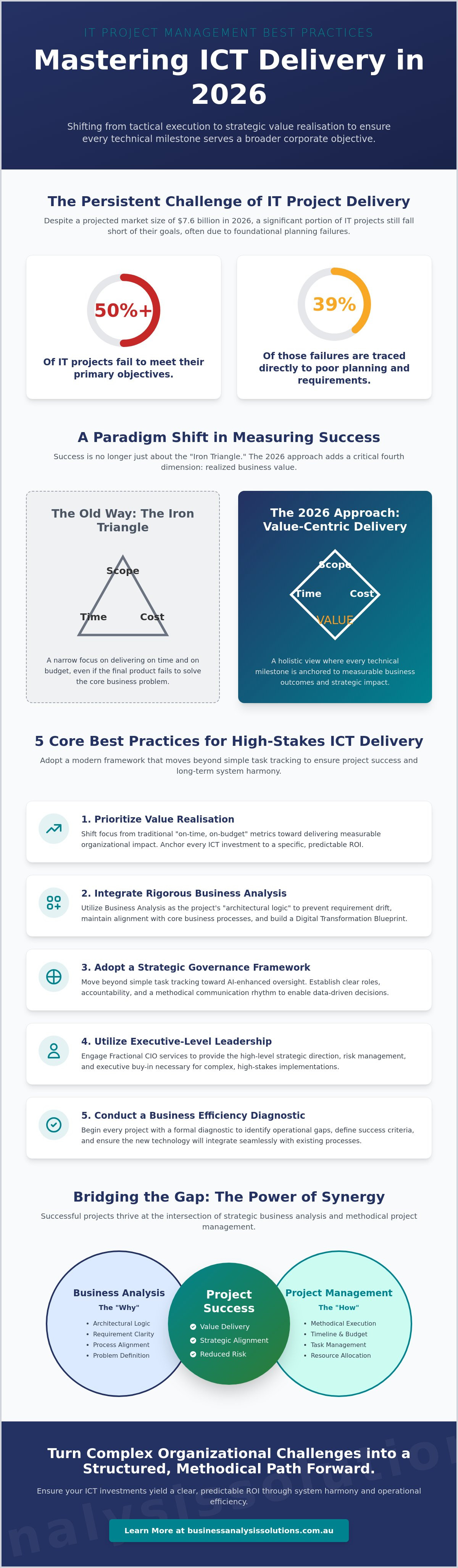
Did you know that over 50% of IT projects still fail to meet their objectives, with 39% of those failures traced directly back to poor planning? This reality persists even as the project management software market reaches a projected $7.60 billion in 2026. Implementing IT project management best practices 2026 requires more than just adopting Jira or Notion. It demands a fundamental shift toward strategic governance and rigorous business analysis to ensure every technical milestone serves a broader corporate objective.
You likely understand the frustration of watching a technical delivery drift away from its original business case while budgets climb and timelines slip. It is a common challenge where technical output and organizational goals fail to align, creating friction between stakeholders and delivery teams. You're looking for a way to turn these complex organizational challenges into a structured, methodical path forward that prioritizes clarity and reliability.
This guide will show you how to master the high-level frameworks and methodical approaches required to deliver complex technology projects with precision and measurable organizational value. We'll explore how to leverage hybrid methodologies, integrate Fractional CIO oversight, and ensure your ICT investments yield a clear, predictable ROI through system harmony and operational efficiency.
Key Takeaways
Shift focus from traditional "on-time, on-budget" metrics toward value realisation to ensure every ICT investment delivers measurable organizational impact.
Integrate rigorous Business Analysis as the architectural logic for your projects to prevent requirement drift and maintain alignment with core business processes.
Adopt a strategic governance framework that incorporates IT project management best practices 2026, moving beyond simple task tracking toward AI-enhanced oversight.
Utilize executive-level leadership through Fractional CIO services to provide the strategic direction and risk management necessary for high-stakes implementations.
Conduct a formal Business Efficiency Diagnostic at project inception to identify operational gaps and ensure seamless integration of new technology.
Table of Contents
The Evolution of IT Project Management: Why Strategy Trumps Tactics in 2026
Digital maturity in 2026 is defined by an organization's ability to convert technical potential into tangible financial performance. IT project management serves as the primary mechanism for this conversion. It is no longer sufficient to treat a rollout as a isolated technical exercise; it's a core driver of organizational change. Adopting IT project management best practices 2026 requires a shift from a reactive, firefighting posture to a proactive, strategic one that prioritizes logic and precision.
For decades, the "Iron Triangle" of scope, time, and cost was the sole barometer of success. While these metrics remain relevant, they're no longer the primary goal. Delivering a project on time is a hollow victory if the resulting system fails to drive operational efficiency or solve the underlying business problem. The focus has moved toward value realisation. This approach demands that every technical milestone is anchored to a specific business outcome, ensuring that ICT investments produce a measurable return.
Many organizations still fall into the trap of "hope-based" management. They implement new systems and hope the staff adopts them, or they set a budget and hope it remains static despite shifting requirements. With 39% of projects failing due to poor planning, this lack of structure is a significant liability. Success in complex ICT environments relies on the clarity provided by a Digital Transformation Blueprint. This document establishes firm project boundaries and ensures that every technical decision supports the overarching digital strategy, preventing the project from drifting into irrelevance.
The 2026 Value-Centric Approach
Modern software project management methodologies must now account for "Impact" as a critical fourth dimension. Strategic alignment is the best defense against the accumulation of technical debt and project fatigue. When a team understands how their work contributes to system harmony, performance improves. 2026 IT project management is a disciplined vehicle for organizational evolution that transforms technical requirements into sustainable business value.
Defining Project Success Criteria
Success must be defined by measurable KPIs established long before the first configuration begins. It's vital to differentiate between project completion and business adoption. A project is only successful when the new technology is seamlessly integrated into existing business processes and utilized by the workforce. This level of ICT sustainability requires consistent executive buy-in. Leaders must view these initiatives as long-term strategic assets rather than one-off expenses. Establishing these criteria early provides the analytical framework needed to track progress and identify potential issues before they compromise the project's ROI.
Core Best Practices for High-Stakes ICT Solution Delivery
High-stakes ICT delivery requires a move away from reactive troubleshooting toward a framework of total project control. In 2026, the complexity of integrated systems means that a single point of failure can disrupt an entire organizational ecosystem. Implementing IT project management best practices 2026 starts with establishing a rigid governance structure. Every stakeholder must have a defined role and clear ownership of specific outcomes. This accountability ensures that decisions are made based on data rather than consensus-driven delay.
Predictability is the hallmark of professional project management. To achieve this, leaders must maintain a methodical communication rhythm that bridges the gap between technical requirements and broader organizational objectives. This isn't about more meetings; it's about the quality and sequence of information. A steady flow of data ensures that leadership can make informed decisions about financial performance and operational efficiency without getting lost in technical complexity. It creates a sense of momentum that keeps teams focused on the strategic outcome rather than just the next task.
The Diagnostic Foundation
Every successful project begins with a Business Efficiency Diagnostic. Before a single dollar is allocated to a new ICT solution, you must understand the current operational landscape. Applying technology to a flawed process only accelerates inefficiency. A diagnostic phase identifies existing bottlenecks and ensures that the proposed solution addresses a documented business problem. This phase is the bedrock of the Digital Transformation Blueprint, providing the empirical data needed to set realistic project boundaries. If you don't anchor your project in a clear understanding of current process mapping, you risk delivering a technically sound product that provides zero business value.
Methodical Risk Management
Risk mitigation in 2026 has evolved beyond static spreadsheets. It now involves predictive data analytics to identify potential disruptions before they manifest. Engaging an expert ICT consultancy helps uncover "unknown unknowns," particularly regarding vendor dependencies and third-party API integrations. You need a living risk register that evolves alongside the project lifecycle. This methodical approach is supported by expert insights on IT project management, which emphasize that proactive identification is the only way to maintain a predictable timeline. Managing these risks requires a commitment to resolution rather than just documentation. If your current projects lack this level of coordination, a professional Business Efficiency Diagnostic can provide the clarity required to reset your delivery framework and ensure system harmony.
Bridging the Gap: The Intersection of Business Analysis and Project Management
IT project management often fails when treated as a standalone administrative function. In reality, Business Analysis provides the architectural logic that prevents a project from collapsing under its own weight. By integrating IT project management best practices 2026, organizations ensure that technical delivery is always anchored to operational reality. Without this logical connection, teams often fall victim to "Requirement Drift," where the scope expands to accommodate features that don't actually solve the core business problem. This misalignment is a primary driver of budget overruns and missed deadlines.
Bridging the communication gap between technical teams and business leadership is a critical responsibility of the project lead. Leadership often speaks in terms of financial performance and strategic outcomes, while technical teams focus on configuration and deployment. Business Analysis acts as the necessary translator. It converts high-level strategic intent into granular technical requirements. Utilizing a digital transformation blueprint for business provides a shared language and a fixed reference point. This ensures everyone remains focused on the same strategic goals throughout the project lifecycle, preventing technical output from diverging from business objectives.
Process Mapping as a Project Prerequisite
You can't improve what you haven't documented. Visualising the "As-Is" state against the "To-Be" state is a critical prerequisite for any technical implementation. This level of business process mapping serves as the baseline for clarity. It allows project managers to link every task to a specific process improvement. If a proposed feature doesn't directly enhance a documented process, it's a candidate for removal. This methodical approach ensures that the project remains lean and focused on driving efficiency rather than just adding complexity.
The Requirements Traceability Matrix
Precision in 2026 requires a rigorous Requirements Traceability Matrix (RTM). This tool ensures that every technical feature serves a documented business requirement. It's a pragmatic way to reduce waste by eliminating "nice-to-have" features that add unnecessary complexity and cost. By maintaining focus on the established blueprint, the RTM prevents scope blowouts and keeps the project aligned with the initial business case. It provides the objective evidence needed to justify technical decisions to stakeholders, reinforcing the project's commitment to delivering tangible value. This disciplined approach eliminates ambiguity and ensures that the final delivery matches the original strategic vision.
Methodology and Governance: Adopting Hybrid and AI-Driven Frameworks
Selecting a delivery methodology is no longer a binary choice between Waterfall and Agile. In 2026, the industry has converged on a "fit-for-purpose" model that acknowledges the distinct requirements of different project components. While infrastructure and regulatory compliance often demand the rigid structure of Waterfall, user-facing applications benefit from the iterative nature of Agile. Adopting IT project management best practices 2026 means mastering this hybrid standard to ensure technical precision without sacrificing flexibility. This methodical approach allows organizations to maintain a predictable timeline while remaining responsive to shifting business needs.
Governance has also evolved from retrospective reporting to real-time project health monitoring. Modern organizations are increasingly replacing the traditional Project Management Office (PMO) with a Value Management Office (VMO). The VMO's primary function is to protect the strategic intent established in the Digital Transformation Blueprint. It ensures that every resource allocation is justified by a corresponding increase in operational efficiency or financial performance. This shift ensures that governance is an active driver of progress rather than a bureaucratic hurdle. Standardising documentation across these frameworks is essential for long-term system harmony, ensuring that the logic behind technical decisions remains accessible long after the project team has disbanded.
The 2026 Hybrid Methodology
The 2026 hybrid standard uses predictive elements for high-risk, fixed-cost components while employing adaptive cycles for features requiring user feedback. You should structure your sprints around business value milestones rather than just technical outputs. This ensures that the project delivers usable increments of value throughout its lifecycle. Maintaining a methodical pace is crucial; it avoids the team burnout often associated with poorly managed Agile environments. By setting clear boundaries for each phase, you provide the stability necessary for technical teams to focus on high-quality delivery.
AI Integration in Project Governance
Artificial Intelligence has become a standard component of professional project oversight. Leveraging advanced business technology allows you to automate status reporting and eliminate the manual data entry that often leads to human error. Predictive analytics now provide early warning signs of budget and timeline deviations, allowing for proactive resolution before issues escalate. It's important to remember that these AI tools are for decision support, not decision replacement. The final authority remains with the project lead, who uses the data to drive strategic outcomes. If your current governance framework lacks this level of predictive clarity, you can request a Business Efficiency Diagnostic to identify where automation can most effectively support your delivery goals.
According to recent industry data, 54% of project managers now use Generative AI in up to half of their projects to enhance forecasting and risk management. This integration is not just about efficiency; it's about accuracy. Using data-driven insights to track progress ensures that stakeholders receive a transparent view of project health, reinforcing trust and professional competence across all organizational levels.
Executive Oversight: The Fractional CIO and Strategic Implementation
Even the most sophisticated frameworks require a strategic anchor to remain effective. High-stakes ICT delivery in 2026 demands executive-level leadership that can bridge the gap between technical milestones and long-term financial performance. While a project manager focuses on the tactical execution of tasks, a broader perspective is necessary to ensure that technical output doesn't diverge from organizational goals. Incorporating Fractional CIO services Australia into your governance model is one of the most effective IT project management best practices 2026. This approach provides the high-level oversight required to turn a complex rollout into a sustainable business asset.
The shift from project delivery to long-term operational efficiency is where many organizations struggle. A project should not be considered complete simply because the software is live. True success is found in the "steady state" that follows, where the new technology is seamlessly integrated into daily processes. Achieving this requires a commitment to resolution and a focus on end-to-end results. By moving beyond the immediate delivery cycle, leaders can ensure that every ICT investment contributes to a harmonious and efficient organizational ecosystem.
Strategic Advisory vs. Technical Management
It's important to distinguish between tactical project management and strategic advisory. A Project Manager is responsible for the "how" and "when" of a delivery, managing timelines and resources within the established boundaries. In contrast, a Fractional CIO addresses the "why" and "so what," ensuring that every decision aligns with the company's broader digital strategy. This executive oversight is crucial for resolving high-level roadblocks that often stall technical progress, such as budget reallocations or shifting corporate priorities. This level of leadership ensures that the project remains a priority and continues to drive value even when faced with complex organizational challenges.
Closing the Loop: Post-Implementation Review
The final phase of a project is often the most unglamorous, yet it's essential for long-term success. A formal post-implementation review measures actual impact against the initial Digital Transformation Blueprint. This is an objective, data-driven assessment of whether the project delivered the expected ROI and solved the documented business problems. Establishing a culture of continuous improvement through expert project management allows your organization to learn from every delivery. It turns every project into a case study for future efficiency. To begin this journey toward precision and predictable results, the next logical step is initiating a Business Efficiency Diagnostic to identify the specific gaps in your current ICT delivery framework.
Driving Strategic Value Through Methodical ICT Delivery
Mastering IT project management best practices 2026 requires a fundamental rejection of "hope-based" delivery in favor of structured governance and architectural logic. Success is no longer measured by the mere deployment of a tool; it's defined by the measurable realization of business value. By prioritizing rigorous Business Analysis and utilizing a Digital Transformation Blueprint, you ensure that every technical milestone directly contributes to your organization's financial performance and operational efficiency. It's about moving beyond technical completion toward sustainable business adoption and system harmony.
Achieving this level of precision demands a partner who understands how to bridge the gap between complex technical requirements and broader strategic objectives. With over 20 years of industry expertise, we specialize in resolving the fragmentation that often stalls high-stakes projects. Our results-driven methodology is designed to create predictable outcomes for every ICT investment. Book a Business Efficiency Diagnostic to align your 2026 ICT projects with your strategic goals and secure a clear path to organizational success. You have the ability to transform technical challenges into a reliable engine for growth.
Frequently Asked Questions
What are the most common reasons IT projects fail in 2026?
Poor planning remains the primary driver of failure, with 39% of unsuccessful projects linked to inadequate initial mapping. In 2026, failures also stem from a lack of alignment between technical output and core business objectives. When technical teams work in silos without strategic oversight, the resulting systems often fail to drive operational efficiency. This fragmentation leads to budget overruns and missed deadlines that could be avoided with a structured, methodical approach to delivery.
How does business analysis differ from project management?
Business Analysis establishes the architectural logic by defining the "what" and "why" of a project through process mapping and requirements gathering. Project Management focuses on the "how" and "when," coordinating the resources and timelines needed to deliver those requirements. While the analyst ensures the solution solves a documented business problem, the manager ensures the delivery remains on track. Both roles must collaborate closely to ensure system harmony and measurable organizational value.
What is a Digital Transformation Blueprint and why do I need one?
A Digital Transformation Blueprint is a strategic framework that establishes fixed project boundaries and aligns technical initiatives with high-level organizational goals. You need this document to prevent scope blowouts and ensure that every ICT investment delivers a clear return. It acts as a single source of truth, bridging the communication gap between technical teams and executive leadership. Without it, projects lack the necessary direction to achieve long-term operational efficiency and financial performance.
Is Agile or Waterfall better for large-scale ICT implementations?
Neither methodology is universally better; the 2026 industry standard favors a hybrid model that combines the strengths of both. Predictive Waterfall elements provide the necessary structure for high-risk infrastructure and compliance, while adaptive Agile cycles allow for iterative improvement in user-facing applications. This "fit-for-purpose" approach ensures you maintain a predictable timeline without sacrificing the flexibility required to respond to shifting business needs during complex ICT implementations.
How can a Fractional CIO improve project outcomes?
A Fractional CIO provides the executive-level IT leadership and strategic oversight required to align high-stakes projects with your company's financial performance. Unlike a tactical manager, a Fractional CIO resolves high-level organizational roadblocks and ensures that technical decisions support the broader digital strategy. This level of oversight acts as a strategic anchor, providing the quiet confidence and analytical direction needed to turn complex technical rollouts into sustainable business assets.
What role does AI play in modern project management best practices?
AI serves as a powerful tool for real-time project health monitoring and predictive data analytics. It automates status reporting and forecasts potential budget or timeline deviations before they manifest as critical issues. Integrating these AI-driven tools into your governance framework is now a core component of IT project management best practices 2026. It allows for more precise decision support, ensuring that project leads can maintain a methodical pace and deliver tangible organizational results.
How do I manage scope creep in a complex technical project?
Managing scope creep requires a rigorous Requirements Traceability Matrix and a firm commitment to your Digital Transformation Blueprint. Every proposed change must be anchored to a specific, documented business process improvement. If a feature doesn't directly enhance operational efficiency, it should be rejected to maintain project focus. This disciplined approach eliminates the "nice-to-have" features that often lead to technical debt and ensures the final delivery matches the original strategic vision.
What are the key components of an IT project risk management plan?
A comprehensive plan includes a living risk register, predictive analytics for early warnings, and defined strategies for managing third-party vendor dependencies. It must also address regulatory requirements like the EU AI Act or data protection standards. Identifying "unknown unknowns" through expert ICT consultancy ensures that risks are mitigated before they disrupt the project timeline. This methodical risk management creates a sense of momentum and professional competence, ensuring that complex organizational challenges don't compromise delivery.



Comments