IT Project Governance Framework: A Strategic Guide to High-Performance Delivery in 2026
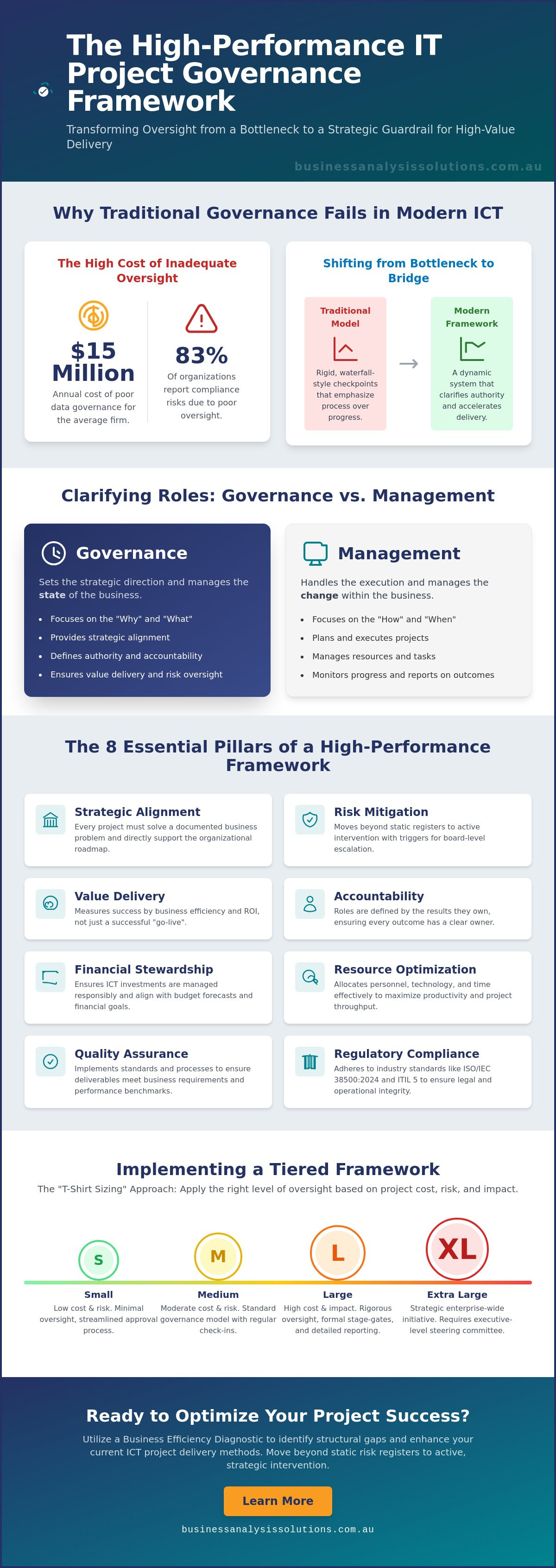
Research indicates that poor data governance costs the average firm $15 million annually. With 83% of organizations reporting compliance risks due to inadequate oversight, the perception of governance as a slow-moving administrative hurdle is no longer just a nuisance; it's a significant financial liability. You've likely felt the friction when an IT project governance framework functions as a bottleneck rather than a bridge to innovation. It's difficult to maintain momentum when decision-making authority is blurred and strategic goals are sidelined by technical complexity.
This guide provides the architectural pillars required to transform governance into a strategic guardrail for high-performance delivery. You'll learn to implement a repeatable structure that secures your ICT investments and ensures every technology initiative yields measurable organizational value without sacrificing speed. We'll explore how to align your operations with the latest standards, such as ITIL 5 and ISO/IEC 38500:2024, to establish a system where clear accountability and operational agility coexist.
Key Takeaways
Align technology investments with documented business problems to ensure every initiative delivers measurable organizational value.
Distinguish between governance and management to eliminate unnecessary bureaucracy and clarify decision-making authority.
Adopt a tiered "T-shirt sizing" model to apply the appropriate level of oversight based on project cost, risk, and impact.
Implement a robust IT project governance framework that moves beyond static risk registers toward active, strategic intervention.
Utilize a Business Efficiency Diagnostic to identify structural gaps and optimize current ICT project delivery methods.
Table of Contents
Defining the IT Project Governance Framework in 2026
In 2026, an IT project governance framework is the structural intersection where strategic alignment, risk management, and value delivery converge. It's no longer a static document gathering dust on a server. Instead, it's a dynamic system that ensures every technological investment serves a specific business objective. While Corporate Governance of IT focuses on high-level accountability and regulatory compliance for the entire enterprise, project-specific governance narrows that focus. It provides the granular oversight needed to manage individual ICT initiatives from inception to value realization. This distinction is vital; one manages the state of the business, while the other manages the change within the business.
The 2026 digital environment is characterized by unprecedented complexity and rapid shifts in regulatory requirements. Frameworks like ISO/IEC 38500:2024 and ITIL 5 now demand a more responsive approach than the bureaucratic models of the past. Organizations that treat governance as a hurdle often find themselves paralyzed by indecision. Conversely, those who view governance as a strategic enabler use it to clarify decision-making authority and accelerate delivery. It's about building a structure that provides confidence without creating friction.
The Strategic Link to Digital Transformation
Effective governance acts as the essential foundation for a Digital Transformation Blueprint for Business. Without this structure, transformation efforts often devolve into a series of disconnected technical upgrades rather than a cohesive evolution. High-performance delivery depends on maintaining system harmony across complex, integrated ICT solutions. When systems are synchronized and data flows are optimized, the organization operates with superior efficiency. Governance is the mechanism that translates executive vision into technical reality. It bridges the gap between high-level strategy and the practical requirements of implementation, ensuring technical teams remain focused on the intended business outcomes.
Why Traditional Oversight Fails in Modern ICT
Traditional governance models often rely on rigid, waterfall-style checkpoints that emphasize process over progress. These frameworks don't suit the rapid cycles of modern automation implementation or agile development. In the current environment, the speed of technological shifts requires a framework that can pivot without losing its grip on risk. When governance is absent or treated as a checkbox exercise, organizations face the high cost of invisible failure. This happens when a project meets its technical milestones but fails to produce a measurable ROI or solve the original business problem. Modern oversight has shifted. We've moved from monitoring tasks to monitoring outcomes. This approach removes roadblocks by establishing clear accountabilities from the start. It's the difference between a project that just finishes and a project that truly performs.
The 8 Essential Pillars of a High-Performance Framework
A high-performance IT project governance framework rests on eight architectural pillars that ensure technical execution remains subservient to commercial objectives. While many organizations focus on the "what" of project delivery, high-performance frameworks prioritize the "why" and the "how." These pillars transform governance from a passive oversight function into an active driver of project success.
Strategic Alignment: Every project must solve a documented business problem. If an initiative doesn't directly support the organizational roadmap, it represents a misallocation of resources.
Risk Mitigation: This involves moving beyond a static risk register. Active intervention means identifying specific triggers that require immediate board-level escalation before they impact the critical path.
Value Delivery: Success is measured through business efficiency rather than just a successful "go-live." If the technology doesn't improve the bottom line or operational throughput, it hasn't delivered value.
Accountability: Roles are defined by the results they own, not the tasks they perform. This ensures that every outcome has a clear owner responsible for its resolution.
The remaining pillars include Financial Stewardship, Resource Optimization, Quality Assurance, and Regulatory Compliance. Together, these elements create a stable environment where complex ICT initiatives can thrive. A professional Business Efficiency Diagnostic can help identify which of these pillars are currently missing from your organizational structure.
Structure and Decision-Making Authority
Clear structures prevent the "decision by committee" paralysis that frequently stalls technology projects. The Steering Committee must focus on strategic direction, budget approvals, and high-level risk, while the Project Working Group manages tactical execution. Central to this is the Single Point of Accountability (SPA) concept. For every ICT project, one individual must own the ultimate outcome. This clarity ensures that when roadblocks appear, the path to a decision is direct. Establishing these escalation paths early prevents technical or budgetary issues from festering and causing avoidable delays.
Transparency and the Information Repository
Static monthly status updates are no longer sufficient for modern project delivery. You need a centralized "source of truth" for all project documentation to maintain transparency across the stakeholder group. This repository should house everything from process maps to financial tracking. When everyone accesses the same data, the risk of miscommunication drops significantly. This transition toward real-time reporting is a cornerstone of Understanding Business Technology. It shifts the culture from reactive troubleshooting to data-driven decision-making. High-performance delivery depends on this visibility; it ensures that every stakeholder, from the project manager to the fractional CIO, operates with the same set of facts.
Governance vs. Management: Eliminating the Bureaucracy Myth
A common misconception among leadership teams is that governance is synonymous with red tape. In reality, a well-structured IT project governance framework is the primary driver of execution speed. To understand why, we must distinguish between management and governance. Management is focused on "doing things right," which involves the tactical execution of tasks, timelines, and resource allocation. Governance is focused on "doing the right things," ensuring the project remains aligned with the organization's strategic intent. When these two functions are confused, projects often suffer from "invisible failure," where they finish on time but deliver no actual business value.
Effective governance doesn't add unnecessary steps; it clarifies existing ones. By defining decision-making authority early, you remove the ambiguity that leads to endless meetings and circular discussions. This structure provides the essential "air cover" required for Expert Project Management. It allows the project team to focus on delivery while the governance layer manages the external pressures and strategic shifts that could otherwise derail the timeline. By resolving conflict at the leadership level, governance clears the path for technical teams to maintain momentum.
The Role of the Steering Committee
The Steering Committee should function as a strategic filter rather than a technical review board. Its purpose isn't to scrutinize technical specifications but to ensure the project continues to justify its resource consumption. To maintain this focus, the committee must include cross-functional representation from Finance, Operations, and IT. This ensures that technical decisions aren't made in a vacuum. At every stage gate, the committee must ask three fundamental questions: Is this initiative still strategically relevant? Does the projected ROI still justify the remaining spend? Are we actively mitigating the top three risks? If the answer to any of these is no, the committee has the authority to pivot or terminate the project before more capital is wasted.
The Project Manager’s Relationship with Governance
For a project manager, the IT project governance framework is a powerful tool for stakeholder management. It serves as a "Governance Shield," protecting the delivery team from unauthorized scope creep and conflicting priorities. When a stakeholder requests a change that falls outside the agreed-upon objectives, the PM can refer to the governance framework as the objective arbiter. This maintains the project's integrity without the PM needing to engage in personal or political friction. This process is significantly strengthened by the early integration of Business Analysis. By ensuring requirements are meticulously mapped and validated against business needs before reaching governance gates, the PM ensures that the project remains defensible and focused on high-performance outcomes.
Implementing a Tiered Framework: The T-Shirt Sizing Approach
One of the most frequent errors in organizational coordination is applying a uniform level of oversight to every initiative regardless of its complexity. This approach either leaves high-risk projects under-managed or drowns low-risk tasks in unnecessary paperwork. An effective IT project governance framework utilizes a tiered "T-shirt sizing" model to match oversight levels with project reality. By categorizing projects as Small, Medium, or Large based on their risk profile, cost, and organizational impact, you ensure that resources are allocated where they're most needed. This logical stratification allows leadership to maintain control without hindering the velocity of minor updates.
The implementation of this tiered structure follows a methodical five-step process. First, categorize every initiative by its potential for disruption and financial investment. Second, assign "light-touch" governance to low-risk automation implementation or maintenance tasks, allowing them to proceed with minimal intervention. Third, mandate full Steering Committee oversight for Tier 1 strategic overhauls that affect core business functions. Fourth, establish "Gate Reviews" that align with the project’s specific velocity; a fast-moving agile project requires more frequent, shorter checks than a long-term infrastructure upgrade. Finally, review and recalibrate the framework quarterly. This ensures the system remains responsive to delivery performance and changing market conditions.
If your current project portfolio feels sluggish or lacks clear direction, a formal Digital Strategy review can help you establish these tiers and restore operational momentum.
Defining Tier 1: Strategic ICT Investments
Tier 1 projects are high-impact initiatives such as ERP migrations or core system changes that carry significant reputational and financial risk. These projects require the most rigorous governance artifacts, including a comprehensive Business Case, an active Risk Mitigation Plan, and a mandatory Post-Implementation Review. Given the complexity of these investments, many organizations utilize Fractional CIO Services to lead Tier 1 governance. This provides the high-level expertise needed to navigate technical requirements while ensuring the project remains firmly anchored to executive objectives.
Defining Tier 3: Tactical and Maintenance Projects
Tier 3 focuses on tactical efforts like localized process mapping or minor ICT solutions that don't fundamentally alter the enterprise architecture. The goal here is to avoid "over-governing." By using standardized templates and self-service governance protocols, teams can maintain progress without waiting for committee meetings. While these projects don't require heavy oversight, they must still be recorded in a "Governance Lite" register. This ensures a clear audit trail and maintains system harmony without introducing the bureaucracy that typically stifles small-scale innovation.
Optimising Project Success with Expert ICT Governance
Transitioning from theoretical understanding to operational reality requires a shift from accidental oversight to a deliberate IT project governance framework. Most organizations possess some form of project control; however, these are often fragmented and reactive. A professional Business Efficiency Diagnostic serves as the critical first step in identifying where these structural gaps exist. By examining your current project delivery methods against industry standards, you can pinpoint exactly where decision-making authority or strategic alignment is breaking down. This diagnostic doesn't just find faults; it provides a roadmap for system harmony.
Objective, external audits provide the clarity that internal teams often lack due to their proximity to daily operational friction. An external perspective removes personal bias and focuses strictly on whether your governance structures are delivering the intended ROI. Business Analysis & Solutions acts as the bridge between technical execution and executive vision. We ensure that your ICT investments aren't just completed but are fully integrated into your broader organizational objectives. This deliberate approach replaces the "bureaucracy myth" with a lean, results-driven structure that prioritizes performance over paperwork.
The Fractional CIO as Governance Lead
The presence of a Fractional CIO brings a level of quiet confidence to complex projects. This role isn't merely about technical advisory. It's about understanding how technical decisions impact financial performance. By integrating an executive-level lead who understands both ICT and the balance sheet, you build a culture of accountability. This leadership style provides professional mentorship to internal teams, teaching them to navigate the IT project governance framework as a tool for success rather than a compliance burden. It ensures that high-level strategy remains connected to the granular details of project execution.
Next Steps: Strengthening Your ICT Portfolio
Strengthening your ICT portfolio begins with a methodical review of your current project health against the eight pillars discussed earlier. You should prioritize the development of a custom governance charter that reflects your specific risk appetite and organizational structure. This document becomes the "source of truth" for how technology change is managed within your business. It's time to move beyond reactive troubleshooting. For organizations ready to eliminate ambiguity and drive high-performance delivery, contacting Business Analysis & Solutions for a strategic blueprint is the logical next step toward operational excellence.
Advancing Toward High-Performance Delivery
Establishing a robust IT project governance framework is the most effective way to ensure technology investments translate into measurable business results. We've explored how a tiered oversight model and clear decision-making authority eliminate the friction often associated with technical change. By prioritizing strategic alignment and outcome-based monitoring, you move beyond administrative compliance toward true operational agility. This shift ensures that every project serves the organization's broader objectives while maintaining the velocity required in a digital environment.
Business Analysis & Solutions is an Australian-owned and operated boutique consultancy with over 20 years of industry experience. We specialize in bridging the gap between technical ICT requirements and executive strategy to ensure your projects remain on track and within budget. To identify structural gaps in your current approach and refine your delivery model, book a Business Efficiency Diagnostic to optimise your project governance. Transforming your governance structure is a methodical process, but the resulting clarity and improved ROI will redefine your organization's digital future.
Frequently Asked Questions
What is the difference between project governance and project management?
Governance focuses on "doing the right things" by ensuring strategic alignment and establishing decision-making authority. Project management is about "doing things right" through the tactical coordination of tasks, timelines, and resources. While management handles the day-to-day execution, governance provides the oversight and accountability structures that keep the project anchored to business objectives.
Does every IT project need a formal governance framework?
Every initiative requires oversight, but the level of formality must match the project's risk and cost profile. As established in the T-shirt sizing model, a small automation update may only require "light-touch" documentation. Conversely, a large-scale system migration demands a comprehensive IT project governance framework to mitigate significant financial and operational risks to the enterprise.
Who should sit on an IT project steering committee?
The committee should consist of cross-functional leaders who possess the authority to make strategic and financial decisions. This typically includes the Project Sponsor, a senior Finance representative, heads of the affected business units, and an IT lead. This diverse representation ensures that technical decisions aren't made in a vacuum and remain balanced against broader organizational needs and budgetary constraints.
How does governance improve the ROI of ICT projects?
Governance improves ROI by ensuring that capital is only allocated to initiatives with a documented business case and clear value delivery metrics. By establishing formal "gate reviews," organizations can identify underperforming projects early and pivot or terminate them before more resources are wasted. This discipline prevents the high cost of projects that meet technical goals but fail to deliver financial performance.
Can an agile project have a formal governance framework?
Agile projects thrive under a framework that prioritizes strategic guardrails and outcome-based monitoring over rigid task management. Formal governance in an agile context involves setting clear financial limits and strategic objectives while granting the team tactical autonomy. This structure provides the necessary "air cover" for the team to maintain delivery velocity without losing alignment with the organizational roadmap.
What are the signs that our current IT governance is failing?
Primary indicators of failure include persistent scope creep, ambiguous decision-making authority, and projects that fail to meet their original strategic goals. If your leadership team is frequently surprised by technical roadblocks or if governance is perceived purely as a bureaucratic hurdle, your current IT project governance framework is likely disconnected from the reality of your operations.
How do we implement governance without slowing down our technical teams?
Implementation succeeds when you apply a tiered approach that matches oversight to the project's risk level. By pre-defining escalation paths and using standardized templates for tactical reporting, you eliminate the ambiguity that typically causes delays. High-performance governance actually accelerates delivery by resolving strategic conflicts at the executive level before they impact the technical team's momentum.
What is the role of a Fractional CIO in project governance?
A Fractional CIO provides executive-level IT advisory and acts as an objective lead for the governance process. They bridge the gap between technical requirements and executive strategy, ensuring the steering committee has the precise data needed for informed decision-making. This role brings professional mentorship to the organization and helps build a sustainable culture of accountability across the ICT portfolio.



Comments