IT Project Failure Statistics Australia: The 2026 Executive Report
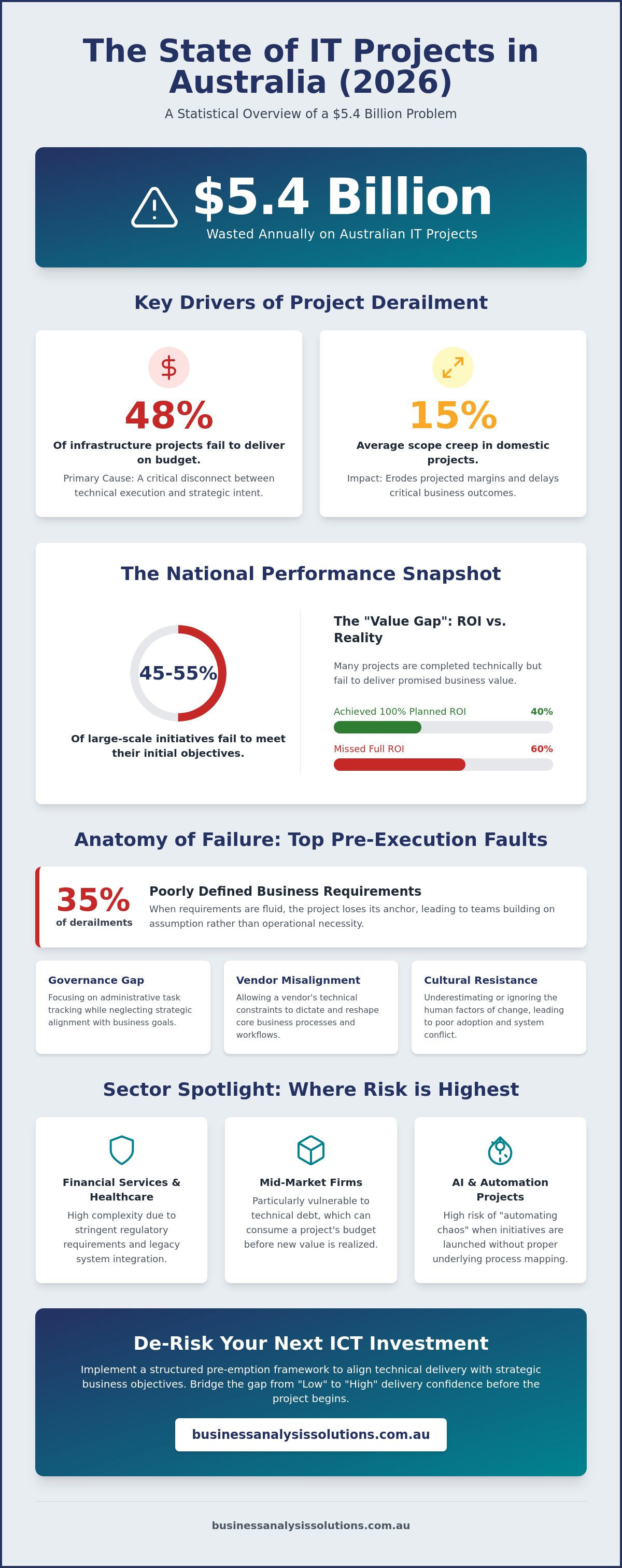
An estimated $5.4 billion is wasted every year in Australia on IT projects that fail to meet their primary objectives. While technical complexities are frequently cited as the cause, the data suggests a deeper systemic issue: 48% of Australian infrastructure projects fail to deliver on budget because of a disconnect between technical execution and strategic intent. Reviewing the latest IT project failure statistics Australia has recorded for 2026 is essential for any executive who values operational efficiency over reactive troubleshooting.
It's a reality that many leaders face when scope creep, which now averages 15% in domestic projects, begins to erode projected margins and delay critical outcomes. This report provides the clarity you need to bridge the gap between complex technical requirements and your organization's financial performance. You'll gain access to a logical framework for identifying red flags before they escalate and a structured approach to ensuring every ICT investment delivers a measurable return. We will examine the current state of delivery confidence and the specific governance markers that separate successful transformations from costly failures.
Table of Contents
Current IT Project Failure Statistics in Australia (2026)
The current landscape of Australian ICT reveals a persistent struggle with execution and strategic alignment. Analysis of IT project failure statistics Australia has recorded for 2026 indicates that between 45% and 55% of large-scale initiatives fail to meet their initial objectives. This is not merely a technical issue. It's a breakdown in the coordination between organizational strategy and technical delivery. For projects with budgets exceeding $10 million, the average cost overrun remains a significant burden on corporate balance sheets. These trends are often driven by a failure to account for the 4-6% cost escalation predicted for major Australian cities this year, which compounds existing budget variances.
A critical observation in the current market is the "Value Gap." Only 40% of Australian businesses report achieving 100% of their planned ROI from digital transformations. This discrepancy highlights a fundamental weakness in how organizations define and track success. While many projects are technically "completed," they often fail to deliver the operational efficiencies promised at the outset. This results in billions of dollars in wasted capital and lost opportunity across the national economy. Moving from a "Low" to a "Medium-High" delivery confidence rating now requires more than just standard project management; it demands a structured diagnostic approach to identify risks before the first line of code is written.
The 2026 Benchmark for Project Success
Success in 2026 is defined by the "Success Triangle," which requires a project to be delivered on time, on budget, and with fully realized business requirements. Projects initiated without a formal Digital Transformation Blueprint are statistically more likely to join the 48% of infrastructure projects that fail to meet budget expectations. In the public sector, we see a trend toward stability due to the mandatory use of Delivery Confidence Assessments for Tier 1 and Tier 2 projects. Conversely, the private sector continues to experience higher volatility as organizations frequently bypass rigorous diagnostic phases in a misguided attempt to accelerate delivery speed.
Sector-Specific Failure Rates
Financial services and healthcare continue to face the highest complexity risks due to stringent regulatory requirements and legacy system integration. In these sectors, common causes of project failure like scope creep and technical debt often derail long-term objectives. Australian mid-market firms are particularly vulnerable to technical debt, which can consume a disproportionate share of a project's budget before any new value is realized. Additionally, AI-driven automation projects are emerging as a high-risk area. Without proper process mapping, these initiatives often fail to resolve underlying inefficiencies, leading to automated chaos rather than the intended system harmony.
The Anatomy of Failure: Why Australian ICT Projects Struggle
Analyzing the root causes of project distress reveals that technical glitches are rarely the primary culprit. Instead, IT project failure statistics Australia generates often point to a systemic failure in the pre-execution phase. Requirement volatility remains the most significant hurdle; poorly defined business requirements account for 35% of project derailments. When requirements remain fluid, the project loses its anchor, leading to an environment where technical teams build based on assumptions rather than operational necessity. This lack of precision contributes to the estimated A$5.4 billion wasted each year across the Australian economy.
The governance gap further complicates delivery. There's a fundamental difference between administrative project management and strategic oversight. Many organizations focus on tracking tasks and timelines while neglecting broader strategic alignment. This oversight often leads to vendor misalignment, where software developers are inadvertently allowed to dictate business processes. When a vendor’s technical constraints begin to reshape your organizational workflow, system harmony is compromised. Additionally, cultural resistance remains a significant factor; technical adoption frequently stalls when change management is excluded from the strategy. Implementing strategic business analysis can help identify these gaps before they become critical.
Requirements vs. Reality
Defining business logic during the development phase is a prohibitively expensive approach to digital transformation. This practice triggers a cycle of constant "Change Requests" that inflate budgets and extend timelines. Utilizing expert project management acts as a critical buffer, ensuring that technical execution remains subservient to executive goals. Without this layer, leadership often falls victim to "Black Box" syndrome. They see the financial outgoings but lose all visibility regarding actual technical progress and its alignment with the desired ROI.
Governance and Decision Paralysis
Australian projects frequently stall at the "Steering Committee" level due to a lack of technical fluency among decision-makers. This decision paralysis is particularly acute in mid-sized firms that lack executive-level IT leadership. A Fractional CIO resolves these conflicting stakeholder requirements by providing a single point of strategic accountability. This ensures that every technical decision is weighed against its ability to drive financial performance and operational efficiency. It’s a methodical approach that replaces reactive decision-making with structured, data-driven progress.
The Economic Impact of Project Failure on Australian Organisations
The financial repercussions of failed ICT delivery extend far beyond the initial budget blowout. When we examine IT project failure statistics Australia produces, the focus is frequently on the $5.4 billion in annual waste, yet this figure only captures the surface level of the problem. Direct losses encompass sunk costs in licensing fees, hardware procurement, and external labor. However, the true burden lies in the operational friction and brand erosion that follow a botched rollout. A system that is only partially functional often requires more manual intervention than the legacy architecture it was intended to replace, creating a state of perpetual "firefighting" that drains executive focus.
Organizational morale also takes a measurable hit during these periods of instability. Staff turnover often spikes following a traumatic IT rollout, as high-performing employees grow frustrated with inefficient tools and broken workflows. The cost of replacing specialized talent, combined with the loss of institutional knowledge, adds a layer of expense that is rarely accounted for in a project's original risk assessment. This creates a cycle of reactive spending where capital is used to stabilize the workforce rather than driving the business forward.
Quantifying the Opportunity Cost
Calculating the true cost of a failed project requires a logical framework that accounts for market positioning. A six-month delay in deploying a critical system doesn't just stall internal progress; it allows competitors to capture market share that may never be recovered. This delay directly compromises business efficiency by diverting high-value resources away from strategic innovation to fix avoidable delivery errors. When an organization is stuck in a cycle of remediation, its appetite for future digital maturity diminishes, leading to a long-term stagnation that is difficult to reverse through standard procurement.
The "Legacy Drag" Effect
Failed implementations frequently result in "Shadow IT," where frustrated staff adopt unapproved, third-party tools to bypass broken or overly complex corporate systems. This creates significant security risks, as sensitive organizational data moves outside of governed environments into unmanaged applications. These abandoned or poorly integrated ICT solutions remain as a permanent drag on technical agility, complicating every subsequent attempt at modernization. The cumulative financial burden of maintaining "zombie projects" drains operational budgets that should be allocated to growth-focused initiatives, effectively subsidizing past failures with current revenue.
De-risking Your Project: The Pre-emption Framework
To reverse the negative trends identified in IT project failure statistics Australia generates, organizations must shift from reactive management to a structured pre-emption framework. This logical approach ensures that technical delivery is an outcome of business strategy rather than an isolated activity. By following a methodical sequence of diagnostic and planning steps, leadership can mitigate the risks of budget blowouts and misalignment before significant capital is committed.
Step 1: Conduct a Business Efficiency Diagnostic to evaluate current operational performance and identify where technology can drive the most value.
Step 2: Execute detailed process mapping to visualize every workflow, ensuring that automation opportunities are identified and bottlenecks are removed.
Step 3: Develop a Digital Transformation Blueprint that prioritizes measurable ROI and strategic objectives over purely technical features.
Step 4: Establish an independent governance layer, often through Fractional CIO services, to provide executive-level oversight and hold vendors accountable to business outcomes.
You can begin de-risking your next initiative by engaging a professional business analysis service to conduct a preliminary diagnostic of your current environment.
The Power of the Diagnostic
A Business Efficiency Diagnostic serves as a cost-effective insurance policy for any ICT investment exceeding $100,000. This phase allows leadership to identify critical red flags within their current business technology stack before signing restrictive vendor contracts. It provides the clarity required to separate essential "must-have" requirements from "nice-to-have" distractions that frequently cause scope creep and inflate delivery costs.
Bridging the Gap with Process Mapping
Visualizing a workflow through comprehensive process mapping prevents technical teams from building a solution that is technically functional but operationally flawed. It's the primary mechanism for ensuring system harmony across disparate departments. A Digital Transformation Blueprint provides a fixed North Star for the entire project lifecycle, ensuring that every technical decision remains anchored to the original business objectives. This level of precision eliminates the ambiguity that often leads to the 35% of derailments caused by poorly defined requirements.
Strategic Oversight: Why a Fractional CIO is the Success Factor
Mid-sized Australian businesses frequently experience a leadership vacuum where technical execution and business strategy fail to intersect. This absence of executive IT guidance is a significant factor contributing to the IT project failure statistics Australia records each year. While internal teams may be proficient at managing day-to-day operations, they often lack the strategic authority required to challenge vendor assumptions or realign projects with shifting corporate objectives. Fractional CIO services resolve this by providing high-level expertise on a flexible basis, ensuring that technical investments remain subservient to financial performance.
An objective, third-party perspective is invaluable during vendor negotiations and project audits. Vendors often prioritize their own product roadmaps over your specific operational needs. A Fractional CIO acts as a strategic advocate, auditing technical proposals to ensure they align with the Digital Transformation Blueprint established during the diagnostic phase. This oversight moves the organization away from a cycle of project failure and toward a standard state of operational excellence. It's a methodical transition from reactive troubleshooting to proactive system harmony.
The Fractional Model for Project Recovery
A Fractional CIO provides the strategic intervention necessary to rescue distressed projects. While a Project Manager focuses on the tactical execution of tasks, the CIO evaluates whether those tasks still serve the broader business goals. They establish a culture of accountability by implementing data-driven decision-making processes that remove emotion from technical pivots. By realigning a failing initiative with documented business requirements, they can often recover sunk costs and steer the project toward a successful, albeit delayed, conclusion.
Long-term Strategic Alignment
Strategic oversight ensures that the ICT investments you make today are capable of supporting your business vision for 2030. It prevents the accumulation of technical debt by prioritizing scalable solutions and continuous improvement. This long-term view is essential for maintaining a competitive edge in a market where automation and digital maturity are the primary drivers of growth. Establishing this level of foresight requires a commitment to structured governance and professional analysis. Ensure your next project is a success by taking the first step toward better oversight. Book a Business Efficiency Diagnostic with Business Analysis & Solutions today.
Securing Your Organization’s Digital Future
The evidence presented in this report confirms that technical proficiency alone is insufficient to guarantee project success. By addressing the root causes of misalignment through a structured pre-emption framework, leadership can move beyond the sobering IT project failure statistics Australia continues to produce. Success requires a methodical transition from reactive troubleshooting to proactive governance. Implementing a rigorous diagnostic phase and establishing strategic oversight ensures that every ICT investment is a calculated step toward operational efficiency rather than a high-risk gamble.
Business Analysis & Solutions brings over 20 years of industry experience to this challenge, specializing in bridging the gap between technical delivery and organizational objectives. Our proven methodology for developing digital transformation blueprints provides the stable foundation required for achieving long-term system harmony. You can take immediate action to protect your margins and drive tangible progress today. Secure your project ROI with a professional Business Efficiency Diagnostic and transform your technical delivery into a high-performance strategic asset. With the right framework in place, your organization's next transformation can be its most successful one yet.
Frequently Asked Questions
What is the most common reason for IT project failure in Australia?
Poorly defined business requirements remain the primary driver of project derailment, accounting for 35% of failures. While technical complexities are often blamed, the root cause is typically a disconnect between organizational goals and technical execution. This lack of clarity leads to significant scope creep and decision paralysis at the executive level.
How much do Australian businesses typically overspend on failed IT projects?
Australian organizations lose an estimated $5.4 billion annually to failed IT initiatives. Research indicates that 48% of infrastructure projects fail to deliver on their original budget targets. Additionally, scope creep averages 15% across domestic projects, with every 1% of scope expansion driving a 1.6% increase in total costs.
Can a failed IT project be rescued once it is over budget?
A distressed project can be rescued through objective auditing and strategic realignment of its core objectives. This process involves pausing development to conduct a Business Efficiency Diagnostic and realigning technical tasks with documented business goals. Engaging a Fractional CIO often provides the necessary professional distance to make objective decisions about cutting non-essential features to save the project.
What is the difference between a Project Manager and a Business Analyst?
A Project Manager is responsible for the tactical execution of a project, focusing on timelines, resource allocation, and budget tracking. A Business Analyst operates at a strategic level, ensuring the technical solution aligns with organizational needs by defining precise requirements. While the PM manages the schedule, the BA validates that what is being built actually solves the business problem.
How does a Digital Transformation Blueprint help prevent project failure?
A Digital Transformation Blueprint serves as a fixed North Star that anchors technical delivery to measurable business outcomes. It prevents failure by prioritizing ROI over non-essential features and providing a clear roadmap for all stakeholders. This structured approach significantly reduces the ambiguity that typically leads to requirement volatility and budget blowouts.
Is it worth hiring a Fractional CIO for a single IT project?
Hiring a Fractional CIO is highly effective for high-stakes projects where the cost of failure exceeds the investment in strategic oversight. They provide executive-level strategy and vendor accountability without the financial burden of a full-time hire. This model is particularly valuable for mid-market firms navigating complex transformations that require a high degree of organizational coordination.
What are the red flags that an IT project is about to fail?
Primary red flags include persistent scope creep, frequent change requests, and a lack of executive visibility into technical progress. If requirements are being defined during the development phase rather than before it, the project is at high risk. These indicators often signal a breakdown in the IT project failure statistics Australia tracks for projects with low delivery confidence.
How do Australian IT project failure rates compare to global statistics?
Australian IT project failure statistics Australia records are largely consistent with global benchmarks. While international research suggests large IT projects run 45% over budget, Australian data shows 48% of infrastructure projects fail to meet their budget targets. The national waste of $5.4 billion reflects a systemic challenge in bridging the gap between technical requirements and strategic organizational intent.



Comments