Interim CIO vs Fractional CIO: Choosing the Right Strategic IT Leadership in 2026
With global spending on digital transformation reaching nearly $3.9 trillion in 2026, it's startling that up to 95% of these initiatives still fail to meet their primary objectives. You likely recognize that a lack of strategic direction in your IT department isn't just an operational bottleneck; it's a significant financial risk. When ICT and business objectives aren't aligned, even the most expensive technology projects can stall. Choosing the right leadership model, specifically an interim CIO vs fractional CIO, is the most critical decision you'll make to stabilize your operations and protect your bottom line.
It's understandable to feel hesitant about the high cost and long lead times of permanent executive recruitment. You need a solution that provides immediate executive-level advocacy at the board level without unnecessary complexity. This article details the critical differences between these two leadership models to help you determine which structure best secures your organization's digital future. We'll provide a clear roadmap for achieving system harmony and ensuring your technology investments deliver tangible, long-term value through a methodical, results-driven approach.
Table of Contents
Defining the Roles: Interim CIO vs Fractional CIO
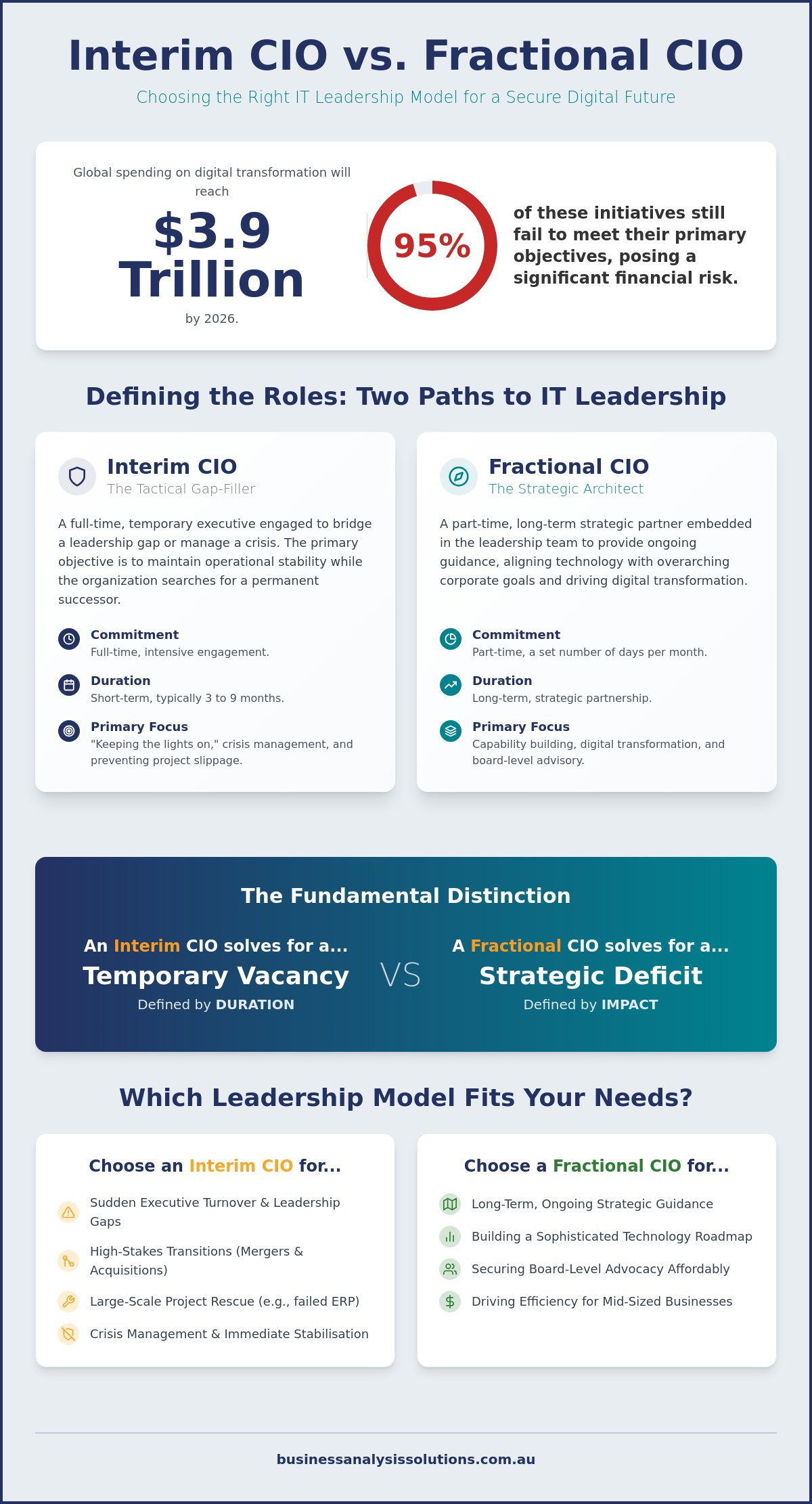
Organizations often reach a critical juncture when a technology leader departs or when rapid growth outpaces current technical capabilities. The path forward isn't always a direct line to a permanent hire. Instead, leaders must evaluate the specific needs of their digital infrastructure. The choice between an interim CIO vs fractional CIO depends on whether the organization is solving for a temporary vacancy or an ongoing strategic deficit. While both roles provide executive-level oversight, their structures and intended outcomes differ significantly.
The Interim CIO: The Tactical Gap-Filler
An interim CIO serves as a full-time, temporary executive. They are typically engaged to bridge a leadership gap or manage a specific crisis. Their tenure usually lasts between three and nine months, during which they maintain the status quo. The primary objective is to ensure operational stability while the organization searches for a permanent successor. They focus on keeping the lights on, managing existing staff, and preventing project slippage. This role is a tactical necessity during periods of sudden executive turnover or major organizational transitions like mergers.
The Fractional CIO: The Strategic Architect
A fractional CIO acts as a part-time, long-term strategic partner. They are embedded in the leadership team for a predetermined number of days per month, providing ongoing guidance. This model prioritizes the alignment of business technology with overarching corporate goals. As highlighted in this Fractional CIO definition, the role offers high-level advisory and governance without the $300k+ salary requirements of a full-time executive. It's a relationship built on longevity, focusing on capability building and digital transformation rather than just filling a seat.
The key distinction is simple. An interim appointment is defined by its duration; it's a fixed-term solution for a temporary gap. A fractional appointment is defined by the scope of its strategic impact. In the 2026 Australian business landscape, the fractional model has become the preferred choice for mid-sized organizations. These businesses require sophisticated technology roadmaps and board-level advocacy but don't need a full-time executive present 40 hours a week. By adopting a fractional approach, they gain access to seasoned expertise that drives efficiency and financial performance through a structured, methodical approach. This flexibility allows for a more agile response to market shifts while maintaining a consistent digital strategy.
When an Interim CIO is the Logical Choice
Organizations often encounter moments where technology leadership cannot wait for a standard six-month recruitment cycle. When evaluating the interim CIO vs fractional CIO models, the interim path is the logical choice for scenarios requiring full-time, intensive intervention. This is especially true when an organization must navigate a crisis or a high-stakes transition that demands the total bandwidth of an experienced executive. It's a model built for high-impact, short-term resolution.
Sudden executive turnover serves as a primary catalyst for this hire. Without a "safe pair of hands" at the helm, IT departments often experience operational drift, where strategic projects lose momentum and staff focus wavers. An interim leader provides immediate stability, allowing the board to re-evaluate the requirements of the permanent role without the pressure of a leadership vacuum. This period of reflection is essential for aligning the future role with the company's evolving digital needs.
High-stakes events like mergers or acquisitions also necessitate a full-time interim presence. Integrating disparate ICT infrastructures requires a dedicated leader to manage the complex coordination of systems, data, and cultures. Similarly, large-scale project rescue remains a common use case. With an estimated $5.4 billion wasted annually in Australia on IT projects that fail their primary objectives, an interim CIO is often brought in to salvage a stalled ERP implementation or a failing digital transformation. Their objective is to stop the financial bleed and restore system harmony through disciplined project management.
Crisis Management and Stabilisation
A seasoned interim leader initiates a comprehensive audit of existing risks within the first 30 days. This methodical approach identifies immediate vulnerabilities in infrastructure and governance, providing the board with an objective reality check. Beyond technical resolution, they play a vital role in maintaining staff morale during periods of uncertainty. By providing clear direction and professional distance, they prevent the loss of key talent during the transition. In the event of a cybersecurity breach, the interim CIO orchestrates the technical response while managing stakeholder communications to mitigate reputational damage.
Transitioning to Permanent Leadership
The interim role is inherently designed to end. During their tenure, they assist the board in defining the precise requirements for the next full-time hire based on current organizational needs. They focus on cleaning up technical debt and optimizing processes before a new leader arrives. This ensures a seamless hand-over that protects institutional knowledge and sets the permanent successor up for success. Exploring professional ICT solutions during this phase ensures that the transition remains logical and results-driven. This structured approach helps determine the best path forward, whether that involves a full-time hire or a shift in the interim CIO vs fractional CIO strategy for the long term.
When a Fractional CIO Offers Superior Value
Mid-sized organizations often reach a threshold where technical complexity outpaces the capabilities of a standard IT manager, yet the financial burden of a full-time executive remains unjustifiable. With total employer costs for a full-time CIO in Australia often exceeding $340,000 annually, many boards find themselves trapped between a lack of direction and excessive overhead. In the evaluation of an interim CIO vs fractional CIO, the fractional model emerges as the superior choice for companies seeking long-term growth rather than a temporary fix. It provides a permanent strategic seat at the table without the full-time price tag.
A fractional leader focuses on bridging the persistent gap between technical teams and the non-technical C-suite. They translate complex infrastructure requirements into the language of financial performance and operational risk. This ensures that every technology investment is anchored in business logic rather than technical trends. By implementing a digital transformation blueprint for business, they provide a structured methodology for modernization that aligns with the organization's three-to-five-year goals.
Strategic Guidance Without the Executive Overhead
The fractional model offers "on-tap" expertise, allowing companies to access high-level advisory for board meetings, vendor negotiations, and annual budgeting. These professionals bring a cross-industry perspective that internal hires often lack, having observed successful patterns and common pitfalls across multiple sectors. This breadth of experience allows them to identify opportunities for business efficiency that might remain invisible to those embedded in a single organization. Fractional leadership scales in direct proportion to business growth, providing increased oversight as technical requirements become more complex.
Implementing Long-Term Digital Strategy
While an interim leader might stabilize a department, a fractional CIO moves the organization from reactive firefighting to proactive, strategy-led investment. They take ownership of the project management of multi-year digital roadmaps, ensuring that initiatives don't stall after the initial excitement fades. This ongoing stewardship is critical for complex tasks like automation implementation or cloud migration, where consistency is the primary driver of ROI. By maintaining a long-term presence, the fractional CIO ensures that ICT solutions remain integrated, secure, and fully supportive of the broader organizational objectives. This methodical approach transforms technology from a cost center into a documented driver of competitive advantage.
Comparison Framework: Interim vs Fractional
The selection of an interim CIO vs fractional CIO requires a rigorous assessment of the organization’s current state versus its desired future maturity. It's not merely a choice of hours worked; it's a choice of leadership philosophy. One model acts as a powerful, short-term surge to correct a specific course, while the other serves as a steady, guiding hand that shapes the organization’s digital destiny over several years. Understanding the mechanics of each engagement is essential for board-level decision-making.
Commitment Level: Interim roles demand 100% of the executive's bandwidth on a full-time basis, whereas fractional roles operate on a set number of days per month.
Typical Duration: Interim placements are finite, typically spanning 3 to 12 months. Fractional engagements are indefinite, often lasting multiple years to oversee full digital cycles.
Primary Focus: An interim leader prioritizes continuity and crisis resolution. A fractional leader prioritizes long-term strategy and sustainable growth.
Cost Structure: Interim models usually involve high daily rates or fixed-term contracts. Fractional models utilize a predictable monthly retainer, ensuring long-term budget stability.
Cost-Benefit Analysis for the Board
Evaluating the ROI of a fractional leader over a 24-month period reveals significant cost efficiencies. While an interim hire addresses an immediate void, the hidden costs, such as typical industry recruitment fees of 20-30% and full-time executive benefits, can inflate the total cost of ownership. Fractional models eliminate these overheads, providing a higher impact per dollar for organizations that have moved past the initial crisis phase and are now focused on system harmony. This model allows for the reallocation of capital toward actual technical implementation rather than executive maintenance.
Cultural and Operational Integration
Integration is handled differently in each model. An interim leader must influence culture rapidly to maintain morale during a transition, acting as a temporary bridge. Conversely, a fractional leader leverages their "outsider" status to maintain absolute objectivity in strategic ICT decisions. This professional distance allows them to provide unbiased advocacy at the board level while mentoring existing internal IT teams to improve their operational agency. Deciding on the interim CIO vs fractional CIO model ultimately depends on whether your team needs a temporary commander or a long-term strategic collaborator. To determine which model aligns with your specific operational requirements, consider a professional Fractional CIO service assessment.
The Strategic Approach: Fractional CIO Services Australia
Business Analysis & Solutions delivers executive IT leadership through a structured methodology that prioritizes clarity over complexity. We understand that technology is a tool for business resolution, not an end in itself. Our approach is rooted in logic and a commitment to end-to-end results. When considering an interim CIO vs fractional CIO, many organizations find that our fractional model offers the necessary board-level advocacy without the friction of full-time executive recruitment. Our team brings over 20 years of experience to every engagement, ensuring a "right-first-time" approach to ICT strategy that bridges the gap between technical requirements and broader organizational objectives.
From Diagnostic to Implementation
Every successful engagement begins with a meticulous assessment of your current operational state. We use the Business Efficiency Diagnostic to identify specific leadership gaps and technical bottlenecks. This process provides a clear baseline for improvement, ensuring that subsequent investments are anchored in business logic. From this diagnostic foundation, we develop a Digital Transformation Blueprint that serves as the roadmap for our fractional leadership. Key components of our strategy include:
System Harmony: Aligning disparate software and hardware into a unified, efficient architecture.
Process Mapping: Documenting and optimizing workflows to eliminate redundancies.
Results-Driven Oversight: We oversee automation implementation to drive tangible ROI and operational agency.
Our engagements are inherently collaborative. We don't just provide advice; we work alongside your internal teams to improve their technical competence and confidence. This methodical approach ensures that the changes we implement are sustainable and well-integrated into your corporate culture.
Securing Your Organisation’s Digital Future
As we move through 2026, the need for flexible, high-level technology leadership will only intensify. A fractional CIO represents the most sustainable choice for organizations focused on long-term growth and stability. This model provides the executive advocacy required at the board level while maintaining the agility needed to respond to rapid technical shifts. By choosing the right model in the interim CIO vs fractional CIO debate, you protect your organization from operational drift and ensure that technology remains a driver of financial performance.
We invite you to contact Business Analysis & Solutions for a strategic ICT consultation. We bring a sense of calm assurance to complex organizational challenges, resolving technical ambiguity through a structured, methodical approach. Our goal is to provide the direction you need to secure your digital future with professional precision and documented results.
Securing Your Strategic Technology Roadmap
Determining the right path in the interim CIO vs fractional CIO debate requires a precise evaluation of your organization's current maturity and long-term objectives. If you're managing a sudden leadership vacancy or a high-stakes merger, the full-time intensity of an interim role is essential. However, for organizations seeking to drive sustainable growth and system harmony, the fractional model provides consistent, executive-level advocacy without the burden of full-time overhead.
Business Analysis & Solutions leverages over 20 years of industry experience to help you navigate these transitions. We specialize in delivering Digital Transformation Blueprints that bridge the technical-executive communication gap, ensuring your ICT strategy remains firmly grounded in business logic. Our methodical approach resolves technical ambiguity and prioritizes tangible outcomes for your digital future.
Ready to stabilize your operations and implement a clear roadmap for transformation? Book a Fractional CIO Consultation with Business Analysis & Solutions to secure a "right-first-time" approach to your technology leadership. Taking this structured step now ensures your systems remain a driver of competitive advantage throughout 2026.
Frequently Asked Questions
What is the difference between a fractional CIO and an IT consultant?
A fractional CIO is an embedded member of your leadership team with ongoing accountability for strategic outcomes. Unlike an IT consultant who typically delivers a specific project and then exits, a fractional leader provides continuous stewardship and board-level advocacy. They focus on the long-term alignment of technology with business goals, whereas consultants focus on defined technical scopes or implementations.
How much does a fractional CIO cost in Australia?
The cost of engaging a fractional CIO in Australia is structured as a predictable monthly retainer rather than a full-time salary. This model provides significant financial efficiency because organizations only pay for the high-level strategic leadership they require. While a full-time CIO salary often exceeds $340,000 annually, the fractional approach allows mid-sized businesses to access the same level of expertise at a sustainable price point.
Can a fractional CIO manage our existing IT managed service provider (MSP)?
Yes, a fractional CIO provides the necessary executive oversight to ensure your MSP delivers tangible value. They act as an informed advocate for your business, reviewing Service Level Agreements, auditing technical performance, and ensuring the MSP's roadmap supports your digital strategy. This relationship prevents operational drift and ensures that outsourced technical services remain aligned with your broader organizational objectives.
When is the best time to transition from an interim CIO to a fractional CIO?
The ideal time to transition occurs once the immediate crisis or leadership vacancy that necessitated an interim hire has been resolved. In the debate of interim CIO vs fractional CIO, organizations often find that after six months of stabilization, they no longer require a full-time presence. Moving to a fractional model at this stage maintains strategic momentum while significantly reducing executive overhead costs.
Does a fractional CIO handle day-to-day helpdesk issues?
No, a fractional CIO operates exclusively at the strategic and governance level. Their role involves digital strategy, process mapping, and ICT solutions rather than technical troubleshooting or ticket resolution. They ensure that your internal teams or external providers are structured to handle day-to-day support effectively, allowing the CIO to focus on driving business efficiency and long-term digital transformation.
What qualifications should I look for in an interim or fractional CIO?
You should prioritize candidates with at least 15 to 20 years of senior technology leadership experience. Essential qualifications include a proven track record in strategic planning, business analysis, and complex project management. The most effective leaders demonstrate a deep understanding of industry standards and possess the ability to translate technical requirements into financial performance metrics that resonate with board members and stakeholders.
How many days per week does a fractional CIO typically work?
A fractional CIO typically works between one and four days per month, though some complex organizations require one day per week. The engagement is highly flexible and scales based on your specific technical requirements and the pace of your digital roadmap. This allows you to increase or decrease executive oversight as your organization grows or as major technology projects reach critical milestones.
Can a fractional CIO help with cybersecurity and Essential 8 compliance?
Yes, they provide the strategic governance required to implement and maintain frameworks such as the ACSC Essential 8. While they don't perform the granular technical configurations, they prioritize cybersecurity investments and ensure that risk management is integrated into the overall business strategy. This methodical approach ensures your organization achieves compliance through logical planning and consistent executive-level oversight.



Comments